Engraved Airmail Sheet with a Struck Postmark
Transform a reference photo into a single-ink engraved print on a thin airmail sheet, then photograph the finished paper with one imperfect postmark.
Example outputs
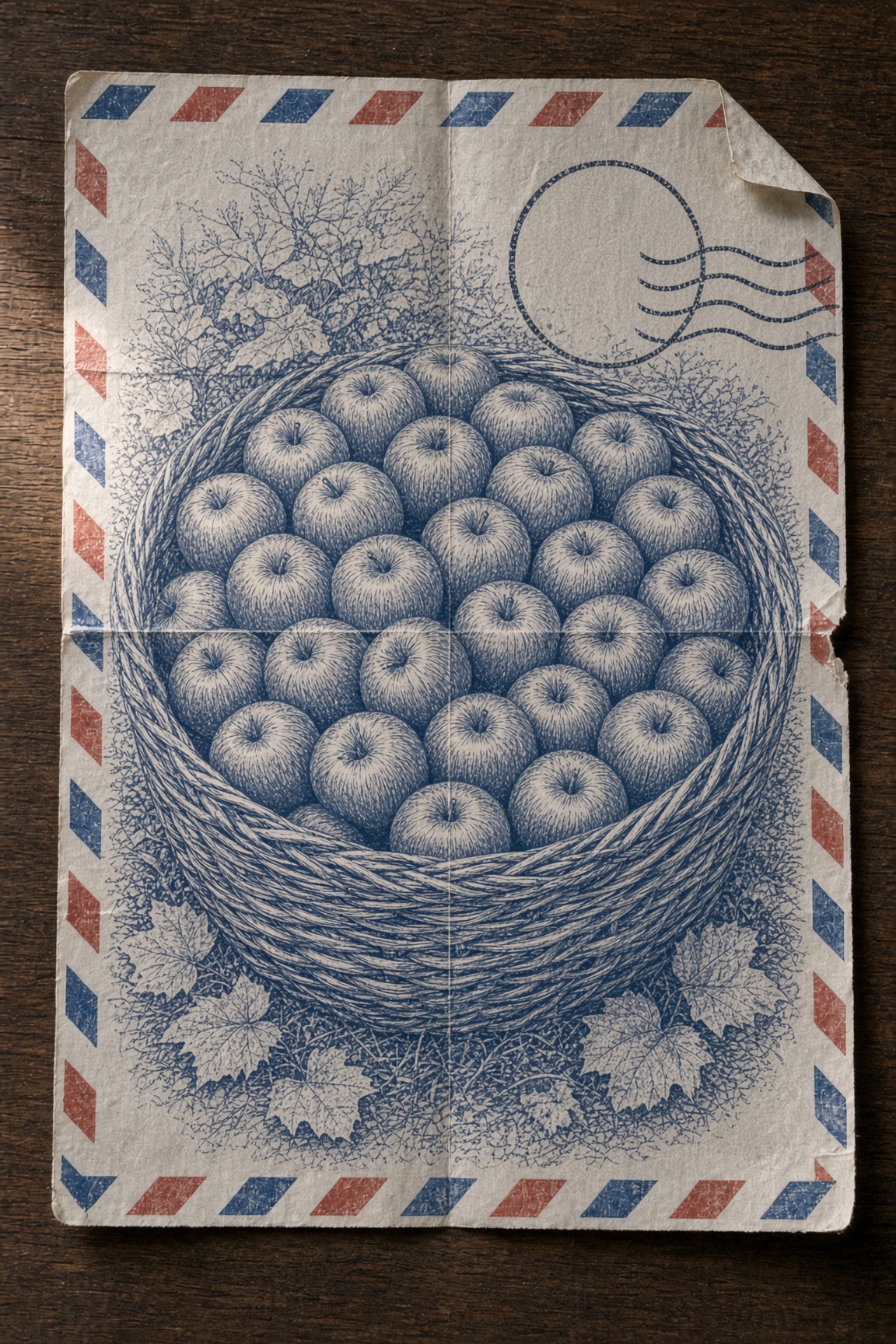
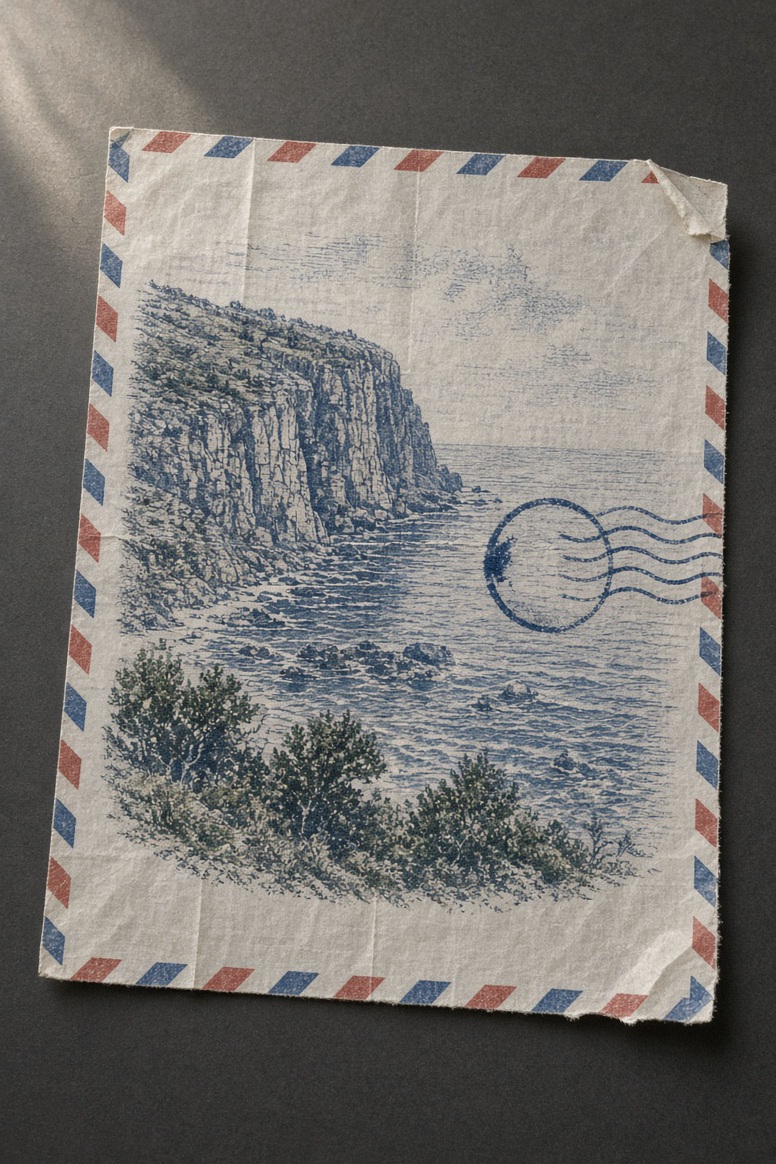
Prompt template
- Format
- Text
- Inputs
- Reference_photo (image) · Required
- Outputs
- Finished_sheet_photo (image)
Turn the attached photo into one picture engraved and printed on a thin airmail letter sheet, then photograph that finished sheet as a physical object. Output one single vertical image, clearly taller than wide. Do not make a grid or a before-and-after pair.

THE PIECE
Show one thin sheet of airmail paper—the lightweight kind you can almost see your hand through—lying flat and a little askew on a dark desk under soft daylight from one side. The sheet has been folded and opened again, so two soft fold creases cross it and the paper does not lie perfectly flat. Its edge has a border of short slanted bars in blue and red, repeating all the way around; the border is slightly out of register, so the blue and red do not line up. One corner is dog-eared and one edge is softly torn. A short contact shadow sits under the sheet. Nothing else is in the frame.

HOW THE PICTURE IS MADE
The picture from the photo covers almost the whole sheet and is printed in one single ink, a faded postal blue, the way security printing is done. Every tone is made of marks, with no smooth grey: use long parallel engraved lines where a surface turns, cross-hatching where it turns away from the light, and loose stipple dots where it fades out. Let the lines swell and thin along their length, with some breaking where the plate was worn. Where the ink is heaviest, it has soaked into the paper and spread a hair past the line. Where it is lightest, the paper shows through white.
The paper's own grain and the fold creases run across the printed picture, so the ink skips on the ridges of the folds. Because the sheet is thin, printing on its back shows through faintly, upside down, in the wide empty areas.
Then strike one postmark on top, over the picture and nothing else: a single circle of ink about a fifth of the sheet wide, with a wavy bar of three lines running off one side. The stamp was pressed unevenly, so one side of the circle is thick and wet and the other is dry and broken; a faint second impression of its edge sits beside it where the stamp rocked. The postmark ink is darker than the printed picture and sits on top of it.
Two creases lie over the basket and the ink goes pale along both. Over open water the ring is hollow, so the sea runs on underneath. Strokes fill the fruit stem to edge. In the leaves they thin out to veins and stipple.

WHAT CARRIES OVER FROM THE PHOTO
Keep the subjects of the photo, their number, their position, and their outlines. Nothing new appears and nothing is taken out. Anything worn, held, or sat on in the photo comes across as its own engraved shape, counted off the photo exactly.
If a person is in the photo, keep their facial features, skin tone value, age, hairline, and expression recognizable, built from engraved lines rather than smooth shading.
An animal keeps its own markings, as areas of denser and looser line rather than painted detail.
Engrave fur and hair as groups, one stroke for a clump, not one line per strand.
Keep the far distance in the picture, but render it with stipple alone and no outlines.

FAILURE CONDITIONS
1. Any letter, number, logo, maker mark, signature, date, address, barcode, or watermark anywhere in the frame is a failure. This includes inside the postmark: the postmark is ink only, a circle and a wavy bar, with no town, date, or numbers in it. Lettering and signs that exist in the photo must come out as blank engraved tone.
2. Any area of smooth continuous grey or smooth gradient, meaning tone with no line or dot visible in it, covering more than a fifth of the sheet is a failure.
3. More than two ink colours in the printed picture and the postmark together is a failure. The blue and red border bars do not count.
4. A postage stamp, sticker, label, seal, or second postmark anywhere in the frame is a failure. There must be one postmark only.
5. A postmark covering less than a tenth or more than a third of the sheet is a failure. A postmark that sits under the printed picture instead of on top of it is also a failure.
6. A different number of people, animals, or vehicles than the photo has is a failure.
7. Thick card, glossy paper, or any sheet whose back does not show through at all in the empty areas is a failure. The paper must be tissue-thin letter paper.
8. The blue and red border must be visible on all four edges. Anything in the frame other than the sheet, the desk, and the light is a failure: no hands, pen, rubber stamp, envelope, or second sheet.
9. A horizontal image, square image, or more than one image is a failure.

IF YOU CANNOT DO ALL OF IT
Keep the single-ink engraving and the struck postmark first. If a face will not come out engraved without photographic skin texture, build that face from four or five bands of hatching instead of adding texture. If a busy background will not reduce, drop the whole of it to open stipple and leave only the subject in line.
What you'll create
Fine single-ink hatching replaces photographic surfaces on thin paper with crossed fold creases. Red-and-blue edge bars and a struck postmark give the physical print an airmail character.
Frequently asked questions
Is the output a before-and-after pair?
No. It is one photographed sheet.
Should faces retain photographic skin?
No. They are built from engraved linework.
Comments
Tried this prompt? Share what you made, compare results, or ask a question