Chibi Witch and Glowing Ghost
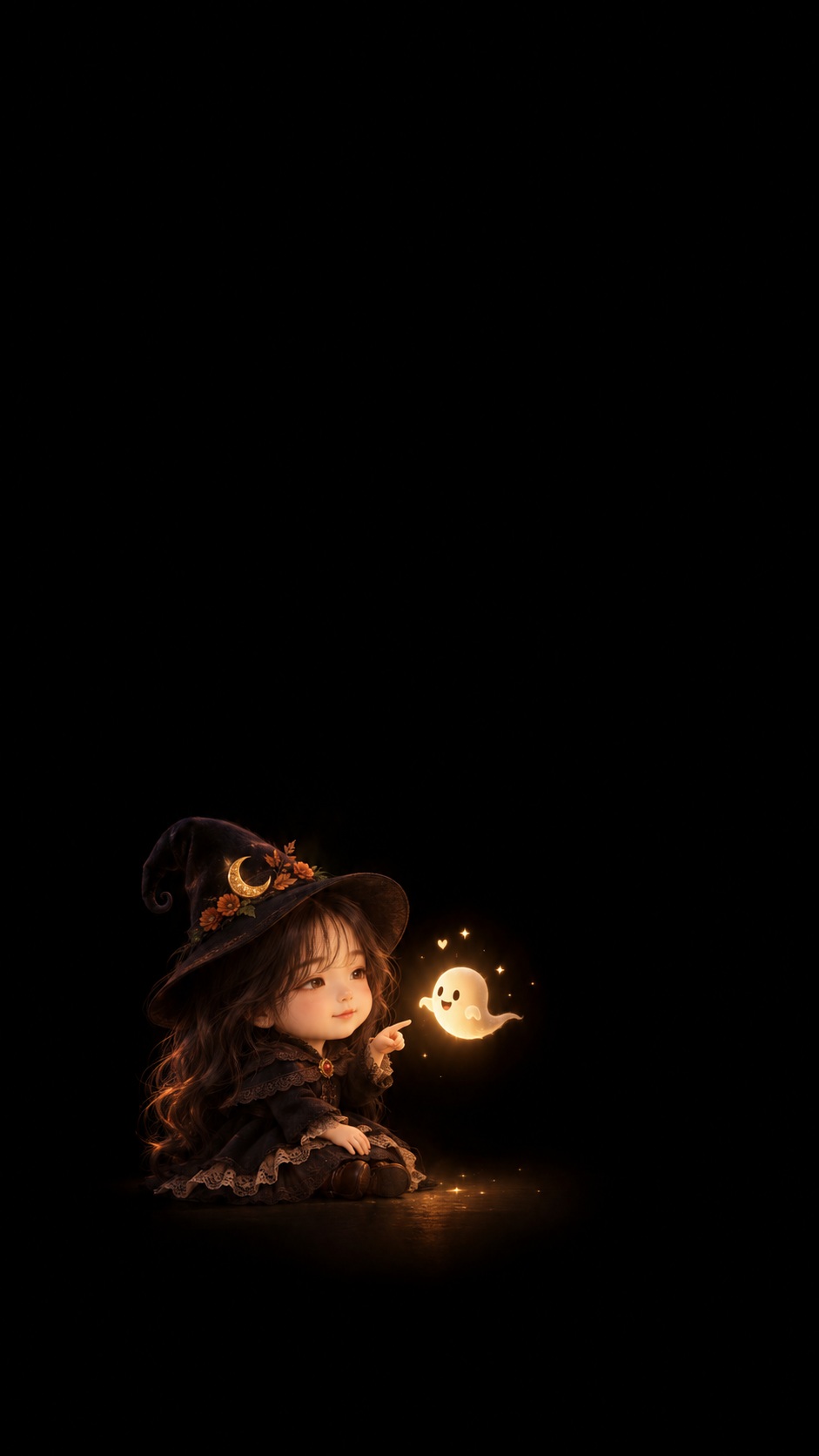
Create a distant, low-key 2.5D/3D CG scene of a recognizable chibi version of the reference subject dressed as a witch, sitting and pointing at a small glowing ghost.
Example outputs
Prompt template
- Format
- Text
- Inputs
- reference_photo (image) · Required
- Outputs
- generated_image (image)
Create one image in a single pass: a cute, small-child chibi “minime” of the subject in the reference photo, dressed as a little witch, sitting on a dark floor and pointing at a small glowing ghost. Render it as a stylized 2.5D / 3D CG character in a dark, low-key night scene, seen from far away. Use the photo only for recognizability; everything else comes from these instructions.

SUBJECT
- First determine whether the subject is human or animal. Fur, a muzzle, an animal nose, or animal ears mean the subject is an animal, even if it wears clothes or stands like a person. Never turn an animal into a human.
- HUMAN: Use only the eyes, nose, and mouth (their shapes, eyelid type, eye tilt, nose bridge and tip, lip shape and thickness, size, spacing, and relative positions), plus the hairstyle, hair color, and parting. Do not add makeup; render the face bare. Gender follows the photo.
- ANIMAL: Use the species, head, ears, muzzle, nose and eye shapes, eye color, fur color, markings, and texture. Render the same animal as a small, round baby version, with its own muzzle, nose, and ears, wearing the same witch outfit.
- If the subject wears glasses or sunglasses in the photo, keep the same frame design at a small child’s scale. If there are none, add none.
- Do not use the photo’s face shape, jawline, skin, clothes, other accessories, pose, head angle, gaze, expression, lighting, or background.

IDENTITY LOCK
- The character must be instantly recognizable as the subject. Resemblance must be strong and takes priority over darkness and mood.
- The eye, nose, and mouth shapes, as well as their size, spacing, and relative positions, are locked to the photo.
- Do not beautify, average, or symmetrize the features, or use generic cute-doll features. Do not enlarge the eyes into big doll or anime eyes.
- Apply the 2.5D stylization through face volume, skin material, eye rendering, and hair rendering, never by altering the features.
- Design the whole character at full detail first, then shrink the entire character (head, hat, body, and dress) uniformly to its small size in the frame. Never shrink the head alone.

COMPOSITION
- Vertical 9:16. The background is pitch-black everywhere.
- Use a wide, distant shot: the camera is far away, and the child and ghost are small in a large black space.
- Fit the whole scene (from hat tip to skirt hem, including child and ghost) in the lower-middle area of the image. Keep the entire upper half of the image completely empty and black.
- Keep the child, including the hat, inside the lower-left quarter of the image. Leave clear empty black space on all four sides; the child must never touch the image edges.
- The ghost is small, about one third of the child’s height, floating at face height to the child’s right and slightly in front of the child, toward the camera.
- Place the camera at the child’s eye level, straight-on, with a long lens.

CHARACTER
- Chibi proportions, about 3 heads tall: a big, round head and a small, round body. While sitting, the head without the hat is about 40 percent of the figure’s height.
- Keep the hat in proportion to the head: the brim is only about 1.5 times as wide as the head. The dress is small and close to the body.
- The human character is a young child about 4 to 6 years old, with short arms and legs and small hands. For an animal subject, render a baby version of that same animal as specified above.
- Pose: sitting on the floor with the legs folded to the side, knees together, and the skirt spread in a small circle on the ground. The near hand rests on the knee. The other hand is raised at chest height, with the index finger gently pointing toward the ghost.
- Keep the face almost frontal: turn the head only about 20 degrees toward the ghost so both eyes, the nose, and the whole mouth are clearly visible. Only the eyes glance sideways at the ghost.
- The hat brim sits high on the forehead and never shades the eyes.
- Use correct anatomy: five fingers per hand and natural joints.

FACE
- Use toddler-like face proportions for a human subject.
- Give the human face very round, soft, chubby proportions, built as clearly sculpted 3D volumes: full round baby cheeks, a rounded forehead, and a small rounded chin.
- Small rounded ears are partly visible through the hair, with bare earlobes.
- The human child’s face is bare and makeup-free. Add a natural rosy flush to the cheeks and nose tip, and soft pink lips with no gloss.
- Expression: a small, gentle, closed-mouth smile at the corners of the mouth only. Keep the eyes open and relaxed with their natural shape; no squinting and no eye smile.

OUTFIT
- Hat: dark brown-black witch hat, with a floppy brim and a tall, crooked cone that bends backward and ends in a curled tip. Decorate the left side of the hat band with a small gold crescent moon ornament, small dark rust-orange flowers, and dried leaves.
- Dress: black witch dress with a short layered capelet over the shoulders, a small gold brooch with a tiny red gem at the collar, long sleeves with lace cuffs, and a ruffled skirt with delicate lace trim at the hem.
- Shoes: small dark boots peeking out from the hem.
- If the human subject is male, use the same hat and black lace-trimmed outfit, cut as a short wizard robe over trousers.
- No earrings, jewelry, or other accessories.

GHOST
- A small, round, cute sheet ghost floats in the air on the right.
- Its body is milky white with a soft, warm amber inner glow and slightly translucent edges.
- Give it a simple face: two black oval eyes and a small, open, happy smile. Add a tiny rounded arm nub on the side facing the child.
- The bottom of the body thins into a wavy, wispy tail sweeping to the right.
- Add a few tiny, faint golden hearts and star sparkles around the ghost.

LIGHTING
- The ghost’s glow is the only light source. No studio light and no rim light from other directions.
- FACE EXCEPTION: Because the ghost floats in front of the child’s face, its glow softly and evenly lights the whole face: both eyes, the nose, the mouth, and both cheeks are clearly readable, with only a gentle shadow on the far side. The face is the brightest part of the child.
- Everything else stays dark. The light falls off quickly, so the hat crown, dress, legs, and far side of the hair sink into deep shadow with only faint dark-amber detail.
- Floor: almost invisible, with only a faint warm reflection under the ghost and a few scattered tiny sparkles.
- Overall, about 85 percent of the frame is near-black. Use a black and warm amber palette only. No cool or blue light.

RENDER
- Stylized 2.5D / 3D CG character render, like a high-end 3D animated feature character with a soft painterly finish.
- HUMAN: skin is smooth, clean, matte, and made of soft porcelain-clay material with a gentle subsurface glow. No pores or brush strokes. ANIMAL: soft, fine, individually rendered fur.
- Eyes: glassy CG eyes with clear depth in the irises and a crisp, warm catchlight from the ghost.
- Hair: sculpted CG hair made of soft, neatly grouped strand clumps with smooth color gradients and a few fine flyaway strands.
- Fabrics have fine detail visible only where the glow reaches: a velvety hat, matte black dress, delicate lace, and small glints on the gold ornaments.
- Not a photo, not a flat illustration, not anime cel shading, and not glossy plastic.

AVOID
- A small head on a big body, an oversized hat or dress, or child proportions longer than 3.5 heads.
- The character filling the frame, a close-up or medium shot, or the character touching the image edges.
- A face hidden in shadow, the hat brim shading the eyes, or a strong head turn or profile.
- Squinting eyes or eye smiles that change the eye shape.
- A bright overall image, bright dress or body, bright floor, or studio lighting.
- Big doll or anime eyes and generic cute-doll faces.
- Earrings, jewelry, makeup, the photo’s clothes, or accessories other than its glasses.
- Any text, letters, logos, or watermarks.
- Turning an animal into a human, or changing its species or fur color.
- A scary ghost, extra or deformed fingers or limbs, or a cropped hat or ghost.
What you'll create
A recognizable miniature version of the reference subject sits on a dark floor in a witch outfit, pointing toward a small luminous ghost. Distant framing keeps the whole character and ghost contained within a restrained nighttime composition.
Frequently asked questions
Should the ghost be frightening?
The source explicitly excludes a scary ghost, keeping the small supernatural companion cute.



Comments
Tried this prompt? Share what you made, compare results, or ask a question