Ink Shadow: A Photorealistic Hanji Transformation
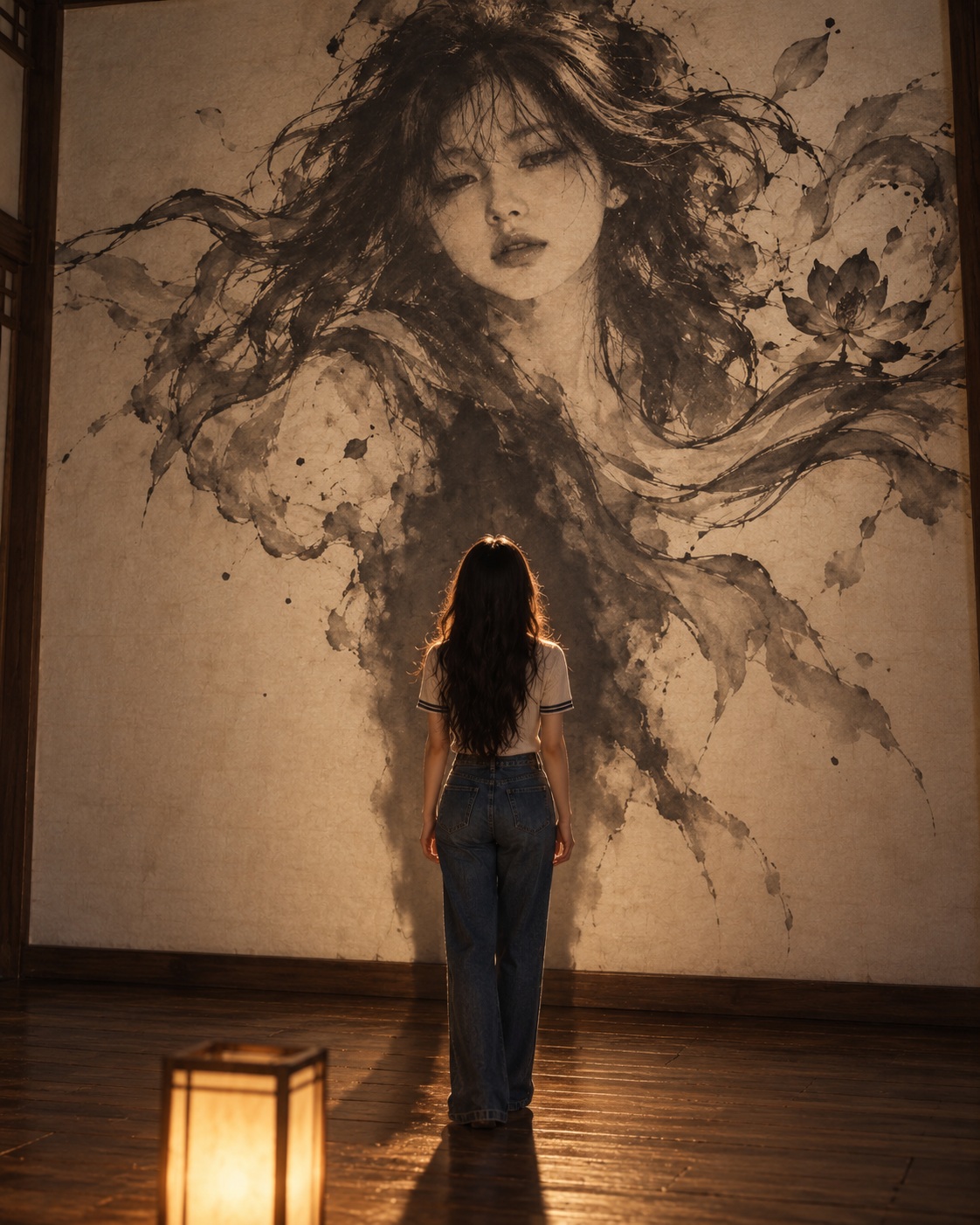
Create a photorealistic scene in which a person’s shadow spreads into a Korean ink-wash painting on hanji paper, revealing their face and inner self.
Example outputs
Prompt template
- Format
- Text
- Inputs
- Uploaded_photo (image) · Required Relevant_context (text) · Optional
- Outputs
- Finished_image (image)
TASK {
  Create ONE single image in ONE pass.
  A fully photorealistic photo of the person from the uploaded photo, seen ONLY from behind, standing and facing a traditional Korean hanji paper wall.
  The person casts exactly ONE shadow on the hanji wall in front of them,
  and that shadow is SPREADING into ink — like a drop of ink soaking into wet hanji, the shadow itself bleeds outward and blooms into a Korean ink-wash painting (sumukhwa).
  Out of that spreading ink, the person's OWN FACE and their "inner self" (decided by analysis) emerge.
  The real person shows only their back; their face appears ONLY in the ink.
  The viewer must instantly feel "my shadow is melting into ink and becoming a painting right now."
  It must never look like a normal shadow standing in front of a separate painting.
}

INPUT {
  The uploaded photo is used for three things only:
  1) The eyes, nose and mouth (their shape, size, spacing and relative position) for the ink face on the wall.
  2) The hairstyle, hair color, hair length and outfit, for both the real back view and the ink face's hair.
  3) ANALYSIS of the person (impression, look, atmosphere).
  Do NOT take the photo's head tilt, head direction, gaze direction, facial expression, body pose, camera angle, lighting or background.
  If the uploaded subject is an animal (bear, cat, etc.), keep it as that exact animal — never turn it into a human.
}

IDENTITY_LOCK {
  Applies to the ink face on the wall.
  The face shape may be redrawn naturally, but the eyes, nose and mouth must keep the photo's exact form, size, spacing and relative position.
  No beautification, no averaging, no symmetrizing, no idealizing.
  Likeness must come from the SHAPES and POSITIONS of the features captured in brush lines — not from photographic detail or realistic shading.
  The face must be instantly recognizable as the same individual — set the likeness bar high.
  Expression is drawn fresh as described in INK_FACE_STYLE, not copied from the photo.
}

POSE {
  Full-body back view. The real person stands in the lower middle of the frame with their back fully to the camera, facing the hanji wall,
  looking up at their own shadow. The real person's face is NOT visible at all — no profile, no turned head, no face in any reflection.
  Natural, still standing posture, arms relaxed.
  Body proportion: 8.5 heads tall, natural adult anatomy, correct head size for the back view.
}

SCENE {
  A dim traditional Korean room (hanok interior). The wall in front of the person is one continuous surface of plain off-white hanji paper on a wooden lattice,
  running edge to edge — not a framed panel, not a scroll, not a canvas.
  A single warm light source (a low paper lantern on the floor) sits BEHIND the person, between the camera and the person, slightly off-center,
  so it throws ONE large, tall shadow of the person forward across the wooden floor and up onto the hanji wall.
  The lantern may appear at the bottom edge of the frame or only as a warm glow from below.
  The person's back is rim-lit warmly by the lantern. Minimal props, deep warm darkness around, calm and quiet atmosphere.
  Real camera photo: natural lens, realistic depth of field, real fabric and hair texture, natural grain.
}

SHADOW_INK {
  There is exactly ONE shadow, and the shadow and the ink are the SAME thing. No separate painting exists on the wall.
  It reads as ONE continuous transformation from bottom to top:
  1) FLOOR: starts at the person's feet, physically connected — a normal, clean, dark shadow.
  2) BASE OF THE WALL: still clearly the person's back silhouette (legs, hips), a flat dark shadow shape with no clothing details inside —
     but its edges are already starting to soak into the paper.
  3) MIDDLE: the silhouette's edges loosen and BLEED outward into the hanji like ink on wet paper —
     feathered capillary bleeding along the paper fibers, soft blooming halos, tendrils of ink seeping sideways and upward,
     the dark mass thinning into gray washes as it spreads. The shadow is visibly dissolving.
  4) TOP: from the spreading ink above the shoulders, the person's FACE blooms out large (much larger than the real person's head),
     and the inner self forms within the same spreading ink around it — face and inner self made of the same bleeding ink as the shadow.
  There must be NO hard boundary anywhere between the shadow and the ink painting — the dark shadow mass flows directly into the face and inner self.
  The ink looks wet and still spreading at this very moment.
  All ink stays connected to the shadow; the rest of the hanji wall stays plain, bare paper.
  The ink exists ONLY on the wall. No ink, no brush strokes, no painterly texture on the real person, their clothes, the floor or the room.
}

INK_FACE_STYLE {
  The face is formed by brush and bleeding ink on hanji, like a master's traditional East Asian ink figure painting — NOT a drawing, NOT a photo.
  - Features are drawn with confident brush LINES of varying thickness: eye outlines, brows, nose line, lip outline.
  - Shading uses only 2–3 flat ink wash tones, with soft bleeding edges into the paper.
  - Large areas inside the face stay as bare hanji paper (negative space) — the cheeks, forehead and jaw are mostly unpainted paper.
  - Visible brush texture, ink pooling, dry-brush breaks and paper fiber texture throughout.
  - Hair is the spreading ink itself — sweeping washes and bleeding tendrils, not individually rendered strands.
  - Simplified, stylized, painterly — obviously made of ink from across the room.
  - Near-frontal, eyes gazing softly DOWN toward the real person standing below (not at the camera), head upright, calm and knowing expression.
}

ANALYSIS {
  Analyze the person from the photo (look, impression, outfit, atmosphere) and from anything known about them in this conversation.
  From that, decide freely what their inner self is — any being, figure, creature or form — and how it emerges from the spreading ink.
  Choose what truly fits this person, not a generic or default choice.
}

STYLE_CONTRAST {
  Real person, floor and room: 100% photorealistic, like a real photograph.
  Shadow and ink on the wall: 100% authentic ink on hanji paper, spreading and bleeding.
  These two must never blend into each other.
}

NEGATIVE {
  no shadow standing in front of a separate painting, no hard edge between shadow and ink, no crisp shadow outline on the upper wall,
  no clothing details, sleeve stripes or folds inside the shadow, no framed panel, no scroll, no canvas border around the ink,
  no text, no letters, no calligraphy, no captions, no seal stamp, no signature, no watermark,
  no scenery or decorations on the wall outside the shadow, no moon, no mountains, no buildings, no flower branches unless part of the inner self,
  no photorealistic ink face, no grayscale photo face, no hyperrealistic pencil or charcoal drawing, no smooth skin gradients, no skin pores,
  no glossy lips, no realistic eye reflections, no airbrushed shading, no finely rendered individual hair strands on the wall,
  no ink face looking at the camera, no tilted ink head,
  no visible face on the real person, no turned head on the real person, no ink effect on the real person,
  no second shadow, no shadow detached from the feet,
  no second light source, no extra people, no anatomical errors
}

OUTPUT {
  Vertical 4:5. One finished image only.
}
What you'll create
A real person faces a Korean paper wall while a single connected shadow spreads like soaking ink. The face appears only within the emerging sumukhwa artwork, contrasting photographic reality with a symbolic inner self.
Frequently asked questions
Can the real person turn to show the face?
No. Only the back is visible; the face exists in the ink.
How many shadows are allowed?
Exactly one, connected logically to the feet.



Comments
Tried this prompt? Share what you made, compare results, or ask a question