Invent a Legendary Creature as an Antique Natural History Plate
Create a scientifically detailed antique engraving of a completely original legendary creature shaped by the user's personality and history.
Example outputs
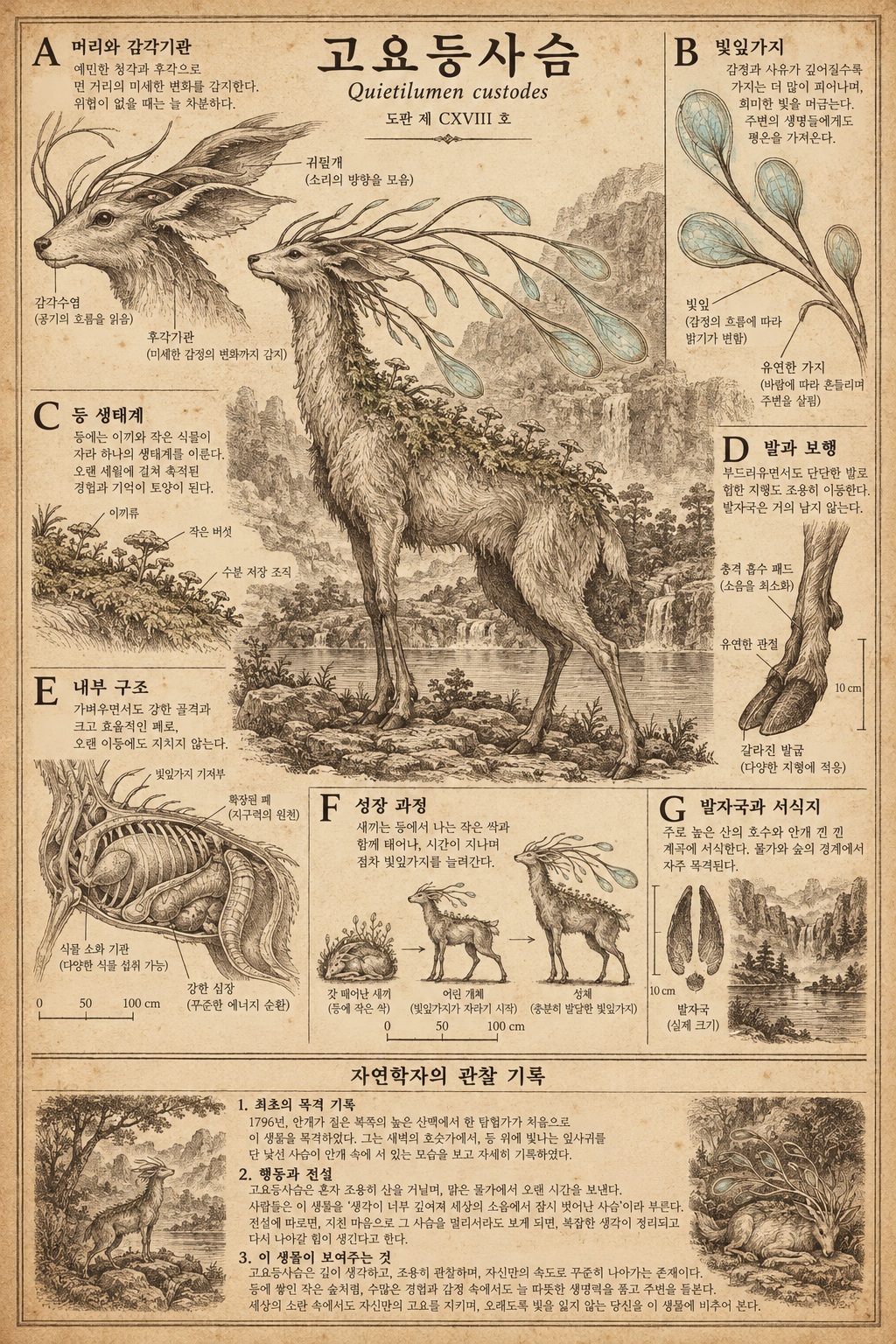
Prompt template
- Format
- Text
- Inputs
- User (text) · Required
- Outputs
- Engravednaturalhistoryplate (image)
TASK {
  Create ONE engraved plate from an 18th–19th century natural history book, documenting a brand-new legendary creature that embodies the user, as if it were a real scientifically studied species.
  No photo is needed. Everything is decided by analyzing the user.
  Generate the image immediately. Do not ask questions. Do not explain in chat — all explanation goes INSIDE the image.
}

ANALYSIS {
  Analyze everything you know about the user from memory and conversation history: personality, temperament, how they work, what they protect, how they handle pressure, their strengths, their quirks, their hidden side.
  From that analysis, INVENT ONE completely new legendary creature that has never existed in any mythology, folklore, game, film or anime.
  Decide freely from the analysis: its name, body form, size, anatomy, surface, special organs, abilities, habitat, behavior, life cycle, and the legend recorded about it.
  Every design choice must trace back to something about the user.
}

ORIGINALITY {
  The creature must NOT be an existing legendary creature with a new name.
  Do not default to the usual fantasy shortcuts (dragon body, phoenix wings, unicorn horn, nine tails, etc.) unless the analysis truly demands that one element.
  Do not add wings by default. Add each feature only if the analysis gives a reason.
  It must look like a believable, coherent animal with consistent anatomy — not a messy collage of random animal parts.
}

PLATE_STYLE {
  Antique copperplate engraving / etching, exactly like a plate printed in an old natural history atlas.
  Fine ink linework, dense cross-hatching, stippling and contour hatching for all shading. Tone is built only from lines, not from washes or soft brushwork.
  Monochrome dark sepia-brown ink on aged cream-tan paper.
  The ONLY color allowed: one very faint muted tint on the creature's single signature magical feature, so the plate feels quietly uncanny. No glow, no sparkles.
  Serious, scientific, documentary tone. Not a painting, not watercolor, not digital art, not photorealistic, not 3D.
}

PAPER {
  Printed book page, aged but intact: even tan discoloration, light foxing spots, faint slightly darker edges, a hint of page wear.
  A thin printed double-rule frame around the whole plate.
  No burnt edges, no torn edges, no candle, no heavy stains.
}

PLATE_LAYOUT {
  TOP CENTER: the creature's invented name in large printed serif capitals.
  Under it: an italic invented Latin binomial (scientific name), then a small "Plate No." line with a Roman numeral.
  CENTER (about 40% of the page): the main engraving — the creature in a dramatic moment of its legend or natural behavior within its habitat (decided by analysis), shown in full.
  AROUND THE CENTER: 6–7 lettered study panels, labeled A, B, C, D, E, F, G in order.
  BOTTOM: a full-width section separated by a horizontal printed rule, titled "Naturalist's Field Notes", with small engraved vignettes in both bottom corners and the notes text between them.
}

STUDY_PANELS {
  Each panel = a heading with a large printed initial letter (A, B, C...), a 2–3 line description, and an engraved study drawing with 2–4 small labels connected by thin straight leader lines.
  Choose 6–7 study types that fit THIS creature, in the manner of a real anatomical atlas — for example: head and mouthparts, eye, its signature organ, limbs or locomotion, surface texture shown inside a circular magnified view, internal anatomy as a cutaway, juvenile form, skeleton or remains, tracks or traces.
  Include 1–2 small printed scale bars with measurements next to the relevant drawings.
  Every panel's content must be consistent with the main engraving's anatomy.
}

FIELD_NOTES {
  3 short paragraphs in printed book text:
  1) the first recorded sighting (an invented year, place and observer),
  2) its behavior and the legend locals tell about it,
  3) a closing observation that explains why this creature embodies the user, based on the analysis.
  Keep it concise so it renders cleanly.
}

TEXT_LANGUAGE {
  ALL readable text on the plate — name, plate number line, panel headings, descriptions, labels, scale units, field notes — must be written in the language the user is currently using in this conversation.
  Headings above are given in English only as meaning; translate them into the user's language.
  Do not mix in other languages, except the italic Latin scientific name.
  Text looks PRINTED in an old book typeface (serif), not handwritten.
  Correctly spelled, clean and legible. No gibberish or fake script.
  Never write the user's real name anywhere on the plate.
}

NEGATIVE {
  No human figures, except at most one tiny faceless silhouette beside a scale bar for size comparison.
  No human face on the creature.
  No existing mythological creature, recolored or renamed.
  No creature from a modern game, film, anime or brand.
  No chaotic patchwork anatomy.
  No watercolor wash, no painterly brushwork, no glow, no sparkle effects, no saturated color.
  No handwritten-style text, no burnt or torn paper, no candle.
  No logos, watermarks, brand names, studio names or signatures.
  No garbled, misspelled or meaningless text.
}

OUTPUT {
  Single image, 2:3 vertical.
}
What you'll create
An original creature is documented through an eighteenth- or nineteenth-century book-plate aesthetic. Its anatomy, habitat and behavior reflect supplied personal context rather than an existing mythic species.
Frequently asked questions
Can an existing dragon be renamed?
No. The creature must be newly invented rather than a known being with another name.
Is a portrait photo required?
No. The design is driven by conversation context.
Comments
Tried this prompt? Share what you made, compare results, or ask a question