Taisho Romance in Kanazawa
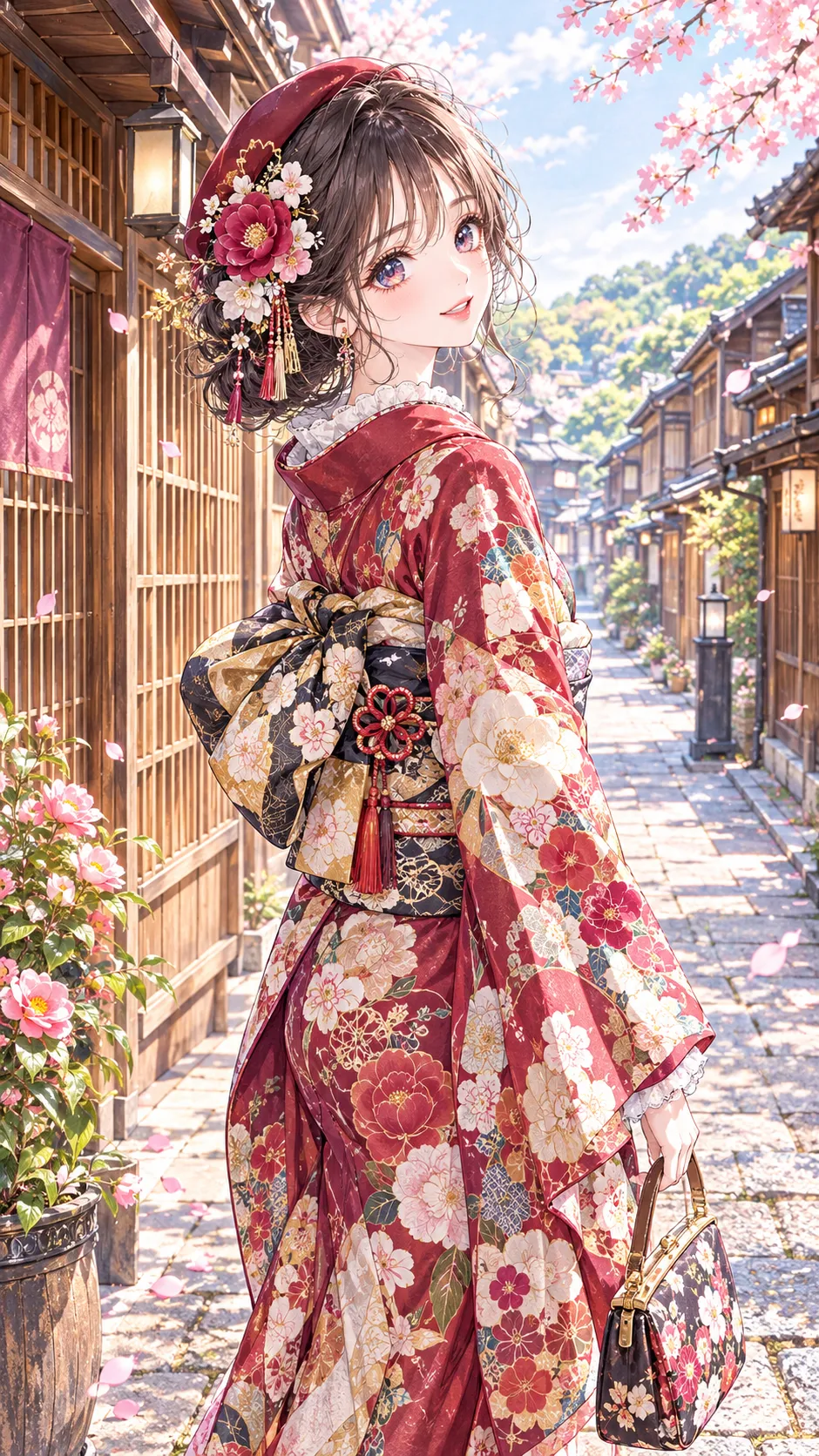
Create a vivid 2D shōjo manga fashion illustration of an adult woman exploring Kanazawa’s historic Higashi Chaya District in elegant Taisho-inspired kimono.
Example outputs
Prompt template
- Format
- Text
- Outputs
- Illustration (image)
Create a stunning, fully 2D shōjo manga fashion illustration that blends Kanazawa’s Higashi Chaya District in Ishikawa Prefecture with glamorous Taisho Romantic kimono fashion.

## Concept
The protagonist is a fictional adult woman with an exceptionally cute, doll-like face. Show her enjoying a romantic stroll through Kanazawa’s historic Higashi Chaya District, taking in its beautiful wooden machiya townhouses and traditional streetscape.

Make the image feel like a lavish, full-color opening illustration for a contemporary shōjo manga: glamorous and full of story. It should not look like a tourist poster.

## Heroine and kimono fashion
Depict an exceptionally cute adult woman with large, luminous eyes, delicate features, and a soft, appealing expression. Do not fix her facial features, hairstyle, hair color, or expression; create an original heroine with a different charm each time. Keep her head-to-body proportions natural and her figure beautifully proportioned as an adult woman.

Dress her in glamorous, refined Taisho Romantic-style kimono fashion suited to Kanazawa’s traditional streets. Draw inspiration freely from Taisho Romance, Showa retro, classical kimono, retro modern, and romantic Japanese-Western fusion styles. Choose freely among garments such as a colorful komon kimono, an elegant visiting-kimono style, an antique kimono, or a hakama ensemble.

Create an original outfit that harmonizes with the beautiful streetscape. Incorporate motifs such as camellias, peonies, chrysanthemums, plum blossoms, geometric patterns, or traditional Japanese designs. Freely coordinate the kimono patterns and colors, obi knot, obijime, obiage, hair ornaments, sandals, and bag to make the complete outfit beautiful. Elegant Japanese-Western touches—such as a lace collar, classical boots, or a retro hat—are also welcome.

Avoid repeating the same outfit structure or decorations each time; make the fashion feel fresh and distinctive. The kimono must have a naturally wearable construction, with its collar, sleeves, obi, hem, and overlapping layers arranged correctly. Dress the kimono in the conventional way: from the wearer’s perspective, the right front panel goes underneath and the left front panel goes over it. Wrap the obi naturally around the torso, and connect each sleeve to its corresponding arm. Keep the neckline and skin exposure modest, for a demure and charming look.

Choose colors freely from a varied palette that harmonizes beautifully with Kanazawa’s wooden townhouses and traditional streets. Use a broad range of refined yet vivid combinations, such as deep crimson, indigo, jade, wisteria, golden yellow, natural ivory, or muted blue.

## Setting and composition
Set the scene in Higashi Chaya District, Kanazawa, Ishikawa Prefecture. Depict traditional wooden machiya townhouses, beautiful latticework known as kimusuko, and atmospheric streets with stone-paved-looking surfaces. Carefully render the historic teahouse architecture, subdued wood tones, distinctive eaves, and other details that make the scenery feel authentically Kanazawa. Do not replace the setting with fictional temples, shrines, castles, or palatial buildings.

The season is mild spring. Soft sunlight falls across the townhouse lattices, and the streets feel bright and romantic in the fresh spring air.

Vary the heroine’s pose, position, gaze, body orientation, and camera angle from one image to another. Choose a pose suited to a travel scene, such as walking naturally, glancing back, or admiring the streetscape. Keep her balance, shoulder and hip placement, and the connections between her arms and legs natural. Avoid awkward twisting and extreme perspective.

Choose a framing that balances the heroine’s appeal with the beauty of the setting, ranging from a full-body view to a knee-up or mid-thigh composition. Make her the appealing central subject while ensuring the traditional Higashi Chaya streetscape remains clearly visible.

## Art style and finish
Create a fully 2D, exquisitely rendered shōjo manga illustration. Use delicate, crisp hand-drawn linework, beautiful luminous eyes, an exceptionally cute face, and a soft, appealing expression. Render the heroine in a polished, ornate shōjo manga style. Give the background the delicate transparency of a soft watercolor, with beautiful hand-drawn details.

Carefully render the kimono’s intricate patterns, the obi and hair ornaments, the natural layering of the fabric, the townhouse lattices, and the details of the historic architecture. Keep the perspective consistent between the heroine and the background. Ensure natural proportions for the face, body, shoulders, torso, hips, and legs. Draw anatomy accurately, including the number and placement of arms, legs, fingers, and joints, and make the connection between body and clothing look natural.

Use soft spring daylight, clear atmospheric depth, and a glamorous, refined palette to create a heart-stirring Kanazawa romance. Aim for a one-of-a-kind image with a fresh heroine, outfit, hairstyle, pose, and composition each time.

Do not use a photographic, live-action, 3D CGI, or dimensional-anime style. Use a vertical 9:16 composition. Do not include text, logos, or watermarks.
What you'll create
An adult heroine strolls past wooden machiya townhouses in refined original kimono styling. Luminous eyes and delicate manga rendering balance romantic character design with natural adult proportions.
Frequently asked questions
Can the hairstyle and expression change?
Yes. The template asks for an original heroine each time.
Which architecture anchors the scene?
Historic wooden machiya houses define Higashi Chaya.


Comments
Tried this prompt? Share what you made, compare results, or ask a question