- Category
- Art & Illustration
1970s Tokyo Women’s Liberation Fashion Portrait
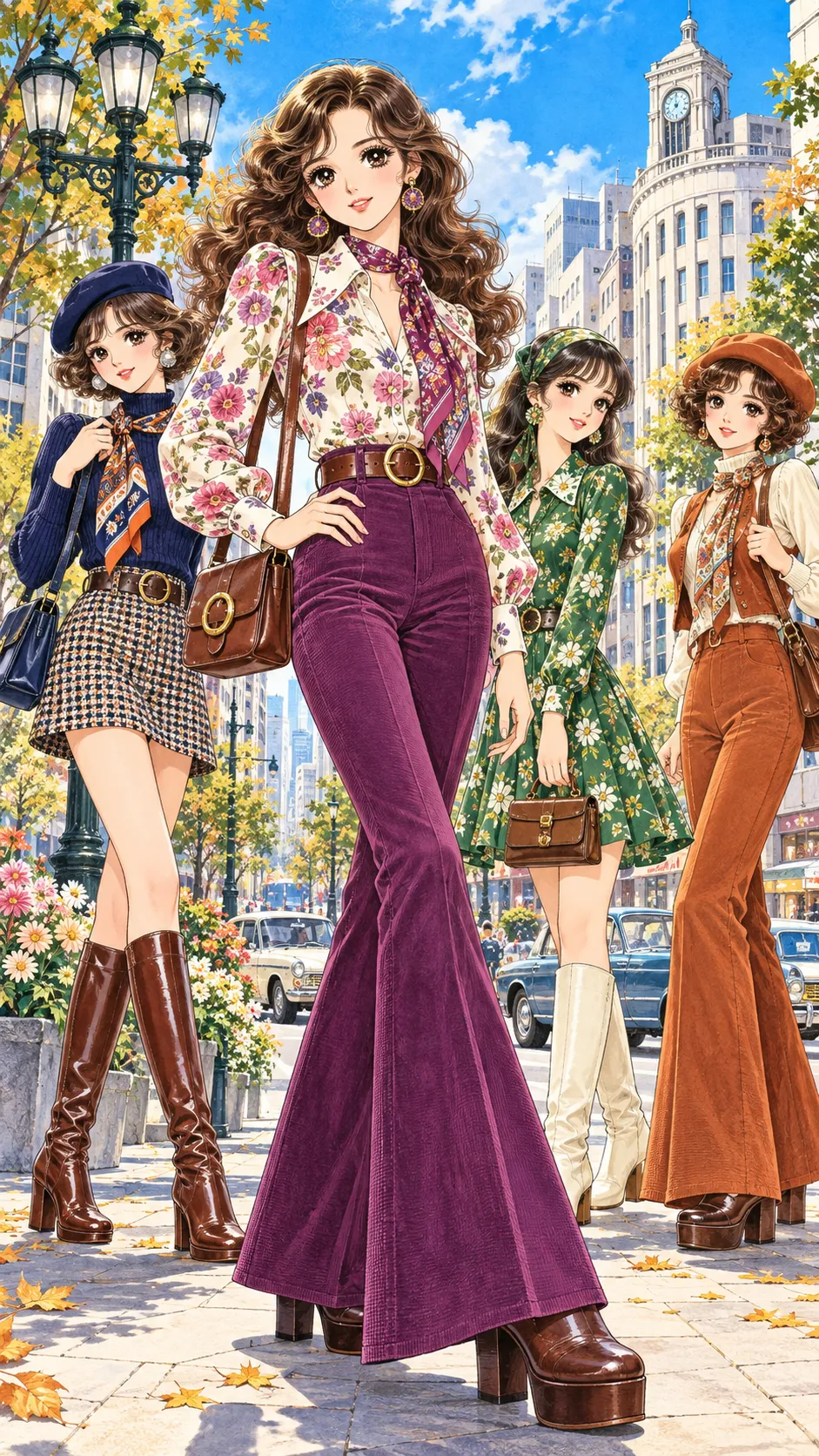
Create a bright, elegant shojo-manga-inspired 2D fashion illustration of four adult women walking confidently through early-1970s Tokyo, expressing freedom and independence through retro fashion.
By Threads — Published on — Modified on
Example images
Prompt template
- Format
- Text
- Outputs
- Illustrated_group_fashion_poster (image)
Create a vertical 9:16, fully hand-drawn 2D fashion illustration titled “Women Walking into a New Era, 1970.” Depict the hope of a new era through glamorous Showa-retro fashion, with a respectful symbolic reference to Japan’s women’s liberation movement around 1970. The women should express freedom, independence, and self-determination as they confidently walk through the city.

SETTING AND ATMOSPHERE
Set the scene on a bright city street in early-1970s Tokyo beneath a clear blue sky. Include period-inspired buildings, a classical streetlamp, street trees, and retro cars. Warm autumn sunlight falls across the street, while flowers and greenery bring color to the urban scene. The streetscape should feel hopeful and convey a changing era. Use a sophisticated composition reminiscent of a 1970s fashion advertisement.

PEOPLE AND FASHION
The central figure is a beautiful adult Japanese woman with large, clear eyes and delicate, attractive features, rendered in the style of a 1970s shojo manga: long eyelashes, refined contours, naturally rosy cheeks, and a graceful smile. Give her soft, voluminous wavy hair.

Dress her in glamorous early-1970s-inspired retro fashion: a floral blouse with a large collar, a classic belt that defines the waist, high-waisted bell-bottom trousers that lengthen the legs, and classic platform boots. Add period-inspired accessories such as large earrings and a vintage-style shoulder bag. Vary the outfit colors, floral pattern, hairstyle, and accessories from one generation to the next.

Place three additional adult women around the central figure, each wearing a different 1970s-inspired outfit. Their looks may include miniskirts, patterned dresses, high-waisted trousers, berets, scarves, and tall boots. Give each woman attractive features, but vary their hairstyles, expressions, and outfit combinations. Show them enjoying their individual styles and confidently expressing their personalities.

POSE AND COMPOSITION
Make the central woman large and prominent in the middle of the frame. Give her a poised fashion-model stance: one hand resting at her waist and the other arm relaxed at her side. Turn her body slightly at an angle while facing her face toward the viewer, using a natural shift of weight to create a beautiful silhouette. The other women should pose naturally and elegantly, as if pausing on a city street. Do not show them dancing or throwing their arms wide.

Compose the image as a glamorous, polished group portrait suitable for the opening spread of a fashion magazine. Make the central woman the largest figure and the others slightly smaller, with clear foreground and background relationships between them.

COLOR PALETTE
The most important color requirement is a sophisticated palette that balances brightness and elegance. Retain the richness of 1970s colors without letting the image become excessively yellow or orange. Use plum purple, deep navy blue, ivory white, dusty rose, forest green, terracotta, champagne gold, and clear sky blue. Pair the central woman’s floral blouse with bell-bottom trousers in a beautiful, deep color. Balance the surrounding women’s outfits across navy, green, rose, and brown. Keep the sky a luminous, clear blue; use soft ivory and subdued gray for buildings; and give the street trees natural greens with restrained autumn colors. Keep the background palette controlled so the women’s clothing stands out.

Do not use the yellowed color of an old photograph, excessive sepia, or an overly strong all-orange treatment.

ART STYLE
Blend beautiful 1970s shojo-manga character art with the sophisticated colors of vintage fashion illustration. Use delicate, elegant outlines; large, sparkling eyes; soft, fluffy hair; and careful coloring that conveys fabric texture. Render the floral patterns and accessories with fine detail. Combine the transparency of watercolor with the vivid color of colored ink.

The result must be a fully hand-drawn 2D illustration, not photorealism: evoke a beautiful shojo-manga cover or high-end fashion illustration. Keep the work bright, glamorous, charming, and refined.

HISTORICAL THEME
Use the women’s liberation movement that spread in Japan around 1970 as context for a symbolic portrayal of women’s freedom, independence, and agency. Show the women not as people who simply follow someone else, but as individuals walking into a new era by their own choice. Do not recreate real movement participants, a specific demonstration, or a particular historical event. Treat the social movement with respect while expressing hope for freedom through fashion art.

ANATOMY AND DETAIL
Render every figure’s anatomy naturally and accurately. Each person must have exactly two arms, one on each side, and five fingers on each hand. Connect shoulders, arms, wrists, and hands naturally. Do not confuse one person’s arms or legs with another’s. Keep the clothing’s placement on each body clear and accurate. Avoid extreme body twists, unnatural joints, extra fingers, or duplicated arms.

FINAL REQUIREMENTS
Create a vertical 9:16 fashion-poster composition with large, beautiful adult women in shojo-manga style, sophisticated 1970s fashion, a bright Tokyo streetscape, a clear blue sky, and an elegant, richly colored palette. Aim for a high-quality, fully 2D illustration. Include no text, logos, or political slogans. Do not use a photographic or live-action look, 3DCG, or 3D rendering.





Comments — 0