- Category
- Art & Illustration
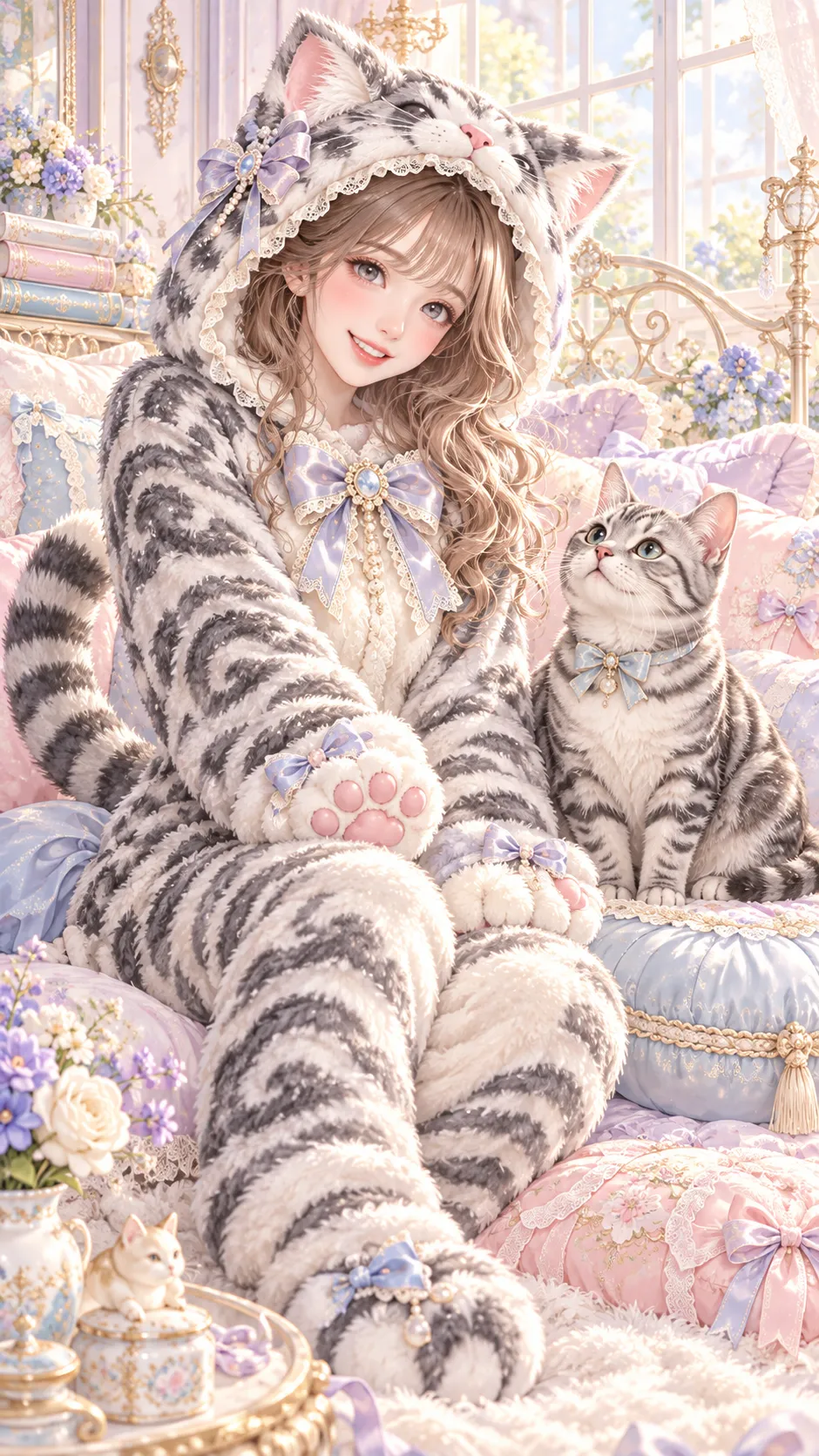
American Shorthair Kigurumi: Fluffy 2D Illustration
Create a sweet, ornate 2D illustration of an adult woman in a plush American Shorthair kigurumi beside a real cat, with classic tabby markings, a bright fancy room, and carefully specified anatomy.
By Threads — Published on — Modified on
Example images
Prompt template
0 copies
- Format
- Text
- Outputs
- Illustration (image)
Create a beautiful, high-end 2D illustration in a delicate shōjo manga style, with graceful Art Nouveau ornamentation. Depict a beautiful adult woman wearing a complete, hooded, full-body American Shorthair cat kigurumi, seated beside one real, lively American Shorthair cat. Combine a dreamy, sweet atmosphere with the natural charm of the cat. Use a vertical 9:16 composition.

SUBJECTS AND EXPRESSIONS

Make the woman the main subject, large enough for her face, hood, full outfit, and the outfit’s markings and texture to be clearly visible. Give her an elegant, friendly, sweet doll-like face: large, clear, jewel-like eyes; softly rounded, full cheeks; a small, naturally rounded chin; a refined nose; a charming mouth; and a bright, smiling expression. Keep her face recognizably human and natural. Do not turn it into a cat’s face. Her expression should balance adult beauty and sweetness, with transparent-looking highlights in the eyes and a natural flush in the cheeks. Do not make the chin excessively pointed.

Beside her, depict one real American Shorthair cat, not a plush toy. Give it a naturally rounded head, clear eyes, full cheeks, a naturally proportioned muzzle, a small nose, upright triangular ears, dense short fur, and a gentle, curious expression. Its eyes should be appealing but not exaggeratedly huge, and its muzzle and head should remain naturally proportioned. Show a beautiful classic tabby pattern, including a large swirling pattern on the sides, natural stripes on the legs, and one ringed tail. Distinguish the cat’s natural short coat from the kigurumi’s artificial, dense plush fabric.

KIGURUMI

Dress the woman in a fully worn, loose-fitting, one-piece, hooded cat kigurumi made from soft plush fabric, connected naturally from the neck to the feet. Give it a rounded, marshmallow-like silhouette and warm, modest loungewear coverage, with no exposed body. Ensure the fabric connects naturally across the shoulders, torso, hips, and legs; show one sleeve on each side and one leg on each side.

Make the plush exceptionally fluffy while retaining the look of short, dense American Shorthair fur: combine high-density short-pile boa, premium microfur, and soft sherpa fleece. Depict countless fine, short, soft tufts layered together, as if full of air, with a dense, velvet-like surface rather than smooth, uninterrupted cloth. Give the hood, cheeks, chest, cuffs, and feet especially rich, soft pile. Use delicate highlights and shadows to show the volume and texture.

Choose one naturally harmonious American Shorthair coat color and pattern for the outfit and match it to the real cat. The available coat variations include silver classic tabby, brown classic tabby, red classic tabby, cream tabby, blue classic tabby, silver patched tabby, and brown patched tabby. Do not limit every version to silver. Make the markings follow the fur naturally: stripes along the back, large rounded swirls on the sides, flowing curves around the shoulders, natural horizontal stripes on the legs, and ring-shaped stripes on the tail. Clearly show the large swirls characteristic of a classic tabby, not just simple straight stripes. Represent the pattern as changes in the fur’s color, not as raised additions.

Give the hood a pair of natural-looking cat ears, one on each side. Each ear should have a broad base, taper gently to a softly rounded tip, stand upright, and angle outward naturally. Use soft short-pile fur matching the outfit on the outside, with delicate pale pink-beige or cream fur inside and short, soft tufts along the edges. Show exactly two triangular cat ears; do not make them long rabbit ears, oversized Chihuahua-like decorative ears, or round bear ears. A small cloth pink cat nose, soft rounded muzzle, or subtle tabby decoration may appear on the hood, but must not cover the woman’s face. Her eyes, nose, and mouth must remain clearly visible, with her bangs or face-framing hair naturally showing through the hood opening. Do not add extra eyes or noses around her face.

Decorate the outfit with one refined ribbon at the chest, and delicate lace or small pearls at the cuffs or hood edge. A natural coat-color transition may appear on the belly. Keep decorations attractive but subordinate to the classic tabby markings. Use the same coat color and pattern for the soft, rounded cat-shaped room slippers, with small tasteful ribbons or pearls if desired.

MITTENS AND TAIL

Put one soft, rounded, plush paw mitten at the end of each sleeve, for exactly two mittens total. Connect each mitten naturally to its corresponding sleeve. Match their short-pile fur and markings to the outfit; add subtle pale pink or brown paw-pad embroidery on the palm side. Human fingers should remain inside the mittens: do not show fingers or another hand emerging from them. The paw pads are decorative embroidery, not separate protrusions.

Attach exactly one soft, ring-striped cat tail to the back of the kigurumi at the woman’s waist. Let it curve gently, coordinate its fur and color with the outfit, and show it slightly along the outside of her right side. Keep it separate from her arms and legs, and clear of her face and mittens. It is a costume decoration, not a limb: it must not grow from a shoulder or arm, branch, end in a hand or mitten, or appear as a third arm. Do not make it enormous or excessively long and feathery.

POSE AND COMPOSITION

Seat the woman naturally on a large fluffy cushion in a bright, fanciful room. Place the cat sitting on a separate cushion immediately to her left. The woman turns her face slightly toward the cat and smiles warmly; the cat looks up at her and tilts its head affectionately.

Bend the woman’s right arm naturally at her right side and rest the right mitten on her right knee. Bend her left arm naturally at her left side and rest the left mitten on the cushion between her and the cat. Connect each shoulder, sleeve, and mitten in one clear, natural structure. Keep the left mitten from overlapping the cat’s body or legs. Do not have the woman lift the cat or cross her arms in a complicated way.

Seat the cat steadily, with its front paws naturally together and its hind legs tucked beneath its body. Turn its face slightly toward the woman. Its own striped tail should connect naturally to its body and remain clearly distinct from the kigurumi tail. Do not force every leg to be visible when the seated pose naturally hides some of them.

Use the vertical 9:16 frame to include the woman’s full body and the small cat naturally. Make both expressions clearly visible and keep the woman and cat large enough to show the kigurumi’s fine fur and markings. Clearly separate their outlines.

HAIR, COLOR, AND ROOM

Allow varied hairstyles, including short hair, short or medium bobs, shoulder-length hair, long straight hair, loose waves, and soft curls. Hair color is also flexible; choose a harmonious option such as natural black, dark brown, ash brown, honey brown, or milk-tea beige. Let the hair show naturally from the hood and give each version its own character; do not fix the design to one hairstyle or hair color.

Use a bright, dreamy pastel fancy room, not an outdoor setting. Include soft cushions, a fluffy rug, delicate lace, ribbons, and pale flowers. Let soft natural light fill the room. Choose a varied pastel palette for the decorations rather than relying only on pink; possible colors include lavender, mint green, baby blue, milky pink, peach, butter yellow, pale lilac, ice blue, champagne beige, and pearl white. Choose ribbon, lace, pearl, cushion, and background colors freely. Add restrained Art Nouveau curves, small floral motifs, elegant furniture, or similarly graceful details. Keep the background simple and bright, with pale cushions and furnishings that provide natural contrast so the cat’s coat and tabby markings remain easy to see. Avoid dark lighting and excessive decoration.

ANATOMY AND STRUCTURAL ACCURACY

Maintain natural adult human anatomy beneath the plush outfit: exactly two arms, two legs, two mittens, and one costume tail. Preserve plausible shoulder, elbow, waist, knee, ankle, and foot positions, with each leg connecting naturally from hip to knee to ankle and slipper. Keep the right mitten on the right knee and the left mitten on the cushion between the woman and cat. Make the relation between the woman’s limbs and the costume tail unmistakable. Avoid extra or missing limbs, duplicate mittens, awkward joints, inconsistent left and right sides, or multiple tails.

The real cat has a natural feline skeleton: one head, two eyes, two ears, two front legs, two hind legs, and one tail. Do not give it human arms or hands. Keep the woman’s mittens separate from the cat’s front paws, and keep the cat’s tail distinct from the kigurumi tail. Prioritize natural, accurate anatomy for both subjects.

ART STYLE AND FINISH

Render the result as a refined, fully 2D hand-drawn illustration, not a photograph, photorealistic image, 3D CGI, or figurine. Use delicate, elegant shōjo manga illustration with graceful Art Nouveau ornamentation, soft outlines, luminous eyes, finely drawn hair, and polished, expressive color. Build the kigurumi’s dense short-pile texture with fine strokes and soft shading, especially around the hood, cheeks, chest, cuffs, and feet. Give the fur many fine strands and layered highlights and shadows. Let the classic tabby pattern flow naturally with the fur. Draw the real cat’s short coat with its own natural direction and fine fur tips, clearly distinct from the kigurumi’s plush pile. Create rich, soft volume through detailed 2D drawing.

FINAL CHECK

The finished image should show a beautifully smiling adult woman in a fully worn, rounded American Shorthair kigurumi, with a naturally triangular-eared hood, high-density plush short fur, and clearly visible classic tabby swirls. Include exactly two naturally connected arms and legs, two round paw mittens, and one ring-striped costume tail attached at the back of the waist. Place one real, affectionate American Shorthair beside her, with natural feline anatomy, four legs, and one striped tail. Keep their silhouettes distinct in a bright, charming fancy room with freely chosen pastel decorations and a hairstyle that may vary. Avoid photographic styling, 3D CGI, a dark or horror atmosphere, and unnatural body structures. Emphasize the American Shorthair’s full cheeks, beautiful classic tabby pattern, soft short fur, rounded fluffy costume, and the woman’s warm smile.


Comments — 0