- Category
- Art & Illustration
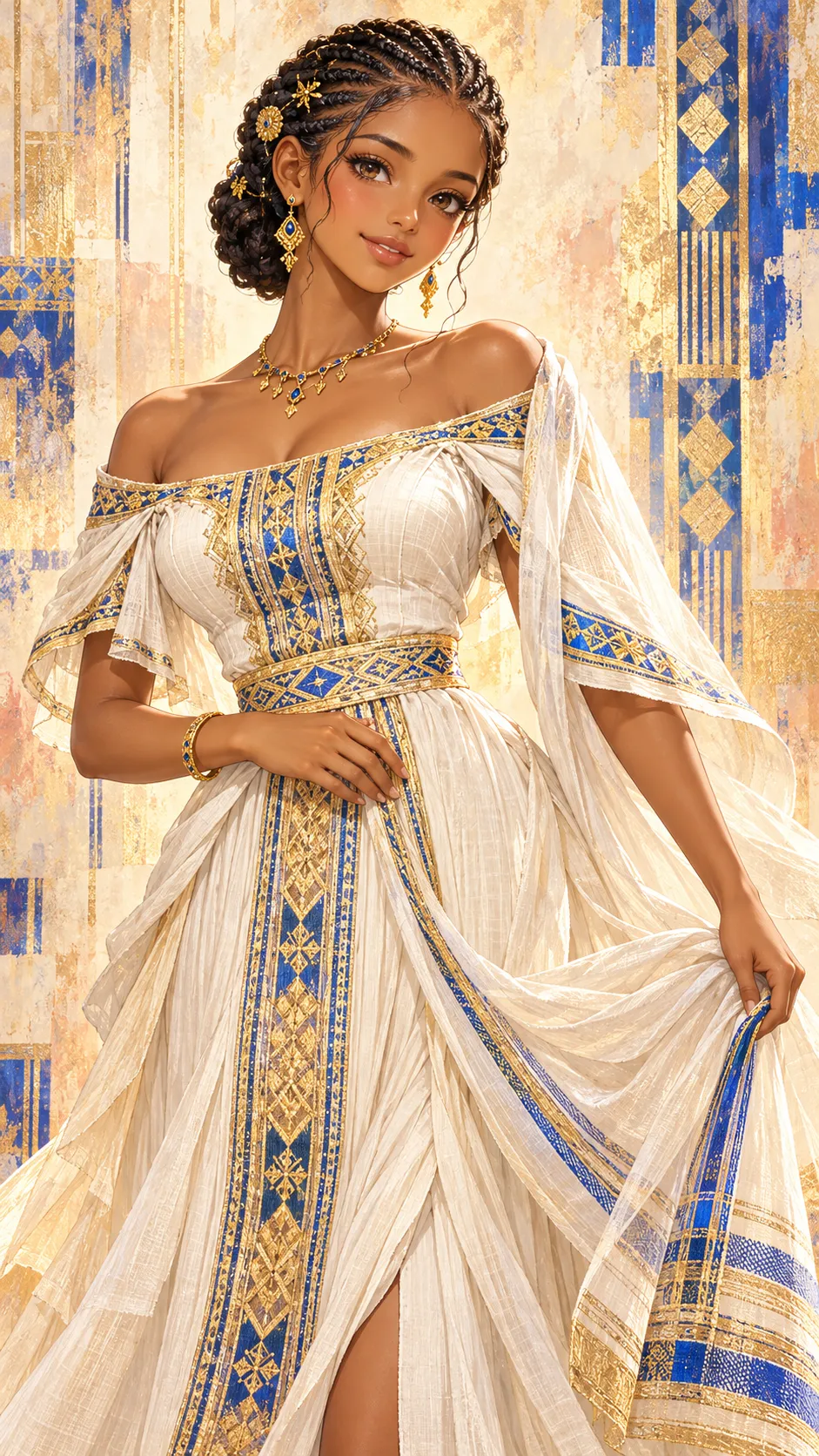
Ethiopian Habesha Couture — Manga-Style Fashion Portrait
Create a polished 2D fashion illustration of an adult Ethiopian woman in a couture outfit inspired by the Habesha kemis, traditional tibeb decoration, and netela shawl. Combine ivory textiles, champagne-gold embroidery, royal-blue accents, and a refined editorial pose.
By Threads — Published on — Modified on
Example images
Prompt template
- Format
- Text
- Outputs
- FashionPortraitIllustration (image)
Create a luxurious, fully 2D fashion illustration of a beautiful adult Ethiopian woman, inspired by Ethiopian Habesha culture and traditional white textiles. Reimagine the Habesha kemis, tibeb decorative weaving, and netela shawl as contemporary haute couture rather than reproducing traditional clothing exactly. Respect Ethiopian textile culture while creating a refined, artistic fashion design. The woman is posing for a high-fashion magazine portrait; she is not dancing.

The overall image should evoke a world-class fashion magazine editorial and combine the charm of a shoujo manga heroine with sophisticated luxury-fashion illustration. Use a vertical 9:16 composition.

SUBJECT AND EXPRESSION

Depict a beautiful adult Ethiopian woman with a graceful, charming, delicate face reminiscent of a shoujo manga heroine. Give her naturally warm, deep-brown skin, rendered with soft highlights and beautiful shading. Preserve the richness of her natural brown complexion; do not lighten her skin unnaturally. Her large, clear eyes are dark brown with delicate, jewel-like highlights and long lashes. Give her a naturally shaped nose, refined full lips in an elegant rose pink, softly rounded cheeks with a warm natural flush, and gently arched brows. She smiles brightly and sweetly, with a gentle, calm, confident expression. Respect the diversity of Ethiopian women’s natural beauty while blending it with charming shoujo-style features. Avoid an excessively mature-looking face or a provocative expression. Emphasize the beautiful contrast between her brown skin and the pure-white clothing.

HAIR

Her hair is natural black, arranged in a delicate, beautiful updo inspired by Ethiopian braided hairstyles. Place neat, fine braids from the front of the head toward the back, following the scalp naturally and gathering into an elegant bun at the back. Draw a natural hairline; keep the braids moderately sized rather than excessively tiny or complex. Keep her forehead, eyebrows, and facial outline visible. Add only a few small, tasteful antique-gold hairpins. Do not use a huge crown or feather ornaments. Treat the hairstyle as an original design inspired by Ethiopian aesthetics, not as an exact reconstruction of a traditional style.

COSTUME: HABESHA-INSPIRED HAUTE COUTURE

Design a refined, original couture outfit inspired by the textile traditions of the Habesha kemis. Use an elegant palette of ivory white, warm champagne gold, vivid royal blue, soft cream white, and restrained antique gold. Make the clean beauty of the white textile and the distinguished luxury of its gold decoration the focus. Some skin may be visible, but keep the overall look tasteful and high-fashion.

Top: Create a modern original top inspired by the weaving traditions of the Habesha kemis, primarily in fine ivory-white fabric. Combine an elegant boat neckline with a shallow off-the-shoulder design that flatters the shoulders and collarbones; let the outer edges of both shoulders show naturally. Cover the chest tastefully without emphasizing exposure. Add delicate champagne-gold geometric embroidery from the neckline across the chest, with fine royal-blue accent lines. Draw inspiration from tibeb stripes and decorative woven patterns. Place a beautiful vertical ornamental panel flowing from the chest toward the waist. The top should follow the body naturally in a refined silhouette, not an extreme corset shape.

Sleeves: Use short, elegant draped sleeves made of soft ivory fabric, naturally layered below the shoulders so that part of the upper arms is visible. Edge the sleeves with fine champagne-gold embroidery. Make the boundary between sleeve and arm clear, and do not let overlapping fabric look like an extra arm.

Waist: Add a slim champagne-gold decorative sash. Place a small geometric motif in royal blue and gold at its center. Let the sash flatter her figure tastefully. Do not use a large metal buckle. Cover the abdomen with beautiful white woven fabric.

Skirt: Create an elegant, long skirt inspired by the flowing silhouette of the Habesha kemis, primarily in fine ivory-white woven fabric. Let it fall naturally from the waist in a graceful vertical silhouette, with soft fabric layers and delicate draping. Add decorative vertical panels at the front in champagne gold and royal blue, with fine stripes and geometric patterns inspired by tibeb. Keep the ornamentation delicate and regular so it enhances the beauty of the woven fabric. Include soft layers of cream-white fabric at the sides. Do not use an extremely wide Rococo-style skirt or multiple layers of tulle. Balance the quality of the white fabric with the richness of the gold embroidery.

SHAWL: NETELA-INSPIRED DRAPE

Include a delicate, important netela-inspired shawl in soft ivory white. Edge it with refined bands of royal blue and champagne gold. Give the lightweight woven fabric a natural, subtle translucency, but do not make it overly transparent. The shawl flows naturally from behind her left shoulder, along the outside of her left arm, and down toward the front. She gently holds its end in her left hand. Use one shawl only; do not let its fabric look like multiple arms or sleeves. Let it fall in a beautiful gravity-led curve. Do not blow it dramatically upward or make it look as if she is in the middle of a dance. Present it quietly and elegantly, as part of a high-fashion magazine pose.

JEWELRY

Create tasteful original jewelry inspired by Ethiopian decorative aesthetics, without claiming to reproduce adornments with specific religious or ceremonial meanings. Give her one delicate antique-gold necklace that rests naturally near the collarbones, combining small gold beads with royal-blue decorative stones. Use a single necklace, not layers of oversized gems. Add elegant, slender antique-gold drop earrings with fine geometric details and small royal-blue stones. Add a slim gold bracelet to her right wrist. Keep all jewelry understated but luxurious.

POSE: STILL, ELEGANT EDITORIAL PORTRAIT

She is not dancing. Pose her naturally, standing with her body turned just slightly away from facing directly forward. Her back is gently straight, her shoulders relaxed, and her face turned toward the viewer. Tilt her head very slightly and give her a bright, charming smile. This is a sophisticated editorial pose that displays the couture outfit: one hand rests lightly at the waist, while the other gently holds the shawl.

Right arm: Let her right arm fall naturally from the shoulder with a slight bend at the elbow. Place her right hand gently on the decorative sash at the front of her waist. Her fingers are softly held together, and her wrist is not bent unnaturally. The shoulder, elbow, and wrist form a natural curve.

Left arm: Let her left arm rest naturally at her side with a slight bend at the elbow. Her left hand is a little below waist level, gently pinching the end of the shawl with her fingertips. Do not raise the shawl high. Keep the left arm visible rather than hiding it behind her body, and connect shoulder, elbow, wrist, and fingertips naturally.

The pose should show a beautiful shoulder line, graceful neck, natural décolletage, soft waistline, and confident upright posture. Keep her expression charming and sweet. Do not spread her arms widely, raise her arms overhead, twist her body excessively, or use a movement that suggests she is dancing.

ANATOMICAL ACCURACY

Prioritize natural, accurate anatomy. Show one shoulder on each side, one arm on each side, and one hand on each side. Connect each shoulder, upper arm, elbow, forearm, wrist, and palm naturally. Keep the right arm a natural length as it reaches the hand at the waist, and the left arm a natural length as it reaches the hand holding the shawl. Each hand has one thumb and four fingers. Avoid extra or fused fingers, unnatural joints, overly long arms, and twisted wrists. Do not let shawl or sleeve draping resemble an extra arm. If the hands would otherwise look unnatural, some fingers may be naturally obscured by the fabric or clothing; do not force every finger to be prominently visible. Natural anatomy and the subject’s beauty take priority.

COMPOSITION

Use a vertical 9:16 format. Place the woman prominently near the center and make her large enough to read clearly. Use a medium-long portrait, framed mainly from the top of her head to below the waist or around the thighs; do not force the entire body into the frame. Clearly show her beautiful deep-brown skin, charming face, intricate braids, graceful white outfit, champagne-gold embroidery, royal-blue decorations, and softly flowing netela-inspired shawl. Place her face naturally in the upper part of the frame and do not crop the top of her hairstyle. Clearly depict the connection between shoulders and arms and the natural overlap between shawl and arm. Show the jewelry well.

BACKGROUND

Create a refined contemporary abstract-art wall inspired by Ethiopian traditional textiles and decorative aesthetics. Use soft champagne beige, bright cream white, pale sand gold, restrained royal blue, and warm peach beige. Include subtle fine vertical lines, abstract woven patterns, and small geometric shapes. Keep gold decorative lines delicate. Leave bright negative space around the woman. Add soft tonal variation so the white outfit does not disappear into the background. Highlight the beautiful contrast between her deep-brown skin and white clothing. Keep the background subordinate to the subject. Do not depict a realistic cityscape, tourist landmark, stage, or audience seating. Avoid a huge halo, excessive metallic decoration, or a symmetrical ornamental frame.

ART STYLE

Create a polished, high-end, fully 2D illustration combining charming shoujo manga character design with sophisticated luxury-fashion illustration. Use beautiful deep-brown skin, clear large eyes, soft cheeks, natural Ethiopian facial features, delicate clean linework, intricate braids, pure-white woven fabric, fine champagne-gold embroidery, royal-blue geometric motifs, elegant gold jewelry, and a graceful shawl. Render the face and skin clearly as illustration; do not give the skin a photographic, photorealistic texture. Use soft hand-painted brushwork alongside beautiful outlines. Do not use photography, live-action imagery, 3D CGI, a figurine-like appearance, or excessively realistic skin. The finished work should be bright, elegant, romantic, and richly detailed, with a beautiful shoujo manga-inspired fully 2D painting style.

FINAL IMAGE

The finished image is a luxurious fashion portrait of a beautiful adult Ethiopian woman inspired by Habesha culture and traditional white textiles. She has warm, beautiful deep-brown skin, large clear dark-brown eyes, a bright charming smile, and a delicate braided updo. She wears an original ivory-white Habesha kemis-inspired couture outfit with fine champagne-gold embroidery, beautiful royal-blue tibeb-inspired decoration, an elegant top that tastefully reveals her shoulders and décolletage, a soft netela-inspired shawl, and delicate gold jewelry. She is not dancing: she stands confidently in a refined fashion pose, one hand resting lightly at her waist and the other gently holding the shawl. Keep her anatomy, arms, wrists, and fingers natural. Use bright, refined colors; emphasize the contrast between deep-brown skin and ivory-white fabric, with gold ornament and vivid royal-blue accents against a sophisticated modern abstract background. The result should feel like a high-end, fully 2D fashion painting worthy of a leading fashion magazine, celebrating Ethiopian decorative textile aesthetics and the woman’s grace. Vertical 9:16. No text, logos, or watermarks.




Comments — 0