- Category
- Design & Image
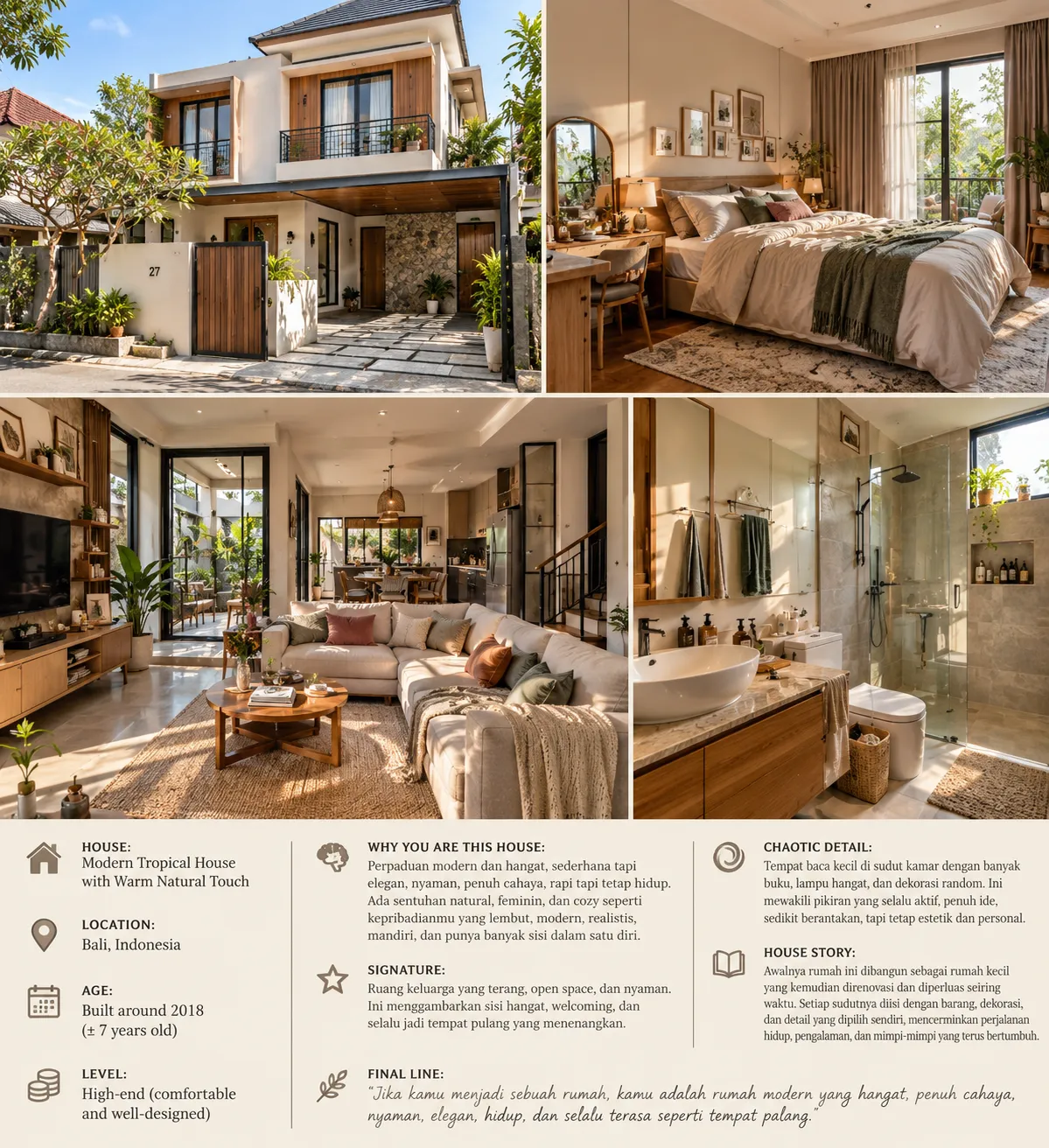
If You Became a House
Turn the personality and emotional vibe in a reference photo into a distinctive, photorealistic house shown in four clear views, with a brief story and house details.
By Threads — Published on
Example images
Prompt template
- Format
- Text
- Inputs
- Reference_photo (image) · Required
- Outputs
- House_concept_image (image)
Use the uploaded photo only to understand the person's vibe, energy, mood, personality, emotional atmosphere, warmth, chaos, elegance, simplicity, contradictions, and overall character. Do not copy their outfit, pose, hairstyle, background, or objects. Transform that impression into one believable real house: if this person literally became a house, what house would they be? The house should feel like a physical manifestation of their personality.

Create a completely fresh house concept on every generation. Start randomizing from the first generation; do not default to any particular house type, aesthetic, country, architectural style, age, condition, wealth level, or visual style. Randomize the location, setting, climate, era, house age, architecture, size, floors, shape, façade, roof, windows, doors, materials, colors, furniture, interior style, landscaping, wealth level, condition, atmosphere, unusual details, lighting, camera angle, and composition. Do not repeat or substantially recreate previous results. If previous generations are available, make this house fundamentally different from them; do not make merely small variations.

Let the personality determine the house. Its size, age, condition, and cost may range from tiny, ordinary, modest, or imperfect to enormous, luxurious, eccentric, or brand-new. Do not automatically make it beautiful, old, luxurious, expensive, or neglected. Keep even inexpensive, unusual, or imperfect houses visually readable and appreciable as real buildings: not excessively dirty, faded, gloomy, muddy, abandoned-looking, or dull.

Make the house itself the clear main subject. Show its façade, walls, roof, windows, doors, entrance, proportions, materials, path or driveway, and surrounding property. Use only a few plants or other modest landscaping elements; never let vegetation obscure or dominate the architecture.

Make the result look like a real existing property photographed by a professional real-estate or architecture photographer, not an AI architectural render. Use realistic proportions, authentic materials and textures, believable furniture, subtle imperfections and wear, natural shadows and reflections, and photographic depth. Avoid CGI appearance, plastic or overly smooth surfaces, excessive sharpness or HDR, impossible architecture, warped doors or windows, floating or duplicated furniture, artificial symmetry, sterile showroom interiors, and other AI-looking details. Photographic realism matters more than visual perfection.

Use bright natural daylight only: soft sunlight, realistic window light, clear visibility, natural exposure, gentle shadows, and a fresh daytime atmosphere. No night, dark cinematic mood, horror atmosphere, gloomy lighting, heavy shadows, or underexposure. Every room must be bright enough to see its architecture, furniture, materials, and details clearly.

Create one uncluttered composition divided into exactly four large, easy-to-read views of the same house:
1. EXTERIOR — Show the full façade, roof, entrance, windows, architecture, surroundings, age, and condition.
2. BEDROOM — Show a complete bedroom, including bed, wardrobe, bedside furniture, windows, lighting, objects, materials, and personality.
3. LIVING ROOM — Show a complete living room with seating, table, shelves, windows, rugs, lighting, decorations, furniture, and realistic signs of life.
4. BATHROOM — Show a complete bathroom with fixtures, sink, toilet, shower or bathtub, storage, materials, lighting, and personality.

Make each view large enough to understand immediately. Do not squeeze rooms into tiny panels, overcrowd the composition, or let furniture, plants, shadows, or decoration hide the architecture. All four views must clearly depict the same house.

Choose furniture to suit the location, era, architecture, economic context, and personality. Unexpected combinations, unusual materials or colors, eccentric objects, imperfect renovations, and personality-driven details are welcome, but keep everything physically believable rather than nonsensical CGI. The result should make the viewer think, “Why does this house look exactly like this person?”

Include a large, clean, highly readable text area with these details. Keep the wording short and the text large and legible:
HOUSE: [house type]
LOCATION: [a randomly chosen location and country]
AGE: [approximate age or construction period]
LEVEL: [modest, ordinary, high-end, luxury, ultra-luxury, or another fitting level]
WHY YOU ARE THIS HOUSE: Briefly explain how the architecture, interior, furniture, colors, condition, atmosphere, and unusual details reflect the person's vibe in the uploaded photo.
SIGNATURE: Identify the feature that represents the person most strongly and explain why.
CHAOTIC DETAIL: Describe the strangest unexpected feature and what it represents.
HOUSE STORY: Give a short fictional architectural history explaining how the house came to be this way.
FINAL LINE: “If you became a house, you would be…”

Do not include any people, silhouettes, mannequins, occupants, or human reflections. Show only the house, its four clear spaces, furniture, and information.

Final priorities: a personality-driven, freshly randomized house; clear architecture and rooms; bright natural daylight; limited vegetation; natural photographic realism; exactly four large views; clean readable text; and no people.


Comments — 0