- Category
- Art & Illustration
- Model
- openai-chatgpt
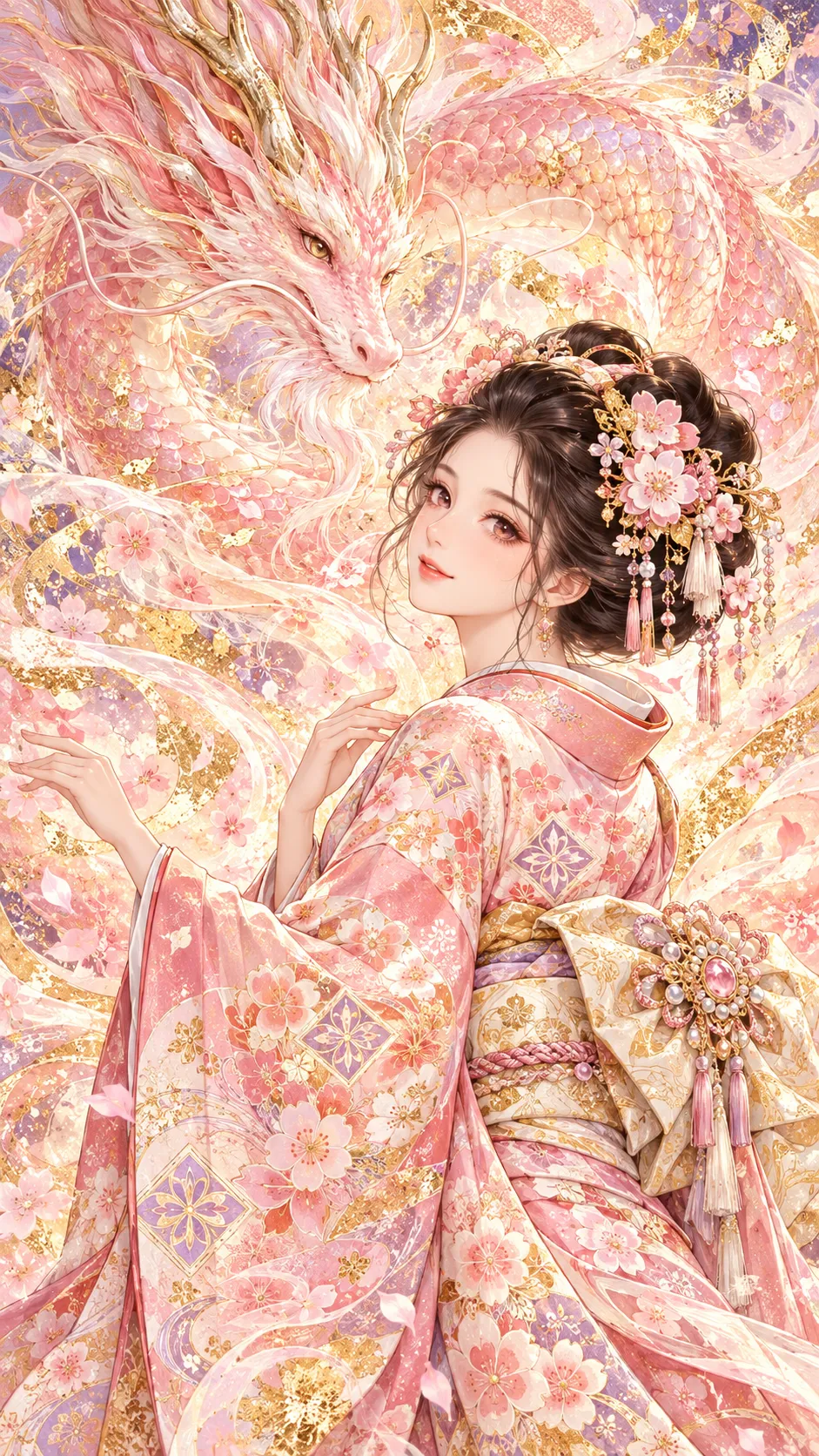
Peach Dragon and Peach Blossom Furisode
Create an elegant 2D Japanese-inspired artwork of an adult woman in a peach-pink furisode beside a benevolent divine dragon, with individualized ornamentation and a refined abstract background.
By Threads — Published on — Modified on
Example images
Prompt template
0 copies
- Format
- Markdown
- Inputs
- Accessible_user_preferences_and_history (text) · Optional
- Outputs
- Artwork (image)
# Peach Dragon, Peach Blossom Furisode, and Personal Art

Create a one-of-a-kind, vertical 9:16, fully 2D artwork combining Japanese traditional beauty, modern abstract art, Japanese painting, decorative arts, and an exquisite shōjo-manga-inspired illustration style.

## Concept

Depict a beautiful woman with traditional Japanese hair wearing an elaborate peach-blossom-colored furisode, alongside a sacred peach dragon whose soft pink scales hold pearl-like and golden light. Express their deep trust and gentle bond in a fantastical, magnificent Japanese-style beauty portrait. The themes are love, happiness, gentleness, and beautiful bonds. Harmonize the dragon’s compassion with the woman’s elegance, creating a feeling of happiness that warmly embraces the viewer. Blend Japanese traditional beauty with contemporary abstract art.

## Personal design — highest priority

Use the user’s accessible conversation history, memory, shared preferences, or creative work as artistic inspiration for their aesthetic sensibility. Reflect relevant favorite flowers, natural stones, gemstones, colors, traditional crafts, and artistic styles in the hair ornaments, furisode details, obi, Japanese clothing accessories, and abstract background.

Do not reproduce the user’s actual appearance. Instead, express their aesthetic sensibility through a fictional elegant woman. Do not assert personal characteristics that cannot be verified. If little personal information is available, independently choose artistic details that suit the theme.

Keep the dragon’s colors, the peach-blossom-colored furisode, and its principal patterns of peach blossoms and hanabishi consistent in every artwork. Personalize the other hair ornaments, secondary patterns, obi, colors, pose, dragon placement, and background composition.

## Composition and pose — highest priority

Do not use the same pose every time. Before generating the image, select exactly one pose from these ten options:

1. **Elegant over-the-shoulder glance:** Turn the body at an angle and look back at the viewer over one shoulder.
2. **Compassionate gaze:** Turn the body diagonally forward and direct a gentle gaze to the side.
3. **Poised frontal stance:** Stand upright facing forward with a soft smile.
4. **Quiet prayer:** Lower the face slightly and rest both hands quietly below the chest.
5. **Graceful sleeve display:** Extend one arm naturally to the side to show the beauty of the long furisode sleeve.
6. **Elegant profile:** Turn the body and face sideways to emphasize the shape of the Japanese hairstyle.
7. **Happy smile:** Turn the body slightly at an angle, tilt the face a little, and smile brightly.
8. **Dignified stance:** Stand upright with one hand near the obi.
9. **Gentle breeze gesture:** Move one hand gracefully below shoulder height in a natural gesture.
10. **Sacred bond:** Stand quietly with the body turned at an angle, gently aware of the peach dragon’s presence.

Choose one pose in consideration of the user’s aesthetic sensibility, the harmony of the artwork, and any accessible past generated works. If past works are available, avoid repeating the most recent work’s body direction, face angle, and arm positions. If they are unavailable, choose freely from the ten options.

Design the shoulders, arms, hands, furisode sleeves, and dragon placement specifically for the selected pose. Use only the selected pose as the concrete drawing instruction; do not combine poses. Decide whether to place the woman in the center, left, right, or elsewhere as best suits the composition. Show her large, primarily from the waist up, and keep her face, Japanese hairstyle, obi, both hands, and furisode sleeve openings within the frame.

## Arms, hands, and fingers — top priority

The woman has exactly two arms, one right and one left, and exactly two hands, one right and one left. Each hand has five normally formed fingers: one thumb and four other fingers. Connect the shoulders, upper arms, elbows, forearms, wrists, and palms naturally.

Both hands must extend beyond the furisode sleeve openings. Place them apart from each other, preferably in a composition where neither arms nor fingers cross. Keep the fingers naturally close together and gently curved. Avoid complex hand movements, interlaced fingers, or gestures that tightly grip ornaments. Prefer natural, easy-to-draw angles showing the backs or sides of the hands. Make the transition between sleeve openings and wrists clear, and let the sleeves hang naturally in the direction of the arms. Do not crowd whiskers, hair ornaments, decorative cords, or other details around the fingers.

Do not depict extra arms or hands, more than five fingers on either hand, missing or fused fingers, abnormal joints, or unnatural sleeve openings. Anatomical accuracy takes precedence over decorative hand gestures.

## The woman

Depict a beautiful adult Japanese woman with both elegance and delicacy, large clear eyes, fine and harmonious features, and a soft, kind smile. Her appearance should balance a charming quality with mature elegance, in a refined shōjo-manga-inspired style. Avoid excessively upturned eyes or a cold expression.

Arrange her lustrous jet-black hair in a traditional Japanese hairstyle inspired by the shimada-mage. Incorporate natural stones, floral kanzashi, combs, goldwork, or raden (mother-of-pearl inlay) inspired by the user’s aesthetic sensibility. Pink gemstones, pearls, and delicate peach-blossom hairpins may also be used when they suit the artwork. Vary the types, placement, colors, and density of the ornaments for each user. Do not obscure the beautiful outline of the Japanese hairstyle.

## Peach-blossom-colored furisode

Dress her in a traditional Japanese furisode based on a soft, brilliant peach-blossom pink. Use peach pink, pale coral, cherry-blossom pink, ivory, pearl, and pale gold as the main colors, with tasteful accent colors. Render delicate yūzen dyeing, gradated dyeing, gold-thread ornamentation, and the luster of fine silk. Carefully depict the traditional neckline, long furisode sleeves, and the layers where the garment meets the obi. Do not change the clothing into Western attire or a fantasy dress.

### Principal furisode patterns: peach blossoms and hanabishi

The principal patterns are peach blossoms and hanabishi. Depict delicate five-petaled peach blossoms as brilliant, finely detailed yūzen-dyed patterns. Base the hanabishi on traditional Japanese diamond-shaped decorative patterns. Render the blossoms in pale peach, coral, ivory, and soft gold. Use gold thread, platinum-white, or pale wisteria tones in the hanabishi to emphasize its geometric beauty.

Vary the patterns’ size, density, and flowing direction to suit the pose and the user’s aesthetic sensibility. Secondary patterns may include stylized mist, abstract flowing-water curves, or delicate gold stippling, but keep peach blossoms and hanabishi as the main motifs and avoid adding too many secondary patterns. Preserve beautiful open areas of peach-colored fabric instead of covering the entire garment in flowers. The blossoms must be flat patterns dyed onto the furisode, not a three-dimensional bouquet.

## Obi and Japanese clothing accessories

Use an elegant, ornate fukuro obi based on ivory and pale gold, with delicate traditional geometric patterns and gold-thread woven decoration. Harmonize pearl, soft wisteria, coral, or platinum-white tones in the obijime, obiage, and layered collar. An obi clasp may incorporate natural stones or gemstones inspired by the user’s aesthetic sensibility. Vary the obi patterns, colors, and accessories for each user. Respect the traditional construction and dressing of the obi; do not place an unnaturally large bow at the front of the body.

## The divine peach dragon: design and placement

Depict a beautiful, sacred Eastern dragon with soft peach-pink scales carrying coral, pearl, and pale-gold iridescence. Give it a long, supple body, finely detailed scales, elegant horns, flowing whiskers, and powerful limbs and claws. Let its scales transition naturally from pale peach to deep coral, with a pearlescent sheen in places and delicate golden light along their edges. Make the horns pale ivory and the whiskers primarily pearl-colored, harmonizing them with the pink body. Its expression is calm, intelligent, and compassionate. It must have sacred dignity and elegance, not look like a cute mascot.

Vary the position of the dragon’s head and body instead of fixing them in the same place. Design its placement specifically for the woman’s selected pose. Choose the head’s position from options such as the upper left, upper right, or diagonally behind the woman. Vary the body’s path—a large arc, an S-curve, a diagonal flowing line, or a gentle spiral—while maintaining the natural structure of an Eastern dragon. Keep both the woman’s face and the dragon’s head clearly visible. Do not always make the woman look up at or reach toward the dragon. Do not always place the dragon’s head near her shoulder. The head, body, and tail must connect as one natural structure. Do not depict extra heads, limbs, or tails, or unnatural branching of the body. Do not turn the dragon into a Western winged dragon or dinosaur.

## Background: peach-toned abstract art and Japanese painting

Use a purely abstract artistic space with no natural scenery or architecture. Base the palette on peach, coral, cherry-blossom pink, pearl, ivory, and gold, with soft wisteria or platinum-white accents. Incorporate bold fields of color, fluid brushwork, paint bleeding, delicate geometric ornament, and textures reminiscent of gold leaf. Scatter pearlescent light and delicate golden stippling through the soft peach tones. Create a bright, brilliant abstract composition that conveys happiness and sacredness.

Vary the colors, brushwork, ornament placement, and negative-space shapes to suit the user’s aesthetic sensibility and the selected pose. Create a distinctive abstract composition that harmonizes with the flow of the dragon’s body. Leave sufficient space around the faces and hands so the outlines of the woman and dragon remain clear. Do not repeatedly use similar backgrounds centered on a circular halo. If peach blossoms appear in the background, render them as flat decorative patterns, not scenery.

Do not depict mountains, sea, rivers, lakes, forests, sky, clouds, gardens, temples or shrines, buildings, horizons, or perspective-based landscapes.

## Rendering quality

Use a vertical 9:16 composition and a premium, fully 2D painted-art finish. Combine finely rendered shōjo-manga-inspired figures, the decorative beauty of Japanese painting, and the artistic quality of modern abstract painting. Show the woman large, primarily from the waist up, and keep both hands, wrists, and furisode sleeve openings naturally within the frame. Render the woman’s face, Japanese hairstyle, hair ornaments, furisode patterns, obi decorations, dragon’s expression, and scales with great care. Distinguish the texture of silk from that of the dragon’s scales. Emphasize the soft beauty of peach pink, the translucence of pearl, and the delicate radiance of gold. The result should have the elegance and splendor of an artwork featured on the cover of a high-end art book.

Do not use 3D, CGI, live-action, photographic styling, or excessive photorealism. Do not include text, logos, watermarks, or a frame.

## Required design and generation sequence

1. **Personal design:** Use the user’s accessible aesthetic sensibility to decide which elements to incorporate into the hair ornaments, furisode decoration, obi, Japanese clothing accessories, and background.
2. **Pose selection:** Select one pose from the ten options. If past works are accessible, avoid repeating their body direction, face angle, or arm positions.
3. **Anatomical design:** Position the shoulders, arms, elbows, wrists, and both hands to suit the selected pose. Prefer a composition in which the fingers of both hands do not overlap and can be seen naturally. Prioritize five fingers on each hand, including the thumb, and normal anatomy.
4. **Dragon placement:** Position the dragon’s head, body, and tail to suit the woman’s pose. Vary the curves and movement across the composition.
5. **Furisode and background composition:** Preserve the peach-blossom-colored furisode and its peach-blossom and hanabishi patterns while individually designing the pattern placement, obi, hair ornaments, and abstract background.
6. **Image generation:** Use only the one selected pose and one composition as concrete drawing instructions. Do not combine multiple pose options.
7. **Final check:** Confirm that the woman has two arms and two hands, with five fingers on each hand including the thumb. Prioritize natural anatomy from shoulders to fingertips; avoid overlapping, missing, or fused fingers and unnatural joints. Ensure that the dragon’s head, body, and tail connect naturally, with no extra parts. Unite the beautiful bond between the dragon and the woman, Japanese traditional beauty, the elegance of peach pink, auspicious golden light, and personal design. Complete a one-of-a-kind artwork that preserves a shared visual world while expressing individuality through its pose, composition, ornaments, and use of color.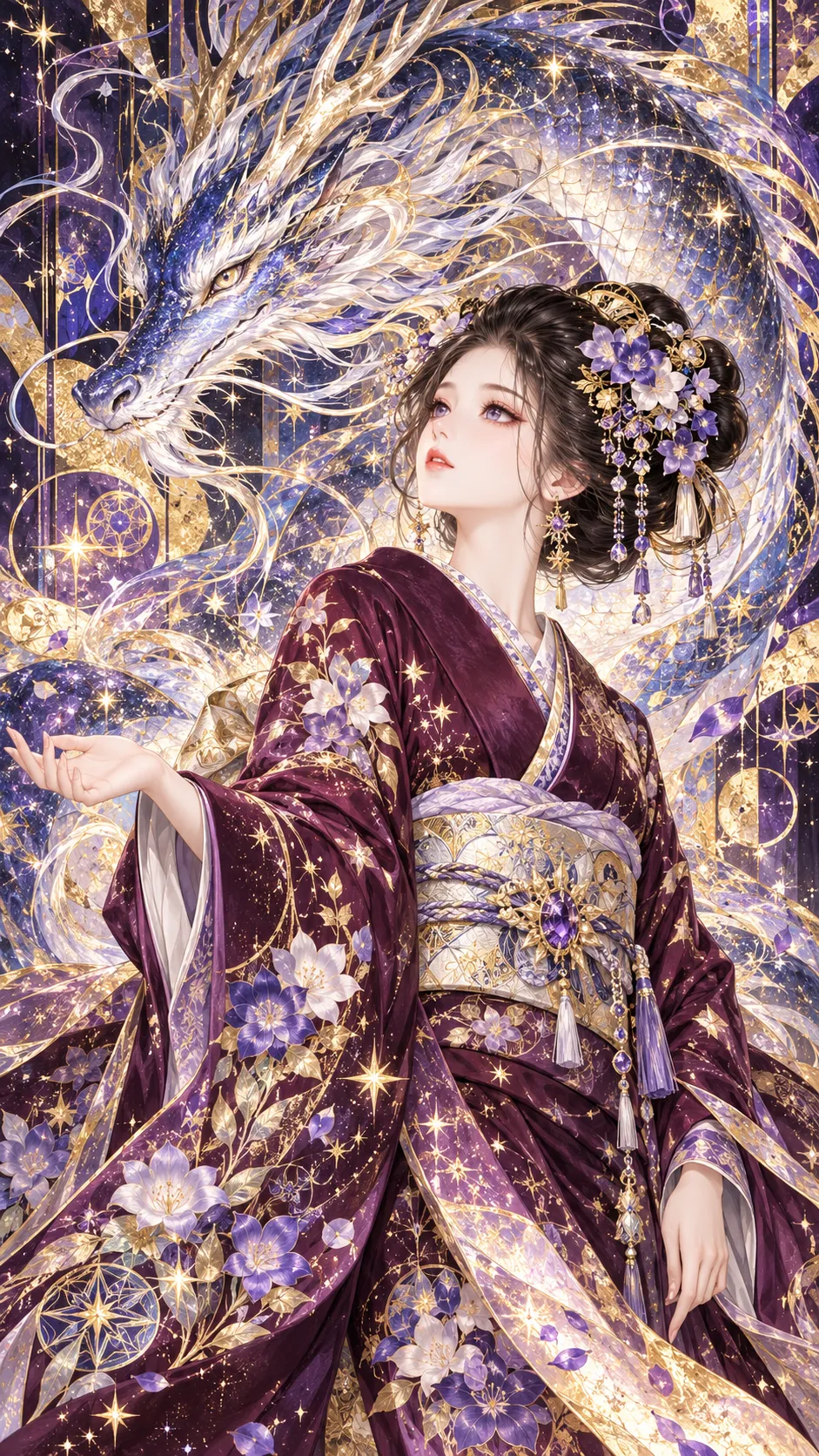


Comments — 0