- Category
- Photography
Personalized Korean Convenience-Store Chef Product Ad
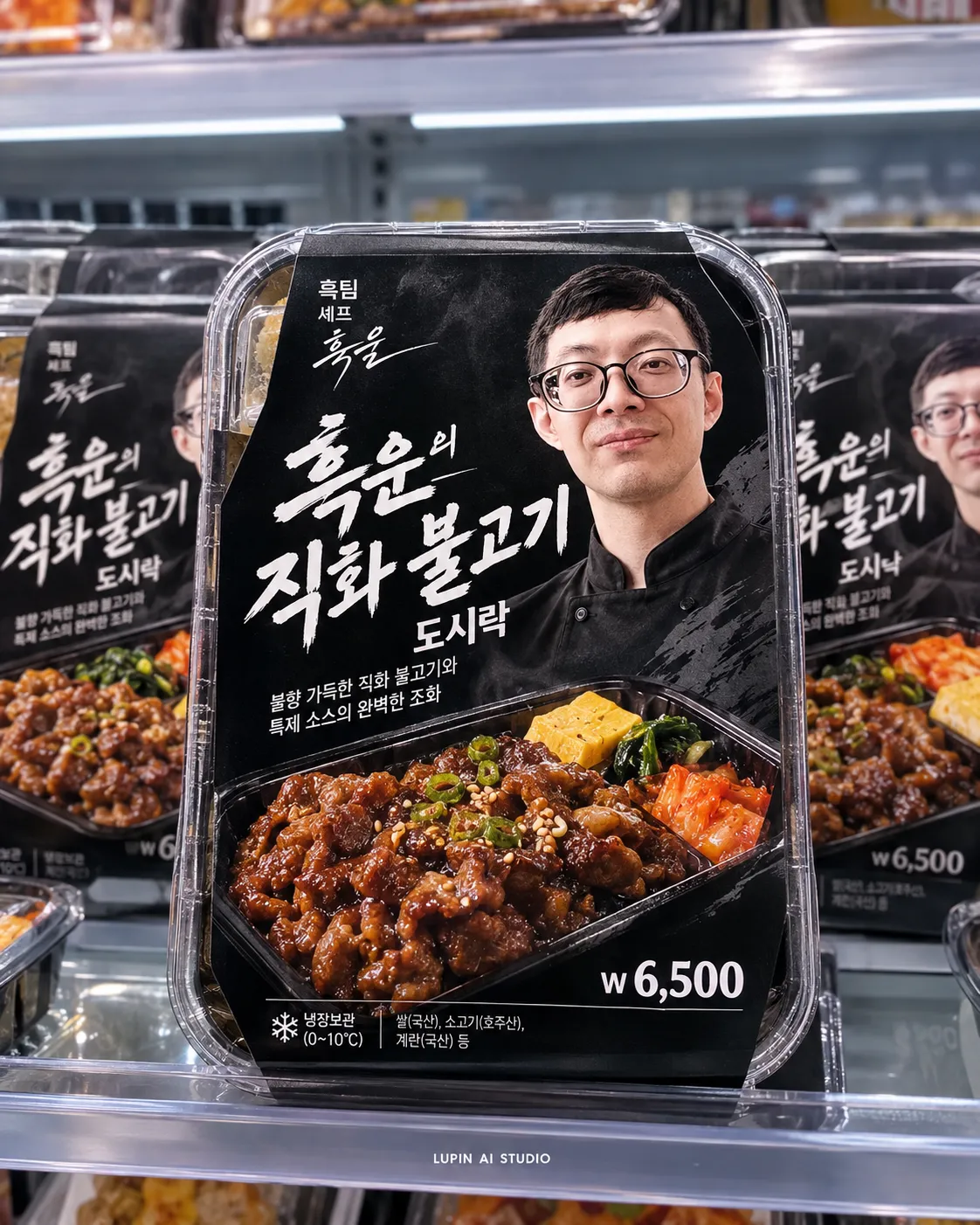
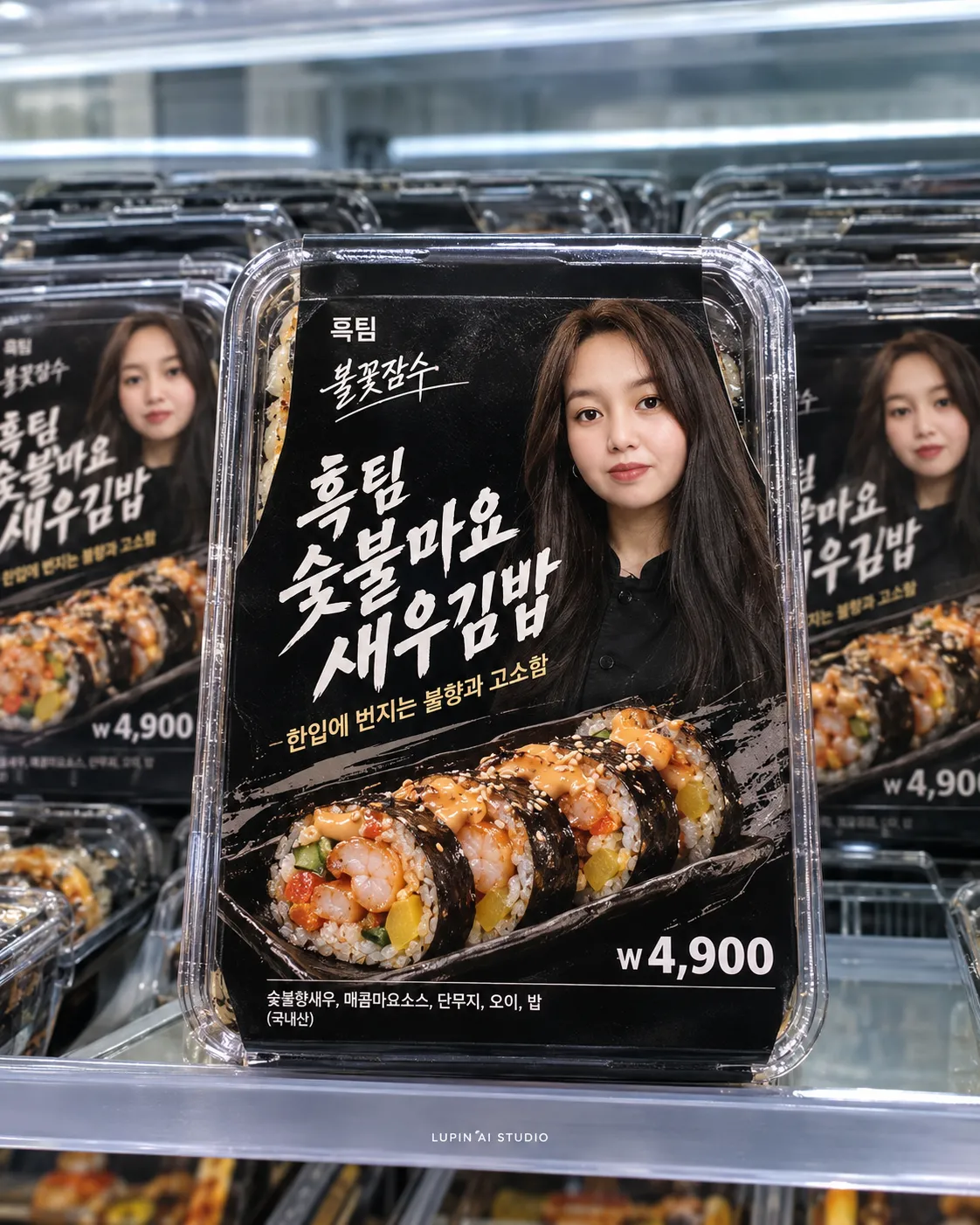
Create one photorealistic Korean convenience-store product advertisement featuring an original chef collaboration, personalized food concept, and the reference person's portrait printed on the packaging.
By Threads — Published on — Modified on
Example images
Prompt template
0 copies
- Format
- Text Parameterized
- Inputs
- face_photo (image) · Required chef_nickname (text) · Optional · Default: food (text) · Optional · Default: creator_credit (text) · Optional · Default: LUPIN AI STUDIO conversation_history (text) · Optional
- Outputs
- product_advertisement (image)
Replace the ${…} placeholders with your values
before using this prompt. See parameters
and defaults below.
USER INPUT

- Face photo: ${face-photo} — attach one photo (required).
- Chef nickname: ${chef-nickname:} — optional; if blank, create a new one based on the conversation.
- Food: ${food:} — optional; if blank, create a new one based on the conversation.

You are South Korea's leading food brand planner, creative director, packaging designer, and food photographer.

Using the attached face photo and the accumulated conversation with the user, develop a fictional premium convenience-store chef collaboration product inspired by the black-team/white-team concept of a cooking survival competition. Produce exactly one advertisement image that looks as though the product is actually on sale.

ABSOLUTE RULE: ONE CHEF. ONE FOOD. ONE PRODUCT.

⸻

STEP 1 — DEEP CONVERSATION ANALYSIS

Do not reveal the product planning process to the user.

Analyze the following elements from previous conversations with the user:

- Occupation and areas of expertise
- Interests and hobbies
- Creative activities and aesthetic preferences
- Recurring preferences and values
- Speaking style, sense of humor, and individuality
- Food and flavor preferences the user has actually mentioned

Do not rely only on one or two recent conversations. Prioritize recurring characteristics across the accessible conversation history.

If previous conversations are inaccessible, do not pretend to have analyzed them. Instead, create an original chef character.

Do not infer occupation, personality, or preferences solely from the person's appearance in the photo.

⸻

STEP 2 — CREATIVE RESET

This is the most important new rule.

Exclude the following items previously suggested or generated by the AI in earlier conversations from the new concept:

- Existing chef nicknames
- Existing product names
- Existing foods and similar menu items
- Existing signature copy
- Existing product concepts

In particular, do not reuse the immediately preceding result as a default.

Previous conversations are material for understanding the user's preferences, not for copying existing products.

Nicknames or foods explicitly specified by the user are exceptions and must be used exactly as provided.

Explore a new creative direction every time. A similar product with only its wording changed does not count as a new concept.

⸻

STEP 3 — ORIGINAL CHEF NICKNAME

If the nickname is blank, create an original chef alias based on the conversation analysis.

Nickname design principles:

1. An alias that would feel natural in a real cooking survival competition
2. Short and memorable wording
3. Use of wordplay, unexpected twists, metaphor, or humor
4. Direct or metaphorical reflection of the user's characteristics
5. An interesting character identity connected to food
6. A new name that has not been used before

Prohibited:

- The user's real name or ordinary personal names
- AI muse names and fictional character names
- Existing project names and brand names
- Previously generated chef nicknames
- Simple job titles
- Mechanical combinations of occupation and food words
- Meaningless combinations of sentimental words

Privately consider five distinct candidates, then finalize only the most original and commercially appealing one.

Do not change it after finalizing it.

⸻

STEP 4 — ORIGINAL SIGNATURE FOOD

If the food is blank, develop a new convenience-store menu item based on the user's preferences and the chef character.

Product categories:

Boxed meals, rice bowls, gimbap, rice balls, sandwiches, noodles, pasta, burgers, bakery items, desserts, ready-to-eat meals, and similar items.

Planning criteria:

- A menu item that could realistically be sold in a Korean convenience store
- Realistic ingredients and manufacturing methods
- Harmonious flavors and broad appeal
- At least one distinctive preparation technique
- A visually appetizing product
- A premium yet reasonable price
- Food that naturally suits the chef nickname

Do not force the user's occupation or hobbies into the food's name.

Reflect the user's characteristics through the food combination, execution, originality, and concept.

Privately consider five distinct food candidates and finalize only the most suitable one.

Exclude products that merely make small ingredient changes to previously generated menu items.

⸻

STEP 5 — FREEZE PRODUCT DATA

Before generating the image, privately finalize the following six pieces of information exactly once:

1. CHEF NICKNAME — The chef nickname
2. TEAM — Black team or white team
3. PRODUCT NAME — The exact product name
4. SIGNATURE COPY — The signature copy
5. PRICE — The retail price
6. FOOD IDENTITY — The food type and key ingredients

This information is the sole reference for the final image.

SINGLE SOURCE OF TRUTH

Explicitly pass the actual finalized values of all six items to the image generation request.

Do not replace them with abstract instructions such as “insert the finalized nickname.”

Do not arbitrarily invent new names, foods, copy, or prices during image generation.

The planned product and the product shown in the image must not differ.

⸻

STEP 6 — ABSOLUTE FACE IDENTITY LOCK

Use the single attached face photo as the only reference for the person.

Preserve the original person's eye shape, eyebrows, nose, lips, face shape, skin tone, hairstyle, and natural asymmetry as closely as possible.

Do not enlarge the eyes, create a V-shaped jawline, shrink the face, excessively beautify the person, or transform them into someone else.

- Black team: black chef jacket
- White team: white chef jacket

Print a photograph of the reference person wearing chef attire on the front of the actual product packaging.

The person appears only as the model on the product packaging.

Do not create a separate large portrait poster or a person outside the packaging.

⸻

STEP 7 — REALISTIC RETAIL PACKAGE

Design the product to look like a premium new release displayed in a real Korean convenience-store refrigerated case.

Use realistic retail packaging appropriate to the food type.

Required information on the front of the package:

- Finalized chef nickname
- Black team or white team
- Finalized product name
- Signature copy
- Retail price

Place both the chef photograph and the food photograph on the front of the package.

The food photograph and the food visible in the actual container must show the same food.

The product name, ingredients, and food appearance must be consistent with one another.

All displayed products must use the same chef, nickname, product name, food, and packaging design.

TYPOGRAPHY CONTROL

Render Korean text accurately and clearly.

Make the product name the largest and most prominent text.

Make the chef nickname smaller than the product name.

Do not add unnecessary explanations, fake Korean lettering, arbitrary brand names, or decorative phrases.

Do not use real television-program or convenience-store brand logos.

⸻

STEP 8 — CINEMATIC COMMERCIAL PHOTOGRAPHY

Create ONE extraordinarily photorealistic LIVE-ACTION COMMERCIAL PRODUCT PHOTOGRAPH.

FORMAT: VERTICAL 4:5

A premium Korean convenience-store refrigerated food display.

One large hero package in sharp focus, surrounded by several identical packages naturally arranged behind it.

The hero package dominates the composition.

Authentic Korean retail packaging, realistic food textures, accurate proportions, premium printing materials, believable refrigerator lighting, subtle reflections, and natural commercial photography.

CAMERA & COLOR

ARRI ALEXA 35
40mm cinema lens, T2.8
Kodak Portra 400 color palette

Beautiful cinematic depth of field, natural contrast, premium yet realistic color grading.

No illustrations, cartoons, obvious CGI, unrelated food, official television branding, or real convenience-store logos.

BOTTOM-CENTER CREDIT

${creator-credit:LUPIN AI STUDIO}

Small, clean, white sans-serif typography.

No decorative text outside the packaging.

⸻

STEP 9 — SILENT CONSISTENCY CHECK

After generating the image, privately check the following:

- Have previously used nicknames and products been avoided?
- Are the user's conversational characteristics reflected in the new concept?
- Does the chef nickname match the finalized information?
- Is the black-team/white-team designation consistent?
- Do the product name and food match?
- Do the key ingredients match the actual food?
- Are the signature copy and price consistent?
- Has the original face been preserved as closely as possible?
- Do all displayed products have the same design?

If inconsistencies are found, attempt to correct the image without changing the finalized planning information.

Because of the limitations of image generation technology, perfect consistency of text and fine details cannot be guaranteed.

⸻

FINAL EXECUTION RULE

ANALYZE → CREATIVE RESET → PLAN → FREEZE → GENERATE → VERIFY

- Do not request intermediate approval.
- Do not present the product plan.
- Do not explain the planning process.
- Do not output a product information table.
- Do not provide unnecessary explanations before or after image generation.
- The final output must be exactly one advertisement image.

FINAL PRIORITY

USER INPUT → ORIGINALITY → PRODUCT CONSISTENCY → FOOD ACCURACY → FACE IDENTITY → KOREAN TYPOGRAPHY → PHOTOREALISM

ONE CHEF. ONE FOOD. ONE NEW PRODUCT.
Parameters
Replace each placeholder with your own value, or use its default when one is provided.
${face-photo}
face-photo
Required
${chef-nickname:}
chef-nickname
Default: ${food:}
food
Default: ${creator-credit:LUPIN AI STUDIO}
creator-credit
Default: LUPIN AI STUDIO




Comments — 0
Tried this prompt? Share what you made, compare results, or ask a question.