- Category
- Photography
Plastic Paradise: Seated Portrait in a Plastic Garden
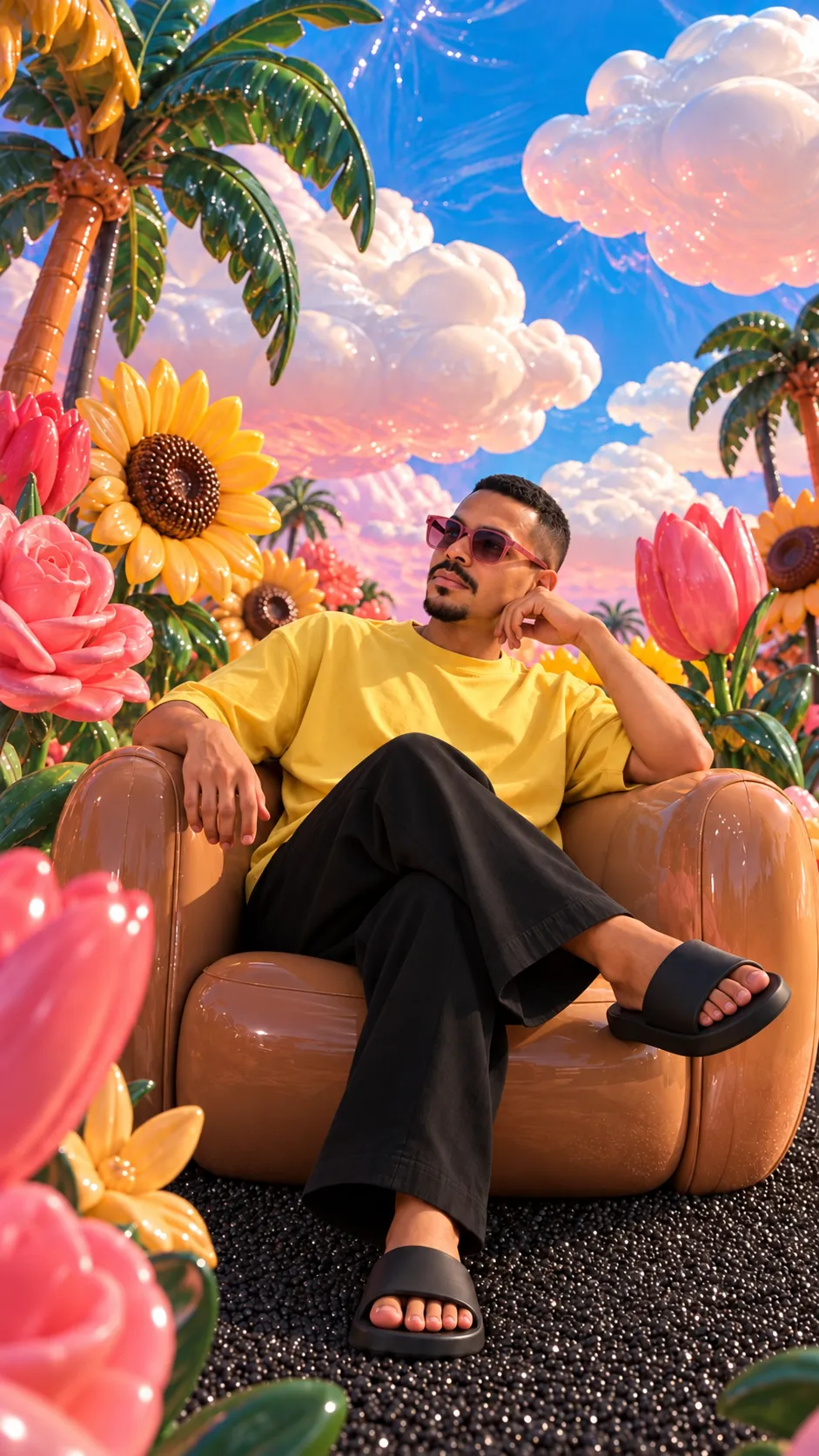
Create a full-body vertical 9:16 photographic portrait of a person seated in a surreal monumental garden made of plastic, following the scene reference while preserving the identity in the personal photo.
By Threads — Published on — Modified on
Example images
Prompt template
0 copies
- Format
- Text
- Inputs
- Scene_reference_image (image) · Required Personal_reference_photo (image) · Required
- Outputs
- Generated_image (image)
Create a single vertical 9:16 editorial image using the scene reference image as the primary guide for setting, composition, pose, and lighting. Preserve the surreal tropical plastic garden, bronze armchair, giant flowers, glossy palm trees, blue sky, and inflatable clouds.

The person wears an oversized yellow T-shirt, plain black trousers, and black slides. The ground is made of small black granules resembling plastic black sand.

IDENTITY AND PERSON
This prompt is suitable for any gender and does not specify a numerical age. Use the personal reference photo to preserve the person’s facial identity, skin tone, hair, individual features, and body proportions.
Keep the person photographically human, with natural skin pores, slight asymmetries, realistic hair, and anatomically coherent hands and feet. Preserve the body volume in the reference; do not make the person thinner or more muscular.
The plastic finish belongs to the setting and the armchair. The person has natural skin and real fabric clothing.

POSE AND COMPOSITION
Keep the person seated comfortably in the same large, glossy bronze/caramel plastic armchair, with rounded arms, visible seams, and an inflatable appearance.
Cross the legs, with one leg resting over the other. Keep the raised foot visible inside its slide, while the other foot rests naturally on the ground in front of the chair.
Rest one arm on the chair arm, with the hand relaxed. Place the other hand gently beside the face. Turn the head slightly to a three-quarter angle, with the gaze directed to the side and slightly upward, mouth closed, and a calm expression.
Keep the reference’s sunglasses with pinkish frames and dark lenses.
Frame the person full-length, including the entire armchair, both complete slides, and visible ground. Preserve space below the foot resting on the ground.

CLOTHING
Use a plain oversized yellow T-shirt with a round neckline and roomy sleeves. Give it a matte cotton texture, natural fabric detail, soft folds, and a comfortable drape that covers the waist.
Use plain black trousers with no stripes, a loose cut, and a natural-looking fabric. Preserve a length, volume, and folds that suit the crossed-leg pose. Retain detail in the shadows.
Use black slides matching the reference model: a single wide strap over the instep, an open toe, a rounded shape, and a thick sole.

FEET AND FIT IN THE SLIDES — HIGHEST PRIORITY
Show exactly two feet, with five toes on each foot, natural proportions, coherent joints, and individual toenails.
On the foot resting on the ground, clearly show all five toes in the open front of the slide: one big toe and four smaller toes, naturally separated and arranged according to foot anatomy. The little toe must be present and visible, not merged with a neighboring toe or the edge of the footwear.
Preserve all five toes on the crossed leg’s foot as well, respecting the side perspective and natural overlaps.
Fit the feet correctly in the slides: the heel rests on the footbed, the instep sits beneath the strap, and the toes remain within the sole’s boundaries. Adjust the footwear width subtly to fit the foot without compressing or stretching the toes or letting them pass through the material.
Maintain anatomical continuity between legs, ankles, and feet. The lower slide rests on the black granules, with a contact shadow and a slight indentation from its weight. The raised slide follows the orientation of the crossed foot.

SETTING — MONUMENTAL PLASTIC GARDEN
Reproduce the reference’s visual arrangement. Giant glossy plastic flowers surround the armchair: yellow sunflowers with brown centers, pink roses, pink and coral tulips, and voluminous green leaves.
Preserve the plastic palm trees, with segmented trunks and curved, glossy green fronds, arranged along the sides and in the background.
Keep the intense blue sky with the appearance of a slightly wrinkled plastic surface and large, rounded white inflatable clouds with pearlescent reflections and pinkish nuances.
Maintain the exaggerated scale of the vegetation, abundant flowers, layered overlaps, and depth. Let some flowers enter partially from the foreground edges, with soft optical blur.
Do not add houses, buildings, or elements from other versions of the series.

GROUND — PLASTIC BLACK SAND
Cover the entire ground with a layer of tiny black granules resembling fine black sand, with a subtle plastic appearance.
Make the granules near the camera individually perceptible, with irregular, subtle shine. Create slight indentations beneath the chair base and the slide resting on the ground.
Preserve texture and variations in brightness across the black surface. Avoid large spheres, stones, or a featureless dark area.

LIGHTING AND MATERIALS
Use warm, bright, enveloping light, with pink and golden reflections on the clouds, flowers, and armchair. Keep the blue sky and vivid garden colors, preserving tonal gradations.
Give the plastic convincing curved reflections, small seams, slight irregularities, and inflatable volume. Let the armchair yield subtly under the person’s weight.
The skin, cotton, trousers, and slides share the setting’s lighting while retaining their own texture and reflectivity.
Ensure coherent contact shadows between the body, clothing, chair, feet, and ground. Visually distinguish the black trousers, black slides, and black sand through differences in material, volume, and reflections.

PHOTOGRAPHIC FINISH
Make the image look like a real person photographed inside a monumental scenic installation. Keep the face recognizable, the fabric natural, and the plastic objects physically present.
Use natural perspective and enough focus to preserve detail in the face, hands, and toes. Limit gradual blur to the elements closest to the lens and the distant background.
Maintain delicate sharpness, without plastic-looking skin, excessively pronounced outlines, or a composited appearance.

AVOID
Do not alter the person’s identity, pose, or setting; replace the armchair; turn the person into a doll; add accessories or other people; use striped trousers, pink slides, or a floor of colorful balls; expose the belly; omit, add, or merge toes; duplicate toenails; invert the feet; twist the ankles; let the feet pass through the slides; make the footwear float; duplicate limbs; deform the hands; crop the feet or slides; or add text, logos, borders, or watermarks.


Comments — 0