- Category
- Photography
Sheltered by Light: Monumental Angel Wings and White Satin
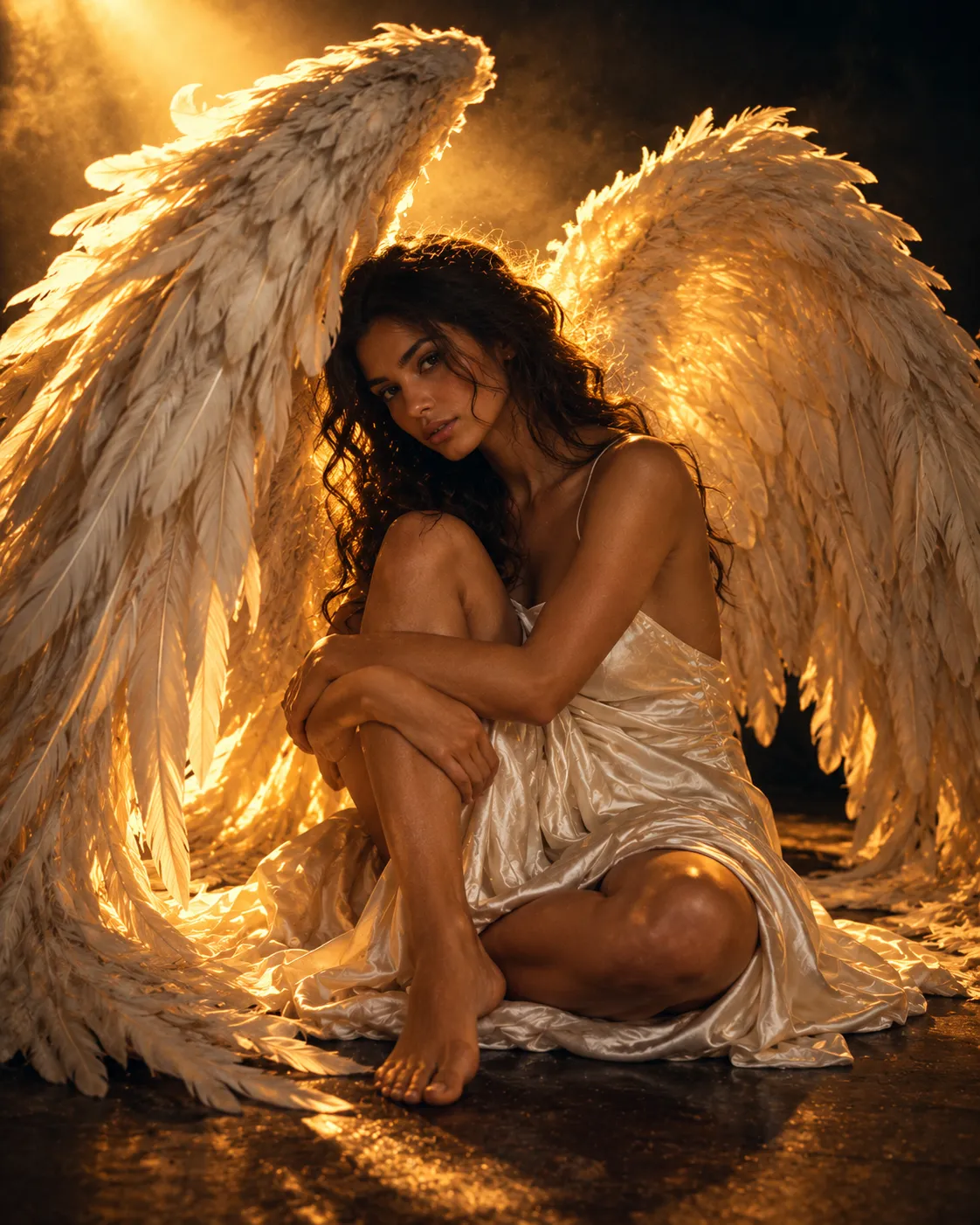
Create a vertical 4:5 photorealistic editorial portrait of an adult woman resting within monumental ice-white angel wings, lit by dramatic golden backlight in a dark studio.
By Threads — Published on — Modified on
Example images
Prompt template
- Format
- Markdown
- Inputs
- PersonalReferencePhoto (image) · Optional
- Outputs
- GeneratedEditorialPortrait (image)
Create a single, vertical 4:5, photorealistic female editorial photograph of an adult woman seated on the floor in a delicate pose inspired by a ballerina at rest. She wears a white satin dress and has two monumental, ice-colored angel wings that curve around her body.

Use a dark, minimalist setting with intense yellow-gold backlight and subtle mist that reveals a few light beams. The scene should convey introspection, protection, and presence, with physically convincing materials and lighting.

## Identity and expression
When a personal reference photograph is provided, faithfully preserve the subject’s identity, apparent age, face shape, eyes, nose, mouth, hair, skin tone, and body proportions.
Do not alter the subject’s appearance to reproduce a beauty standard. Preserve small asymmetries and natural skin texture.

Position her body sideways to the camera. She gently turns her face toward the lens and looks directly at it in a three-quarter view. Her expression is serene and contemplative, with her lips naturally closed.
Her face must remain recognizable even when partly in shadow.

## Pose — ballerina at rest
The woman sits on one hip, with her body weight resting naturally on the floor.
One leg is folded in front of her torso, its knee raised close to her chest. Both arms wrap around that leg, with her hands resting gently on the shin below the knee.
The other leg remains folded on the floor, curving around the outside of the raised leg. Its knee points slightly to the side, and its foot rests near the opposite hip in a comfortable, anatomically possible position.
Keep the two legs clearly separated, without impossible entanglement or fused limbs. Her feet are bare and relaxed, with a gentle extension at the ankles; do not force a pointed-toe position.
Her spine curves gently toward the knee she is holding, her shoulders are low, and her neck is relaxed. The posture conveys rest and intimacy.

## Dress — white satin
She wears a long white satin dress with delicate straps and a flowing drape. It covers her bust and follows the seated pose naturally.
The fabric forms folds over her abdomen, around the raised knee, and on the floor. The hem rests alongside the grounded leg, allowing the pose to remain legible and the feet to be discreetly visible.
Give the satin a soft, directional sheen, subtle differences between taut and loose areas, discreet seams, and realistic weight.
Preserve the fabric’s white color in areas shielded from the light. Areas struck by the backlight should receive yellow-gold reflections without turning the entire dress gold.
Add no jewelry or other accessories.

## Wings — monumental scale and embracing shape
There must be exactly two large wings, with a coherent origin at the upper back. Their bases are partly hidden by the body and layers of feathers.
Each wing rises above the head and opens out to the side before curving forward. Together, they form a broad shelter around the woman, enclosing her silhouette without hiding her face, arms, or the knee she is holding.
The wing closest to the camera follows one side of her body and descends almost to the floor. The other opens behind her, with enough of its structure visible to make the presence of both wings clear.
The wings occupy most of the composition. Leave enough margin to show their main curves and tips without abrupt cropping.
The feathers are ice-white, with natural variations among white, pearl gray, and subtly cool neutral shadows. Use small, dense feathers near the bases and long, overlapping feathers at the tips.
Show feather shafts, delicate barbs, slight irregularities, and variations in orientation. Avoid mechanical repetition, a plastic appearance, or a uniform texture.
The wings should have plausible volume, weight, and structure within the fantasy premise, as physical elements occupying the same space as the model.

## Setting and composition
Use a dark studio with a matte charcoal floor and a deep black background. The floor should appear only where it catches the light, with contact shadows beneath the body, dress, and wing tips.
Frame the entire woman and the main span of the wings. Place the camera near the seated subject’s face height, slightly forward of her profile.
Use a gently asymmetrical composition. The face and arms are the center of attention, framed by the curves of the wings.
Do not add clouds, staircases, columns, a halo, symbols, other people, or decorative elements.

## Lighting — yellow-gold backlight
Position the main light source above and behind the woman, offset to one side.
Let the light pass through gaps between the wings and reach the feather edges, hair, part of her shoulder, and some folds of the satin. Fine feathers may show delicate translucency.
Create intense yellow-gold and aged-gold reflections, with subtle mustard nuances in illuminated areas. Preserve the ice color of wing areas that do not receive direct light.
Keep the front of the body relatively dark. Light the face from the side and with subtle reflected light from the feathers and dress, enough to reveal the eye turned toward the camera, the shape of the nose, and the mouth.
Do not add uniform frontal fill light. Do not create a continuous rim of light around the entire subject.

## Atmosphere and beams
Use fine, irregular mist behind and between the wings, enough to make some paths of light visible.
Let the feathers and body interrupt the beams, creating an alternation of bright and dark areas. Preserve black spaces and transparent gaps between them.
Do not obscure the face or fill the entire studio with smoke. Avoid perfectly parallel rays, lasers, or graphic lines.

## Exposure and color
Keep the image predominantly dark, with brightness concentrated on the feathers, satin, and parts of the face.
Use strong contrast between the backlight and background, with soft transitions within illuminated areas. Preserve texture in the light feathers and fabric, avoiding large blown-out white regions.
Use charcoal and very dark brown shadows, with subtle olive nuances from ambient light. The skin should have natural tonal variation under the golden lighting.
Do not apply a uniform yellow filter, sepia, or an orange color cast across the entire photograph.

## Focus, optics, and texture
Use a natural perspective equivalent to a 35–50 mm lens, with enough distance to accommodate the wings without distorting the face or limbs.
Focus primarily on the face, with enough depth of field to make the arms, knee, and nearby feathers legible. Adjust the aperture as needed; prioritize a readable pose over excessive blur.
Use the appearance of ISO 800–1600 and an exposure near 1/60–1/125 s as aesthetic references for low light, without imposing motion blur on the still subject.
Use perceptible optical softness, moderate microcontrast, and fine, subtly irregular texture. Preserve skin, hair, satin, and feather detail in illuminated regions.
Apply slight light diffusion to the brightest highlights while keeping the rest of the image naturally defined.

## Final result
Show a figure folded inward within her own wings, silently looking at the camera. The white satin follows her pose, the ice-colored feathers catch golden edges, and the darkness preserves the intimacy of the scene.
The wings are the fantasy; the body, materials, shadows, and light should convey the presence of a real photograph.

## Avoid
Altered identity, a generic face, small wings, extra wings, mechanically repeated feathers, entirely yellow wings, an obscured face, a twisted neck, impossibly entangled legs, duplicated limbs, fused hands, deformed feet, stiff fabric, plastic skin, intimate exposure, a halo, artificial clouds, opaque smoke, graphic light beams, uniform glow, HDR, aggressive sharpening, CGI, painting, collage, text, borders, and watermarks.




Comments — 0