- Category
- Art & Illustration
Sweet Dolly in a Fluffy Capybara Kigurumi
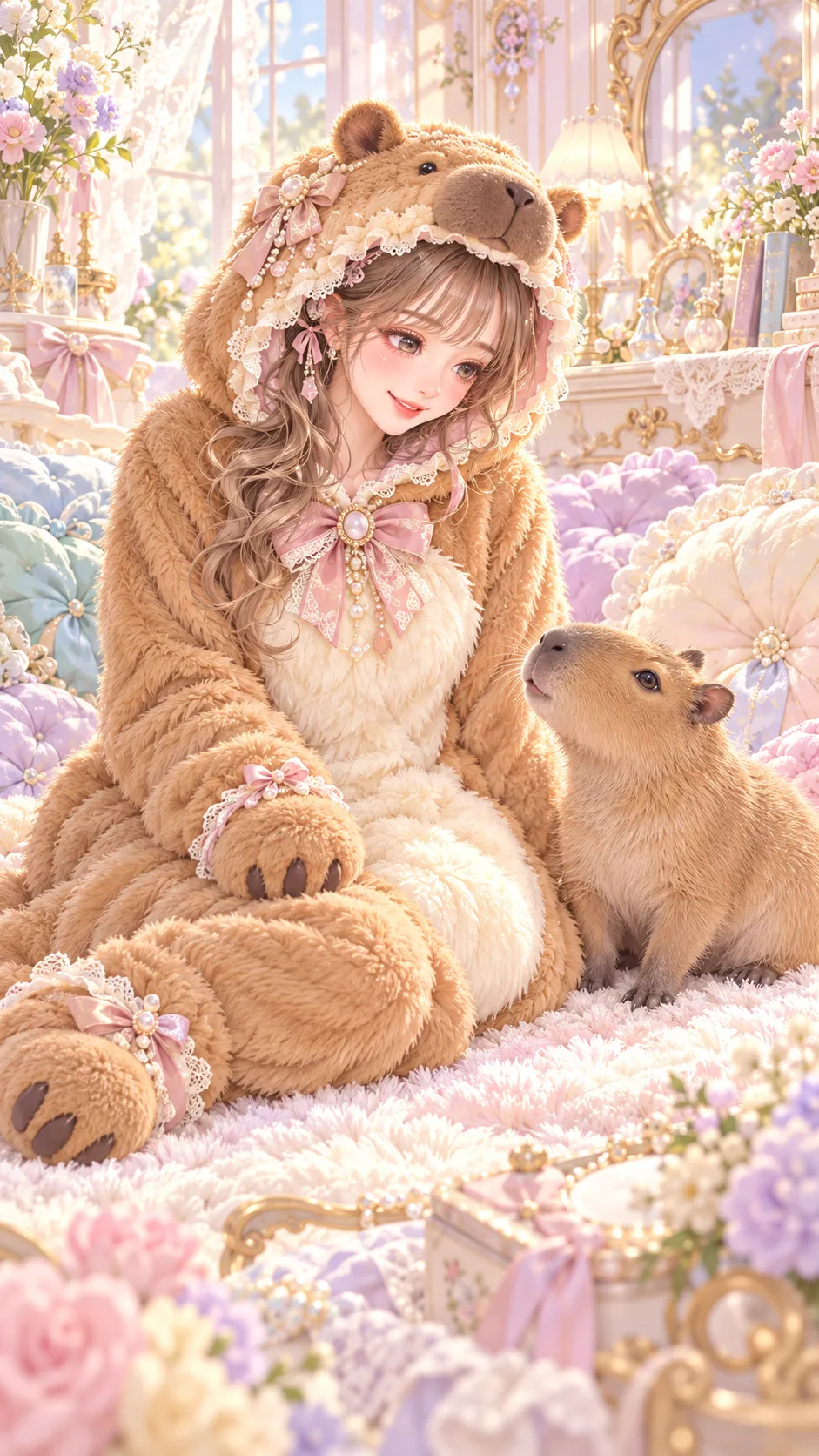
Create an elegant 2D shoujo-style illustration of an adult woman in a plush, hooded capybara onesie, sitting beside a real baby capybara in a bright pastel room. Emphasize their gentle eye contact, luxurious fur textures, and anatomically natural poses.
By Threads — Published on — Modified on
Example images
Prompt template
0 copies
- Format
- Text
- Outputs
- Capybara_kigurumi_illustration (image)
Create a vertical 9:16, premium-quality, fully 2D hand-drawn illustration in a beautiful shoujo-manga style, with graceful Art Nouveau ornamentation. Depict a beautiful adult woman—a sweet, approachable heroine with a refined, doll-like face—wearing a luxurious, full-body capybara kigurumi. She sits naturally with her legs folded to one side on a fluffy rug in a bright, whimsical room, beside a real baby capybara. The woman turns her face toward the animal and smiles gently; the baby capybara looks up at her with a calm, curious expression. Let the two meet each other's gaze and convey a warm, peaceful moment.

COMPOSITION AND POSE
Use a vertical 9:16 composition. Place the woman large in the frame, slightly left of center, with the baby capybara beside her on the right. Her upper body faces mostly forward, turned slightly toward the animal. She sits on the rug with her hips stable on the floor, back naturally upright, and shoulders relaxed. Bend both knees naturally and let both legs flow gently to her right. Clearly distinguish the position of each thigh, knee, shin, ankle, and foot; keep the legs anatomically connected and do not twist them unnaturally. Her feet rest naturally on the rug, wearing rounded, plush capybara-paw slippers. Show the woman’s face, hood ears, both arms, both mittens, bent legs, and feet naturally and clearly.

Her right arm is one continuous, natural limb from shoulder through upper arm, elbow, forearm, sleeve, and mitten. Bend the elbow naturally and place the right mitten gently on her right knee. Her left arm is likewise one continuous limb from shoulder to mitten. Lower it naturally along her left side, bend the elbow slightly, and rest the left mitten lightly on the rug beside her left hip. Keep the outlines of both arms and sleeves clear; do not cross the arms, hide the left arm behind the capybara, or let either sleeve merge with the torso. Each arm ends in exactly one mitten, and each mitten connects to its own sleeve. Do not add extra arms, forearms, hands, fingers, sleeves that resemble a third arm, or mittens detached from the body.

The woman’s two legs must remain distinct and naturally connected. Show anatomically consistent knees, shins, ankles, and feet, with the knees and toes pointing in coherent directions. The plush fabric should form natural folds and volume around the hips and knees without stretching unnaturally or merging with the legs. Her feet wear one rounded, puffy capybara-foot slipper each, made from brown-toned plush matching the onesie, with small, soft dark-brown claw-like details at the toes and delicate lace and a small ribbon at each ankle. Keep the legs naturally proportioned and do not add extra legs or fuse the two legs together.

THE WOMAN’S FACE AND HAIR
Give her a refined, sweet doll-like face reminiscent of a shoujo-manga heroine: large, clear, jewel-like eyes with translucent highlights; softly rounded, full cheeks; a small, naturally rounded chin that is not sharply pointed; an elegant nose; a charming mouth; and a bright, gentle smile. Balance adult beauty with an endearing, approachable expression. Keep her face naturally human, with soft contours, clear eyes, and a natural blush. Do not transform her own ears or nose into animal features. Her hair should show naturally around the hood. Choose a hairstyle such as a short cut, short or medium bob, semi-long hair, long straight hair, soft waves, or curls. Choose a natural hair color such as natural black, dark brown, ash brown, honey brown, or milk-tea beige. Short and long styles are equally suitable; let the visible hair give the illustration its own character.

THE FULL-BODY CAPYBARA KIGURUMI
Design a roomy, one-piece, hooded kigurumi inspired by an adorable baby capybara. It covers the woman from neck to feet, with the shoulders, torso, hips, and two legs connected naturally. Make the overall silhouette soft, warm, rounded, and marshmallow-like, with no exposed skin. Use a richly layered combination of ultra-dense long pile, premium microfur, and soft sherpa fleece. Show numerous delicate, fine fibers layered with airy volume, varied natural pile lengths, and a three-dimensional surface—not flat, uniform fabric. Give the hood, ears, chest, cuffs, and feet especially dense plush.

Choose a natural capybara-inspired coat color that harmonizes within the illustration: caramel brown, honey brown, milk-tea beige, warm brown, sand beige, toffee brown, cream beige, ivory, or another natural fur color. Use one coherent color choice for each image. Give the chest and belly abundant cream-white or pale milk-tea beige fleece, coordinating its overall feel with the real baby capybara. Add one tasteful ribbon at the chest, with delicate lace and small pearls at the cuffs and hood edge. Do not add an extra tail: capybaras have no conspicuous long tail, so the kigurumi should not have a large tail. Keep decorations charming and elegant without overwhelming the gentle capybara design.

CAPYBARA HOOD: EARS AND MUZZLE
The rounded, plush hood softly frames the woman’s human face. Attach exactly one pair of small, round capybara ears on the upper sides of the hood, slightly outward from the crown. The ears should be thick, softly rounded, and small—not long rabbit ears, triangular cat or fox ears, or large bear-like round ears. Connect them naturally to the hood. Use dense caramel- or honey-brown pile on the outside, slightly deeper warm brown or soft peach-brown inside, and fine fibers along the edges. Include exactly two ears and no extras.

On the upper forehead area of the hood, above the woman’s own forehead, add a soft, fabric capybara muzzle decoration. Make it broad and plump, gently rounded but slightly squared rather than perfectly spherical, in warm brown or toffee brown, with a small dark-brown nose at its tip. Keep it above the woman’s face; it must not cover or overlap her own nose, mouth, or the center of her face. Do not make it extremely long, pig-like with round nostrils, dog-like and pointed, or an oversized bear-like muzzle. It should suggest a capybara’s broad, gentle muzzle. The ears, muzzle, and plush face framing should read as integrated parts of one garment, not as separate floating decorations.

Frame the hood opening with abundant cream-beige long pile, with delicate lace inside the edge, small pearls, and an understated elegant ribbon. Let the woman’s bangs and face-framing hair show naturally through the opening. Keep the hood’s capybara features attached to the fabric and do not let the decorative muzzle obscure her human features.

THE MITTENS
Cover both hands with exactly two rounded, puffy mittens inspired by capybara forepaws: one right mitten and one left mitten. Use dense caramel-brown or milk-tea beige pile, with soft brown fabric details suggesting small capybara claws at the tips. Keep the details cute and suitable for cozy loungewear. The woman’s fingers stay inside the mittens; do not show extra fingers emerging from them. Each mitten must connect to the end of its own sleeve, and neither should appear detached from the woman or merge into the body or background.

THE REAL BABY CAPYBARA
Show exactly one real, lively baby capybara beside the woman on the fluffy rug. It is an actual animal, not a plush toy. Give it a small, endearing face; gentle, clear eyes; small rounded ears; a plump, broad, slightly squared muzzle; a short, soft mouth; a naturally proportioned neck; a rounded body; and natural caramel- or warm-brown fur. Preserve a believable baby-cap ybara face and body shape: do not make its head disproportionately large or its body a spherical stuffed toy. Distinguish its natural fur from the kigurumi’s manufactured, dense plush pile.

The capybara has exactly one head, two ears, two eyes, one neck, one body, two forelegs, and two hind legs—four legs in total. Preserve the animal’s natural skeleton and proportions, with soft baby-like roundness and short, sturdy legs. Do not bend its limbs unnaturally, add extra legs, give it a long tail, or allow its limbs to merge with the woman’s mittens or legs. Its expression is calm and affectionate, with a gentle mouth and curious gaze directed toward the woman. Do not give it an open-mouthed threatening expression or make it look frightening or aggressive.

Let the baby capybara relax naturally on the rug beside the woman. Its body rests securely on the floor; place its forelegs naturally in front of its body and tuck its hind legs naturally underneath or alongside it. Raise its head slightly to look up at the woman. Bend its joints in anatomically natural directions, not like a human’s. Do not force hidden limbs into view. Leave enough natural space between the woman and animal for their silhouettes to remain distinct, and make the capybara’s head, body, and naturally positioned limbs discernible. The woman does not pick it up, put an arm behind it, or place a mitten over its body.

ROOM AND COLOR PALETTE
Set the scene in a bright, cozy, dreamlike fancy room—not by a river or outdoors. Include a fluffy rug, soft cushions, delicate lace, ribbons, and pale flowers. Use gentle, warm natural light. Add restrained, elegant Art Nouveau curves and optional small stars or rounded decorative motifs in the background. Keep the background simple so the woman and baby capybara remain the focus; avoid dark lighting and excessive ornament. Use pale pastel cushions and decor that complement the kigurumi’s brown fur. Choose freely among pastel accents such as lavender, mint green, baby blue, milky pink, peach, butter yellow, pale lilac, champagne beige, ice blue, or sage green. Do not make the entire palette pink; vary and harmonize the pastel combinations.

ILLUSTRATION STYLE AND FINISH
Create a premium, entirely 2D illustration, not a photograph, photorealistic image, 3D CGI, or figurine. Use exquisite shoujo-manga rendering, graceful Art Nouveau ornamentation, soft outlines, luminous translucent eyes, delicate hair linework, and refined, vibrant color. Render the kigurumi’s dense long pile with extremely fine strokes and soft layered shading, especially on the hood, ears, chest, cuffs, and feet. Draw countless soft fibers and natural fur flow. Clearly distinguish the artificial high-density plush of the costume from the baby capybara’s natural coat.

FINAL ANATOMY AND QUALITY CHECK
Prioritize accurate human anatomy and animal anatomy. The woman has exactly two arms and two legs: one right arm connected continuously from right shoulder to right mitten, one left arm connected continuously from left shoulder to left mitten, and two naturally bent, distinct legs. Her right mitten rests on her right knee; her left mitten rests on the rug beside her left hip. Do not cross her arms, add an extra limb or detached mitten, or make fur or a sleeve look like a third arm. Keep the woman and capybara clearly separate; do not confuse or merge their legs or mittens. The capybara has exactly four natural legs, two ears, and no long tail. Avoid unnatural body structure, a dark or horror-like mood, photorealism, and 3D CGI.

Finish with an exceptionally charming, warm, fluffy fantasy: a sweet adult woman in a capybara kigurumi sits elegantly on a soft rug, sharing a gentle gaze with a relaxed real baby capybara in a bright pastel room.




Comments — 0