- Category
- Art & Illustration
Sweet Dolly in a Fluffy Raccoon Kigurumi
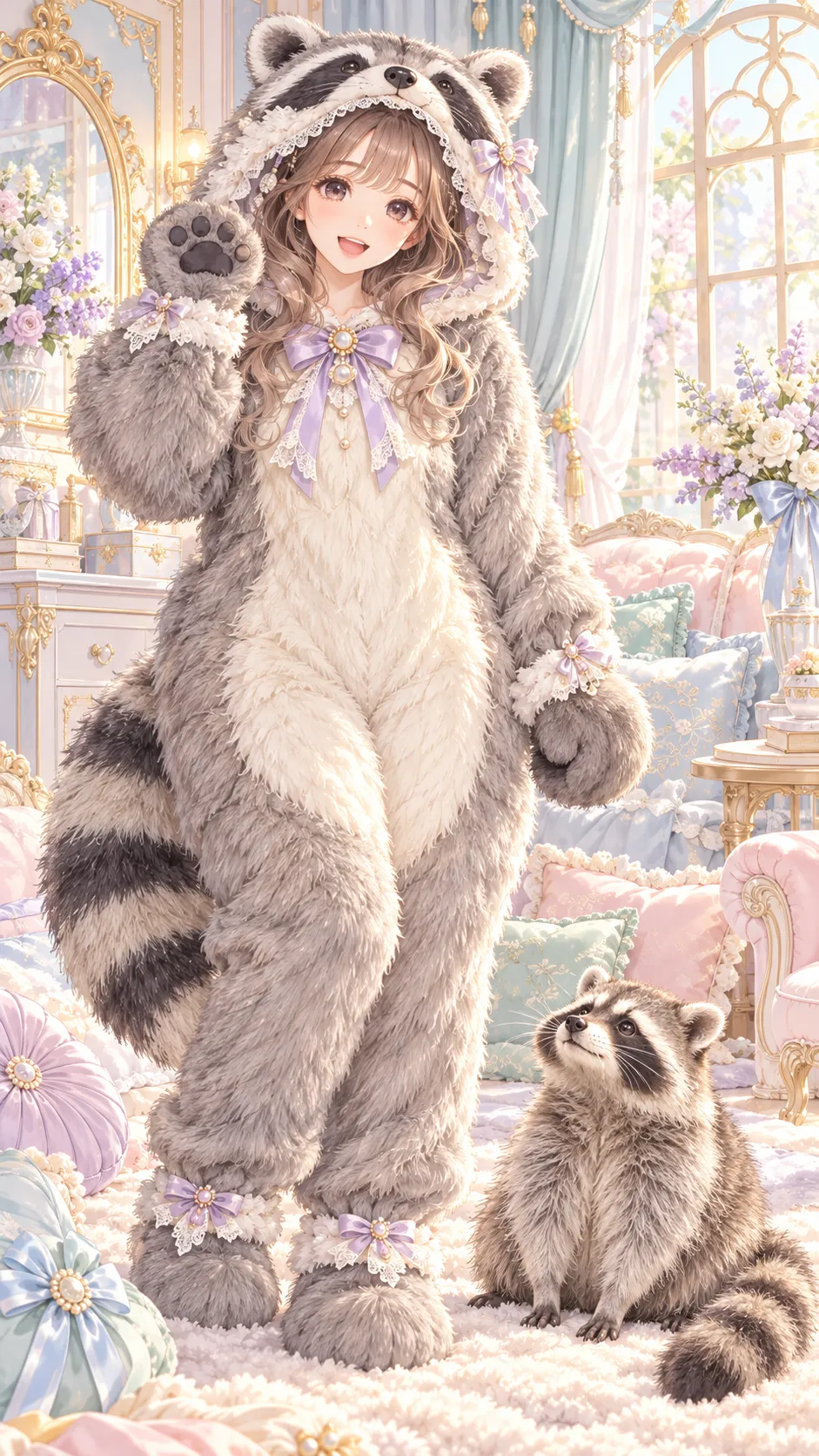
Create a polished 2D shoujo-style illustration of an adult woman in a detailed, fluffy raccoon onesie, greeting a real, curious raccoon in a bright pastel room.
By Threads — Published on — Modified on
Example images
Prompt template
0 copies
- Format
- Text
- Outputs
- Illustration (image)
Create a charming, high-quality 2D illustration in a refined shoujo-manga style with elegant Art Nouveau accents. Use a vertical 9:16 composition. The central subject is a beautiful adult woman with a sweet, approachable doll-like face, large clear jewel-like eyes, softly rounded cheeks, a small natural rounded chin, a graceful nose, and a bright, friendly smile. Give her a natural human face: the raccoon features belong to her hood, not her skin. Keep her eyes and nose unobscured and do not turn her face into an animal face. Show a natural flush in her cheeks and luminous highlights in her eyes.

Dress her in a loose, full-body, hooded raccoon kigurumi, made from exceptionally dense long-pile plush, fine microfiber fur, and soft sherpa-like fleece. Make the silhouette rounded and pillowy, with realistic volume and layered, fine tufts rather than flat gray fabric. Use a harmonious natural raccoon coat palette such as silver gray, warm gray, ash gray, greige, gray-brown, soft brown, cream white, or ivory. Choose a natural combination for each image; include soft cream or ivory shading and a plump cream-white chest and belly. Keep the outfit fully covering and cozy, with no exposed skin.

The hood must read clearly as a raccoon costume. Attach exactly two small, rounded, semicircular raccoon ears to the top of the hood, naturally joined to it. Give them gray plush outer surfaces, pale ivory, cream, or light greige interiors, softly thick bases, and fine fur at the edges. Do not make them long like rabbit ears, pointed like cat or fox ears, or oversized like bear ears. Frame the hood opening with abundant long-pile fur, cream-white cheek areas, delicate lace, and a few restrained pearls and elegant ribbons. Let the woman’s bangs and face-framing hair show naturally. Add a small fabric nose ornament above her forehead on the hood, where it does not overlap her own nose.

Make the raccoon’s characteristic dark eye-mask markings from charcoal-gray and black plush on the hood. Place the symmetrical markings around the hood’s face opening, extending naturally from the upper forehead toward the temples, with cream-white fur around them. The markings must not cover or obscure the woman’s eyes or eyebrows, and must not be painted on her skin. Ensure the hood’s ears, nose ornament, mask markings, fur, and trim form one coherent raccoon costume.

The one-piece garment should connect naturally from the shoulders through the torso and hips to both legs. Use cream-white soft fleece at the chest and a pale ivory belly panel. Add one tasteful ribbon at the chest, with fine lace and small pearls at the cuffs and hood edge. Attach exactly one thick, fluffy tail at the center of the rear waist. It should connect naturally at its base, hang behind her in the standing pose, and peek out slightly at one side rather than being forced into view from the front. Give it natural circular bands of charcoal gray and silver gray, rounded at the tip and covered in dense long-pile fur. Do not make it resemble an extra arm or leg, and do not give it a mitten, fingers, or another appendage.

Pose and anatomy are essential. Place the woman large in the frame, slightly left of center, standing naturally on a soft rug in a nearly front-facing pose. Her legs should be naturally spaced, not crossed, with one foot slightly forward and both feet grounded. Connect both legs naturally from the hips through the knees, lower legs, ankles, and feet. Give her rounded raccoon-paw slippers in matching gray plush, one on each foot, with delicate lace and small ribbons at the ankles.

Her right arm is the greeting arm: show exactly one right arm connected continuously from shoulder through upper arm, naturally bent elbow, forearm, sleeve, and one mitten. Raise the forearm beside her face, keeping the elbow slightly below shoulder height. Place the right mitten just outside her right cheek, separated from her face and hood, with its paw-pad side facing forward in a cute greeting gesture. Make the sleeve outline clear; do not stretch the arm unnaturally or add another forearm or mitten.

Her left arm must also be a single, clearly continuous arm from shoulder through upper arm, gently bent elbow, forearm, sleeve, and one mitten. Let it rest naturally at her left side, with the mitten beside her left hip or outer thigh. Do not bring it across the front of her body, behind her back, or across the right arm. Keep the left sleeve distinct from the torso. The two arms must not cross.

There must be exactly two mittens in total, one at the end of each sleeve. They are rounded plush front-paw mittens, with the human fingers contained inside. Put subtle pale-gray or charcoal paw-pad embroidery on the palm of the raised right mitten. The lowered left mitten may show its side or back. Make both mittens visibly connected to their own sleeves; do not create detached mittens, extra hands, or fingers emerging from them.

Place one real, lively, adorable small raccoon on the floor at the woman’s right foot. It should sit compactly, look up at her with gentle curiosity, and tilt its head slightly. Depict a believable living animal, not a stuffed toy and not a costume: a rounded body, natural gray and brown fur, small rounded ears, a black eye mask, cream-white cheeks, a small black nose, clear gentle eyes, short legs, natural dexterous front paws, and a fluffy tail with black and gray rings. Preserve a natural raccoon face, proportions, and coat texture, distinct from the artificial plush of the woman’s kigurumi. Give it a calm expression and closed or gently relaxed mouth; avoid aggression, a threatening open mouth, or emphasized sharp teeth. Its anatomy should have one head, two ears, two eyes, four legs in total, and one tail. Do not add limbs or ears, and do not make the tail look like a leg. It is fine for hind legs to be hidden naturally by its seated pose.

Keep the woman and raccoon’s silhouettes distinct, with enough space between them to read clearly. Do not place the woman’s arm behind the animal, lift or hold the raccoon, or put an extra mitten in front of it. Keep the woman’s face, hood ears, both arms, both mittens, both legs, and feet visible as naturally as the composition allows, while also showing the raccoon’s expressive face. Do not confuse their legs, tails, or mittens.

Use a bright, welcoming fancy room, not a forest or outdoor setting. Include a soft rug, plush cushions, delicate lace, ribbons, and pale flowers, with bright gentle natural light. Subtle Art Nouveau curves and small stars or rounded decorative motifs may appear in the background. Keep the room warm and comfortable, uncluttered, and subordinate to the woman and raccoon. Use pastel accents for ribbons, lace, pearls, cushions, and room decor; choose freely among lavender, mint green, baby blue, milky pink, peach, butter yellow, pale lilac, champagne beige, ice blue, and sage green. Do not make the entire image pink. The costume itself should retain natural raccoon colors.

Choose a hairstyle and natural hair color freely, including short hair, short or medium bob, semilong or long straight hair, soft waves, or curls; possible natural shades include black, dark brown, ash brown, honey brown, and milk-tea beige. Let the hair visible from the hood give the character a distinctive look.

Render as exquisite, fully 2D hand-drawn illustration, not a photograph, photorealistic image, 3D CGI, or figurine. Use delicate expressive linework, luminous eyes, finely rendered hair, graceful color, and elegant Art Nouveau ornamentation. Build the dense plush texture from many fine strokes and soft layers of shading, particularly on the hood, round ears, chest, cuffs, slippers, and striped tail. Render the real raccoon with naturally flowing fur, clearly distinguishing it from the kigurumi’s manufactured plush.

Prioritize correct human anatomy and animal structure. The woman has exactly two arms, two legs, one right mitten, and one left mitten; each arm must connect clearly from its shoulder to its own mitten. Do not add extra arms, sleeves that look like a third arm, detached mittens, crossed arms, extra legs, or a tail that resembles a limb. The raccoon has exactly four legs, two ears, and one tail. Maintain clear separation between the two characters and their limbs. Finish with a bright, happy, irresistibly fluffy raccoon-kigurumi fantasy.


Comments — 0