- Category
- Art & Illustration
Sweet Lop-Eared Bunny Kigurumi Illustration
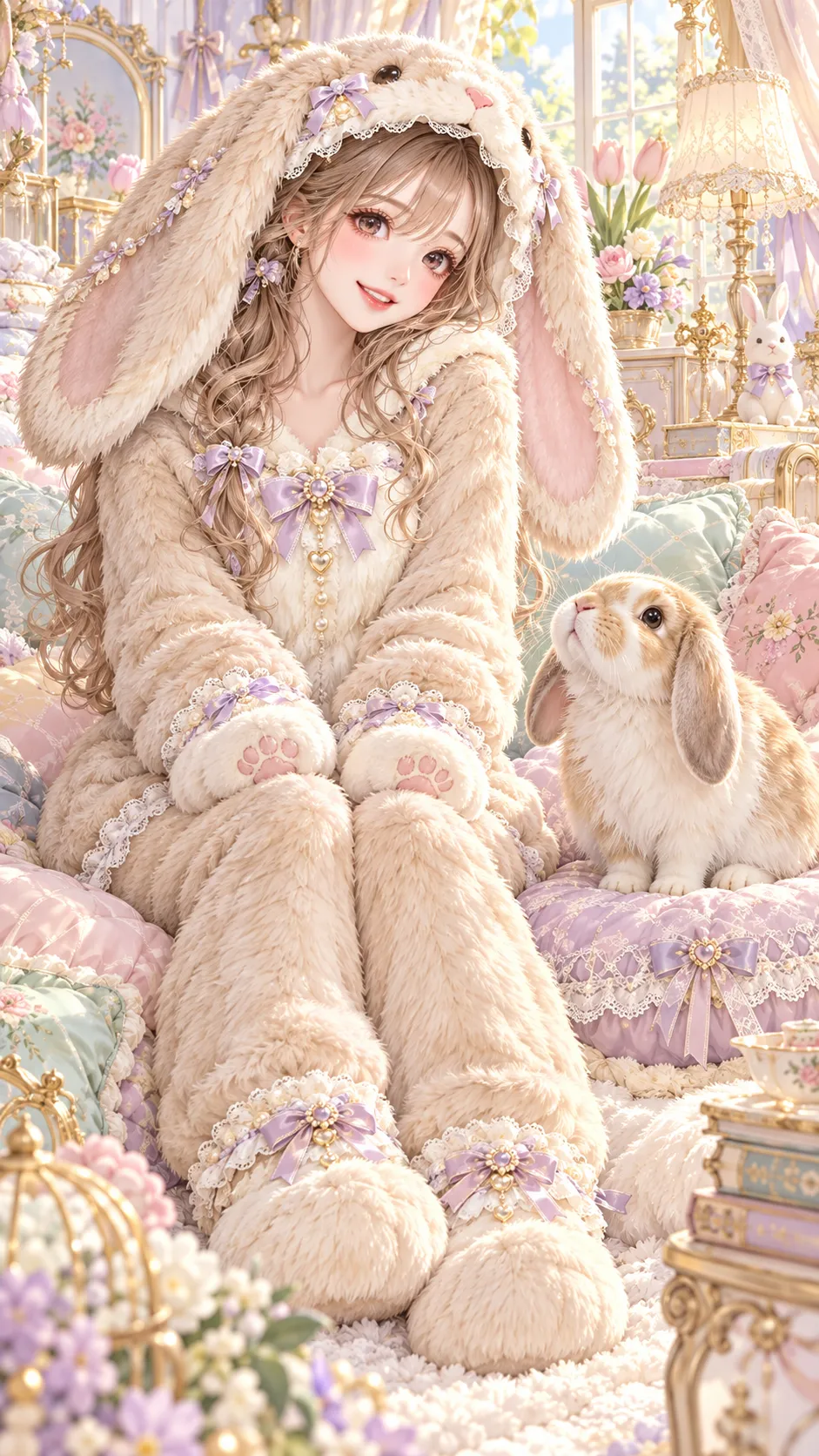
Create a polished 2D shoujo-style illustration of an adult woman in an exceptionally fluffy lop-eared bunny kigurumi, sitting beside a real lop-eared rabbit in a bright pastel fancy room. Emphasize the long drooping ears, plush fur, and clear, anatomically sound separation of the woman and rabbit.
By Threads — Published on — Modified on
Example images
Prompt template
- Format
- Markdown Parameterized
- Inputs
- fur_color (text) · Optional · Default: milk-tea beige accent_color (text) · Optional · Default: lavender
- Outputs
- illustration (image)
Replace the ${…} placeholders with your values
before using this prompt. See parameters
and defaults below.
# Sweet Lop-Eared Bunny Kigurumi

Create a luxurious, completely 2D illustration of a beautiful adult woman wearing a full-body, hooded lop-eared bunny kigurumi, seated on a fluffy cushion beside one real, adorable lop-eared rabbit. They gaze at each other with gentle, happy expressions. Make the exceptionally plush, airy fur and the rabbit’s long, naturally drooping ears the central visual appeal. Prioritize correct human anatomy, animal anatomy, and clearly connected limbs and clothing.

Use ${fur-color:milk-tea beige} as the kigurumi’s main color and ${accent-color:lavender} for its ribbon accents. Delicate lace and small pearls may complement the accents. Keep the colors harmonious and soft. The fur color may be chosen from natural rabbit tones such as cream white, milk-tea beige, ivory, light greige, warm gray, fawn, caramel beige, soft brown, or pale blue-gray. Select a natural-looking color combination for each image, matching the real rabbit’s overall feel; use cream white or ivory on the chest and belly. Do not lock every image to one color. Use freely chosen pastel colors for ribbons, lace, pearls, cushions, and room decorations, such as lavender, mint, baby blue, milky pink, peach, butter yellow, pale lilac, champagne beige, ice blue, or sage green. Do not make the entire palette pink.

## Woman

The main subject is a beautiful adult woman with a graceful, approachable appearance and an elegant sweet-doll face reminiscent of a shoujo manga heroine. Give her large, clear, jewel-like eyes; softly rounded, full cheeks; a small, naturally rounded chin; a refined nose; a cute mouth; and a bright, smiling expression. Balance adult beauty with charm. Keep her face softly shaped and do not make the chin excessively pointed. Give her eyes translucent highlights and her cheeks a natural flush. Her face must remain naturally human: the bunny ears and nose are costume decorations, not features that transform her face into an animal’s.

Choose a varied hairstyle, such as a short cut, short bob, medium bob, semi-long hair, long straight hair, soft waves, or curls. Choose a natural hair color, such as natural black, dark brown, ash brown, honey brown, or milk-tea beige. Short and long hairstyles are equally welcome; let the hair visible around the hood give each image its own character.

## Full-body lop-eared bunny kigurumi

Dress the woman in a loose, one-piece, full-body kigurumi with a hood, made from soft plush from the neckline to the feet. The shoulders, torso, waist, and both legs must connect naturally. The overall silhouette should be plump and rounded like a marshmallow, with no exposed skin. It should read as warm, cute full-body loungewear.

Render the material as exceptionally dense, long-pile boa, luxurious microfur, and soft sherpa fleece. Show abundant volume filled with air, made from countless delicate overlapping tufts—not a smooth, single piece of fabric. Keep the tips light and soft, gently fluffed outward. Give the hood, ears, chest, cuffs, and feet especially dense plush. Use fine lines and soft shading to convey the individual fur strands.

Add soft cream-white sherpa fleece at the chest and a pale ivory fur panel on the belly. Add one elegant ribbon at the chest, and delicate lace and small pearls at the cuffs and hood edge. Attach one small, round, fluffy bunny tail naturally near the back of the waist. Do not force the tail into view in a front-facing composition. Keep decorations elegant and restrained enough to show off the soft rabbit-like fur.

### Long drooping bunny ears — essential

Attach exactly one pair of long, soft lop-rabbit ears to the left and right sides of the top of the hood. The ears must clearly grow from the hood itself. They should spread softly outward from their roots and droop under their own weight beside the woman’s cheeks, with naturally rounded tips. Their outer fur should match the kigurumi; line the inner ears with delicate tufts in pale pink-beige, cream white, or soft gray, harmonized with the costume. Use abundant long-pile fur around the edges to give the ears plush thickness. Make them soft fabric with natural weight and flexibility.

Keep the roots visible enough to make their attachment clear. The ears must not float independently of the hood or appear to grow from the woman’s hair or ribbon. Do not make them stand straight upward, and do not substitute cat-like triangular ears or bear-like round ears. Draw exactly two ears, not four or more, and do not let them cover the woman’s face or eyes.

### Hood details

Give the hood a rounded shape that softly frames the woman’s face. Place a small fabric bunny-nose decoration high on the hood, above the woman’s forehead and never overlapping her own nose. Make it a small, rounded triangle in pale pink-beige or soft brown, with short cream-white fur around it. Add delicate lace around the face opening, with a small, tasteful pearl and ribbon accent. Let the woman’s bangs and hair around her face show naturally through the opening. The hood’s ears, nose decoration, and face-framing fur should read as parts of one coherent garment.

## Arms, sleeves, and paw-like mittens — essential anatomy

The woman has exactly two arms: one right arm and one left arm. Each must extend naturally from its corresponding shoulder, forming one continuous structure through the upper arm, elbow, forearm, sleeve, cuff, and mitten. Make the outlines of both arms and sleeves clear so they do not merge into the torso or the rabbit.

Let the right arm fall naturally from the right shoulder with a slight bend at the elbow; direct the right forearm toward the right thigh and place the right mitten on the right knee. Let the left arm fall naturally from the left shoulder with a slight bend at the elbow; direct the left forearm toward the left thigh and place the left mitten on the left knee. Clearly connect each shoulder, sleeve, and mitten as one continuous arm.

Do not cross or overlap the arms in front of the chest or body. Do not make a sleeve emerge from the center of the torso. Keep the arms separate from the rabbit. Avoid extra cuffs, wrists, branching forearms, or fur shapes that look like a third arm.

Put exactly two plump, rounded mittens on her hands, one at the end of each sleeve. They should suggest bunny forepaws. The palm side may have soft pink or greige paw-pad embroidery, shown as fabric decoration. Keep human fingers inside the mittens; do not add fingers emerging from them. Neither mitten may appear detached from its sleeve, body, or cushion.

## Legs and footwear

The woman sits naturally on a cushion. Connect both thighs naturally to her waist. Point both knees forward and leave a small gap between them; do not cross the legs. Connect each knee naturally to its shin, ankle, and slipper. Keep the legs balanced in length and thickness, with the plush fur flowing naturally from the knees to the ankles. Do not merge the legs or add extra ones.

Give her one rounded, plump bunny-foot-shaped slipper on each foot, made from boa matching the kigurumi. Add delicate lace and a small ribbon at each ankle.

## The real lop-eared rabbit

Place one real, adorable lop-eared rabbit beside the woman, sitting on its own separate cushion. It is a living animal, not a stuffed toy. Give it long, softly drooping ears; a round, gentle face; a small nose; clear, bright eyes; full cheeks; a compact, rounded body; and soft, abundant fur with natural color and texture variation. Preserve the appearance and proportions of a real lop rabbit. Distinguish its natural coat from the kigurumi’s artificial, dense plush.

Give the rabbit calm eyes, a gentle mouth, and a sweet, curious expression. It may tilt its head slightly and look up at the woman. Do not make it threatening or frightened. Preserve natural rabbit anatomy: one head, two ears, two eyes, two forelegs, and two hind legs, for four legs total. The hind legs should be larger than the forelegs. Keep its body rounded and its tail small and round. Do not force hidden hind legs into view when the rabbit is sitting. Do not add extra limbs or ears, and avoid overlapping ears that make it look as if it has four. Its ears should hang naturally to the sides.

## Pose and composition — essential

Use a vertical 9:16 composition. Place the woman prominently, slightly left of center, seated naturally on a large fluffy cushion. Turn her torso almost toward the viewer and her face slightly toward the rabbit. Show her face, hood and long drooping ears, both arms, both mittens, both legs, and feet naturally and clearly.

Place the rabbit beside her on its own cushion, sitting and looking up at her with a gentle head tilt. Leave enough natural space between them to distinguish both silhouettes. Do not put the woman’s arms behind the rabbit, lift or hold the rabbit, or place an extra mitten in front of its body. Make the woman the main subject while keeping the rabbit’s sweet expression clearly visible. Keep the right and left mittens distinctly separated, with the right mitten on the right knee and the left mitten on the left knee. Show each arm’s continuous outline from shoulder to mitten. Do not confuse the woman’s legs or mittens with the rabbit’s body or legs.

## Room and background

Set the scene in a bright, dreamlike fancy room, not a forest or outdoor landscape. Use soft cushions, a fluffy rug, delicate lace, ribbons, and pale flowers. Add gentle, bright natural light and restrained, graceful Art Nouveau curves in the background, with optional small rabbit-inspired floral motifs or rounded decorative details. Use pale pastel cushions that complement the kigurumi’s soft fur. Keep the background simple so the woman and rabbit remain the focus. Avoid dark lighting and excessively intricate decoration.

## Rendering style and final quality

Create a luxurious, completely 2D, hand-drawn illustration in a refined, beautiful shoujo manga style, with graceful Art Nouveau ornamentation. Use soft outlines, translucent eyes, delicate hair linework, and elegant, rich color. Render the high-density long-pile fur with fine strokes and soft layers of shading. Show countless soft tufts on the hood, long drooping ears, chest, cuffs, and feet. Give the real rabbit’s coat a natural flow of fur, clearly distinct from the kigurumi’s artificial plush.

Prioritize correct human anatomy and natural animal anatomy. The woman must have exactly two arms and two legs; the rabbit must have exactly four legs and two ears. Ensure both of the woman’s arms connect continuously from shoulder to mitten, with no extra arm-like sleeves, stray limbs, or detached mittens. Keep the lop-rabbit ears long and drooping, not upright. Make the woman and rabbit’s silhouettes distinct. Avoid photographic or photorealistic rendering, 3D CGI, a figurine-like appearance, dark or horror moods, and unnatural body structures. Finish as an exceptionally sweet, fluffy, cheerful illustration of a woman and a lop-eared rabbit sitting companionably together.
Parameters
Replace each placeholder with your own value, or use its default when one is provided.
${fur-color:milk-tea beige}
fur-color
Default: milk-tea beige
${accent-color:lavender}
accent-color
Default: lavender


Comments — 0