- Category
- Photography
The Evolution of Life in Recycled Egg Cartons
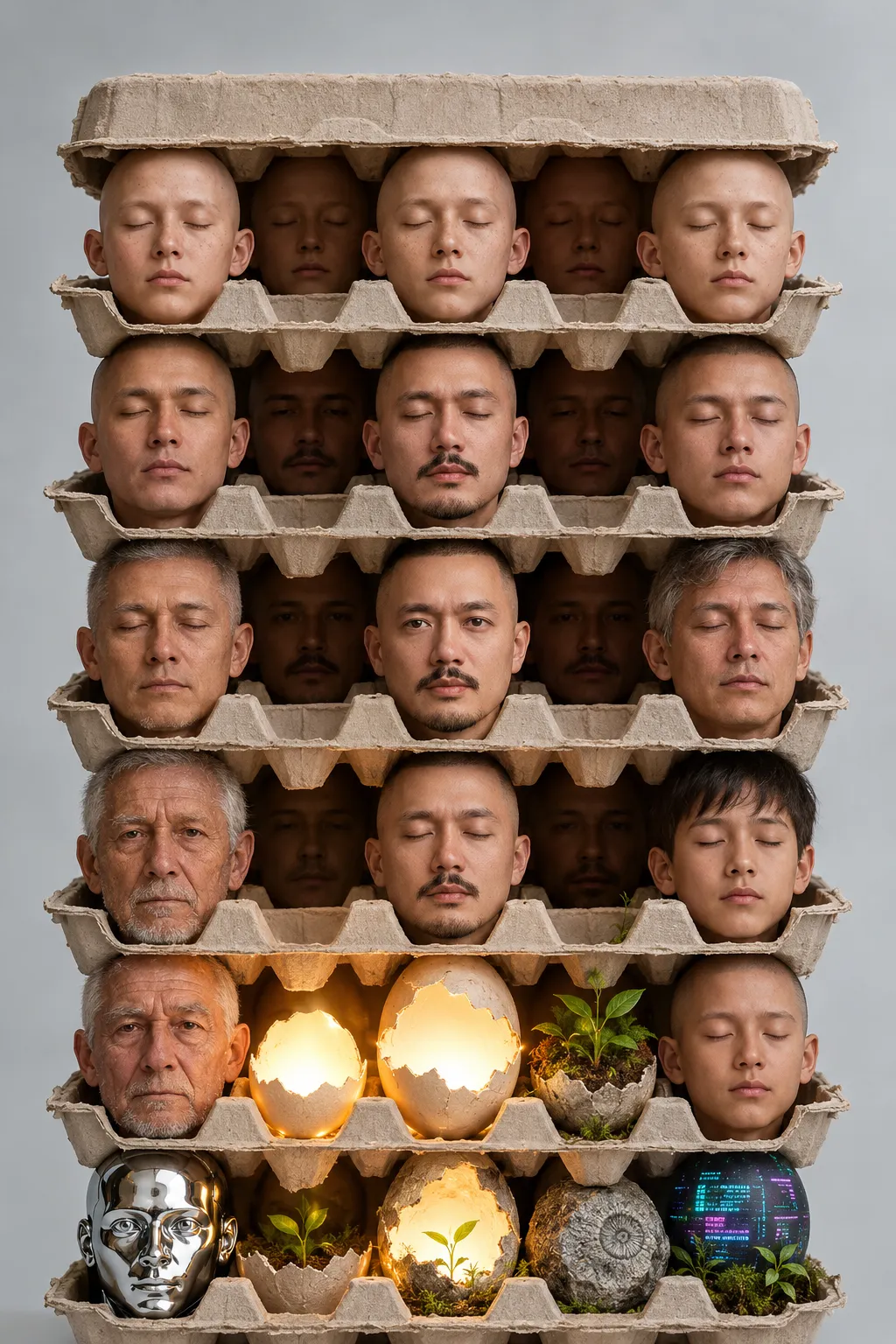
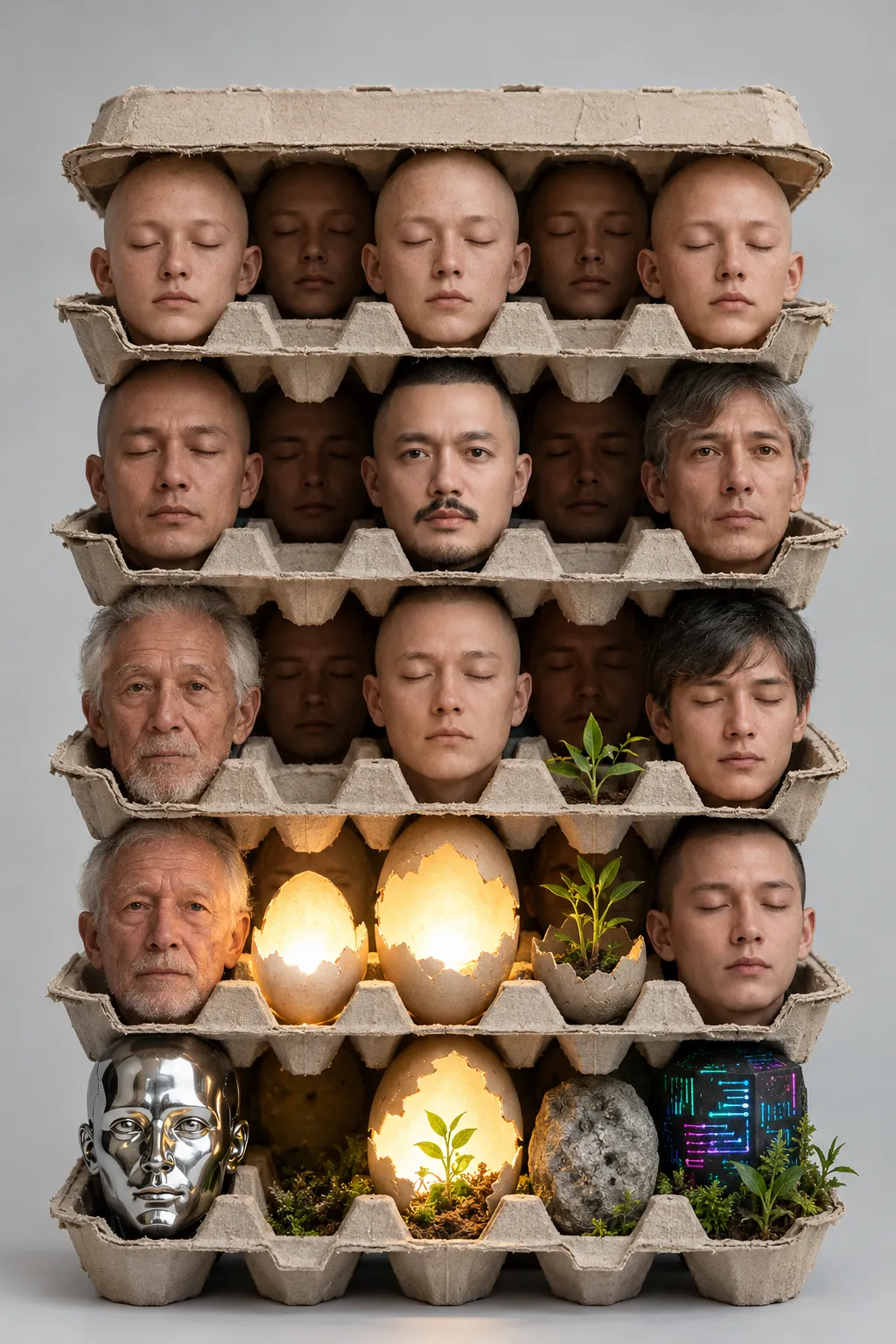
Create a photorealistic surreal conceptual photograph about humanity, consciousness, nature, and artificial intelligence, using stacked recycled egg cartons to symbolize life across stages of existence.
By Threads — Published on — Modified on
Example images
Prompt template
- Format
- Markdown
- Outputs
- Photorealisticsurrealconceptualphotograph (image)
Create a highly realistic surreal conceptual-art photograph depicting the evolution of humanity, consciousness, nature, and artificial intelligence. Use stacked recycled egg cartons as a symbol of life across different stages of existence.

## Composition and structure

Build a neatly arranged tower of approximately five to six vertically stacked, shelf-like trays made from cream-colored recycled cardboard egg cartons. Carefully place human heads, organic objects, and futuristic elements inside the trays’ individual compartments. Position the entire structure precisely in the center of the frame, photographed at eye level against a clean, pale-gray studio background with a minimalist art-gallery aesthetic.

## Top section — human origins

Place several realistic human heads in the topmost tray. They should all have shaved heads, naturally pale skin, subtle freckles, closed eyes, and calm, neutral expressions. Arrange the faces symmetrically, alternating between front-facing compartments and deeper compartments. Their repetition should create a compelling visual rhythm that suggests genetic replication, embryonic development, and the uniformity of human existence.

Show soft, natural skin texture, realistic pores, delicate eyelashes, anatomically accurate facial proportions, and subtle variations in age and skin tone.

## Middle sections — human aging

In the next layers, show human faces at different life stages. Include a young adult with closed eyes, a middle-aged man whose hair is beginning to turn gray, and an elderly man with silver hair. Give them realistic wrinkles, fine lines, age spots, and highly detailed facial features. Some faces should look directly at the viewer; others should appear at rest with their eyes closed.

Place each head inside an egg-carton compartment, maintaining convincing scale, depth, and anatomical realism. The contrast between youth and old age should symbolize the passage of time, memory, mortality, and the human life cycle.

## Lower-middle section — birth, creation, and nature

Fill a lower cardboard tray with several broken eggshells. Two large cracked eggs should emit an intense, warm golden-white light, illuminating their jagged edges and the surrounding cardboard. Their glowing interiors symbolize birth, new consciousness, and the emergence of unknown life forms.

Include a small green sprout emerging from one egg, a miniature living plant in a neighboring compartment, and a mix of natural, organic textures. Place an elderly person’s head on one side and a young person’s head with a calm expression on the opposite side, emphasizing the contrast between the beginning and end of life.

## Bottom section — the future of intelligence

Use the bottom tray to represent the fusion of humanity, nature, geology, and technology. Include a highly polished, reflective chrome humanoid robot head with realistic metallic reflections, placed beside one or two cracked eggs glowing with golden light.

Add a rough gray stone resembling an ancient fossil, a small green plant growing from a cardboard compartment, and a dark futuristic digital object displaying faint code-like light patterns in cyan, magenta, and green. Place each object in its own egg compartment and give each a distinct material character. The robot head represents artificial intelligence, the stone represents the ancient Earth, the plant represents ecological renewal, and the glowing eggs represent the birth of new forms of intelligence.

## Material microdetail

Make the egg cartons look convincingly real, with fibrous molded-paper texture, uneven torn edges, slight dents, faint stains, a worn surface, and an authentic grayish-cream color.

Make human skin photorealistic and lifelike, with natural pores, freckles, wrinkles, fine facial hair, and realistic ears, eyelids, and lips. Give the chrome physically accurate reflections. Make the eggshells thin and fragile, with irregularly cracked edges. Show delicate leaves, natural veining, and realistic shades of green on the plants. Give the stone a rough mineral surface with intricate geological detail.

## Lighting and color grading

Use soft, diffused studio lighting from the front and upper left, creating gentle shadows between the stacked trays. Warm golden light should radiate from the cracked eggs, casting a subtle yellow-gold glow on nearby faces, cardboard, and natural objects.

Use a palette of cool neutral gray in the background, natural cream and earthy browns, realistic human skin tones, restrained green accents, and subtle futuristic touches of cyan and magenta. Include cinematic dynamic range, realistic ambient occlusion, soft contact shadows, and balanced lighting. The glowing eggs should provide the main visual contrast without overexposing the overall scene.






Comments — 0