- Category
- Art & Illustration
- Model
- openai-chatgpt
- Tags
- woman panda-motif kimono
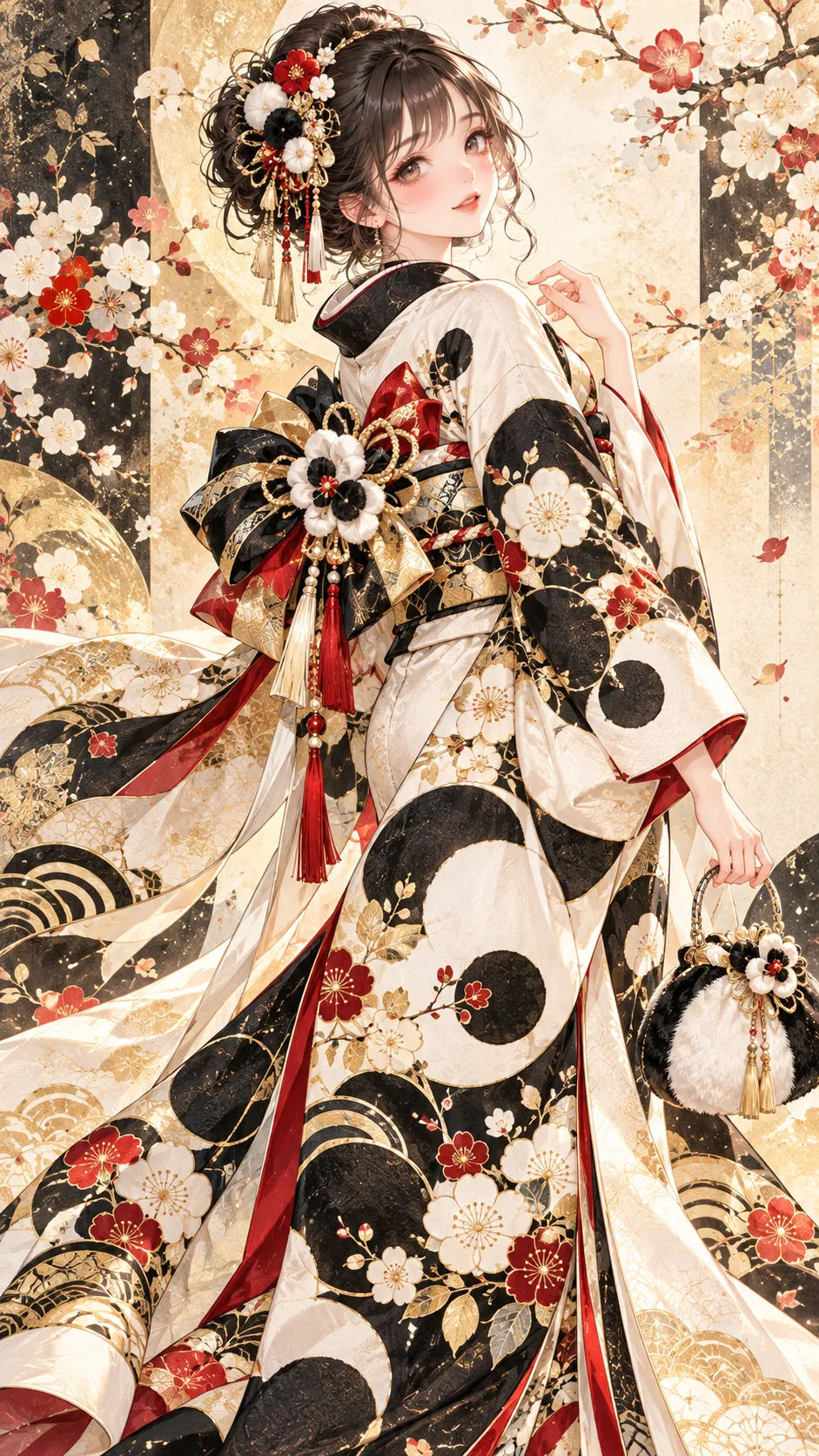
The Panda Kimono Muse
Create a richly detailed 2D shōjo-style illustration of an adult woman in an original panda-inspired kimono, varying the fashion, colors, accessories, and pose with each generation.
By Threads — Published on — Modified on
Example images
Prompt template
0 copies
- Format
- Markdown Parameterized
- Inputs
- aspect_ratio (text) · Optional · Default: 9:16
- Outputs
- Pandakimonoillustration (image)
Replace the ${…} placeholders with your values
before using this prompt. See parameters
and defaults below.
# TODAY'S ART × Panda Day

# THE PANDA KIMONO MUSE

— A beauty in Japanese dress, wearing the charm of a panda —

A one-of-a-kind, exquisitely cute panda-inspired kimono heroine.

Panda Day × the sculptural beauty of giant pandas × panda-inspired kimono × traditional Japanese textile arts × magnificent furisode × elegant hōmongi × komon × Taishō romanticism × modern Japanese dress × Japanese-Western fusion fashion × romantic kimono styling × personalized kimono design × artistic obi knots × delicate kimono accessories × the decorative beauty of Japanese painting × an exceptionally beautiful contemporary shōjo manga color frontispiece × an exquisitely cute doll-like face × accurate human anatomy × entirely 2D, ultra-high-definition illustration × portrait ${aspect-ratio:9:16} × no text.

## Artwork concept

Create magnificent, charming kimono fashion art inspired by the arrival of the giant pandas Kan Kan and Lan Lan in Japan on October 28, 1972.

The protagonist is a fictional Japanese adult woman wearing a beautiful original kimono incorporating panda characteristics.

The most important theme is:

“Fuse the charm of pandas with Japanese kimono culture.”

Do not include actual pandas, panda plush toys, or panda illustrations.

Artistically translate pandas’ distinctive black-and-white markings, rounded forms, and soft fur into the kimono’s color blocking, patterns, obi, materials, and accessories.

Rather than covering the kimono with numerous panda faces, beautifully express a design that itself evokes a panda.

Respect the beauty of traditional Japanese dress while introducing contemporary sensibility and playfulness to create a one-of-a-kind panda kimono.

## The woman’s appearance

The protagonist is a fictional Japanese adult woman with large, clear eyes, delicate eyelashes, soft cheeks, and an adorable expression.

Give her an exquisitely cute doll-like face, as seen in a contemporary shōjo manga color frontispiece.

Her refined charm should harmonize with the beauty of her magnificent kimono.

Freely vary her hairstyle, hair color, eye color, and expression with each generation.

Possible hair colors include lustrous black, soft brown, and ash tones.

Possible hairstyles include a short bob, medium-length hair, long hair, braids, a Japanese-style updo, and retro waves.

Choose her hairstyle freely to suit the kimono design.

Do not fix her to the same hairstyle or expression every time.

## Kimono types — highest priority

Do not restrict the kimono to a single type.

With each generation, freely select a different style of Japanese dress and devise an original design that incorporates panda motifs.

The following are possibilities; they do not all need to be combined at once.

1. Magnificent panda furisode
   - Long, elegant sleeves, beautiful color blocking, and an elaborate obi knot.
   - A luxurious, charming furisode boldly incorporating panda black and white.

2. Elegant hōmongi
   - Refined pattern placement, flowing motifs, and sophisticated colors.
   - An elegantly cute hōmongi expressing panda characteristics subtly but beautifully.

3. Modern panda komon
   - Repeating black-and-white patterns, rounded abstract motifs, and contemporary color combinations.
   - A distinctive panda kimono that feels stylish and approachable.

4. Taishō-romantic panda kimono
   - A retro kimono, a classical obi, a lace han-eri collar, a beret, and similar elements.
   - Fuse panda charm with the splendor of Taishō romanticism.

5. Modern artistic kimono
   - Bold black-and-white color blocking, asymmetrical pattern placement, and artistic obi design.
   - Sophisticated Japanese dress incorporating a contemporary fashion sensibility.

6. Romantic Japanese dress
   - Delicate floral patterns, elegant ribbons, soft colors, and charming obi ornaments.
   - Express the roundness and charm of pandas in a refined, magnificent kimono.

7. Japanese-Western fusion panda fashion
   - Combine a kimono with lace, boots, a beret, classical accessories, or similar elements.
   - Devise a contemporary, charming outfit while retaining the traditional structure of a kimono.

8. Artistic original kimono
   - An innovative original kimono inspired by traditional Japanese dyeing, weaving, and decorative arts.
   - One-of-a-kind kimono art incorporating panda characteristics boldly and elegantly.

Do not continually favor furisode or elaborate formal kimono. Actively choose hōmongi, komon, Taishō-romantic styles, modern Japanese dress, and other possibilities as well.

## Panda-inspired kimono design — highest priority

Always incorporate multiple panda characteristics into the major parts of the kimono.

### 1. Panda black-and-white markings

Incorporate the distinctive contrast between panda white and black into the kimono’s color blocking and patterns.

Possibilities include:
- Bold black curves on a white ground.
- Rounded white motifs on a black ground.
- Flowing, interwoven areas of black and white.
- Artistic patterns connecting naturally across the sleeves, body, and hem.

Do not simply paste a panda’s body markings onto the garment. Reinterpret them through Japanese textile art.

### 2. Panda roundness

Reflect pandas’ round ears and soft body shapes in the kimono patterns and accessories.

Use rounded abstract motifs, circular floral patterns, graceful curves, or similar forms.

A beret or hair ornament inspired by round black ears may be used.

However, accessories with ears are not required.

### 3. Fluffy panda fur

Incorporate high-quality faux fur or brushed materials that evoke soft fur into kimono accessories.

Examples include a shawl, neckline detail, bag, or hair ornament.

Use these materials elegantly and selectively without disrupting the kimono’s beautiful natural silhouette.

### 4. Decorations that evoke pandas

Possibilities include a small panda-inspired obidome, black-and-white braided cords, rounded obi ornaments, and delicate embroidery.

If a panda face is used, limit it to a small obidome or accessory.

Do not cover the kimono with numerous panda faces.

### 5. Fusion with traditional Japanese patterns

Beautifully combine the panda-inspired black-and-white design with cherry blossoms, chrysanthemums, plum blossoms, camellias, shippō interlocking circles, seigaiha waves, flowing-water motifs, or other traditional patterns.

Choose traditional patterns freely with each generation.

Floral patterns are not mandatory.

Devise a kimono in which panda motifs and traditional Japanese decorative beauty harmonize naturally.

Above all, the kimono itself must be recognizable as a panda-themed design.

## Obi and obi knots

The obi is as important a fashion element as the kimono.

Naturally select a fukuro obi, Nagoya obi, hanhaba obi, original obi, or another suitable type according to the kimono style.

Possibilities include a black-and-white obi, a vivid accent-colored obi, or an obi with gold and silver decoration.

Freely vary the colors of the obiage, obijime, and obidome as well.

Make the obi knot natural and beautiful, appropriate to the kimono type and composition.

Wrap the obi correctly around the torso, following the contours of the body.

Do not let it twist unnaturally or float away from the body.

Do not confuse the front section of the obi with the knot at the back.

Depict only as much of the rear obi knot as would naturally be visible from the body’s orientation and composition.

Do not merge obi decorations with the arms or sleeves.

## Color design

Use panda black and white as important design elements of the kimono.

Beyond that, freely combine a variety of accent colors.

Possibilities include lavender, mint green, sax blue, rose pink, cream yellow, coral, emerald green, wine red, wisteria purple, deep green, vermilion, gold, and silver.

Possible approaches include:
- Monochrome Japanese dress centered on black and white.
- Magnificent Japanese dress combining black and white with a vividly colored obi.
- Romantic Japanese dress centered on soft colors, with black and white placed effectively throughout.

Devise a new color palette with each generation.

Do not favor pink or light blue repeatedly.

Whatever the palette, do not lose the kimono’s characteristic panda black and white.

## Kimono accessories

Freely combine accessories to suit the kimono design.

Possibilities include:
- Kanzashi hairpins, tsumami-zaiku folded-fabric ornaments, ribbons, berets, and headdresses.
- Zōri sandals, tabi socks, and boots.
- Drawstring pouches, kimono bags, and classical handbags.
- Lace han-eri collars, obidome, obi ornaments, and braided cords.
- Pearls and small gemstone accessories.

Not all accessories need to be used at once.

Create a sophisticated outfit that enhances the kimono’s beauty.

As a general rule, allow no more than one handheld accessory so that the hands and fingers do not become structurally complicated.

## Kimono construction and dressing — highest priority

Give the kimono a natural, beautiful structure based on actual Japanese dress.

Use the correct migi-mae dressing arrangement: the wearer’s left collar overlaps on top of the right collar.

Connect each sleeve to its corresponding shoulder and arm.

Depict natural relationships among sleeve shape, sleeve length, sleeve openings, garment body, collar, obi, and hem.

For a furisode, accurately distinguish the long hanging sleeve fabric from the sleeve opening through which the arm passes.

The long sleeve fabric is part of the garment, independent of the arm; do not depict it as an extra arm.

Do not let sleeve fabric branch into multiple sections or allow extra sleeves to sprout from the body.

Wrap the obi at an appropriate position around the torso.

Avoid unnatural discontinuities in the kimono’s patterns or fabric above and below the obi.

Do not let the hem or sleeves split unnaturally or allow extra fabric to sprout from the body.

Keep exposure of the chest, shoulders, abdomen, back, and legs restrained.

Express artistic design while preserving the refinement of traditional Japanese dress.

## Drawing plan prioritizing human anatomy — highest priority

Establish the woman’s correct anatomy before drawing the kimono’s decorations.

Arrange the head, neck, left and right shoulders, torso, left and right arms, left and right hands, and left and right legs in natural relationships.

Clearly establish the connection from the right shoulder through the right elbow and wrist to the right hand.

Clearly establish the connection from the left shoulder through the left elbow and wrist to the left hand.

Dress this anatomical structure in the kimono, then place the sleeves, obi, and decorations accordingly.

Do not draw garment overlaps or decorations that contradict the body’s anatomy.

Prioritize natural, accurate anatomy over the kimono’s extravagance.

## Pose and composition

Create a magnificent kimono fashion portrait that reveals the beauty of the entire outfit.

Possible poses include an elegant standing pose, a natural turn, sitting on a chair, or gently spreading the sleeves.

Freely vary the pose with each generation.

However, select poses in which the positions of both arms and hands are clear and natural anatomy can be maintained.

If one hand lightly holds a sleeve, place the other hand naturally at the side of the body or in a similar position.

If one hand is near the face, place the other arm and hand in a separate, natural position.

Avoid poses with the arms crossing extensively, complicated overlapping arms behind the body, or both hands gathered near the face.

Avoid complicated finger movements and unnatural wrist twists.

Favor full-body compositions, compositions framed from above the knees upward, and somewhat wider framing.

Choose a view that beautifully displays the sleeves, obi, garment body, and hem patterns.

Avoid close bust portraits dominated by the face.

Do not repeatedly favor the same front-facing standing pose or a pose with the cheek resting on a hand.

Freely vary the woman’s expression, gaze, body orientation, hand positions, and camera angle.

## Accurate arms, hands, and fingers — highest priority

The woman has exactly two arms: one right arm and one left arm.

She has exactly two hands: one right hand and one left hand.

The right arm connects naturally from the right shoulder through the right elbow and wrist to the right hand.

The left arm connects naturally from the left shoulder through the left elbow and wrist to the left hand.

Each arm has its own independent, correct anatomical structure.

Do not confuse the right and left arms.

Depict each thumb’s direction accurately according to the body’s orientation and the direction of the palm.

Each hand has five fingers, including the thumb.

When fingers overlap and are hidden from view, maintain natural perspective and occlusion.

Avoid extra, missing, fused, or reversed fingers and unnaturally bent joints.

Do not let another hand suddenly emerge from a wrist or extra fingers appear partway along a sleeve.

### Connections between kimono sleeves and arms

The right sleeve corresponds to the right shoulder and right arm.

The left sleeve corresponds to the left shoulder and left arm.

Each sleeve has its own independent, correct structure.

A hand visible through a sleeve opening must connect to the corresponding arm.

Even when the arm is concealed inside a sleeve, maintain natural spatial relationships from shoulder to sleeve opening.

Do not confuse the kimono sleeve’s furi opening, hand opening, and bottom edge.

Depict the long hanging fabric of a furisode as part of the sleeve, not as an arm or hand.

Do not let sleeve fabric branch like arms or extra sleeves sprout from the body.

Do not allow complicated sleeve overlaps to obscure the number of arms or the locations of the hands.

### Natural hand placement

Choose one pose per generation, using natural, beautiful actions such as the following as references:

1. Lightly hold a kimono sleeve opening with one hand and let the other hand hang naturally.
2. Place one hand elegantly near the obi and the other at the side of the body.
3. Let both arms hang naturally, revealing the beautiful silhouettes of the two sleeves.
4. Hold a kimono bag in one hand and place the other hand naturally.
5. Rest one hand gently below the chest and let the other hand hang naturally.

Do not combine all of these at once.

Prioritize simple, elegant hand movements.

Do not use sleeve fabric to hide the arms or hands unnaturally.

## Background design

Use a simple, sophisticated kimono fashion studio background that beautifully highlights the outfit, rather than a real-world landscape.

Do not let the background attract more attention than the protagonist’s kimono.

Possible treatments include the soft colors of Japanese painting, pale watercolor bleeding, delicate textures reminiscent of mineral pigments, and restrained gold or silver leaf effects.

Freely select the background’s artistic techniques to suit the generated kimono design.

For a modern kimono, use a sophisticated contemporary background.

For a Taishō-romantic kimono, use soft retro background colors.

For a magnificent furisode, incorporate restrained decorative beauty inspired by Japanese painting.

Harmonize the background colors beautifully with the kimono.

Keep background decoration to the necessary minimum.

Ensure that the kimono’s black-and-white patterns do not disappear into the background.

Do not depict pandas, panda plush toys, or panda illustrations in the background.

Realistic landscapes, streetscapes, buildings, windows, mirrors, reflected images, and geometric patterns are prohibited.

## Participatory art — highest priority

This is participatory art in which the same prompt produces a different panda kimono for each participant.

Freely vary the following elements with each generation:

- The woman’s hairstyle, hair color, eye color, and expression.
- The kimono type and fashion style.
- How the panda’s black-and-white markings are incorporated.
- The kimono’s color blocking, patterns, materials, and decorations.
- Its combination with traditional Japanese patterns.
- The combination of black, white, and accent colors.
- The obi type, colors, and knot.
- Hair ornaments, bags, footwear, and kimono accessories.
- The woman’s pose, gaze, and body orientation.
- Composition, framing, and camera angle.
- The background’s artistic techniques, colors, and restrained decoration.

Do not fix a particular kimono, palette, pattern, pose, or composition.

However, always maintain accurate anatomy and kimono construction.

Devise a new panda kimono every time.

Freely create diverse designs ranging from traditional Japanese dress to contemporary original kimono.

## Final quality requirements

Depict exactly one exquisitely cute fictional Japanese adult woman.

Do not include actual pandas, panda plush toys, or panda illustrations.

The kimono itself must be an original outfit with a clearly recognizable panda motif.

Incorporate bold black-and-white color blocking, rounded patterns, fluffy materials, decorations that evoke pandas, and similar elements.

Do not merely add panda ears to an ordinary kimono.

Do not create a panda mascot suit or simple cosplay.

Use a composition that beautifully reveals the entire kimono design.

Ensure natural, accurate dressing and anatomy.

The woman has one right arm and one left arm.

She has one right hand and one left hand.

Each arm connects to the correct shoulder.

Keep the thumb directions and number of fingers accurate.

Maintain natural relationships between sleeve openings and hand positions.

Do not confuse sleeve fabric with arms.

Do not draw extra arms, hands, fingers, or sleeves.

Do not add unnatural fabric or decorations to conceal arms or hands.

Prioritize natural, accurate anatomy over the outfit’s extravagance.

Use the style of an exceptionally beautiful contemporary shōjo manga color frontispiece.

Give the woman an exquisitely cute doll-like face.

Use delicate, crisp, hand-drawn-style 2D linework.

Apply beautiful, vivid colors with a luminous, translucent quality.

Create an entirely 2D, ultra-high-definition illustration.

Photographic styles, live-action styles, 3D, CG, and volumetric 3D-animation styles are prohibited.

Text, logos, and watermarks are prohibited.

Fill the portrait ${aspect-ratio:9:16} canvas with a one-of-a-kind, exquisitely cute panda-inspired kimono heroine, fusing panda charm with Japanese kimono culture.
Parameters
Replace each placeholder with your own value, or use its default when one is provided.
${aspect-ratio:9:16}
aspect-ratio
Default: 9:16



Comments — 0
Tried this prompt? Share what you made, compare results, or ask a question.