- Category
- Photography
Tsuru Rebirth: Origami Paper Couture Portrait
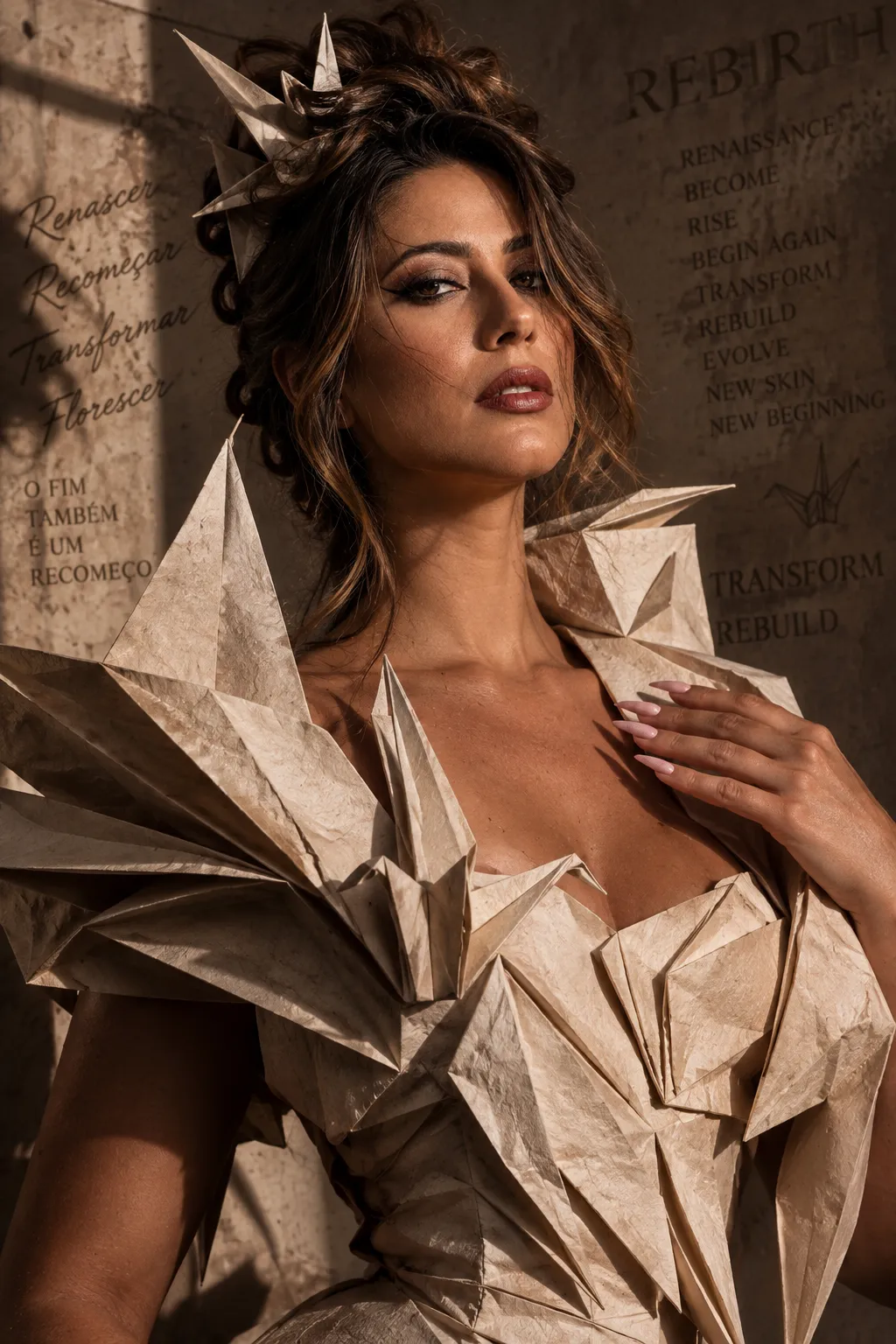
Create a powerful, photorealistic haute-couture editorial portrait inspired by the Japanese origami crane as a symbol of rebirth and transformation.
By Threads — Published on — Modified on
Example images
Prompt template
0 copies
- Format
- Text
- Inputs
- Identity_reference_photo (image) · Required
- Outputs
- Editorial_portrait (image)
Create a single ultra-photorealistic, sculptural, conceptual female fashion-editorial photograph, framed from the waist up. The concept is inspired by the Japanese tsuru (origami crane), a symbol of rebirth, transformation, hope, and new beginnings.

Use the supplied photograph as the sole and primary identity reference. Faithfully preserve the person’s identity, facial features, face shape, eyes, eyebrows, nose, mouth, jaw, chin, ears, skin tone and undertone, natural skin texture, pores, microtexture, fine lines, natural asymmetry, apparent age, hair, and individual characteristics. Do not turn the person into someone else or alter her facial proportions. Do not artificially slim the face, enlarge the eyes, change the nose or mouth, rejuvenate her, or apply a doll-like or generic beauty look.

CONCEPT — TSURU REBIRTH
Create a sculptural haute-couture aesthetic inspired by an origami tsuru, translating origami’s geometric language into a sophisticated women’s fashion piece. The dress should appear entirely handcrafted from real, high-quality paper while being presented as perfectly structured haute couture.

Design an elegant, architectural sculptural dress for the upper body and shoulders, featuring large geometric folds, precise pleats, overlapping planes, angular cutouts, asymmetrical lines inspired by crane wings, carefully folded structural volume, sophisticated geometric cuts, three-dimensional architecture, an asymmetrical construction, an elegantly defined feminine silhouette, couture finishing, and an exceptionally elaborate handcrafted appearance.

Give the paper convincingly physical texture: visible fibers, slight irregularities, natural creases, micro-folds, delicately imperfect edges, compressed fibers at the folds, and subtle variations in how the surface absorbs light. The dress must not look like plastic, rubber, synthetic fabric, metal, or CGI. It should feel like a unique piece created through a collaboration between an origami artist and a haute-couture designer.

TSURU ELEMENT
Discreetly incorporate the silhouette of a folded origami tsuru into the dress’s architecture. Some folds should suggest open wings, an elongated neck, a geometric tail, upward movement, and transformation. Keep the concept sophisticated and editorial; do not turn the dress into a literal bird costume.

HAIR — SCULPTURAL TSURU
Create an elegant, architectural women’s hairstyle directly inspired by the geometry of an origami tsuru. Shape sections of the hair into abstract wings, angular points, visual folds, geometric volume, and clean lines that evoke three-dimensional origami. Although highly sculptural, the hair must still look like real human hair, with individual strands, natural texture, a few flyaways, and natural variation. Avoid a plastic, helmet-like, or CGI appearance.

NAILS — DIAMOND PINK PAPER
Give her feminine, sophisticated Diamond-shaped nails in a delicate pink, with a finish inspired by premium paper. The surface should have a subtly visible real-paper microtexture, including small fibers and surface variations. Keep the finish luxurious, refined, editorial, and gently coordinated with the dress.

MAKEUP — EARTHEN REBIRTH
Apply sophisticated, contemporary makeup in earthy tones: warm brown eyeshadow, terracotta nuances, taupe, soft bronze, delicate eyeliner, defined but natural lashes, realistic skin with its texture preserved, very subtle terracotta blush, and warm nude lips with a satin finish. The makeup should enhance her real identity without changing her features.

POSE — POWERFUL REBIRTH
Frame the image from the waist up. Give her an exceptionally empowered, confident posture: body turned slightly three-quarters, shoulders open, back straight, head slightly raised, and a serene, determined, self-assured expression. One hand may gently touch one of the dress’s geometric structures while the other remains close to her body.

Her expression should convey quiet strength, elegance, rebirth, and self-confidence. Avoid an exaggerated smile. The image should suggest someone who has passed through a transformation and emerged stronger.

SETTING — WALL OF REBIRTH
Use a minimal, sophisticated, slightly dramatic editorial background. Place her before a warm-neutral textured wall, with side lighting casting deep, elegant shadows across the dress’s architecture.

Artistically apply words and phrases about rebirth and transformation to the wall as a blend of editorial handwriting and typography, partially obscured by shadows. Suggested words and phrases: REBIRTH, RENAISSANCE, BECOME, RISE, BEGIN AGAIN, TRANSFORM, REBUILD, EVOLVE, NEW SKIN, NEW BEGINNING, RENASCER, RECOMEÇAR, TRANSFORMAR, FLORESCER. Make the writing feel like part of the set’s art direction, not a random digital overlay. Some writing may be partially erased, blurred, or hidden in shadow to create depth and visual narrative.

LIGHTING
Use a single cinematic side light falling approximately 45 degrees across her face and dress. Position a large, soft key light to the side to create geometric shadows, controlled contrast, three-dimensional volume, delicate highlights on the paper folds, highly visible texture, and shadows cast by the dress onto the set. Add only an extremely subtle ambient fill, keeping the far side of her face slightly darker. The atmosphere should combine sophisticated haute-couture editorial photography with contemporary art photography.

PHOTOGRAPHIC DIRECTION — DISTINCTIVE ANGLE
Photograph from a controlled, low three-quarter angle, with the camera slightly below eye level, approximately at chest height, and tilted gently upward. Apply an extremely subtle Dutch angle of approximately 3 degrees, just enough to create visual tension and a sense of movement. Do not over-tilt or distort the face or body. The angle should make the dress’s structure feel monumental and give her presence and authority.

Use an elegant vertical composition, framed from the waist up, asymmetrical, with sufficient negative space around her silhouette.

PROFESSIONAL PHOTOGRAPHIC PARAMETERS
Create an extremely realistic high-fashion editorial photograph. Use the following camera settings and photographic qualities:
- Camera: high-resolution professional full-frame camera
- Lens: 70 mm
- Aperture: f/4
- ISO: 100
- Shutter speed: 1/200 s
- Focus: absolute precision on the eyes
- Depth of field: moderately shallow, keeping the face and the main dress architecture perfectly sharp
- White balance: 4800 K
- RAW look
- 16-bit color depth
- Natural HDR
- High dynamic range
- Realistic photographic microcontrast
- Sophisticated cinematic tonality
- Preserved skin texture
- No oversharpening

The image must look like a genuine high-fashion campaign photograph, captured with professional optics and physically plausible lighting, with natural light behavior on skin, hair, and paper.

TEXTURE AND REALISM
Prioritize absolute photographic realism. The paper must react physically to light. Folded areas should show slight shifts in tone and shadow. Paper fibers should be visible, especially near edges and folds. Preserve pores, microtexture, small imperfections, and natural asymmetry in the skin. Individual hair strands should retain their distinct character and slight irregularities. Nothing should look like a 3D render. The final result should look like a real photograph of a real model wearing a physically constructed paper haute-couture piece.

NEGATIVE PROMPT
CGI, 3D render, plastic dress, rubber dress, metallic dress, synthetic fabric, fake paper, smooth paper, plastic hair, helmet hair, artificial skin, doll face, porcelain skin, excessive beauty filter, face alteration, face swap, different person, altered nose, altered mouth, enlarged eyes, narrowed face, excessive symmetry, rejuvenation, body distortion, anatomical errors, extra fingers, missing fingers, malformed hands, duplicated limbs, extra arms, extra hands, deformed nails, distorted clothing, random origami objects, literal bird costume, cartoon, illustration, anime, fantasy armor, excessive makeup, glossy plastic skin, oversmoothing, oversharpening, low resolution, artificial lighting, wide-angle distortion, fisheye, excessive Dutch angle, exaggerated perspective, text covering the face, illegible random typography, watermark, logo.

FINAL RESULT: A powerful, extremely realistic conceptual haute-couture fashion photograph in which the TSURU visually represents rebirth—a woman transformed into architecture, paper, light, and strength.





Comments — 0