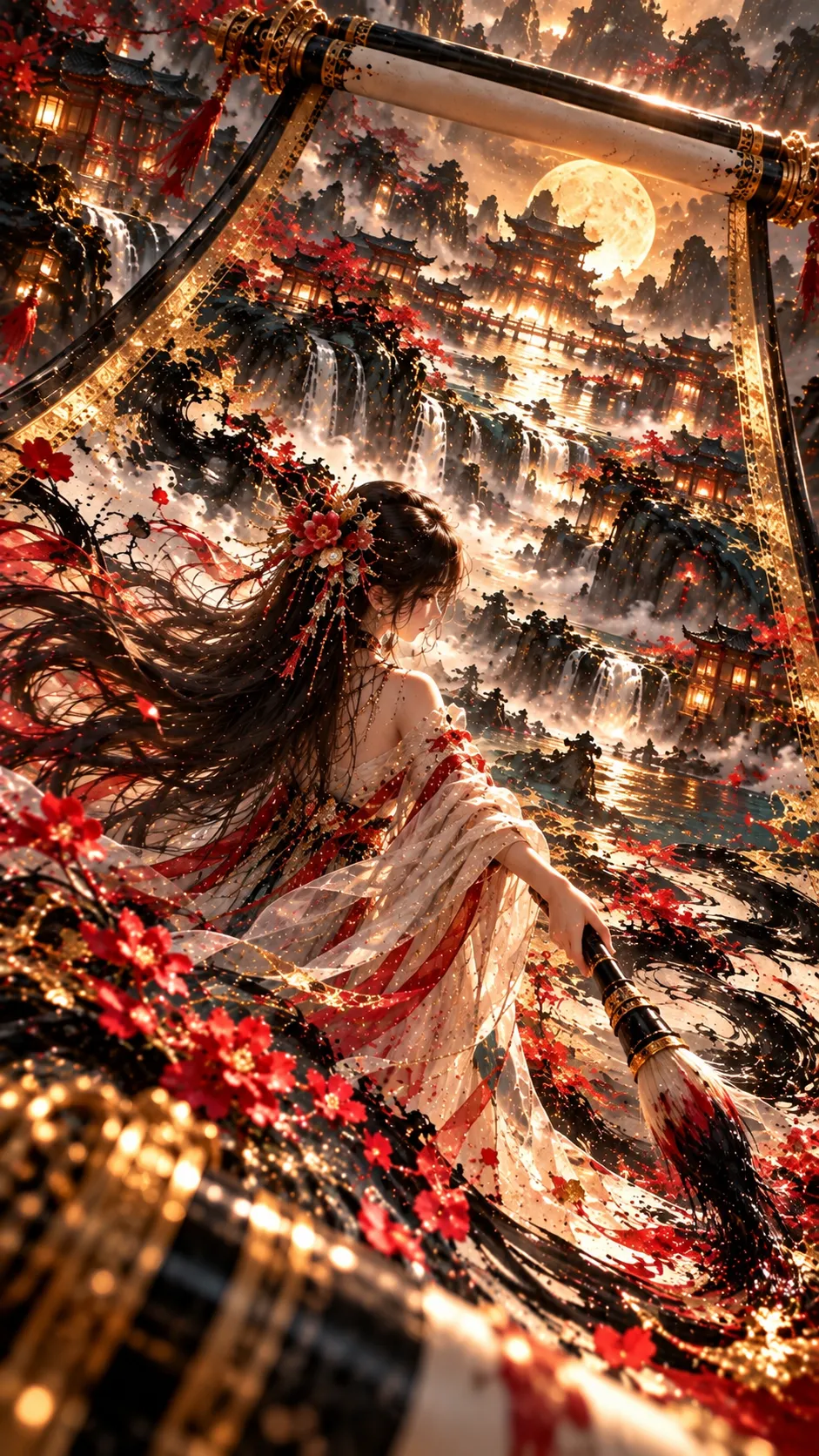
Eastern Fantasy Scroll Painting with a Giant Brush
Create a cinematic 3D scene of a woman painting an expansive moonlit landscape on a giant scroll, preserving the reference image’s composition.
Example outputs
Prompt template
- Format
- Text
- Inputs
- reference_image (image) · Required
- Outputs
- generated_image (image)
Use the user's original reference image as the sole basis for the composition. Prioritize reproducing its spatial structure, camera angle, figure placement, scroll shape, brush proportions, and perspective. Do not redesign the composition or arbitrarily move objects.

Vertical 9:16 composition, hyper-realistic 3D CG in UE5, an Eastern fantasy cinematic scene, 8K HDR.

1. Scroll structure — highest priority

A huge classical black-and-gold scroll spans the top of the image, with thick cylindrical roller ends, intricate gold carving, and metal bands.

Ivory-white rice paper unfurls from the scroll and extends diagonally down through the image, forming a gigantic three-dimensional landscape painting. The paper must have clearly visible edges, realistic paper texture, and a distinct perspective direction.

The scroll must not look like an ordinary background or a decoration floating in the sky. The entire landscape world should extend into the distance along the unfurled scroll, so viewers can immediately recognize it as a gigantic, open classical painting scroll.

Preserve the spatial relationship in the reference image between the horizontal scroll at the top, the diagonal paper, and the distant mountains. Do not turn it into an ordinary landscape composition.

2. Figure placement and pose — do not change

An Eastern woman sits in the lower-left foreground, directly on the paper of the gigantic scroll.

She faces away from the camera. The camera is behind her and slightly to her right. Her back, shoulders, and the back of her head are the main visible features. She turns her head slightly to the right, revealing only a natural side profile, and gazes toward the distant moon and palace.

Do not have her face the camera, stand up, move to the center of the image, or become an oversized portrait occupying most of the frame.

Her dark-brown hair falls naturally from an updo and streams dramatically toward the left side of the image in the wind. Strands of hair intertwine with white sheer fabric and red ribbons, forming a clearly visible flowing curve on the left.

She wears a classical Eastern immortal-style robe woven in moon-white and pale gold, decorated with red cherry-blossom motifs. The skirt spreads naturally across the scroll paper, with realistic weight and soft folds.

3. Giant brush — must be clear and prominent

The woman holds a large, classical long-handled calligraphy brush in one hand. It extends diagonally from her hand toward the lower-right of the image.

The brush is an important, clearly visible object. Do not reduce it to the size of an ordinary calligraphy brush.

The handle is made of ebony-colored material, with a sturdy, elongated proportion, black-and-gold metal bands, and intricate carvings. The brush head is a full bundle of deep brown-black bristles, proportionate in length and width to the handle, with clearly visible fiber detail.

The brush's overall length is approximately 0.8 to 1.1 times the woman's height. Show the entire handle and brush head in frame. Use foreground perspective to make the brush clear and prominent in the lower-right.

Her fingers must grip the handle naturally, with a believable connection between the wrist, forearm, and handle. Keep the brush angled from the woman toward the lower-right; do not point it upward, leftward, or toward the camera.

The brush head should be close to the paper, as if she is painting the landscape on the scroll.

4. Landscape and distance — preserve the reference image's layers

The middle and far distance on the scroll depict a magnificent Eastern fantasy landscape:

- A huge golden full moon sits toward the upper-right in the distance.
- Layered classical Eastern palaces, upturned eaves, and the lights of countless homes are scattered among the mountains.
- Several waterfalls cascade from the cliffs in the middle distance, accompanied by natural mist.
- The water reflects moonlight and palace lights in flowing golden reflections.
- Red cherry-blossom branches extend from the left and above, with red petals scattered around the scroll.
- Keep dark rocks, cherry blossoms, and warm golden bokeh in the lower-left foreground to create near-to-far perspective.

Give the landscape three-dimensional depth, but keep it aligned with the spatial direction of the scroll paper. Do not arrange the palaces, waterfalls, and moon arbitrarily as an ordinary landscape background.

5. Lighting — faithful to the reference image's golden cinematic light

Use warm golden moonlight, palace lights, and light filtering through the waterfall mist together as the illumination.

Golden backlighting outlines the woman's long hair, white sheer fabric, and red ribbons. Soft reflected light preserves the details of her side profile and clothing.

The distant moon is bright but retains surface texture. Palace lights form small, dense, warm golden points. The waterfalls and mist have silvery-white highlights, and the water reflects the golden lights.

Keep the scroll paper ivory-white, with realistic fibers and delicate reflections; do not blow out the entire surface. Preserve the metallic sheen and dark shadows of the black-and-gold scroll.

Use high dynamic range, physically based global illumination, realistic reflections, and cinematic depth of field. Avoid excessive lens glow, particles, or unnecessary magical effects.

6. Camera and aspect ratio

Use a vertical 9:16 frame and preserve the reference image's high-low arrangement and diagonal perspective.

Top of frame: the huge black-and-gold scroll.

Upper middle of frame: the golden full moon, palace complex, waterfalls, and mountains.

Lower-left of frame: the seated woman, facing away from the camera with her profile turned to the right.

Left side of frame: long hair, white sheer fabric, and red cherry blossoms blowing outward.

Lower-right of frame: the fully visible giant brush, hand, and scroll paper.

Keep the foreground, middle distance, and far distance clearly layered. Do not center the woman, remove the scroll, shrink the brush, or turn the scroll into an ordinary background.

7. Strict negative constraints

Front-facing figure, standing figure, centered figure, figure sitting outside the scroll, scroll turned into a sky decoration, scroll paper missing, ordinary landscape background, brush too small, short brush, thin handle, brush head too small, brush pointing in the wrong direction, arm pointing in the wrong direction, cropped brush, woman obscuring the moon, hair flowing in the wrong direction, incorrect perspective, floating or misplaced architecture, overexposure, excessive particles, cartoon style, text, watermark.

Final goal: Preserve the reference image's composition and object placement as closely as possible, improving only the figure's detail, scroll material, giant brush proportions, landscape depth, and cinematic lighting. Do not rearrange the scene.
What you'll create
A black-and-gold scroll spans the top as ivory paper unfolds through the vertical scene. Gold carvings, textured paper and three-dimensional landscape depth create an elaborate cinematic render.
Frequently asked questions
Should the paper edges remain visible?
Yes. Clear edges and a strong perspective direction make the open scroll recognizable.
What controls figure placement?
The original reference image supplies the spatial structure and figure positions.


Comments
Tried this prompt? Share what you made, compare results, or ask a question