Ming-Dynasty Noblewoman in a Peacock-Green Robe
Create a photorealistic 3D-rendered, overhead portrait of a Ming-dynasty noblewoman in ornate formal dress, posed on an embroidered peony carpet beneath a large antique wooden ceiling fan.
Example outputs
AI-generated video of a Ming-dynasty noblewoman in a peacock-green robe and red pleated skirt lies with her arms outstretched on a round peony carpet, beneath a large antique wooden ceiling fan.
Download video result 1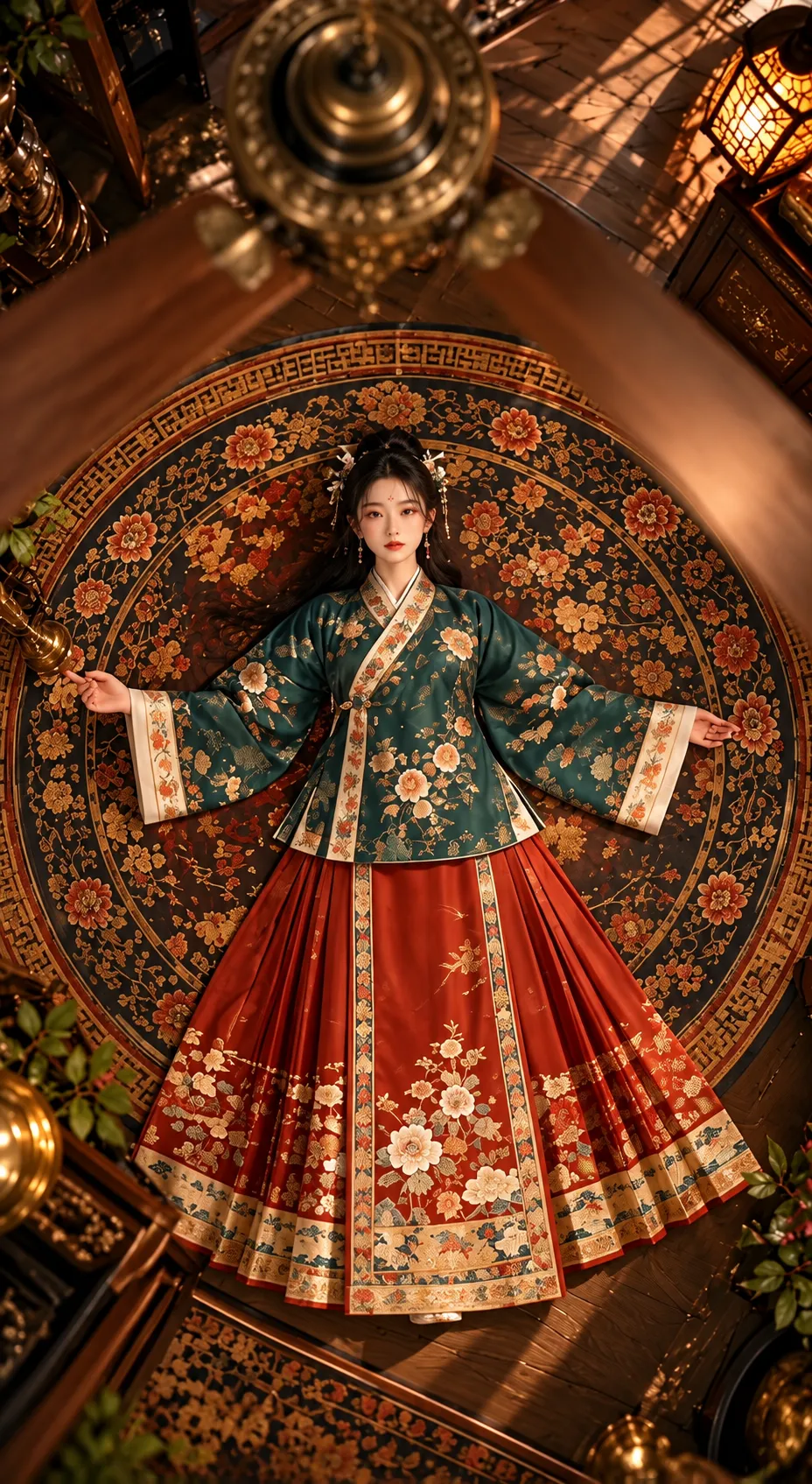
Prompt template
- Format
- Text
- Inputs
- Originalpersonreferencephoto (image) · Required
- Outputs
- Mingdynastycourtportrait (image)
Create one complete 9:16 vertical image of a Ming-dynasty court noblewoman in an elegant, photorealistic 3D-rendered scene.

## 1. Reference person: preserve identity strictly
Use only the user-provided original portrait as the reference for the person. Preserve the original face shape, facial proportions and features, eyes, nose, lips, natural expression, skin tone, hair color, and other recognizable traits. Keep natural, delicate skin texture. Do not replace the person, invent a new face, over-beautify, or over-smooth the skin.

Present her with a dignified, gentle, elegant bearing befitting a Ming-dynasty noblewoman.

## 2. Ming-dynasty noblewoman’s hairstyle
Give her an elegant, high updo characteristic of a Ming-dynasty court woman. Brush her long, dark brown-black hair back and arrange it in a neat, full high bun toward the back of the crown. Keep soft, natural wisps at the forehead and let strands fall naturally beside the face. Adorn the bun with delicate gold floral hairpins and small pearl ornaments, complemented by red and ivory flowers and fine gold branches. Add delicate dangling pearl earrings. Keep the ornaments elaborate but clear of her face.

## 3. Hair ornaments and jewelry
Use Ming-court pearl-and-jade ornament aesthetics. Place a delicate gold floral hairpin at the center of the bun, set with rubies, pearls, and pale-gold details. Add fine gold branches and flowers on both sides, a small number of dangling pearls and fine gold chains, and optionally a small, refined floral forehead ornament. Include gold-and-pearl drop earrings. Do not use a Yuan-dynasty gu-gugu crown, a Qing-dynasty banner headdress, or a tall Tang-dynasty floral crown.

## 4. Formal Ming-dynasty clothing
Dress her in formal Ming-dynasty noblewomen’s attire, layered with a standing-collar long jacket, a xiapei shoulder stole, and a mamian skirt. Use peacock green, vermilion red, moon white, and antique gold as the main colors.

### Upper garment: peacock-green standing-collar jacket
Give her a peacock-green Ming-style standing-collar long jacket made of fine silk with a detailed gold-woven satin finish. The standing collar must be complete and crisp. Use a straight, center-front closure or a Ming-style pipa-lapel construction that clearly reads as Ming clothing. Keep the cut dignified and fitted, with a natural waist; use wide, flowing sleeves with generous cuffs. Trim the cuffs in moon-white and pale-gold brocade. Decorate the jacket with large peonies, plum blossoms, flowering branches, and gold vines, primarily embroidered in ivory, pale gold, and light apricot. Add fine floral gold-woven designs across the chest, shoulders, and front edges. Extend the hem below the waist so it layers clearly over the skirt.

### Shoulder adornment: Ming-style xiapei
Add a characteristic xiapei worn by a Ming-dynasty noblewoman, falling naturally from both shoulders down the front of the skirt. Make it from vermilion-red and antique-gold brocade, with delicate floral embroidery and gold geometric patterns along the edges, plus a small gold ornament at the center. Let both strips hang vertically and symmetrically, conveying the formality and splendor of Ming ceremonial clothing.

### Lower garment: vermilion-red mamian skirt
Give her a high-waisted vermilion-red Ming-style mamian skirt made of substantial fine silk with a gold-woven satin finish. Clearly show its flat front skirt panel and the natural pleats on both sides. Use layers of vermilion, red-gold, and a small amount of deep red. Embroider the skirt with large peonies, flowering branches, auspicious clouds, and traditional floral motifs. Trim the hem with multiple bands of antique-gold and moon-white brocade. Show detailed embroidery and dimensional gold weaving. Let the skirt spread naturally to the sides and below her in an elegant fan-shaped outline. The flat front panel and side pleats must be clearly visible.

### Waist ornaments
Add a delicate gold waist ornament with a small gold-and-jade pendant at the center, finished with vermilion and pale-gold tassels below. Fine gold chains and floral details may adorn the sides. Keep the decorations refined and dignified, not excessively elaborate.

## 5. Pose
Place her at the center of a round embroidered carpet, using the original image’s pose with both arms extended to the sides. Her body may lie naturally or appear in an elegant sleeve-spreading pose. Position her head at the upper center of the frame. Face her toward the camera with a calm, gentle gaze. Extend both arms naturally to either side; her hands should be softly open, with naturally proportioned, slender fingers. Let the wide sleeves extend with her arms to form a symmetrical fan-like silhouette. Allow the peacock-green jacket and vermilion mamian skirt to spread naturally downward. Show the skirt’s flat front panel and side pleats in full. Keep the overall pose dignified, graceful, and characteristic of a Ming-court noblewoman.

## 6. Setting: Ming-court hall with peony decor
Set the scene in a classical Ming-dynasty palace hall. Place a large round peony-embroidered carpet behind her, fully visible. The carpet should have a dark brown-black ground, multiple rings of classical geometric motifs, vermilion, red-gold, and deep-orange peonies, delicate flowering branches and traditional round floral motifs at the center and around it, and a precise continuous-pattern border. Give it the substantial, finely crafted texture of a court carpet.

Around the carpet, show dark redwood flooring with natural grain, classical carved wooden furniture, a traditional wooden screen and carved cabinet, antique-brass palace lanterns, finely made metal incense burners and antique furnishings, and touches of green plants and classical flowers. The overall atmosphere should feel stately, sumptuous, and elegant, like a Ming-dynasty palace.

## 7. Essential foreground element: large antique wooden ceiling fan
Preserve a large, antique Chinese-style hanging ceiling fan at the very top of the image. Place it close to the camera in the foreground for a pronounced near-to-far perspective. It must have a large, round antique-brass metal hub with multiple rings of carved and openwork ornament and finely detailed metal construction, suggesting classical mechanical craftsmanship and aged metal. Extend four broad, dark-brown redwood blades from the hub, with clear natural wood grain and a natural connection to the metal center. Show the fan hanging vertically from the ceiling.

Use a true 90-degree overhead camera angle. Position the fan in the nearest foreground, with its gold center at the upper center of the image and its four wooden blades extending to the sides. It may be naturally cropped by the frame to emphasize its apparent size and the near-to-far perspective. Do not let it obscure her face, hairstyle, or main clothing. It must remain a large antique wooden hanging fan; do not replace it with a modern plastic electric fan, a crystal chandelier, or an ordinary palace lantern.

## 8. Composition and camera
Use a 9:16 vertical frame and a true 90-degree straight-down overhead view. Build three clear spatial layers:

1. **Upper foreground:** the large antique wooden ceiling fan, with an ornate antique-brass hub, four dark-brown redwood blades, and pronounced near-to-far perspective.
2. **Center:** the noblewoman on the round carpet, with her Ming-style updo and gold-and-pearl ornaments clearly visible; a peacock-green standing-collar jacket; a vermilion mamian skirt; and arms extended to either side, with the wide sleeves forming a graceful, symmetrical composition.
3. **Behind the person:** the round peony-embroidered carpet, dark redwood floor, classical palace furniture, lanterns, and metal furnishings.

Keep the fan, person, and round carpet clearly separated into foreground, middle ground, and background. Show the person and main clothing in full. Use natural depth of field to convey the space between the fan and the person.

## 9. Lighting
Use warm golden palace-lantern light as the main ambient illumination, with soft warm-white light on her face and delicate rim light on her hair and shoulders. Give the peacock-green silk a subtle sheen and the vermilion skirt a rich, deep color. Make the gold embroidery’s dimensional reflections clear; give the pearls and jade a soft, natural luster; and show warm metallic reflections on the antique-brass fan. Preserve realistic wood grain on the blades and warm-gold reflections on the dark floor. Control highlights so white embroidery and gold details are not blown out. Use cinematic warm-gold lighting to evoke the splendor and elegance of a Ming imperial palace.

## 10. Rendering and image specifications
- Image format: one 9:16 vertical image.
- Camera: true 90-degree straight-down overhead view.
- Composition: ceiling fan in the foreground, person at the center, round embroidered carpet behind her.
- Rendering: photorealistic UE5 3D CGI, Octane Render, ray tracing, global illumination, PBR materials, volumetric lighting, and cinematic lighting.
- Look: ARRI Alexa 65 film look, 8K HDR, ultra-detailed, photorealistic luxury Ming-dynasty costume photography.
- Show realistic silk, fine gold-woven embroidery, detailed metal carving, redwood grain, and natural fabric physics.

## 11. Strict exclusions
- Do not change the reference person’s face, features, skin tone, or identity.
- Do not generate Tang-, Song-, Yuan-, or Qing-dynasty clothing.
- Do not use a Qing banner headdress, Yuan gu-gugu crown, or tall Tang floral crown.
- Do not omit the Ming standing-collar long jacket, xiapei, vermilion mamian skirt, gold floral embroidery, or jade waist pendant.
- Do not turn the mamian skirt into an ordinary pleated skirt, a Tang-style wide skirt, or a modern long skirt. Do not omit its flat front panel or side pleats.
- Do not turn the clothing into a modern one-piece formal gown.
- Do not change the pose with both arms extended to the sides or the true 90-degree overhead camera angle.
- Do not omit the large antique wooden ceiling fan at the very top of the frame, its antique-brass center, or its four dark-brown redwood blades. Do not replace it with a modern plastic electric fan or crystal chandelier. Do not let it obscure her face or main clothing.
- Do not add extra fingers, distorted hands, or incorrect anatomy.
- Do not add text, a title, an “EP” label, a logo, or a watermark.

## Final result
The finished image must show a Ming-dynasty noblewoman wearing a peacock-green Ming-style standing-collar jacket with gold-woven embroidery, a vermilion-and-antique-gold xiapei, and an ornate vermilion mamian skirt embroidered with peonies and flowers. Add gold-and-jade waist ornaments with tassels. Arrange her long dark brown-black hair in a Ming-style high updo with delicate gold floral hairpins, pearls, and pearl-and-jade ornaments.

Place her at the center of a dark, round peony-embroidered carpet, with both arms extended to the sides, her wide sleeves naturally spread, and her skirt flowing gracefully below and to either side. Preserve the large antique Chinese-style wooden ceiling fan at the very top of the frame, with an ornate antique-brass metal center and four dark-brown redwood blades, creating strong foreground perspective.

Use a true 90-degree overhead view and a three-layer composition: fan in the foreground, person at the center, and round peony carpet behind her. Convey the dignity, splendor, and elegance of a Ming imperial court and classical Eastern art. Deliver one complete image, not a collage or storyboard, and add no text.
What you'll create
A reference-based noblewoman extends her arms on a round peony carpet beneath a large antique wooden ceiling fan. Peacock-green silk, vermilion pleats and gold embroidery form the central layer of a richly lit palace composition.
Frequently asked questions
May the foreground fan cover the face?
No; its four wooden blades establish depth but must leave the face, hairstyle and main clothing clear.
Is the result a multi-panel costume study?
The brief requires one complete vertical image with foreground, person and carpet separated in depth.


Comments
Tried this prompt? Share what you made, compare results, or ask a question