Warring States Noblewoman in a Palace Chamber
Create a photorealistic, cinematic top-down portrait of a woman in historically inspired Warring States robes, reclining beneath a foreground antique bronze ceiling fan.
Example outputs
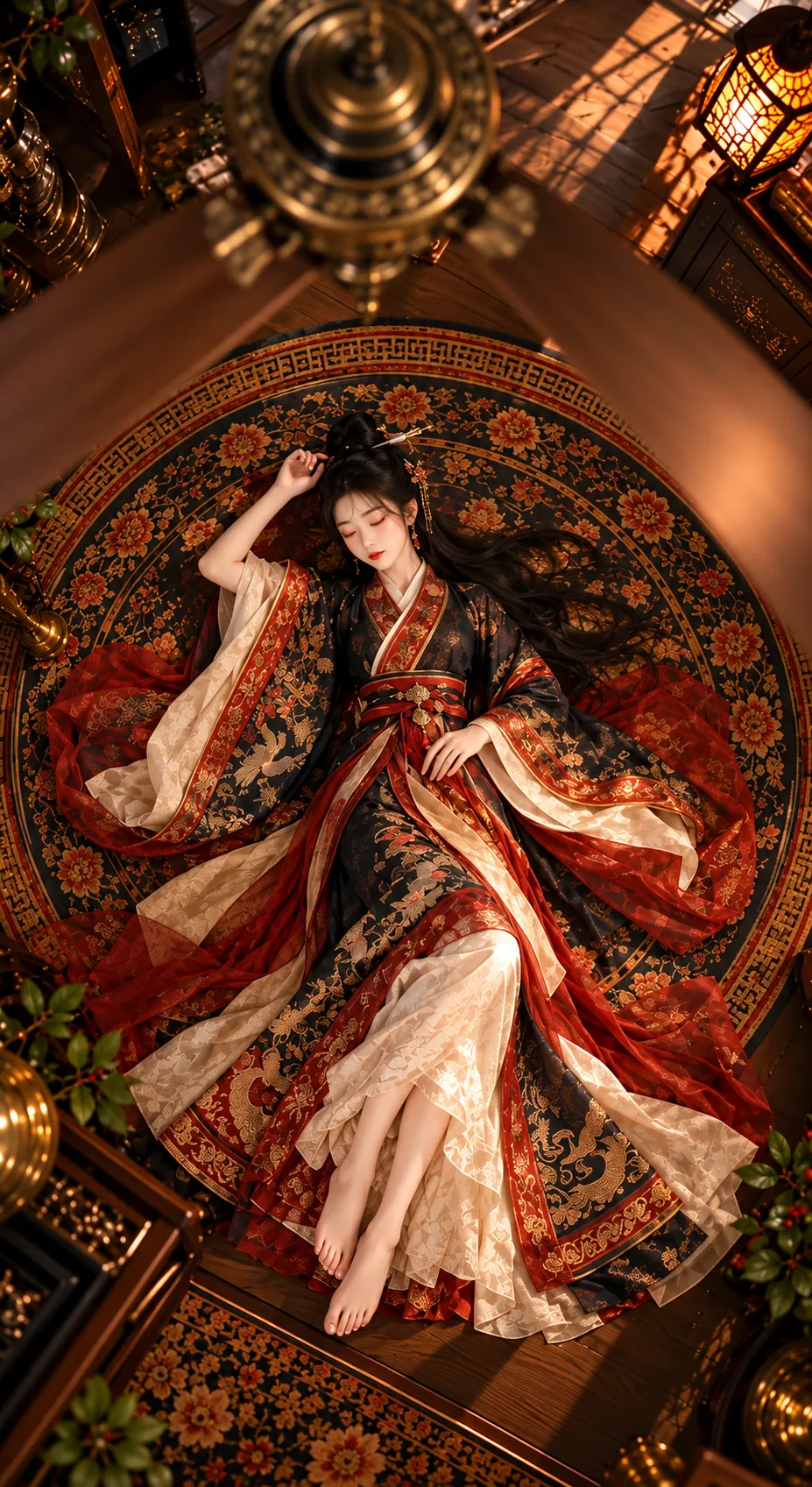
AI-generated video of a woman in black, crimson, and champagne-gold robes reclines on an embroidered circular rug beneath a large antique bronze ceiling fan, in a warm, sunlit palace chamber.
Download video result 1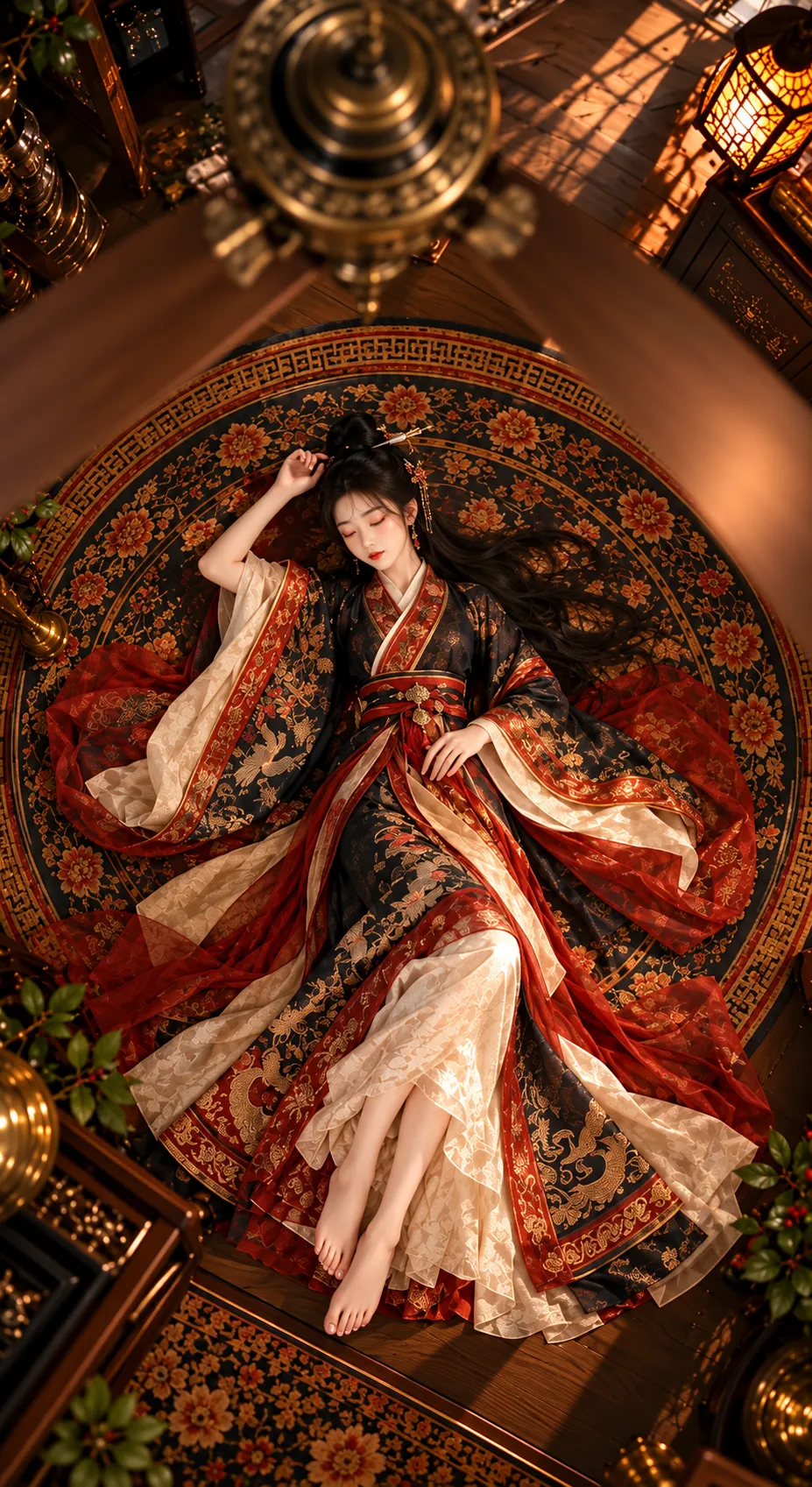
Prompt template
- Format
- Text
- Inputs
- reference_image (image) · Required
- Outputs
- cinematic_portrait (image)
Create a collectible-quality, ultra-photorealistic cinematic portrait that combines Warring States-period aristocratic clothing with a classical palace interior. Use the provided reference image as the sole basis for the woman’s appearance. Preserve her original face shape, facial features and proportions, eyes, nose, lips, skin tone, hair color, and natural character. Do not alter her identity or facial features, over-beautify her, or make her skin look plastic.

SUBJECT AND HAIR
Depict a woman with refined East Asian features, naturally fair skin, and long dark-brown hair. Style her hair in a classical Warring States-period women’s updo, secured with fine gold-and-jade hairpins. Let some of her hair fall naturally across the rug and extend to the right side of the frame. Her makeup is understated; her eyes are gently closed and her expression is peaceful, as if sleeping in a classical palace on a warm afternoon.

CLOTHING
Dress her in an ornate Warring States-period noblewoman’s quju shenyi (curved-hem deep robe), primarily deep black, crimson, and champagne gold. Follow the basic historical structure of a deep robe: a right-over-left cross-collar, connected upper and lower sections, wide sleeves, and a curved overlapping front. Do not substitute a modern high-waisted skirt, mamian skirt, Ming- or Qing-style clothing, Korean clothing, or Western formalwear.

The long, fitted-but-not-tight upper garment should have naturally overlapping front panels, a clear V-shaped collar, and a traditional silhouette gathered at the waist with a woven belt. Give the robe broad, soft, long sleeves that drape naturally. The sleeves should have layered silk construction: dark black brocade on the outside, champagne-gold silk on the inside, and crimson brocade edging. As she reclines, let the sleeves spread onto the rug in soft, fan-shaped folds.

Make the connected lower robe form a long, layered skirt with a clearly visible diagonal wrap and curved overlap. Let the hem flow naturally along her body and spread across the circular rug, with black, crimson, and champagne-gold silk layers. Embroider the deep-black patterned silk with refined gold cloud-and-thunder, coiled-dragon, scrolling-cloud, and Warring States geometric motifs. Add selective crimson brocade and delicate gold-thread embroidery. Keep the gold ornamentation intricate and restrained, not flashy modern sequins. Add a wide crimson woven belt with a central gold-and-jade ornament, small antique jade pendants and rings, and fine tassels. Include jade earrings and small floral gold ornaments alongside the hairpins.

POSE
Have the woman recline diagonally in the center of a large circular black-and-gold embroidered rug. Her head is near the upper middle of the frame and her legs extend naturally toward the bottom. Raise her left hand near her head, with relaxed fingers lightly touching a hairpin or her hair and the elbow naturally bent. Rest her right hand in front of her waist, fingers relaxed. Let her legs overlap naturally and extend along her body’s axis; her feet may be partly visible, with clear, naturally proportioned toes. Her body should form a gentle S-curve, with the robe and wide sleeves spreading naturally around her. The pose must feel relaxed, elegant, and natural—not seated, standing, stiff, or lying flat on her back facing the camera.

PALACE SETTING
Place her in a luxurious bedchamber with classical Warring States aesthetics and a nostalgic court atmosphere. Use dark-brown solid-wood flooring with visible natural grain, plank joins, and subtle reflections. Beneath her, place a large circular rug with a black and dark wine-red ground, multiple gold geometric borders, and intricate classical floral motifs. Include gold peonies, trailing floral designs, and symmetrical traditional patterns in its central and concentric sections. Make the embroidery visibly dimensional, with realistic raised thread, fine fibers, and textile texture.

Around the room, show carved classical wooden furniture, bronze vessels, gold candlesticks, green potted plants, and warm palace lanterns. Include a classical wooden window at the upper right. Afternoon sunlight passing through its lattice should cast clear geometric shadows across the wooden floor. The room should feel stately and richly furnished, without modern furniture, modern decor, or Western interior design.

FOREGROUND CEILING FAN
Include a large antique copper-colored ceiling fan in the extreme upper foreground, directly above the woman. It must clearly be a ceiling fan, not a chandelier, round ornament, candlestick, or other hanging object. Give it a substantial circular bronze motor housing with concentric metal layers, ring-shaped engraved details, vintage mechanical features, and a naturally aged patina. Use deep bronze, champagne gold, and dark gold tones. Extend several broad, thick, dark-bronze metal blades from the motor, with vintage rivets and fine brushed-metal texture.

The camera is directly above the scene, looking vertically down. Place the fan at the very top of the frame, close to the lens, with the large motor appearing bigger in perspective and some blades extending beyond the top and side edges. Use gentle shallow-focus blur on the nearby motor and blades while keeping the fan’s structure recognizable. The circular motor must show dimensional light and shadow, not become a blurry gold sphere. The fan must not disappear, become another hanging object, or obscure the woman’s face.

LIGHTING AND FOCUS
Use warm amber-gold afternoon sunlight as the main light, supplemented by reflections from the copper fan, warm lantern light, and soft fill light on the woman. Let strong warm sunlight enter through the window at the upper right and create defined geometric lattice shadows on the dark wooden floor, with cinematic light-and-shadow contrast.

Soft, diffused golden light should illuminate her forehead, eyelids, nose bridge, cheeks, and chin. Keep her skin naturally luminous with fine texture; avoid overexposure and excessive smoothing. Preserve the subtle sheen in the black brocade, with small precise highlights on the gold embroidery. Give the crimson silk rich wine-red and vermilion gradations, and let the champagne-gold lining catch a soft reflection. Sunlight should bring out the fan’s warm bronze highlights, dark-brown shadows, and brushed-metal texture. Let golden light pick out the rug’s embroidery and raised threads, while the floor remains naturally reflective rather than mirror-like.

Use cinematic shallow depth of field: the close fan is softly out of focus; the woman’s face, robe embroidery, and rug patterns are the primary sharp details; background furniture and decorations are gently softened. Keep the overall image bright, warm, richly toned, and layered, without making the whole image overly yellow or overexposed.

CAMERA AND COMPOSITION
Use a portrait 9:16 aspect ratio and a true 90-degree vertical overhead view, with the camera directly above the woman and pointing straight down. Do not use an oblique angle, eye-level portrait, or conventional room-wide view. Arrange the scene as follows:
- Extreme upper foreground: the large antique bronze ceiling fan, with circular motor and broad blades.
- Center: the woman in her Warring States quju shenyi, reclining diagonally on the fully visible circular black-and-gold rug.
- Lower middle: the robe’s black, crimson, and gold hems and her naturally extended legs.
- Surrounding edges: dark-brown wooden floor, classical furniture, bronze vessels, green plants, and palace lighting.
- Upper right: the classical wooden window and warm afternoon sunlight.

Make the woman and circular rug the main visual center, while the fan creates a foreground frame and a sense of depth. Keep the rug fully visible and circular. The fan should be softly defocused, while the woman’s face and clothing details remain clear and the rug’s pattern is fully legible.

RENDERING QUALITY
Ultra Photorealistic, 90 Degree Top Down Aerial Portrait, Warring States Period Chinese Deep Robe, Ancient Chinese Quju Shenyi, Cross Collar Right Over Left, Wide Flowing Sleeves, Connected Robe Structure, Black Crimson Gold Silk, Ancient Bronze Ornaments, Intricate Warring States Cloud Thunder Patterns, Coiled Dragon Motifs, Antique Bronze Ceiling Fan, Vintage Copper Fan Motor, Wide Bronze Fan Blades, Ornate Circular Black Gold Carpet, Warm Amber Sunlight, Geometric Window Shadows, Luxurious Ancient Interior, Golden Reflections, Cinematic Depth of Field, Realistic Silk Texture, Detailed Bronze Metal Texture, Global Illumination, Ray Tracing, Unreal Engine 5, Octane Render, PBR Materials, 8K HDR.

NEGATIVE INSTRUCTIONS
Do not change the woman’s original facial features. Do not make her sit or stand, give her a stiff pose, or turn her into a flat, rigid, front-facing figure. Do not deform or crop the circular rug. Do not remove the bronze ceiling fan, turn it into a chandelier or circular ornament, let it obscure her face, or make its blades structurally incoherent. Avoid malformed fingers or fused toes. Do not change the clothing into a Ming-style jacket and skirt, mamian skirt, Qing-style dress, Korean clothing, phoenix coronet and ceremonial robe, modernized hanfu, or Western formalwear. Do not reverse the cross-collar direction, remove the connected deep-robe construction, or turn the curved hem into an ordinary long skirt. Avoid blurred embroidery, plastic-looking fabric, mirror-like flooring, overexposed window light, crushed black detail, excessive skin smoothing, cartoon styling, text, and watermarks.
What you'll create
A woman with closed eyes wears an ornate curved-hem robe and gold-and-jade hairpins. Long dark hair trails across a rug, suggesting quiet afternoon rest within the classical interior.
Frequently asked questions
What traditional robe form is specified?
A quju shenyi, or curved-hem deep robe.


Comments
Tried this prompt? Share what you made, compare results, or ask a question