Turn a Photo into a Hand-Bent Neon Sign
Recreate the uploaded photo as a hand-bent glass neon sign, then photograph it mounted on a dark wall. Preserve the photo’s subjects and composition while following strict construction, lighting, and framing constraints.
Example outputs
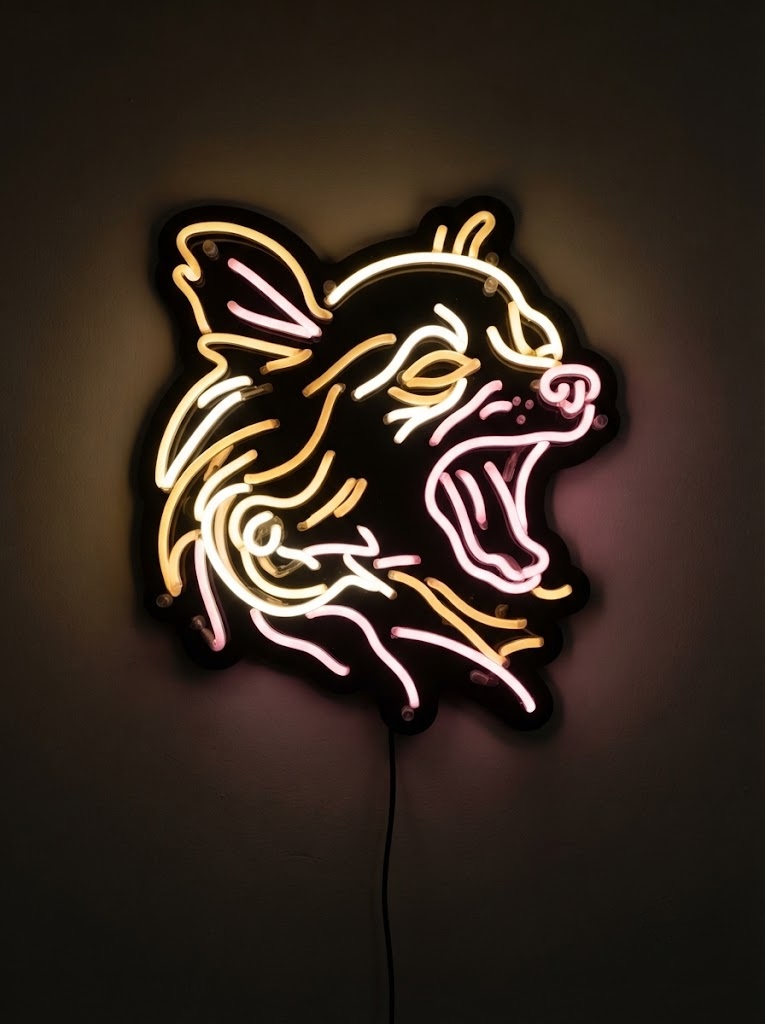
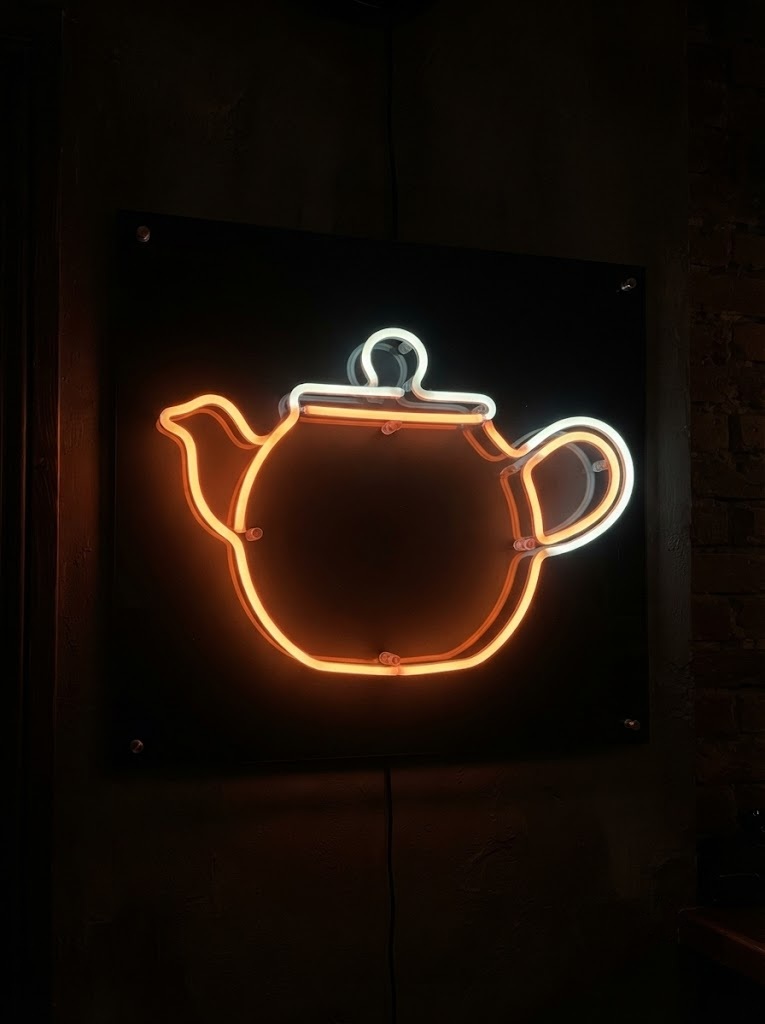
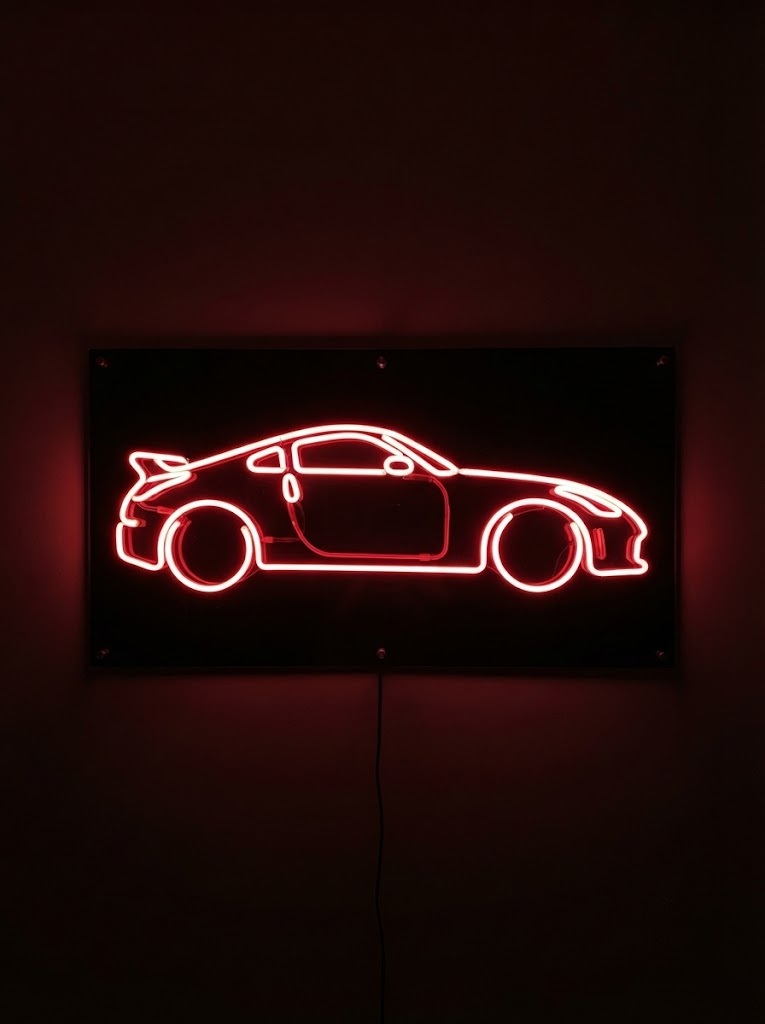
Prompt template
- Format
- Text
- Inputs
- Reference_photo (image) · Required
- Outputs
- Finished_sign_photograph (image)
Amber at the ear, pink at the muzzle, with both colours repeated on the wall.

For the subject with a head, cut its backing to the shape of the head, including the ear tips. For the teapot, keep the backing a plain bolted rectangle.

Turn the attached photo into a single hand-bent neon sign, then photograph the finished sign hanging on a wall in a dark room. Output one vertical image in a 3:4 frame. Do not make a grid or a before-and-after pair.

THE SIGN
Mount one sign flat on a sheet of black matte acrylic that is slightly larger than the artwork, and hang it on a plain dark wall. The room is unlit except for the sign itself, so the wall around it carries a soft coloured wash and nothing else is readable. The acrylic backing has the dusty sheen of a surface that has hung in a bar for years. A thin black power cable leaves the lower edge of the backing and drops out of frame. Nothing else is in the frame.

HOW THE PICTURE IS MADE
Every shape in the picture is a length of glass tube, bent over a flame by hand and filled with gas. The tube has a real diameter, about the width of a finger, so no shape can be finer than that. Drop thin details rather than drawing them.
The strokes are long and continuous. One run of tube carries several shapes before it ends. Where it must travel from one shape to the next without being seen, paint that stretch of tube with black blockout paint; it should read as a dull grey glass line crossing the lit ones.
Each run ends in a short electrode tube that bends back and enters the backing through a small rubber grommet. Hold every run off the backing with two or three small clear plastic standoffs, visible pinching the tube.
The glass is not perfect. Make the bends slightly uneven, let the tube thin a little on the outside of a tight curve, and make the gas glow a fraction brighter near the electrodes.
Light behaves naturally. Each tube has a hot white core, a saturated coloured halo around it, and a wash of that colour spilling onto the acrylic behind it. The wash is brightest right under the tube and fades within a hand’s width. Where two colours sit close, their washes overlap and mix on the backing.
Use no more than three tube colours, chosen from the photo. The rest of the picture is simply the dark backing.

WHAT CARRIES OVER FROM THE PHOTO
Keep the photo’s subjects, their number, their positions, and their outlines. Add nothing and remove nothing.
Rebuild each subject as tube runs: four to eight for a plain object, and up to twenty where an animal’s coat or a machine’s parts need them. Its outline is the first run. Next, add the one or two interior lines that make it readable, such as a jaw, flank, or handle.
If a person is in the photo, keep the pose, hair length, and stance readable. A face is the hardest thing to make in glass, so give it an outline and at most two interior lines.
Keep each animal’s own build and posture. Carry over markings only when they can be represented as a second tube colour across a whole area, never as spots or stripes.
Do not bend the sky, ground, weather, or anything far in the background. Leave them as unlit black backing.

FAILURE CONDITIONS
1. Any letter, number, logo, maker mark, signature, date, or watermark anywhere in the frame is a failure. Do not build lettering or signs that exist in the photo.
2. More than three tube colours is a failure.
3. More than twenty separate tube runs is a failure. Count one run as everything between two electrodes.
4. A lit stroke that begins or ends in midair, without an electrode and a blacked-out return tube carrying it there, is a failure.
5. A sign with no visible standoff is a failure.
6. A glowing line without a wash on the backing behind it is a failure. That would be a painted line, and this is not one.
7. Smooth photographic shading, gradient fill, or texture inside any shape is a failure. Everything must be tube, blacked-out tube, or dark backing.
8. Any part of the photo’s background rendered in lit tube is a failure.
9. A different number of people, animals, or vehicles from the photo is a failure.
10. Anything in the frame other than the sign, its backing, its cable, and the wall is a failure. Include no hands, bar, bottles, or second sign.
11. A horizontal image, square image, or more than one image is a failure.

IF YOU CANNOT DO ALL OF IT
Prioritize the tube diameter and the wash on the backing. If a subject cannot be reduced to eight runs, drop its interior lines and keep only the outline. If a face will not read, turn the head away rather than adding fine tube.
What you'll create
A single neon sign hangs on black matte acrylic in a dark room. Finger-width glass tubes, visible blockout sections and a dangling cable give it a handmade appearance, with colored light washing the wall.
Frequently asked questions
Should this look like a digital neon illustration?
The intended result is a photograph of a physical glass-tube sign with visible construction details.






Comments
Tried this prompt? Share what you made, compare results, or ask a question