The Last Breath: The Smile Before the Darkness
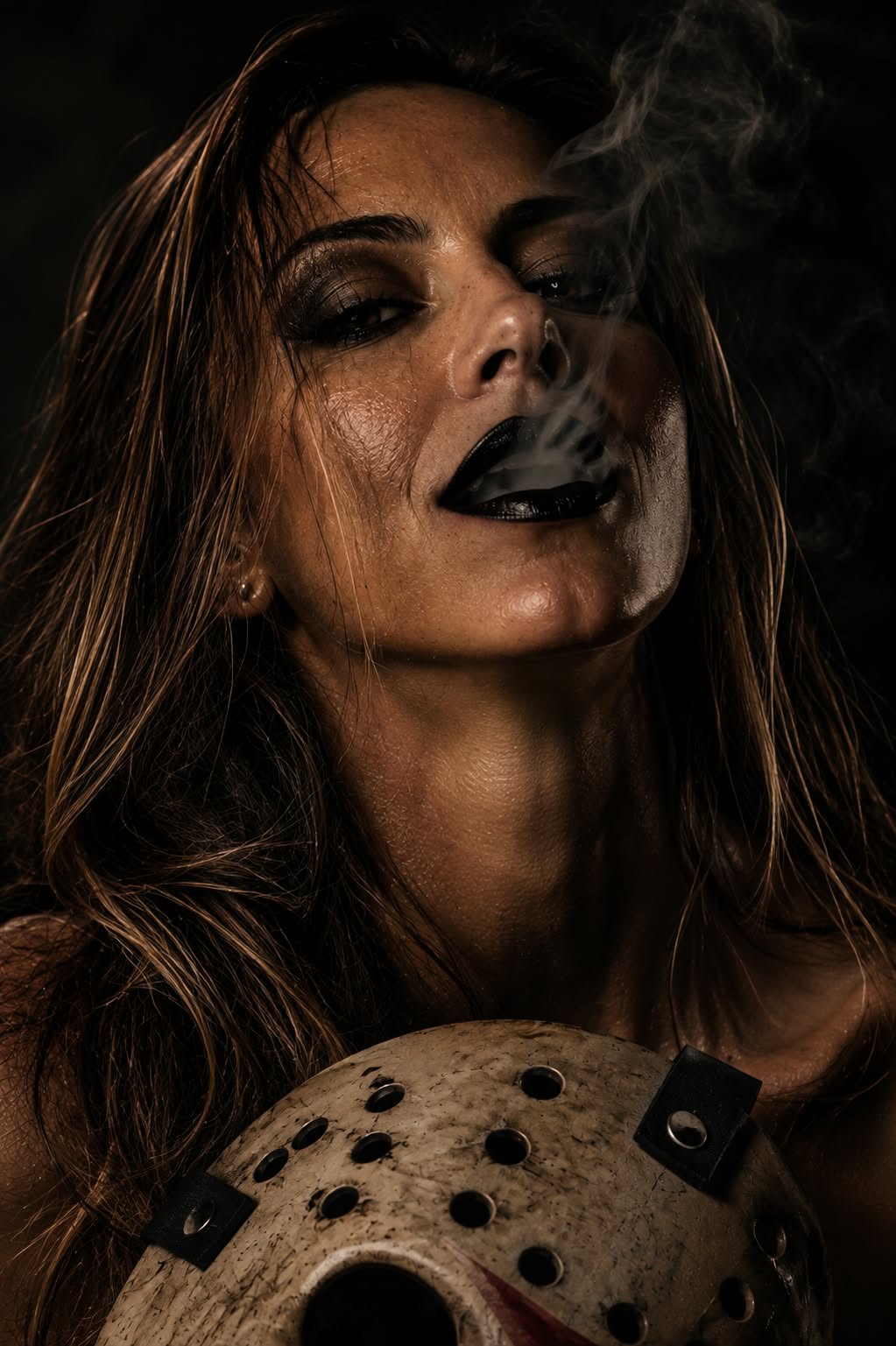
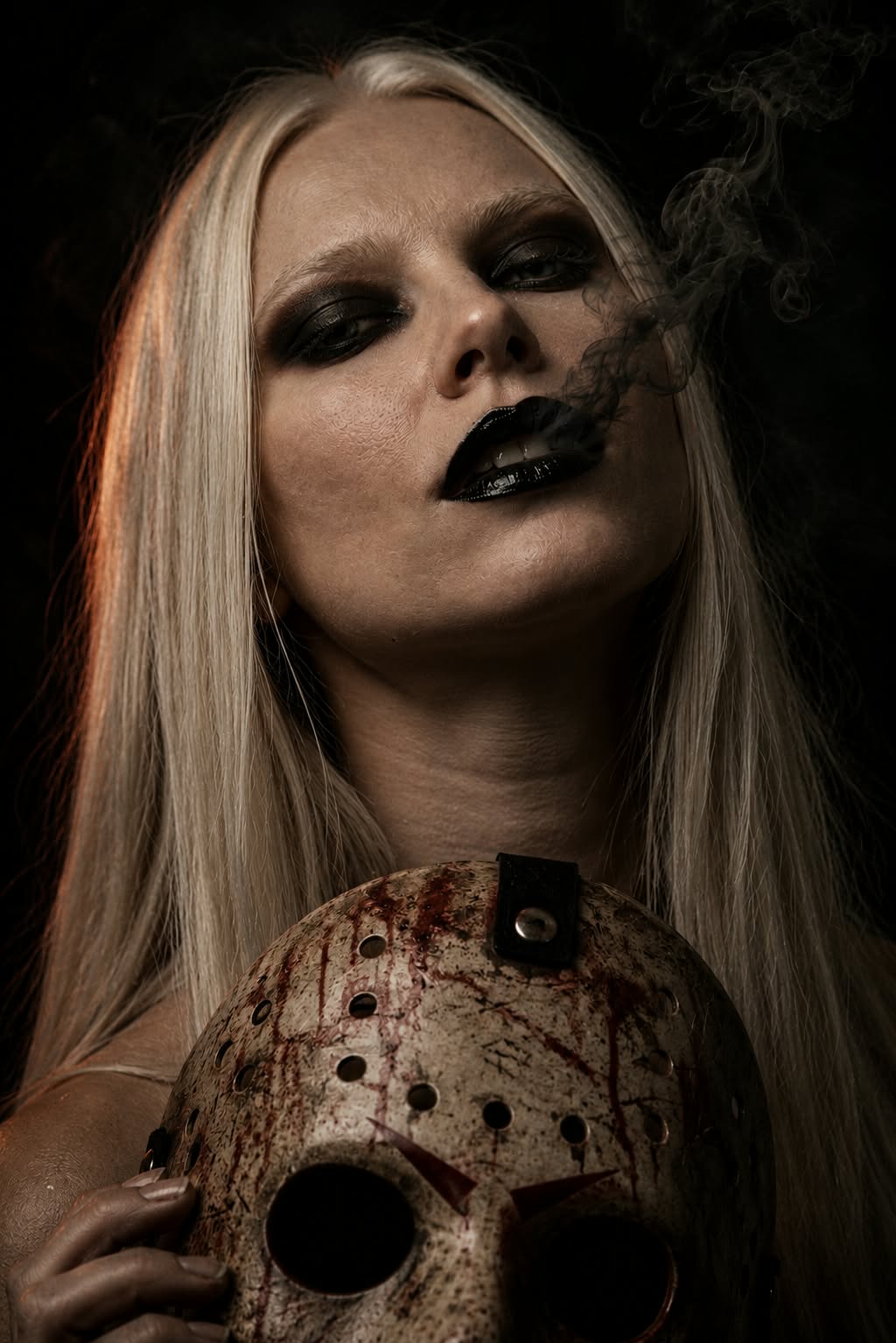
Create a dark, cinematic horror-fashion portrait of a woman with a sarcastic expression, glossy black lips, and smoke rising from her mouth. Reference photos guide the model’s identity and the worn hockey mask, while the prompt specifies the close-up composition, lighting, and analog-film look
Example outputs
Prompt template
- Format
- Text
- Inputs
- Model_reference_photo (image) · Required Original_mask_reference_photo (image) · Required
- Outputs
- Horror_fashion_portrait (image)
Create an editorial psychological-horror photograph with a dark, sophisticated, provocative cinematic look. The female model should have a mysterious, dominant, intimidating presence and a sarcastic, asymmetrical, slightly provocative smile, as though amused by her own darkness. Tilt her head slightly backward and to one side for an expressive, asymmetrical composition. Keep her lips partially open as dark smoke emerges naturally between them and rises in front of her face. Make the image look like a real cinematic photograph, with organic texture, natural imperfections, and optical depth.

IDENTITY PRESERVATION
Use the supplied photograph of the model as the exclusive identity reference. Preserve her original facial structure and proportions; the shape of her eyes, nose, lips, and eyebrows; her natural eye color; her original skin tone and undertone; natural skin texture, pores, fine lines, and small imperfections; and her hair color, cut, length, and volume. Preserve individual features and natural asymmetries. Do not change her identity, slim her face, alter her skin tone, make her look younger, or apply artificial smoothing. She must remain recognizably the same person as in the reference photo.

POSE AND EXPRESSION
Give the model a restrained, sarcastic, asymmetrical smile, with one corner of her mouth slightly raised and her lips partly open. Her expression should convey sophisticated mockery, confidence, and a quiet threat, not an exaggerated or artificial grin. Give her an intense, confident, half-lidded gaze and a slight expressive asymmetry in her eyebrows. Tilt her head backward with a small sideways turn and keep her neck naturally elongated.

DARK GLAM MAKEUP
Eyes: Apply intense editorial makeup with a predominantly matte, deep smoky finish. Use dark coffee brown as the transition base, chocolate brown concentrated in the crease, and intense charcoal black at the outer corner, with a gradual blend between brown and black. Extend the smoky shape horizontally to emphasize the eyes’ natural shape. Blend deep black eyeliner into the shadow and darken the lower lash line with black and brown. Keep the lashes full, separated, and defined, with realistic depth at their roots. Show realistic pigment, visible layers of shadow, and smooth transitions; do not use glitter or metallic particles.

Lips: Apply intense black lipstick with a wet, glossy finish and photographic highlights. Use deep black pigment and a defined contour. Keep the texture creamy, with gloss concentrated at the center of the lips. Let realistic reflections emphasize the lips’ natural shape without altering their anatomy.

DARK SMOKE EFFECT
Make dense, dark smoke emerge directly from the model’s mouth, as if it were a physically realistic breath in a cold, dark environment. Concentrate the smoke between the lips at first, then let fine filaments separate from the main mass and move upward irregularly. Include small swirls, translucent areas, and natural variations in density. Let the smoke pass partly in front of the face without completely hiding the eyes. Use side lighting to reveal its edges and particulate texture. Give the smoke three-dimensional depth and organic movement; avoid the appearance of digital brushstrokes or artificial haze.

DISTRESSED HORROR MASK
Use the supplied original mask photo as the faithful reference for the mask’s design. Show a rigid, rounded, anatomically shaped horror hockey mask with an aged, ivory-white molded-plastic surface. Include numerous circular black ventilation holes; two large, completely dark eye openings; fine scratches and worn marks; yellowish and brownish stains; characteristic angular red markings; a black rectangular piece at the top with a circular silver metal detail; and black side fasteners. Make the mask look old, worn, and realistic.

Hold the mask low, around the model’s neckline and upper chest, in the lower foreground and partly within the frame. It must not cover her mouth, chin, or any important part of her face. One hand should naturally hold the edge of the mask, with anatomically correct fingers and realistic nails. Bring the mask close enough to the lens to create depth, but keep it from competing with the face.

NATURAL HAIR DETAIL
Preserve exactly the model’s hair color, cut, length, and characteristics as shown in the reference. Show individually identifiable strands, natural chestnut and golden variations, small loose hairs near the roots and sides, irregular organic texture, and natural highlights on illuminated strands. Give the hair realistic volume and subtle movement following the head’s tilt. Avoid solid blocks of hair, excessively perfect strands, or a digital-wig appearance.

REALISTIC SKIN TEXTURE
Render the skin with faithful macro-level human detail: visible individual pores, epidermal microtexture, natural expression lines, small pigment irregularities, realistic texture around the eyes and lips, natural skin-oil highlights, authentic transitions between light and shadow, and natural detail around the nose, cheeks, and forehead. Do not use porcelain skin, blur, beauty filters, a plastic finish, or artificial sharpening. Makeup must sit on real-looking skin without erasing its texture.

EXTREME CINEMATIC CLOSE-UP
Abandon the conventional frontal portrait. Use an extreme close-up from a diagonal three-quarter perspective, with the camera slightly below the face. The lower, side angle should create an unusual cinematic perspective without distorting the face or exaggerating anatomical proportions. Let the face occupy approximately 70% of the image. Keep the camera close to the model; angle her head backward and slightly to the side; place the mask in the lower part of the frame; let the smoke rise toward the top; allow some hair to fall naturally along the sides; and show part of the shoulders. Create visual intimacy, tension, and personality. Avoid rigid centering, excessive symmetry, and the look of a conventional studio portrait.

DARK CINEMATIC LIGHTING
Use dramatic lighting inspired by psychological thrillers and analog horror photography. Place the key light laterally at approximately 45 degrees, add a soft rim light to the hair, and keep fill light minimal to preserve the shadows. Add subtle reddish reflections along the edges, a small light directed at the smoke, and controlled light on the glossy lips. Keep the background almost completely black. Reveal skin and hair texture without losing the dark atmosphere.

BACKGROUND
Use a deep black background with faint ambient smoke to create a mysterious, cinematic nighttime atmosphere. Keep the background smoke subtle so the smoke emerging from the mouth remains more prominent. Include no decorative objects, busy scenery, or distracting elements.

ANALOG HORROR CINEMA TEXTURE
Create a distinctive look inspired by 1990s analog cinematic photography. Use fine organic 35mm film grain, natural microcontrast, high-resolution photographic texture, deep blacks with preserved detail, warm brown and amber tones in illuminated areas, subtle burnt reds, gentle halation in the highlights, natural exposure transitions, and true optical sharpness without excessive sharpening. The image should resemble a photograph captured during a professional film production, not a digital rendering.

CAMERA AND OUTPUT SETTINGS
Camera: Sony A1 Full Frame.
Lens: 85mm f/1.4 GM.
Aperture: f/2.8.
Shutter speed: 1/250s.
ISO: 400.
White balance: 3800K.
Focus: the eyes and facial expression.
Depth of field: shallow cinematic depth.
Exposure: -0.7 EV.
Color depth: 16-bit RAW.
Resolution: 8K.
Aspect ratio: 9:16 vertical.

NEGATIVE PROMPT
Do not change the model’s identity, skin color, hair, face shape, or lips. Do not create an artificial smile or exaggerate how far the mouth is open. Do not let smoke hide the eyes. Do not place the mask over the face or raise it to the mouth. Do not alter the original mask design, remove its red markings, or eliminate its holes. Do not create extra fingers, deform the hands, make the hair look artificial, smooth the skin, use a porcelain-skin effect, create a CGI appearance, use conventional frontal lighting, or turn the composition into a generic portrait.

FINAL DIRECTIVE
Produce an extreme-close-up editorial psychological-horror photograph with a diagonal cinematic perspective and the camera slightly below the face. The model should have a sarcastic, asymmetrical, provocative smile, with her head tilted backward and slightly to the side. Dense, dark, three-dimensional smoke should emerge naturally from her mouth and rise in front of her face. Give her eyes a sophisticated charcoal-black and coffee-brown gradient with deep, dimensional smoky makeup, defined lashes, and glossy black lipstick. Preserve the model’s identity, original skin tone, hair, and natural characteristics in full. The aged hockey mask from the original reference photo must be held low around the neckline, occupying only the lower part of the frame without hiding the face. Show extremely realistic epidermal texture, visible pores, individual hair strands, natural microdetails, cinematic side lighting, and organic analog grain. The result should convey a mysterious, powerful, sardonic woman with dark beauty and a hypnotic visual presence.

THE LAST BREATH — THE SMILE BEFORE THE DARKNESS
What you'll create
This prompt creates a cinematic horror-fashion close-up of a woman with a sarcastic expression, dark smoky eye makeup, and glossy black lipstick. Dark smoke rises in front of her face, while she holds a worn hockey mask low in the frame against a nearly black background
Generation settings
Usage instructions
Frequently asked questions
What should the reference photos show?
Use a photo of the model as the identity reference and the original mask as the object reference; they may be separate images
Where should the mask appear in the composition?
Keep it in the lower foreground near the model’s chest, without covering her face
How should the smoke interact with the face?
Have it rise from between the lips and pass partly in front of the face, while leaving the eyes visible


Comments
Tried this prompt? Share what you made, compare results, or ask a question