Vintage Instant-Camera Laughter Portrait
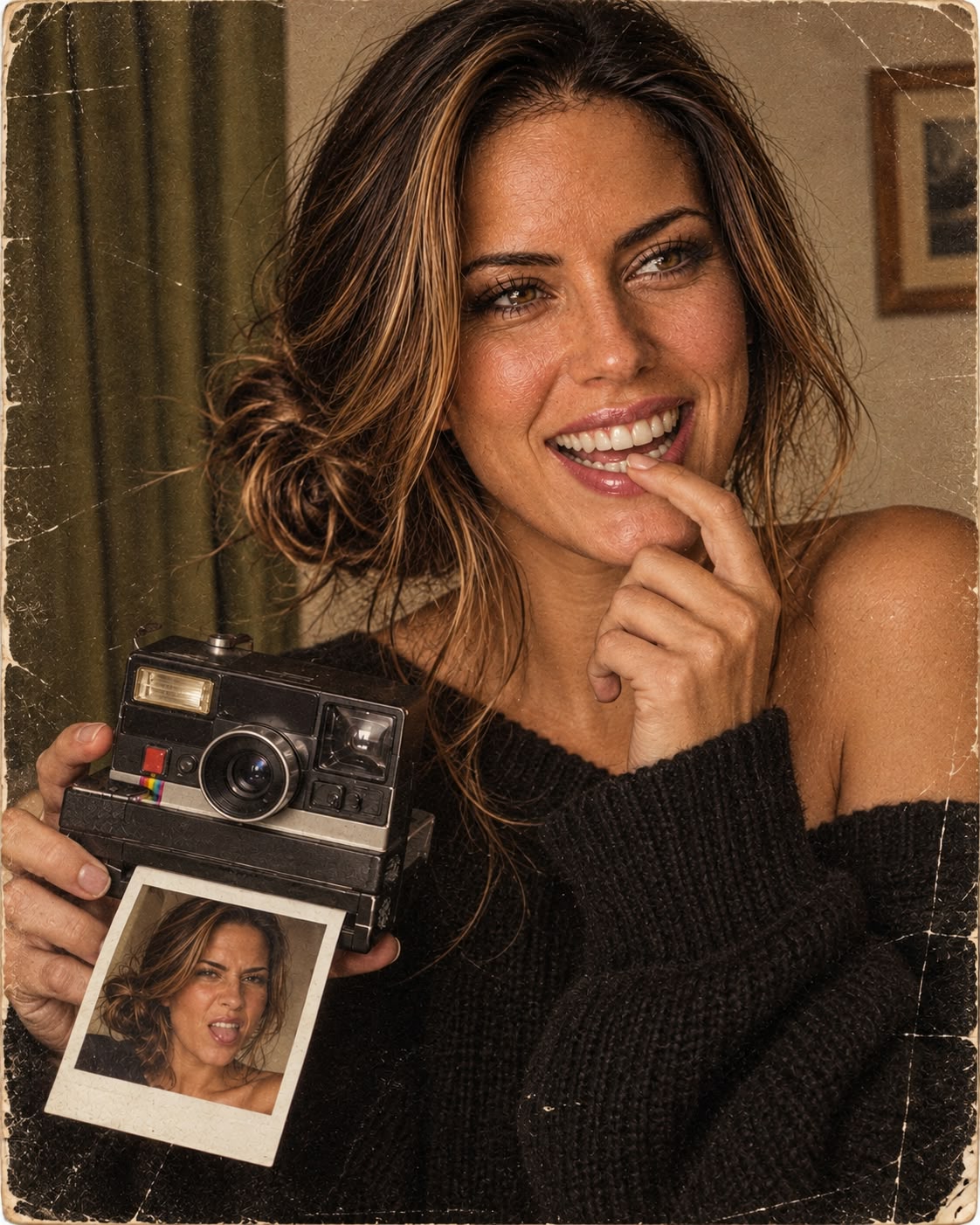
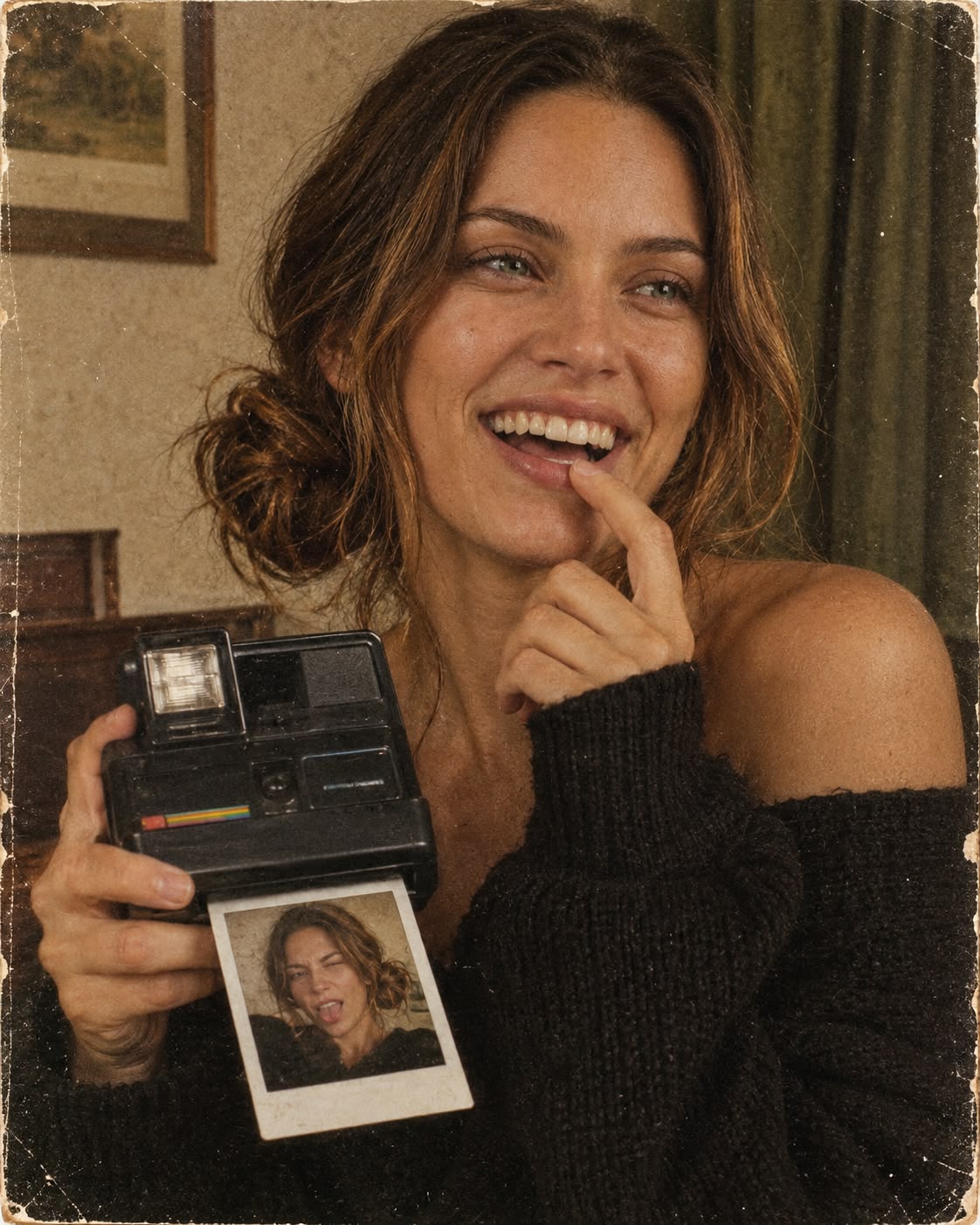
Create a candid, nostalgic analog-style portrait of the woman in a reference photo, laughing with a vintage instant camera in a cozy old British home. The camera ejects a photo of her making a playful face.
Example outputs
Prompt template
- Format
- Text
- Inputs
- Original (image) · Required
- Outputs
- Photographic_portrait (image)
☀️ JOY IN MOTION — THE BEAUTY OF LAUGHTER
ME BEFORE YOU — THE LOST PHOTOGRAPH
VINTAGE ANALOG PHOTOGRAPHY • CANDID EDITORIAL • AUTHENTIC JOY • BRITISH ROMANTIC AESTHETIC • EXTREME MATERIAL REALISM • ULTRA-PHOTOREALISM
FORMAT: Vertical 4:5
DIRECTION: Candid, intimate, documentary, and nostalgic photography.
INSPIRATION: The emotional atmosphere of Me Before You (2016), reinterpreted as an old photograph found in a family album.

• CONCEPT — A MEMORY INSIDE A MEMORY
Create ONE extremely photorealistic photograph, as if it were a candid record made several decades ago.
The protagonist is experiencing a moment of genuine happiness while holding a vintage 1980s/1990s instant camera.
An instant photograph is partially emerging from the camera. It shows the protagonist herself making a funny face, with a mischievous expression, slightly puffed cheeks, and her tongue subtly sticking out.
The photograph within the photograph must clearly show the same woman, preserving her facial features and individual identity.
The composition should convey a fun, spontaneous, and lively memory.
The visual concept should represent two versions of the same happiness: laughter captured by the main camera and a funny face preserved in the instant photograph.

• IDENTITY — ABSOLUTE IDENTITY LOCK
Use only the original reference photograph as the primary and required source of identity.
ABSOLUTE PRESERVATION:
Original facial structure and shape.
Brown eyes and their natural iris characteristics.
Original eyebrows.
Nose, lips, jaw, and chin.
Natural skin tone and undertone.
Pores, microtexture, and individual facial characteristics.
Apparent age and body proportions.
Original hair color, length, and characteristics.
The expression may change naturally, but the woman’s individual identity must remain immediately recognizable.
The printed photograph emerging from the camera must also depict the same protagonist, without face substitution or creating a different person.
ABSOLUTE FACE LOCK • SKIN TEXTURE LOCK • HAIR IDENTITY LOCK • BODY PROPORTION LOCK.
Do not replace the protagonist with any actress from the film.
Do not apply artificial beautification, de-aging, anatomical alterations, or facial filters.

• EXPRESSION — AUTHENTIC JOY
A spontaneous, open, contagious laugh.
Naturally open mouth.
Visible teeth, with natural anatomy and proportions.
Eyes slightly narrowed by laughter.
Raised cheeks.
Small, natural expression lines.
Head tilted slightly.
Gaze directed toward someone outside the frame.
The expression should convey genuine amusement, complicity, and spontaneity, without looking posed.

• HAIR — SIGNATURE SIDE LOW BUN
REQUIRED HAIRSTYLE: A SLIGHTLY UNDONE LOW SIDE BUN.
Brown hair with golden highlights, respecting the reference’s original shade.
The bun is positioned at the side, near the nape of the neck, offset to one side of the head.
Slightly irregular, undone structure.
Natural volume at the crown.
Delicate loose strands around the face.
Small flyaways at the sides and nape.
Natural texture, without a rigid or excessively styled finish.
The bun must be clearly visible in the composition.
EXTREME HAIR STRAND REALISM:
Every strand must be individually defined, with naturally varied thickness, direction, and density.
Preserve realistic separation between locks, shorter strands, flyaways, and small natural irregularities.
Golden and brown highlights should appear organically, following the direction of each lock.
Create depth between strands, internal shadows, and a soft, irregular hair sheen.
The hair must not look like a solid mass, painted surface, or artificial wig.
Do not create a centered bun, high bun, ponytail, or completely loose hair.

• WARDROBE — COZY BRITISH PERSONALITY
OVERSIZED BLACK WOOL KNIT
A heavy, voluminous, oversized black wool sweater.
A wide, asymmetrical neckline, naturally slipped off one shoulder.
Long, voluminous sleeves.
Chunky knit texture.
Visible natural fibers.
Comfortable, slightly unstructured fit.
EXTREME WOOL FIBER REALISM:
The wool must show individual fibers, defined knit stitches, and physically convincing interweaving.
Show the material’s real thickness, small surface irregularities, subtly loose fibers, and deep shadows between the stitches.
Folds should have natural weight, compression, and volume.
Lighting should reveal the fabric texture without turning the black into a smooth or artificial surface.
The garment should convey comfort, personality, and spontaneity.
Do not add extra clothes, socks, or visible footwear.

• MAIN OBJECT — VINTAGE INSTANT CAMERA
The protagonist holds an authentic instant camera inspired by popular 1980s/1990s models.
FEATURES:
Compact vintage plastic body.
Characteristic geometric design from the era.
Black finish with gray details and small colorful elements.
Circular front lens.
Optical viewfinder.
Physical shutter button.
Small signs of natural wear.
Appearance of old photographic equipment.
REQUIRED NARRATIVE DETAIL:
An instant photograph is partially emerging from the camera’s ejection slot.
The printed image must show the protagonist herself making a funny face.
In the photograph:
The same face and identity as the protagonist.
Playful, irreverent expression.
Slightly puffed cheeks.
Tongue subtly sticking out.
Expressive eyes and an amused gaze.
The appearance of an old instant photograph.
Characteristic white border.
The photograph must be visible enough for the funny face to be recognizable.
The camera and printed photograph must have physically correct proportions, coherent perspective, and natural integration.
Preserve the texture of aged plastic, small mechanical details, the glass lens, and the physical characteristics of photographic paper.
Do not turn the camera into a smartphone, modern digital camera, or futuristic object.

• POSE — A MOMENT WORTH KEEPING
The protagonist appears relaxed, leaning slightly diagonally.
One hand naturally holds the instant camera, keeping the partially revealed photograph visible.
The other hand is near her mouth, with the index finger gently touching her lower lip, preserving the composition’s characteristic gesture.
Relaxed, asymmetrical shoulders.
Head slightly tilted.
Body leaning naturally.
A spontaneous laughing expression.
The interaction between the camera, photograph, and laughter should feel completely spontaneous.
Hands must have realistic anatomy, natural fingers, proportional nails, and a physically plausible grip.
Do not create extra fingers, deformations, or artificial joints.

• COMPOSITION — THE ORIGINAL PHOTOGRAPHIC FEEL
Tight medium shot, from the bust to the top of the head.
The face is the main point of attention.
The side bun is clearly visible.
Position the instant camera in the frame so that the object and the photograph emerging from it are clearly identifiable.
Do not let the camera hide the face.
Do not crop the instant photograph.
Balance three elements in the composition:
The facial expression and laughter.
The vintage camera.
The photograph of the funny face.
Preserve a documentary framing, as if someone had captured the scene without the protagonist noticing.

• SETTING — A BRITISH HOME FULL OF MEMORIES
A cozy old residential interior.
Hand-plastered beige-gray wall with hints of sand, warm brown, and ochre.
A tall brownish olive-green curtain, with substantial fabric and natural folds.
Subtle details of an old British home, softly out of focus.
An intimate, nostalgic, cozy atmosphere.
No excess decorative objects or modern elements.

• PHYSICAL TEXTURES — EXTREME MATERIAL REALISM
ABSOLUTE PRIORITY: PHOTOGRAPHICALLY FAITHFUL HUMAN SKIN, HAIR, FABRIC, AND MATERIALS.
SKIN — NATURAL HUMAN SKIN MICROREALISM
Preserve real human skin texture, including:
Individually visible pores, naturally distributed.
Detailed epidermal microtexture.
Fine expression lines.
Small natural irregularities.
Subtle variations in tone and pigmentation.
Realistic texture around the eyes, nose, lips, and forehead.
Natural skin sheen, without an artificial oily appearance.
Organic transitions between light and shadow.
Preserve small individual skin characteristics.
Skin should have real depth and three-dimensionality, without excessive digital smoothing.
Do not remove pores, erase natural lines, or create a uniform surface.
HAIR — INDIVIDUAL HAIR STRAND REALISM
Every strand should appear visually distinct, with natural definition, thickness, and physical behavior.
Preserve:
Individual strands.
Locks with varied density.
Organic golden and brown highlights.
Depth at the roots.
Flyaway hairs.
Small loose hairs.
Three-dimensional volume.
Internal shadows between locks.
Natural, irregular sheen.
FABRIC — REALISTIC WOOL FIBER DETAIL
The sweater should show:
Individual wool fibers.
Chunky knit and defined interweaving.
Three-dimensional knit stitches.
Small natural irregularities.
Subtly visible fine fibers.
Folds with weight and volume.
Deep shadows between the stitches.
MATERIALS — PHYSICAL SURFACE REALISM
The camera should show realistic aged plastic, a glass lens with natural optical reflections, and small signs of wear.
The instant photograph should show photographic paper with thickness, a white border, subtle texture, and an aged printed finish.

Every material must have its own physical characteristics, without looking digitally rendered.
ZERO PLASTIC SKIN • ZERO WAX EFFECT • ZERO PAINTED HAIR • ZERO CGI FIBERS • ZERO SMOOTH FABRIC • ZERO ARTIFICIAL SURFACES.

• VINTAGE AESTHETIC — AN OLD PHOTOGRAPH
The main photograph should look like a color analog print from the 1980s/1990s.
Warm, gently faded tones.
A subtle amber cast.
Moderate contrast.
Slightly lifted blacks.
Aged whites.
Fine, organic film grain.
Small exposure variations.
Subtle old photographic-paper texture.
Slightly worn edges.
Small signs of age.
The instant photograph emerging from the camera should also look analog, with a white border and slightly faded colors.
Keep the aging elegant and subtle.
IMPORTANT: Grain, aging marks, and wear should belong to the surface of the printed photograph, not replace or erase the natural texture of the skin, hair strands, or fabric fibers.
Do not exaggerate scratches, stains, cracks, or wear.

• LIGHTING AND PHOTOGRAPHIC DIRECTION
Warm, diffused natural side light.
Delicate golden highlights on the skin and hair.
Soft, organic shadows.
Lighting that reveals the skin’s microtexture, the separation of hair strands, and the raised wool fibers.
Simulate an analog camera with:
Focal length: 50 mm.
Aperture: f/2.8.
Shutter speed: 1/125 s.
ISO: 400.
Focus priority on the face.
Natural depth of field.
Keep the vintage camera and printed photograph sharp enough to be recognized.
Natural optical sharpness, without excessive sharpening.
The image should show real detail, not an artificially hyper-defined appearance.

• NEGATIVE PROMPT — STRICT PROTECTION
Do not alter the woman’s facial identity.
Do not replace her face.
Do not modify her eyes, nose, mouth, or facial structure.
Do not make her look younger.
Do not apply beauty filters.
Do not remove pores or microtexture.
Do not create plastic, waxy, excessively smooth, or artificial skin.
Do not turn the hair into solid blocks, a painting, a synthetic surface, or a wig.
Do not create repetitive strands or artificial locks.
Do not leave the hair loose.
Do not create a high or centered bun.
Do not create a ponytail.
Do not omit the low, slightly undone side bun.
Do not turn the sweater into smooth fabric.
Do not remove the wool fibers or knit texture.
Do not remove the camera.
Do not replace it with a smartphone.
Do not create a modern camera.
Do not make the instant photograph invisible.
Do not show a different person in the printed photograph.
Do not deform the camera, photograph, or hands.
Do not remove the index finger near the lower lip.
Do not add extra clothes, socks, or footwear.
Do not exaggerate scratches, cracks, or stains on the photograph.
Do not let excessive grain compromise the clarity of facial features.
ZERO CGI • ZERO 3D RENDER • ZERO ILLUSTRATION • ZERO PLASTIC SKIN • ZERO FACE REPLACEMENT • ZERO ARTIFICIAL ANATOMY • ZERO PAINTED HAIR • ZERO SYNTHETIC FABRIC.

• FINAL RESULT — THE BEAUTY OF A MEMORY ☀️
An old, candid, extraordinarily realistic photograph.
The protagonist is laughing, her brown hair illuminated and pinned into a low, slightly undone side bun, wearing an oversized black wool sweater slipped off one shoulder.
Her skin shows pores, microtexture, small irregularities, and natural human details.
Her hair shows individual strands, brown and golden highlights, organic volume, and small loose strands.
The sweater reveals a chunky knit, with individually recognizable wool fibers and physically convincing folds.
She holds a vintage 1980s/1990s instant camera, from which a photograph of the protagonist herself making a funny face is partially emerging.
Her other hand remains near her lips, with the index finger gently touching her lower lip.
In the background, an old British home with aged beige tones and an olive-green curtain.
The entire image has analog texture, gently faded colors, film grain, and the appearance of a printed photograph preserved for decades.
THE PRIORITY IS A PHYSICALLY CONVINCING PHOTOGRAPH, NOT A DIGITAL IMAGE THAT LOOKS LIKE A PHOTOGRAPH.
A photograph that keeps a laugh. And another photograph that keeps a funny face.
Two versions of the same happiness, preserved in time. ☀️
What you'll create
A candid portrait shows a joyful woman holding a vintage instant camera in an old British home. The emerging photograph depicts the same woman making a mischievous face, with faded colors and analog grain connecting both moments.
Usage instructions
Provide the original reference photo, since it is required for the subject’s identity. The prompt builds a candid analog-photography scene around the reference while preserving the same woman in both the main image and the instant print. For a different framing, adjust the specified vertical 4:5 composition while keeping the woman, camera, and emerging photo clearly visible.
Frequently asked questions
Are two different women shown?
No. The main portrait and emerging instant print depict the same woman.
Is the print meant to look newly digital?
No. The entire scene evokes a physical photograph preserved for decades.


Comments
Tried this prompt? Share what you made, compare results, or ask a question