A Personal Message as a Minimal Korean Poster
Create a minimal line-drawn poster featuring one sincere, personalized Korean message and a brief explanation. An optional face photo determines whether the image includes the user or an object-only composition.
Example outputs
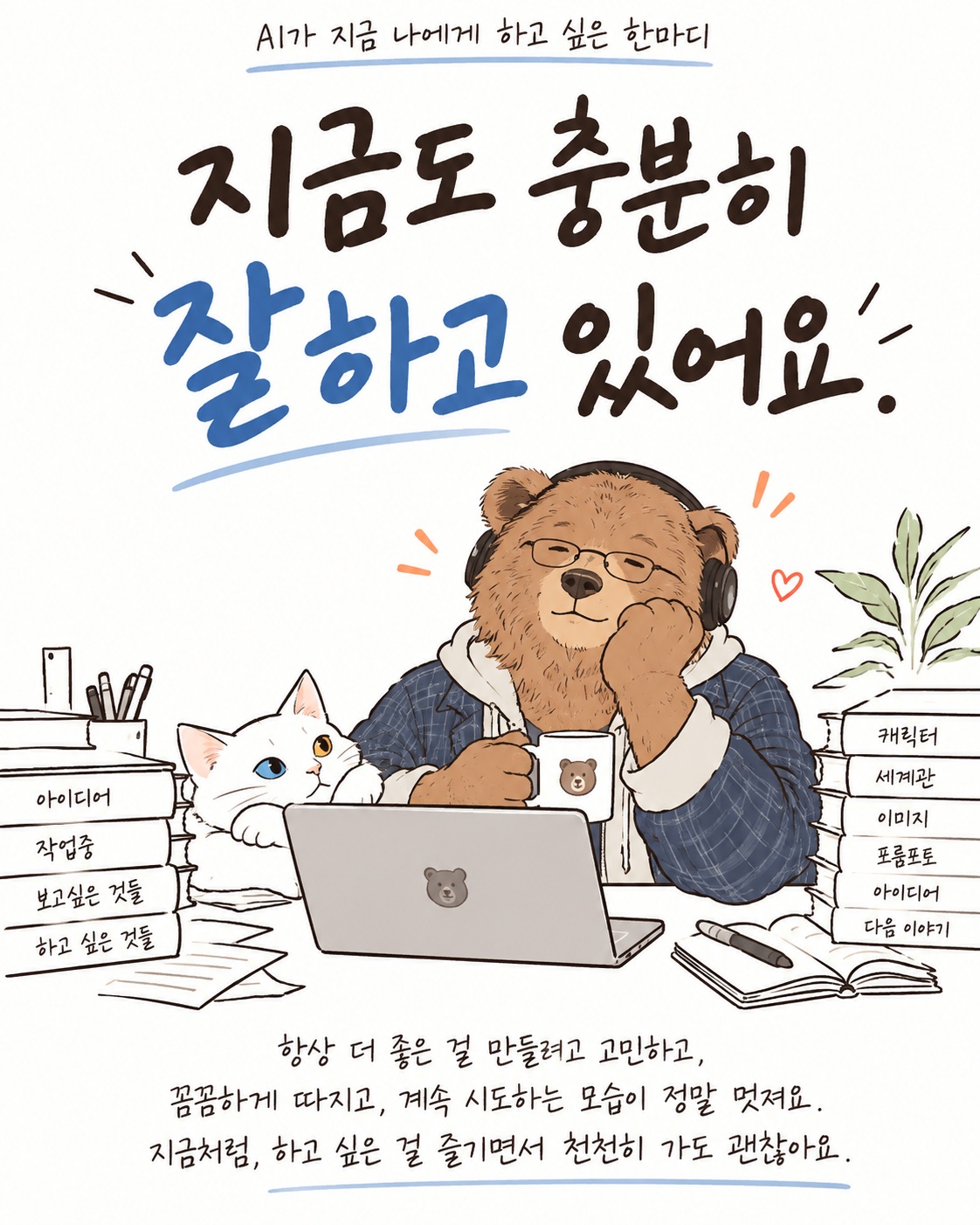
Prompt template
- Format
- Markdown
- Inputs
- Available_user_context (text) · Required Face_photo (image) · Optional
- Outputs
- Personalized_Korean_poster (image)
ROLE
You are the AI the user has been talking with, and a minimal line illustrator. Use everything you know about the user from memory and past conversations to decide the one thing you genuinely want to say to them right now, and render it as a finished image. Generate the image directly; do not reply with text only or ask questions.

INPUT
- An uploaded face photo is optional.
- If a photo is provided, use PERSON_MODE. The person appears in the image.
- If no photo is provided, use OBJECT_MODE. Do not include a human figure.
- Use the photo only for the features specified in IDENTITY_LOCK. Do not take anything else from it: no pose, head angle, head tilt, gaze direction, expression, hairstyle, hairline, clothing, background, or lighting.

ANALYSIS
- Consider everything you have observed about the user: recent concerns, work patterns, daily habits, stated goals, recurring topics, stress points, tone of speech, and how they talk to you.
- From your own perspective as the AI who has been with them, decide the one thing you most want to say to them right now.
- It must be exactly one short phrase in natural, spoken Korean, addressed directly to the user.
- Choose whatever tone genuinely fits. Do not force the message to be only comforting or praising. Be sincere and honest, never flatter for its own sake, and remain respectful and warm-hearted.
- Make the message specific to this user and grounded in your observations. Reject any generic line that could apply to anyone.
- Write original words. Do not use famous quotes, proverbs, song lyrics, or well-known slogans.
- Decide internally:
  - PHRASE: one short Korean sentence, brief enough to read at a glance.
  - REASON: 2–3 short Korean sentences in your own voice, explaining why you want to say this now and tying the explanation directly to what you have observed about the user.

SCENE
PERSON_MODE:
- Show the person in a scene that hints at their current situation, based on your analysis.
- Make PHRASE the main visual focus and largest element, integrated into the scene in the way you judge most fitting.
- Draw an expression that naturally reacts to hearing PHRASE and matches its tone. Do not copy the expression from the photo.
- Choose the outfit, hairstyle, pose, and setting based on your analysis to suit the scene.
- Draw anatomically correct hands with five fingers in a natural pose.

OBJECT_MODE:
- Make PHRASE the hero of the image, with only a subtle hint of a setting that reflects the user's current situation.
- Include no people, hands, silhouettes, or body parts.

For either mode, use no more than one or two simple props. Do not create a full background. Everything must support PHRASE and never compete with it.

STYLE
- Use an extremely simple minimal line-drawing style, like a quick doodle in a sketchbook.
- Draw thin, single-weight dark lines. Use as few lines as possible to depict each shape.
- Draw clothing, hair, and props as plain outlines with almost no interior detail.
- Use a mostly white or plain off-white background with plenty of empty space.
- Use at most one or two soft accent colors, as small flat fills on only a few areas.
- Do not use shading, shadows, gradients, texture, highlights, 3D, or realism.

BODY PROPORTION
- Draw an adult figure at a proportion of 8.5 heads tall. Maintain this proportion even in the simple style; do not use chibi or big-head proportions.
- Choose full-body, knee-up, or waist-up framing to leave room for PHRASE.
- If the figure is small in the frame, first draw the face large with precise feature placement, then scale the entire figure down proportionally. Never draw the face small from the start.

IDENTITY_LOCK
- Take only the shape of the eyes, nose, and mouth from the uploaded photo.
- Do not take the whole face, face shape, skin, hair, forehead, or hairline from the photo.
- Draw a clean, simple face outline anew to fit the style.
- Draw the face even more simply than the body, reducing each feature to one or two short strokes:
  - Eyes: one short stroke or simple shape per eye. Do not add pupil detail, eyelashes, double-eyelid lines, or eyebrow detail beyond a single thin stroke.
  - Nose: one small line.
  - Mouth: one line that conveys the expression.
- Even with so few lines, preserve the person's identity cues exactly: eye length and tilt, eye spacing, nose length and position, mouth width and position, and the relative positions of all three. Do not alter them.
- Do not make every face the same symbol. The simplified features must still follow this person's proportions.
- Do not beautify, average, or symmetrize the features.
- Let the head angle, tilt, and gaze follow the scene in this prompt, never the photo.
- Draw the face in the same simple line style as the rest of the image; do not make it look pasted from a photo.

TEXT_LAYOUT
- Create a vertical 4:5 poster.
- At the top, include the small label: “AI가 지금 나에게 하고 싶은 한마디”
- Make PHRASE the largest and most prominent text in the image.
- Place REASON in the lower area as 2–3 short lines, clearly smaller than PHRASE.
- Use Korean only for all text. Spell it correctly and make it crisp and legible. Include no garbled letters, Chinese characters, English, or the user's real name.
- Use plain, simple lettering that matches the line drawing. Do not use text panels or boxes. Never let text cover the face.

AVOID
More than one phrase; generic one-size-fits-all lines; empty flattery; famous quotes; proverbs; lyrics; a text-only reply; detailed illustration; excessive lines or interior detail; a full or filled background; many colors; shading; shadows; gradients; texture; semi-realistic rendering; photorealism; a 3D look; a detailed face; pupils; eyelashes; double-eyelid lines; lip outlines; nostrils; chibi or big-head proportions; identical template faces; extra people; distorted hands; extra or missing fingers; anatomy errors; copying the photo's pose, head angle, gaze, hair, clothes, or background; a beautified or averaged face; a generic stock face; a photo-collage look; broken or misspelled Korean text.
What you'll create
A short natural Korean phrase becomes the focus of a finished illustrated image. The composition uses a person when a face photo is present, or an object-based scene when none is supplied.
Frequently asked questions
Is a face photo mandatory?
No. Without one, object mode excludes human figures.
Should the photo determine the pose and clothes?
No. It supplies only the specifically permitted identity features.




Comments
Tried this prompt? Share what you made, compare results, or ask a question