Adult and Childhood Self in Matching Poses
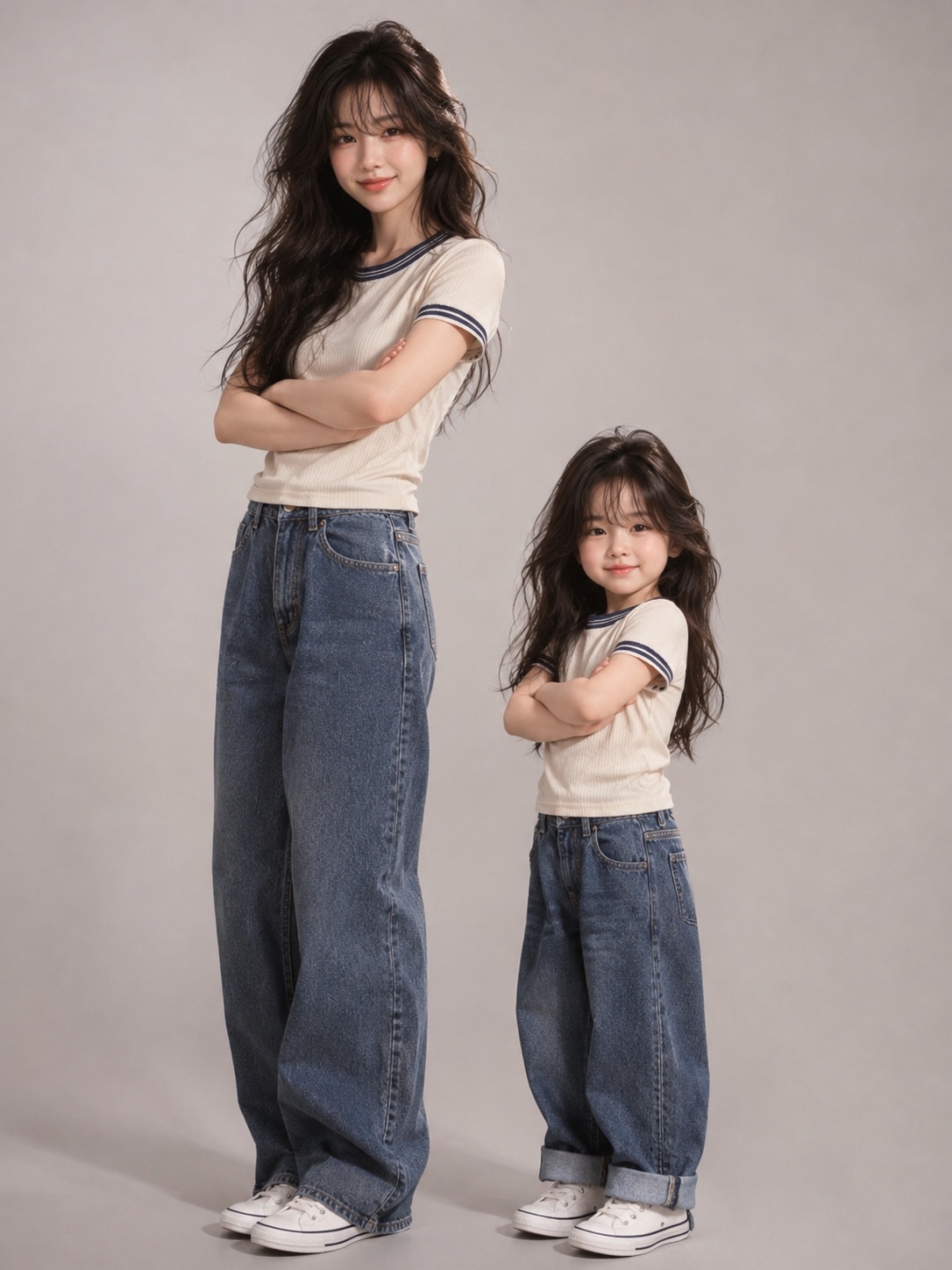
Create a full-body image of the same subject as an adult and a young child, standing side by side in matching poses. Match the uploaded image’s medium and preserve the subject’s recognizable features.
Example outputs
Prompt template
- Format
- Text
- Inputs
- Uploaded_reference_image (image) · Required
- Outputs
- Generated_image (image)
TASK
Create one full-body image of the same subject from the uploaded image as two people standing side by side: the adult version and the same person as a small child.
Both must have exactly the same pose: arms crossed, body turned slightly to the side, and face toward the viewer with a soft smile.
The image style depends on the type of uploaded image.

INPUT_TYPE
- First determine what kind of image was uploaded.
- If it is a real photograph of a person, create a real, photorealistic studio photograph following PHOTO_STYLE.
- If it is a drawing, illustration, anime, cartoon, painting, or 3D character, do not turn it into a real photograph. Draw both people in exactly the same art style as the uploaded image, including its line work, coloring, shading, rendering, and texture. Ignore PHOTO_STYLE. Draw the child in the same style as the adult.

PHOTO_USAGE
- Take only the eyes, nose, and mouth from the image—their shapes, sizes, spacing, and relative positions—and apply them to both people. Do not take the face shape, jawline, lighting, or background.
- Preserve the hairstyle, hair color, and outfit from the image on both people, with matching outfits sized appropriately for each. Complete unseen parts, such as pants and shoes, to match.
- Keep glasses or sunglasses on both people if present in the image; add none if absent.
- Do not take makeup, jewelry, piercings, hats, or hair accessories. Keep faces bare and makeup-free.
- Do not take the pose, head angle, gaze, or expression from the image.
- If the image shows an animal, keep that animal: depict an adult and baby of the same species in the same pose and style.
- Match the subject's gender as shown in the image.

IDENTITY_LOCK
- Both figures must be instantly recognizable as the subject, with a high degree of resemblance.
- The child is the same person as a small child: only the face becomes rounder and chubbier; feature shapes, ratios, and positions remain identical to the adult's.
- The smile changes only the expression, never the features. Do not beautify, average, or symmetrize the features.
- Build each face with full close-up detail first, then scale the entire head down to fit the full-body figure without changing any feature.

COMPOSITION
- Use a vertical 3:4 composition. Show both figures completely from head to feet, with nothing cropped. Leave a small gap between them and center them as a pair.
- Set the camera at the adult's waist height, straight on, using a normal lens with no distortion.

POSE
- Both figures must have exactly the same pose: arms crossed naturally over the chest, bodies turned 20 to 30 degrees toward the same side, and heads turned back so their faces are nearly frontal and level, with eyes directed toward the viewer.
- Keep both feet flat on the floor, with weight slightly on the back leg. The pose should feel relaxed and confident.
- Use natural anatomy and balance. No touching and no props.

BODY
- Adult: about 8.5 heads tall, with natural, slim adult proportions. If the uploaded drawing clearly uses a different head-to-body ratio for its character, follow the drawing's ratio instead.
- Child: about 4 to 6 years old, about 3.5 to 4 heads tall, soft and slightly chubby, with the head reaching the adult's waist.
- Use correct anatomy, including five fingers on each hand and natural joints. Hands are bare, with no nail polish.

FACE
- Adult: natural adult face. Child: round, chubby toddler face with full baby cheeks.
- Both: a soft, gentle, warm smile; lips closed or barely parted; mouth corners lifted; eyes softened but fully open. No teeth and no big laugh.
- Add only a natural, healthy flush on the cheeks; no makeup.

PHOTO_STYLE
Use these instructions only when the uploaded image is a real photograph.
- Create a real studio photo shot on a full-frame camera with a 50mm lens at f/8. Keep both figures sharp from head to toe.
- Show real skin with natural texture and pores, not smoothed or airbrushed. Show real hair strands with flyaways and real fabric texture, seams, and wrinkles.
- Use one consistent softbox light for both figures, with the same direction and color.
- Add natural floor shadows connected to each person's feet and falling in the same direction, so both clearly stand in the same space.
- Use true-to-life color and subtle natural grain.
- Do not make the image look like a 3D render, CGI, doll, figure, wax, or illustration. Avoid plastic or overly smooth skin, sculpted hair, and oversized glossy eyes.

BACKGROUND
Use a plain, seamless, light cool grey-beige backdrop with no objects, rendered in the same style as the rest of the image.

AVOID
- Mixing styles: one person in a different style from the other, or a drawn face on a photo body (or the reverse).
- Floating feet, mismatched shadows or lighting, or a pasted-in or composited look.
- Different poses or turn directions between the figures, awkward or twisted poses, or merged crossed arms.
- Big laughs, visible teeth, or serious or pouty expressions.
- Making the two figures look like different people or the child look like a generic kid.
- Any text, logos, or watermarks. No makeup, jewelry, piercings, or hats.
- Cropped heads or feet, or extra or deformed fingers or limbs.
What you'll create
Two versions of the same person share crossed arms, a slight body turn and soft smiles. The image retains the source’s medium, using a studio photograph for a real photo or matching the original artwork’s style.
Frequently asked questions
Should an illustrated reference become a photograph?
No. Both figures stay in the reference’s original artistic style.
How are their poses related?
The adult and child use exactly the same pose.




Comments
Tried this prompt? Share what you made, compare results, or ask a question