Joseon Figures in a Rococo Court Portrait
Create an aged late-Rococo oil portrait of the person or people in a reference photo, reimagined in authentic Joseon dress. The gender-based figure rules support either a noblewoman or a seonbi, and group portraits when the photo contains multiple people.
Example outputs
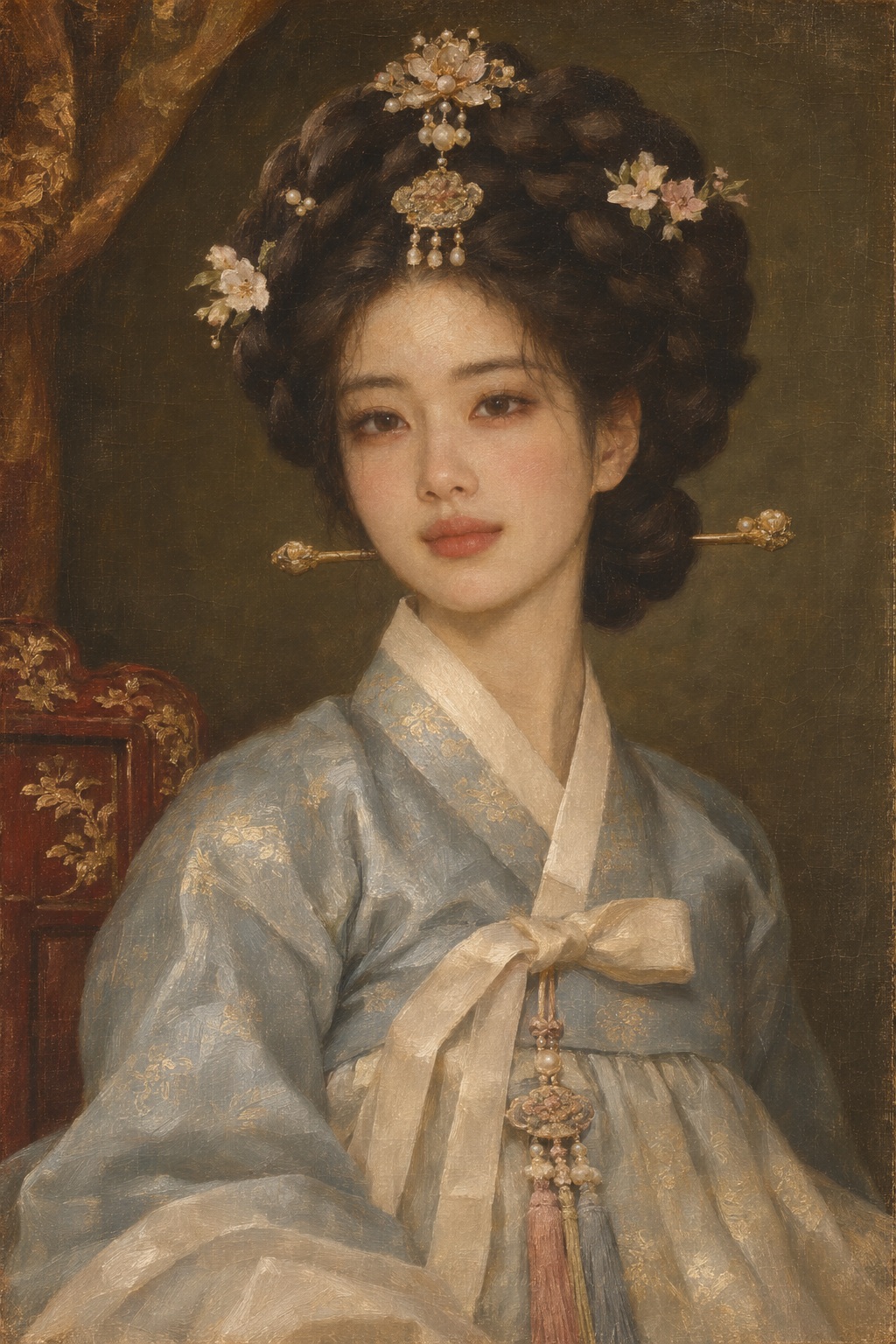
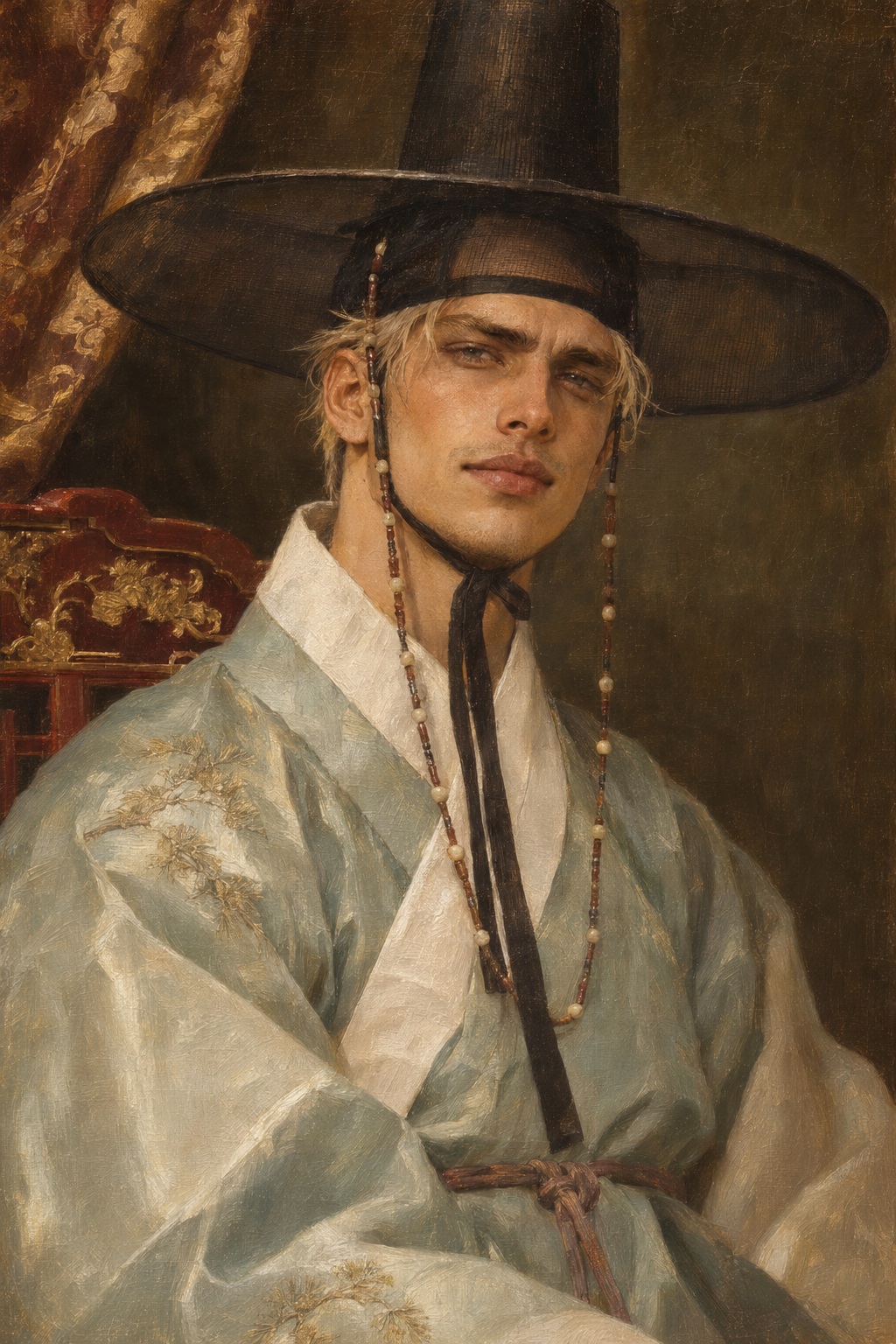
Prompt template
- Format
- Markdown
- Inputs
- Uploaded_photo (image) · Required
- Outputs
- Portrait (image)
## Task
Create a brand-new 18th-century European court portrait painting in the late Rococo style, following the 1780s oil portrait tradition. Feature the person or people in the uploaded photo, reimagined as Joseon-dynasty Korean figures. The result must look like a genuine 240-year-old oil painting hanging in a museum: the entire image, including the face, must be painted.

Use the uploaded photo only as a facial identity reference for the eyes, nose, and mouth. Define everything else—including painting style, composition, pose, head angle, hair, clothing, and background—according to this prompt. Use a vertical 2:3 aspect ratio.

## Gender and group rules
- If the person is female, depict a Joseon noblewoman in hanbok.
- If the person is male, depict a Joseon seonbi (scholar) in a dopo and gat.
- If the photo contains several people, depict each according to these rules in a formal group portrait, with the main figure in front.

## Art style
Paint the image in oil on canvas, by hand, using the technique of a late-18th-century court portrait painter. Give the entire canvas, including the face, the same painterly treatment: softly blended oil paint, visible brushstrokes, slightly blurred soft edges, and simplified forms.

Paint the skin as matte, softly blended oil paint in warm ivory tones, with gently flushed cheeks. Include no pores, skin-texture detail, or glossy highlights. Paint facial features softly, with gentle edges that melt into the surrounding skin, as in old-master portraits.

Paint silk fabric with soft luminous highlights and loose, confident brushstrokes on its folds. Paint hair with soft feathery strokes and loosely suggested strands. Include visible canvas weave, an aged yellowed varnish tone across the whole image, and very faint craquelure.

Use a muted, refined palette of powder blue, ivory, pearl white, soft rose, warm umber, and olive-brown. Use soft directional light from the upper left, with the face and upper chest brightest and the edges fading gently into shadow.

## Detail balance
The face must not be sharper, smoother, or more detailed than the clothing and background. Keep the face, hair, fabric, and background at one consistent level of painterly detail and brushwork. If any part looks like a photograph, repaint it as oil paint.

## Background
Use a dark, softly mottled olive-brown painted wall, plain and atmospheric. At the left edge, include a partly visible deep red-lacquered Joseon wooden chair back with carved gilded details, and a fold of dark golden-brown silk brocade drapery hanging in the upper left. Keep everything outside the figure dim and understated so the figure glows. Use strictly Korean furniture and textiles; include no European furniture.

## Female figure
Depict a Joseon noblewoman in luxurious hanbok: a powder-blue silk jeogori with an ivory collar band (git and dongjeong); a long, wide otgoreum ribbon tied at the chest as the main decorative bow; and a flowing, high-waisted chima in pale blue-ivory silk with subtle gold-leaf patterning. Show delicate translucent inner layers at the sleeve edges.

Style her hair in a grand late-Joseon gache, a voluminous braided wig piled high on the head, adorned with trembling tteoljam ornaments at the front and top, small fresh flowers, and pearl-like accents. Insert the long binyeo hairpin horizontally through the low bun (jjok) at the back of the head, near the nape, with only its two ends visible on either side behind the head. Never place it across the top or front of the gache.

Leave the ears bare: no earrings or ear piercings. Hang a norigae with silk tassels from the otgoreum. The figure should appear elegant, noble, and softly radiant.

## Male figure
Depict a Joseon seonbi in a refined ivory-to-pale-jade silk dopo with wide sleeves and a clean white collar band, tied with a thin sejodae belt cord. Let the fabric fall in soft, luminous folds.

Give him a traditional black horsehair gat with a wide translucent brim and a gatkkeun (gat string) under the chin. Hide the sangtu topknot under the gat, and show a black manggeon headband at the forehead. The figure should appear dignified, scholarly, and gentle.

## Pose and framing
Use a bust-to-waist portrait, with the figure filling most of the canvas and the top of the head ornament or gat brim near the upper edge. Turn the body slightly three-quarter toward the viewer's left, with relaxed, softly sloped shoulders. Turn the face almost fully toward the viewer, with a very slight head tilt. The eyes look directly at the viewer with a calm, gentle gaze.

Do not copy the head angle, tilt, direction, or gaze from the uploaded photo; use only the pose specified here. Use adult figure proportions of 8.5 heads tall, with a graceful long neck.

## Facial identity
Take only the shape of the eyes, nose, and mouth from the uploaded photo. Do not take the face outline, jawline, skin, hair, forehead, hairline, or makeup from the photo. Newly paint the face shape to fit this portrait style.

Do not take the expression from the photo. Paint a serene, composed expression with a faint, gentle closed-lip smile. Paint the face bare in the 18th-century manner, with only a soft natural flush on the cheeks and soft muted-rose lips; use no modern makeup of any kind.

## Identity lock
Keep the eyes, nose, and mouth exactly consistent with the photo in shape, size, spacing, and relative position. Do not beautify, average, or symmetrize the features; do not enlarge the eyes, shrink the nose, or change the lip shape. The person must be recognizable through these feature shapes, while the face is fully painted in old-master oil technique. Likeness must come from the shapes, not photographic detail.

## Exclusions
- No photographic look, photorealistic face, hyperreal skin, skin pores, 3D render, digital airbrush, pasted-photo face, or face sharper than the rest of the painting.
- No modern makeup: no eyeliner, false eyelashes, lash extensions, gradient lips, glossy lips, K-beauty or idol makeup, or contouring.
- No earrings of any kind or ear piercings.
- Do not place the binyeo across the top or front of the hair.
- No European dress, lace ruffles, corsets, powdered European wigs, or ostrich feathers.
- No Chinese hanfu, Japanese kimono, or mixed East Asian costume; use authentic Korean Joseon dress only.
- No text, signature, frame, or watermark.
- No extra fingers or distorted anatomy.
- Do not change the face beyond what the facial identity and identity-lock instructions allow.
What you'll create
The subjects receive Korean ceremonial dress within a museum-aged oil painting. Facial features are painted into the same period surface rather than inserted photographically.
Frequently asked questions
Should the garments be European court dress?
No. The clothing must be Joseon Korean attire.
Is a frame included?
No. Frames, signatures and watermarks are excluded.




Comments
Tried this prompt? Share what you made, compare results, or ask a question