Sumpah Pemuda Historical Editorial Portrait
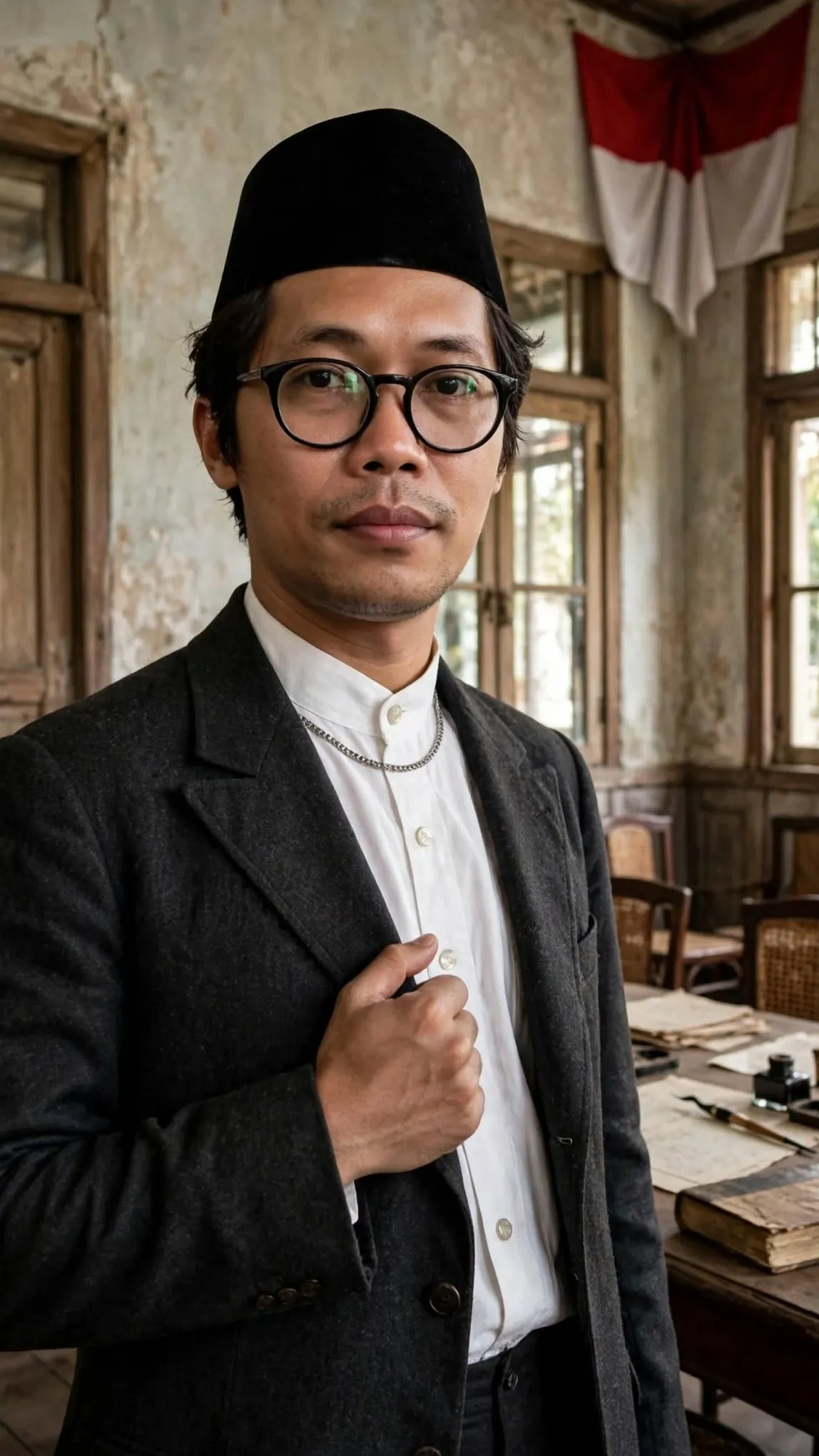
Create one photorealistic historical fashion editorial portrait inspired by Indonesia’s Sumpah Pemuda, with a randomly selected character, outfit, pose, and setting.
Example outputs
Prompt template
- Format
- Text
- Inputs
- Reference_photo (image) · Optional
- Outputs
- Historical_editorial_portrait (image)
Create exactly ONE ultra-photorealistic photograph featuring one adult as a representation of the spirit of Sumpah Pemuda (the Youth Pledge of 28 October 1928). The concept is Indonesian historical cosplay combined with a modern fashion-editorial touch: authentic, distinctive, and filled with pride in the homeland.

Show a real human being with realistic anatomy, natural skin texture, believable clothing details, an emotional expression, and professional photographic lighting. The result must look like a live shoot made with a professional camera—not a commemorative poster, painting, anime, illustration, or 3D character.

1. RANDOM CHARACTER SELECTION

Randomly choose ONE character that best suits the Sumpah Pemuda theme. Do not produce the same character or appearance every time.

Choose one of these concepts at random:
- Young freedom fighter: a young man or woman from the 1928 era in period-appropriate resistance clothing, a classic shirt, traditional fabric, headband, or suitable historical accessories.
- National-movement figure: a young intellectual in a classic formal suit, white shirt, vintage jacket, peci cap, or national-movement-era accessories.
- Indigenous youth of the Indonesian archipelago: an Indonesian youth in attire inspired by one Indonesian region, styled authentically and elegantly.
- Modern national patriot: historical-inspired clothing combined with modest, realistic contemporary military-inspired fashion that remains respectful of history.
- Classic revolutionary youth: a charismatic figure in a vintage shirt, traditional trousers or fabric, classic shoes, and a determined pose expressing courage and resolve.
- Youth of archipelago unity: a character representing Indonesia’s diversity through a harmonious combination of cultural elements, without carelessly mixing traditional attributes.

You must select one character at random and adapt all visual elements to the selected character.

2. GENDER AND HIJAB ADAPTATION

This prompt must work for female or male subjects, with or without a hijab.

If you select a female character wearing a hijab, use a hijab whose color, material, and style suit the chosen historical or traditional clothing. It must modestly cover the hair, neck, and chest, with realistic, elegant fabric folds. Pair it with modest clothing without losing the character’s historical identity.

If you select a female character who does not wear a hijab, use a historically appropriate hairstyle, such as a classic bun, simply arranged hair, or an authentic vintage style. Avoid modern hairstyles that strongly conflict with the character concept.

If you select a male character, use styling suited to the selected character, such as a classic peci cap, traditional headband, neatly cut short hair, vintage shirt, classic jacket, or relevant cultural attributes.

Choose one of these configurations at random. If a reference photo is used, do not change the subject’s hijab status. Preserve the subject’s identity and characteristics from the reference.

3. RANDOM OUTFIT GENERATION

Randomly determine an outfit suited to the selected character, drawing inspiration from Indonesian clothing of the 1920s through the 1940s, resistance attire, traditional clothing of the Indonesian archipelago, and historical fashion-editorial interpretations.

Possible outfits include:
- A classic white shirt with suspenders, vintage fabric trousers, and a black peci cap.
- A late-colonial-era suit inspired by the style of national-movement figures.
- A cream or brown shirt with traditional fabric and a headband.
- A classic kebaya with batik fabric, simple accessories, and an old-era hairstyle.
- Traditional Indonesian attire selected at random, with authentic textile details and accessories.
- Historically styled resistance clothing with a simple shirt, sash, belt, or other relevant clothing details.
- A modern-vintage nationalist interpretation using a palette of maroon, ivory, dark brown, black, khaki, or olive green.

Choose one coherent outfit combination. Pay attention to garment cuts, fabric texture, stitching, folds, buttons, accessories, and the outfit’s suitability for the character.

Do not combine all the costumes at once. Avoid fantasy costumes, excessive armor, irrelevant modern uniforms, inauthentic fake military insignia, and accessories that do not fit the historical context.

4. RANDOM BACKGROUND AND LOCATION

Randomly choose ONE photographic setting that supports the Sumpah Pemuda atmosphere.

Possible settings:
- An old Indonesian colonial-style building with wooden windows and textured walls.
- A historic meeting room with a wooden table, classic chairs, and the atmosphere of a youth meeting.
- An old-town street with 1920s-era architecture.
- The grounds of a historic building in morning sunlight.
- A classic library with wooden bookshelves and old documents.
- A vintage photography studio with a simple backdrop and historical props.
- The courtyard of a traditional Indonesian house with regionally distinctive architecture.
- A room with large windows and incoming sunlight, conveying a quiet, meaningful atmosphere of struggle.
- An outdoor location with the Red and White flag waving naturally.

The setting must look like a real, photographable place, not a fantasy world. Keep the building scale, perspective, shadows, and lighting consistent with the subject’s position.

Choose only one primary setting. Do not create a location collage or combine multiple places in one image.

5. INDONESIAN NATIONAL SYMBOLS

Include nationalistic elements naturally and without excess.

You may choose suitable elements for the composition, such as:
- The Red and White flag with realistic fabric folds.
- Old books or documents evoking the youth movement.
- A wooden table, pen, paper, or classic typewriter.
- A small pin or relevant Indonesia-themed accessory.
- Details in batik or other textiles from the Indonesian archipelago.
- Architecture from a historic Indonesian building.

All props must have believable size, texture, and perspective.

Avoid historically incorrect symbols, irrelevant attributes, and random writing that resembles letters but cannot be read.

6. EXPRESSION, POSE, AND CHARACTER

Choose a pose at random to suit the selected character.

Possible poses include:
- Standing upright and looking confidently toward the camera.
- Holding a book or document with a serious expression.
- Standing near a window as sunlight falls across the face.
- Sitting in a classic wooden chair with a dignified posture.
- Looking into the distance as if thinking about the nation’s future.
- Standing with one hand holding the front of a jacket or traditional garment.
- Holding the Red and White flag respectfully with an expression of pride.

The expression must feel human, emotional, and unforced. The character may appear courageous, calm, intelligent, idealistic, charismatic, or full of the spirit of unity.

Avoid mannequin-like stiffness, exaggerated facial expressions, unnatural gestures, and disproportionate anatomy.

7. THE MEANING AND SPIRIT OF SUMPAH PEMUDA

The image must represent the three central values of Sumpah Pemuda: one homeland, one nation, and one language of unity—Indonesia.

The character should convey the spirit of a bold, principled younger generation that values unity, respects cultural diversity, and has hope for Indonesia’s future.

Use powerful visual storytelling through facial expression, pose, clothing, and setting. Do not add writing or a slogan to the image. Convey the meaning of Sumpah Pemuda through the photograph itself, not through graphic design.

8. PHOTOGRAPHY AND REALISM

Visual style: ultra-photorealistic historical fashion editorial photography.

Photographic specifications:
- Vertical 9:16 aspect ratio.
- High resolution, sharp detail, and professional-photo quality.
- Simulate a professional full-frame camera with a 50 mm or 85 mm portrait lens.
- Frame from the knees to the head, or as a three-quarter-length portrait, depending on the outfit and props.
- Use an eye-level or slightly low camera angle to create a dignified impression.
- Use natural cinematic lighting with a consistent direction of light.
- Use realistic depth of field: the background may be slightly blurred but must remain recognizable.
- Show real human skin texture, including pores, natural facial lines, and believable skin detail.
- Render fabric texture, fibers, stitching, buttons, and accessories convincingly.
- Use natural shadows, high dynamic range, realistic colors, and subtle vintage color grading.
- Keep facial features and eyes sharp, anatomy proportional, and hands and fingers realistic.
- The final result should resemble a real documentary-style photoshoot, not a computer-generated render.

Do not use excessive beauty effects, plastic-like skin, an unnaturally smooth face, implausible lighting, or fantasy effects.
What you'll create
An original character concept combines period-inspired clothing and appropriate cultural details within a realistic photographic scene. Natural texture, sharp eyes and subtle vintage grading support an emotional portrait with contemporary editorial influence.
Frequently asked questions
Is the output a group or commemorative graphic poster?
No; the source asks for exactly one adult in one photorealistic image.




Comments
Tried this prompt? Share what you made, compare results, or ask a question