Aizu-Nuri: The Golden Crane
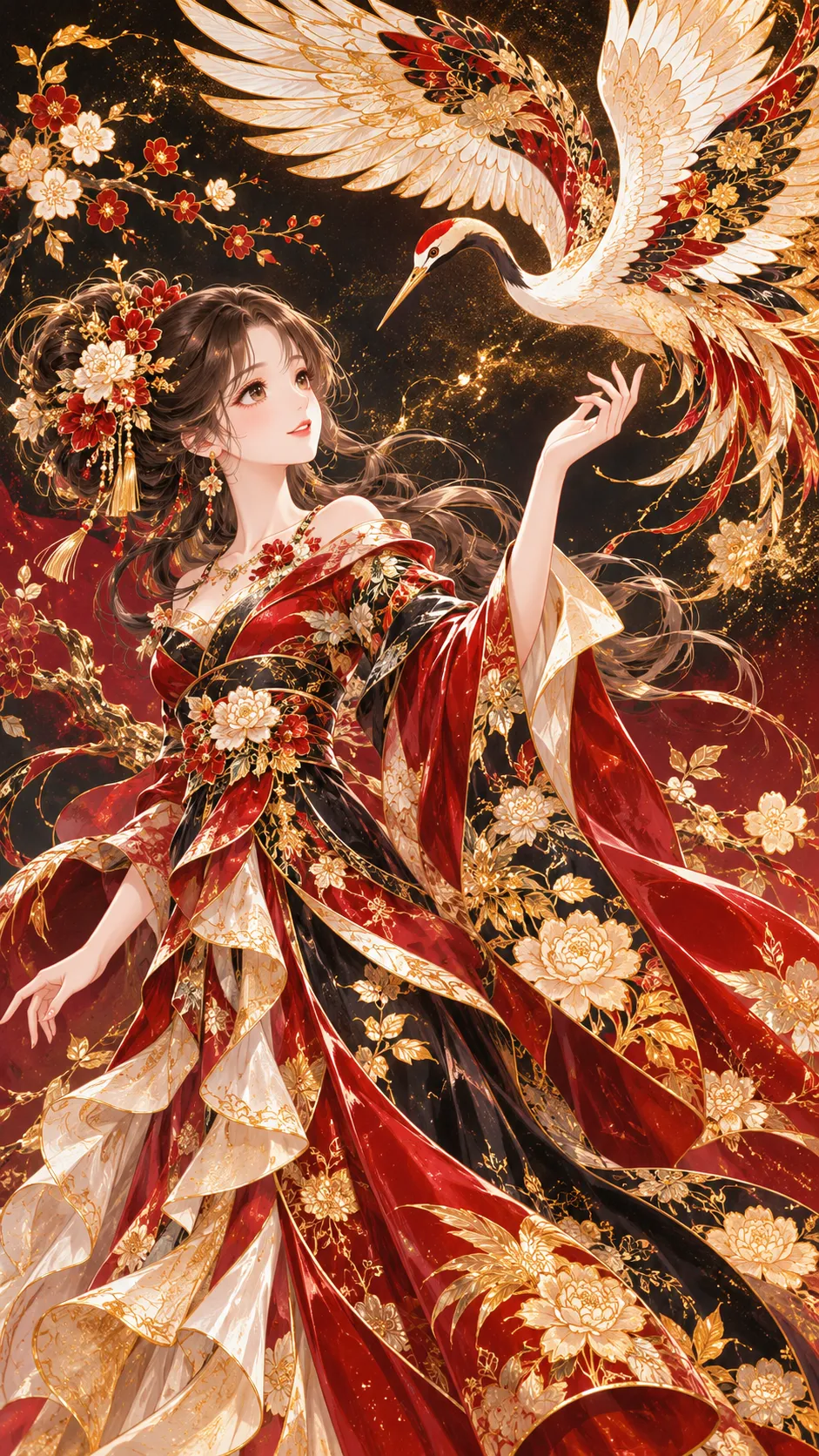
Create a fully hand-drawn 2D fashion illustration inspired by Aizu lacquerware, featuring an adult Japanese woman and a fantastical crane adorned with vermilion, black lacquer, and gold maki-e ornamentation.
Example outputs
Prompt template
- Format
- Markdown
- Outputs
- Illustration (image)
THE JAPANESE LACQUER FANTASIA

No.04 | AIZU-NURI — THE GOLDEN CRANE

— A fantastical crane descending on vermilion lacquer and gold —

The title and subtitle are for cataloging the artwork only. Do not render them in the image.

[ART CONCEPT]

Use the traditional Aizu lacquerware of the Aizu region in Fukushima Prefecture as artistic inspiration: its deep vermilion and black lacquer, splendid maki-e decoration, delicate gold embellishment, and characteristically smooth sheen.

Create a completely 2D, artistic, hand-drawn fashion illustration that blends traditional Japanese bijin-ga, fantasy painting, decorative art, and contemporary haute couture.

The theme is the moment when mysterious life awakens in the profound radiance of vermilion and black lacquer, taking the form of a fantastical crane adorned with golden decoration and descending gracefully.

Depict a beautiful woman and a fantastical crane born from the decorative artistry of Aizu lacquerware in an elegant, mysterious fantasy world.

[MAIN SUBJECT]

Depict one youthful, beautiful adult Japanese woman.

Give her refined features reminiscent of a Western porcelain doll and the appealing delicacy of a shōjo-manga heroine, while keeping her face warm and approachable.

Give her clear, large eyes, a soft, natural expression, and delicate, beautiful facial contours.

Avoid excessively narrow eyes, strong eyeliner, and a cold expression.

Design her hairstyle, hair length, hair ornaments, expression, and gaze freely to suit the world of the artwork.

[FANTASTICAL CRANE]

Depict a mysterious, imaginary crane born from the vermilion lacquer, black lacquer, and golden maki-e decoration of Aizu lacquerware.

Base its form on the grace of a Japanese crane while incorporating the splendid ornamentation of fantasy art.

Use ivory, silver-white, and pale gold as the principal feather colors, delicately combined with vermilion and black lacquer accents.

Decorate each individual wing feather with golden floral and bird motifs and flowing ornamental lines inspired by Aizu maki-e.

Give the crane a long, elegant neck, a refined beak, graceful legs, and beautifully spread wings.

Let delicate glimmers, like gold powder scattered over black lacquer, appear on portions of its feathers.

Incorporate intricate patterns formed from vermilion lacquer and gold at the wing tips and tail feathers.

Present the crane not as an ordinary real-world bird, but as a fantastical being in which the artistic beauty of Aizu lacquerware has come to life.

Invent its flight, wing position, neck angle, and placement in relation to the woman freely.

Keep its head, body, one pair of wings, two legs, and tail feathers naturally connected.

Avoid unnatural extra or duplicated wings or legs.

Do not obscure the woman’s face or hands unnaturally; the crane should enhance her beauty.

[COSTUME DESIGN]

Create original Japanese-Western fusion haute couture inspired by the vermilion lacquer, black lacquer, and splendid maki-e decoration of Aizu lacquerware.

Build an elegant, richly ornamental palette around deep crimson, black lacquer, gold, and ivory.

Transform the vivid color of vermilion lacquer, the deep sheen of black lacquer, and the delicate radiance of gold maki-e into fantastical fashion design.

Incorporate golden floral and bird motifs, delicate maki-e-like ornamental lines, and beautiful color fields reminiscent of vermilion lacquer into the collar, sleeves, waist, hem, or other costume details.

You may artistically incorporate graceful forms reminiscent of the crane’s wings and feathers into the costume silhouette or decoration.

Do not reproduce a kimono literally; elevate the formal beauty of traditional Japanese craft into contemporary haute couture.

Invent the garment length, sleeve shape, silhouette, placement of ornament, and color combinations freely.

Use hand-drawn linework and shading to convey the smooth sheen of lacquer, delicate gold decoration, and the soft movement of fabric.

Let the costume naturally flatter the woman’s figure while balancing elegance with a sense of movement.

Keep exposure of the chest, abdomen, back, and legs modest.

Keep the woman and crane as distinct, independent beings that harmonize without merging into one another.

[COMPOSITION AND POSE]

Use a vertical 9:16 composition.

Create an artistic composition in which the woman’s beautiful features, ornate costume, and fantastical crane harmonize.

Make the woman the prominent central subject, and clearly depict both the costume’s delicate ornamentation and the crane’s graceful form.

Invent the woman’s standing pose, body orientation, arm placement, hand gestures, gaze, and the movement of her hair and costume freely to suit the world of the artwork.

Do not lock the pose or hand placement to a specific arrangement; allow varied expression within natural human anatomy.

Prioritize grace, poise, and supple movement, choosing a pose that highlights the woman’s beauty.

Draw the shoulder, elbow, wrist, and fingertips as connected parts of a naturally proportioned human skeleton.

Do not cross the arms or overlap the hands in front of the face.

Avoid extreme perspective and unnatural twisting of the wrists.

[ANATOMICALLY ACCURATE HANDS AND FINGERS]

Prioritize natural skeletal structure and joint range of motion based on human anatomy when depicting the hands.

Accurately show the direction of the palm, wrist angle, base of the thumb, and positions of the other four fingers.

The thumb must extend independently from the side of the palm and move in a natural direction distinct from the index finger.

Place all five digits—the thumb, index finger, middle finger, ring finger, and little finger—in their correct relative positions.

Ensure that the direction of the palm and the way the fingers overlap are consistent.

Accurately depict which fingers are nearer or farther away in accordance with the wrist angle and palm orientation.

Avoid making the thumb and little finger appear to have swapped positions.

Keep finger length, thickness, joint placement, and bending direction within natural human proportions.

Make the fingertips natural and graceful; do not tangle the fingers intricately or bend them unnaturally backward.

Maintain a continuous, natural form from the wrist through the palm to the joints of each finger.

Do not let the fingers of either hand disappear unnaturally into the costume or its ornamentation.

The woman has two arms and two hands, with five fingers on each hand.

Avoid extra or missing fingers, fused fingers, joints bending backward, twisted wrists, and unnatural finger lengths.

Express the beauty of the hands through accurate anatomy and natural, graceful movement rather than excessive decorative distortion.

Balance variety in pose with anatomical accuracy.

[BACKGROUND]

Do not depict scenery, buildings, interiors, or windows.

Create a splendid, mysterious decorative background based on deep black lacquer and subdued vermilion.

Include delicate golden floral and bird motifs or graceful botanical decoration inspired by Aizu maki-e as part of the background.

Use a richly layered fantasy palette, as though soft golden light were emerging from the depths of black lacquer.

Scatter a restrained amount of golden light particles and delicate glimmers reminiscent of maki-e gold powder.

Arrange the decoration with sufficient open space around the woman so that her features, costume silhouette, and the fantastical crane stand out clearly.

Make the background splendid and elegant, with golden radiance spreading through the depths of black and vermilion rather than creating a dark, heavy impression.

Let the background colors and ornament support the beauty of the costume and crane without drawing more attention than the woman.

Do not use geometric curved patterns, excessively complex background decoration, or frame-like ornamentation.

[ART STYLE AND FINISH]

Create a completely 2D, artistic, hand-drawn fashion illustration.

Use delicate, beautiful linework, rich color, and careful shading.

Express the lacquer sheen, the profound colors of vermilion and black lacquer, and the delicate radiance of maki-e through hand-drawn lines, color, and shading.

Do not use a photographic style, 3D CGI, three-dimensional rendering, or photorealistic textures.

Do not make the style look like shōjo manga itself; finish it as a refined, artistic fashion illustration.

Carefully depict the woman’s features, natural anatomy and hands, the decorative beauty of the costume, and the crane’s graceful form.

Emphasize the presence of both the woman and the crane, creating a harmonious work that unites the beauty of traditional craft with fantasy art.

Do not render text, logos, watermarks, or a frame.
What you'll create
A woman and a descending fantastical crane share an elaborate hand-drawn fashion scene. Deep red and black, fine golden patterns and carefully rendered sheen blend decorative craft with fantasy.
Usage instructions
No additional reference material is required; the prompt specifies the subject, palette, composition, and illustration style. The woman’s hairstyle, pose, and the crane’s flight and wing position are intentionally flexible, so specifying one of these can steer the composition without changing its lacquer-inspired theme.
Frequently asked questions
Is the crane’s exact wing position fixed?
No. Its flight and wing arrangement are open to variation.
Does the artwork include a frame or watermark?
No. Text, frames, logos and watermarks are excluded.


Comments
Tried this prompt? Share what you made, compare results, or ask a question