Edo Kiriko Crystal Dragon Couture Illustration
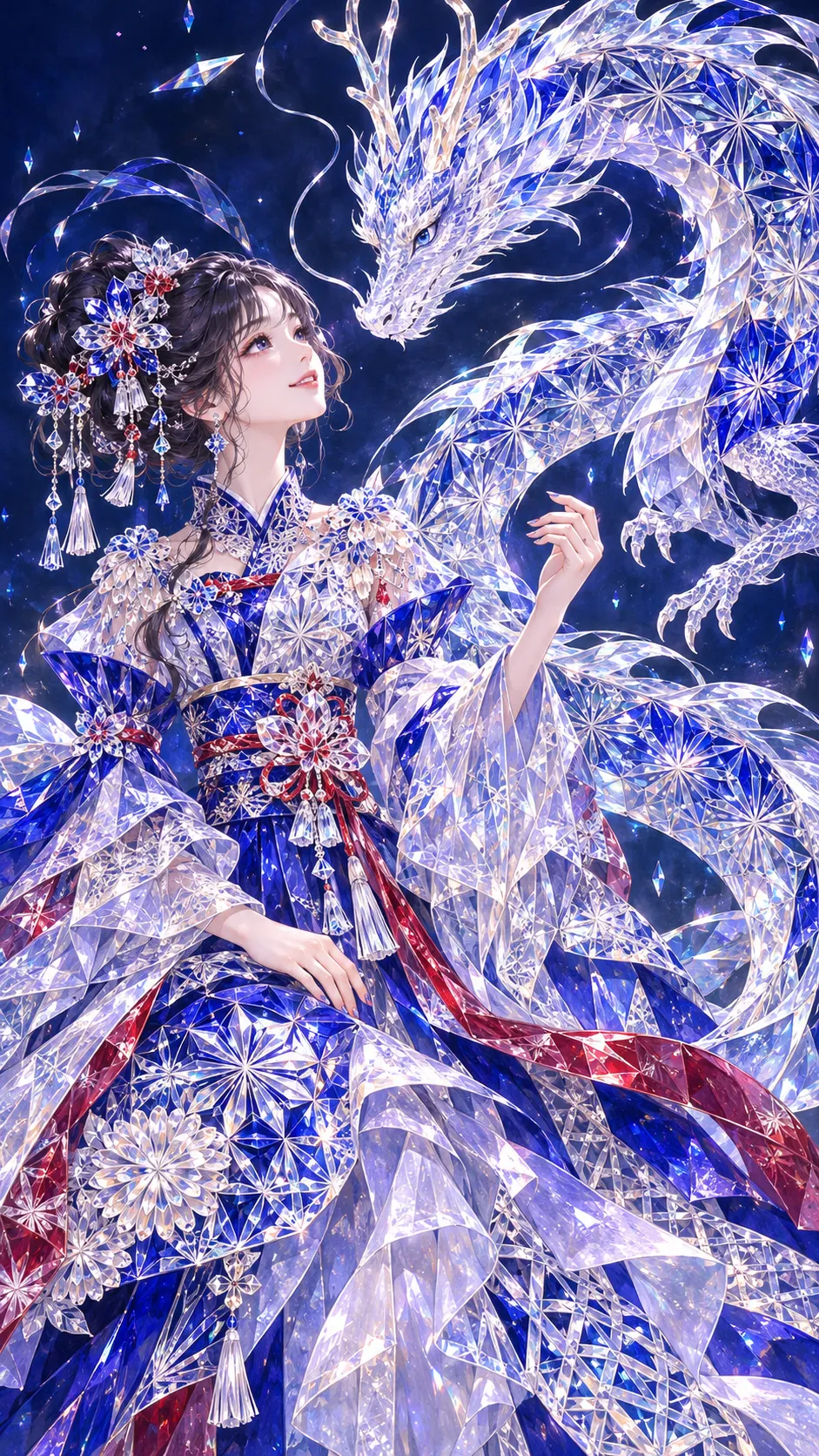
Create a 2D hand-drawn fashion illustration blending Edo Kiriko glass-cutting artistry, traditional Japanese beauty art, fantasy painting, and haute couture. A beautiful adult Japanese woman in a richly decorated outfit stands with a mysterious crystal dragon against a restrained midnight-blue ornamental background.
Example outputs
Prompt template
- Format
- Markdown
- Outputs
- EdoKirikoCrystalDragonIllustration (image)
Create a complete 2D hand-drawn fashion illustration inspired by Edo Kiriko, the Japanese glass-cutting craft traditionally practiced around Tokyo. Use the intricate cuts, traditional patterns, colored overlay glass in lapis blue or red, and brilliant reflections of Edo Kiriko as artistic inspiration. Combine the elegance of traditional Japanese beauty art, the mystery of fantasy painting, the decorative artistry of glasswork, and contemporary haute couture.

Depict the moment when the transparency and intricate cut patterns of Edo Kiriko glass seem to awaken into mysterious life: the radiance of lapis-blue and clear glass transforms into the attire of a beautiful woman and the form of a mysterious crystal dragon. The result must be a fully 2D artistic, hand-drawn fashion illustration.

**Main character:** Depict one youthful-looking but clearly adult Japanese woman. Give her refined, doll-like features and the delicate charm of a shoujo-manga heroine, with large clear eyes, a natural, gentle expression, and a fine, beautiful facial outline. Balance dignified elegance with approachable sweetness. Freely create her hairstyle, hair color, hair ornaments, expression, orientation, and pose to suit the work. Give her a natural relationship with the fantasy crystal dragon through her gaze or body orientation, conveying quiet mystery and graceful presence.

**Costume design:** Create original, elaborate haute couture that transforms the sculptural beauty of Edo Kiriko into fashion. Center the design on deep lapis blue and ornaments reminiscent of transparent crystal glass. Make the sharp, intricate cut patterns characteristic of Edo Kiriko a major design feature. Artistically incorporate the geometric beauty of asanoha (hemp-leaf) patterns, the delicate continuity of kiku-tsunagi (linked chrysanthemum) patterns, and the orderly intersecting lines of yarai patterns into the garment’s construction and decoration. Contrast clear glass with lapis-blue overlay glass using delicate linework, translucent color, and layered embellishment. Place cut-glass-like ornaments that catch the light at the bodice, shoulders, sleeves, waist, and skirt. Freely create the silhouette, sleeve shapes, skirt volume, and placement of ornaments.

Keep the outfit refined and splendid, without excessive exposure of the chest, abdomen, back, or legs. Make the skirt primarily opaque fabric; reserve transparent-glass effects for decorative elements. Do not make the outfit look like armor made entirely of glass: balance soft fabric with intricate glass ornamentation to create elegant fashion.

**Fantasy crystal dragon:** Depict one fantasy crystal dragon beside the woman, born from the beauty of Edo Kiriko. Make it a mysterious, graceful being combining transparent crystal glass with deep lapis-blue colored glass. Give it the long, supple body associated with Japanese dragons, the delicacy of fine glasswork, and the dignified presence of a fantasy guardian. Decorate its body with intricate cut details reminiscent of Edo Kiriko asanoha and kiku-tsunagi patterns. Let the clear and lapis-blue sections overlap beautifully, with delicate silvery-white light reflecting from the cut facets. Give the dragon’s eyes intelligence and gentle mystery, and its expression an elegance that suggests it is watching over the woman. Freely create its size, posture, curves, and position relative to her. Compose the figures so they enhance each other; do not treat the dragon as mere background decoration. Keep the dragon’s head and claws from overlapping the woman’s fingers, and make their outlines distinct. Ensure the dragon’s body connects naturally as one creature, with its head, torso, limbs, and tail visually understandable.

**Color design:** Center the palette on the deep lapis blue emblematic of Edo Kiriko, combined with transparent crystal white, clear ice blue, and delicate silver. Add restrained accents reminiscent of red overlay glass to bring a festive note to the cool palette. Carefully distinguish light passing through clear glass, reflecting from cut facets, and passing through colored glass. Keep the glow delicate and translucent; avoid excessive luminosity or neon effects. Use elegant, vivid colors that allow glass transparency and the warmth of hand-painted art to coexist.

**Background:** Use a sophisticated, fantastical decorative background, not a real landscape or architecture. Set it in a subdued space dominated by deep midnight blue, with delicate reflections reminiscent of Edo Kiriko cut facets and small crystal glints. Give the background moderate contrast and depth so the woman and dragon’s translucency stands out. Do not fill the background with dense geometric patterns; use decoration sparingly. Do not depict landscapes, buildings, windows, a floor, a giant circular ornament, or a geometric curved frame. Keep the background chic and artistic, with the woman and dragon as the main subjects.

**Composition and pose:** Use the full vertical 9:16 frame for a harmonious composition of the woman and fantasy crystal dragon. Keep the woman’s features, costume design, and the dragon’s intricate decoration clearly visible. Do not fix the woman’s position, body orientation, balance, arm placement, hand gestures, gaze, or distance from the dragon. Create a natural, beautiful pose to suit the story and costume design. Freely choose how to express their relationship: she may look at the dragon, face the same direction, stand quietly, or have movement in her pose. It is not necessary for her to touch the dragon or reach toward it. Do not establish holding the skirt hem or letting both arms hang down as standard poses. Decide the hand gestures to suit the garment, body orientation, and natural shift of weight. Do not excessively bend the wrists or fingers to convey elegance. Preserve variety in posing while prioritizing natural skeletal structure and joint movement.

**Anatomical consistency of hands and fingers — highest priority:** The woman has one left arm and one right arm, two arms total, and one hand on each arm, two hands total. Each hand has one thumb and four other fingers, five fingers total. The thumb extends naturally from the thumb side of the palm, with a distinct base and range of motion from the other four fingers. Follow real human anatomy when depicting the orientation of the back and palm of each hand and the positions of the thumb and little finger. Make the structure continuous and natural from wrist to palm, finger bases, joints, and fingertips. Judge which fingers are visible or occluded according to the hand’s orientation; do not force all five to be visible at once. Follow natural human proportions for finger length, thickness, joint placement, and overlap. Avoid duplicated, missing, fused, or extra fingers; unnatural joints; and reversed thumb and little-finger positions.

Connect both arms naturally from shoulders through elbows and wrists to the hands. Avoid complicated crossing of the arms, overlapping hands and face, and exaggerated hands or fingers caused by extreme perspective. If part of a hand is hidden by clothing, make its concealed structure plausibly understandable. Do not let an arm disappear inside a sleeve or a hand emerge from an unnatural position at a cuff. Clearly distinguish the woman’s fingers from the dragon’s claws; do not merge them. Do not rely on prescribing a fixed pose to avoid hand errors; apply anatomical consistency to whatever pose is freely created. If a complex hand gesture looks unnatural, adjust the hand angle or finger overlap to a natural arrangement without undermining the mood.

**Style and rendering:** Create a fully 2D artistic, hand-drawn illustration that combines the grace of traditional Japanese beauty art, the mystery of fantasy painting, and the refined forms of fashion illustration. Prioritize delicate, beautiful contours, careful linework, translucent color, and intricate ornament. Convey glass through layered transparent colors, sharp cut lines, delicate reflected light, and contrast between light and shadow. Even while depicting the transparency of glass craft, unify the work as a warm hand-painted picture. Do not make it photographic, photorealistic, 3D CGI, a three-dimensional render, figurine-like, game-CG-like, or cel-animation-like. Avoid excessive realism and metallic textures; finish as an artistic 2D illustration.

**Final requirements:** Make the intricate Edo Kiriko cut patterns, lapis-blue translucency, and reflections of light clear. The decorative beauty of Edo Kiriko must be present in both the woman’s costume and the fantasy crystal dragon. Harmonize the woman’s delicate features, splendid haute couture, and the dragon’s translucent mystery in a fantastical illustration. Allow creative freedom in the woman’s pose, costume silhouette, hairstyle, expression, and the dragon’s pose and placement. For the woman’s fingers in particular, prioritize natural human structure over ornate visual effects.

Use a vertical 9:16 aspect ratio. Do not include any text, title, logo, signature, or watermark in the image.
What you'll create
A woman’s ornate fashion echoes cut-glass geometry beside a mysterious dragon. Lapis-blue and clear-glass radiance is translated into delicate drawn reflections within a vertical 2D composition.
Usage instructions
This prompt is self-contained and needs no reference image. It specifies a vertical 9:16 illustrated composition, so keep the woman, her glass-patterned couture, and the dragon legible within that frame. The pose, hairstyle, garment silhouette, and dragon placement are deliberately flexible; adjust those elements to change the scene while retaining its Edo Kiriko motifs.
Frequently asked questions
Is actual 3D glass rendering requested?
No. The entire scene remains a hand-drawn illustration.
May ornament replace natural finger anatomy?
No. Natural human structure takes priority over ornate effects.



Comments
Tried this prompt? Share what you made, compare results, or ask a question