The Iridescent Black Panther — Takaoka Lacquerware Fantasy
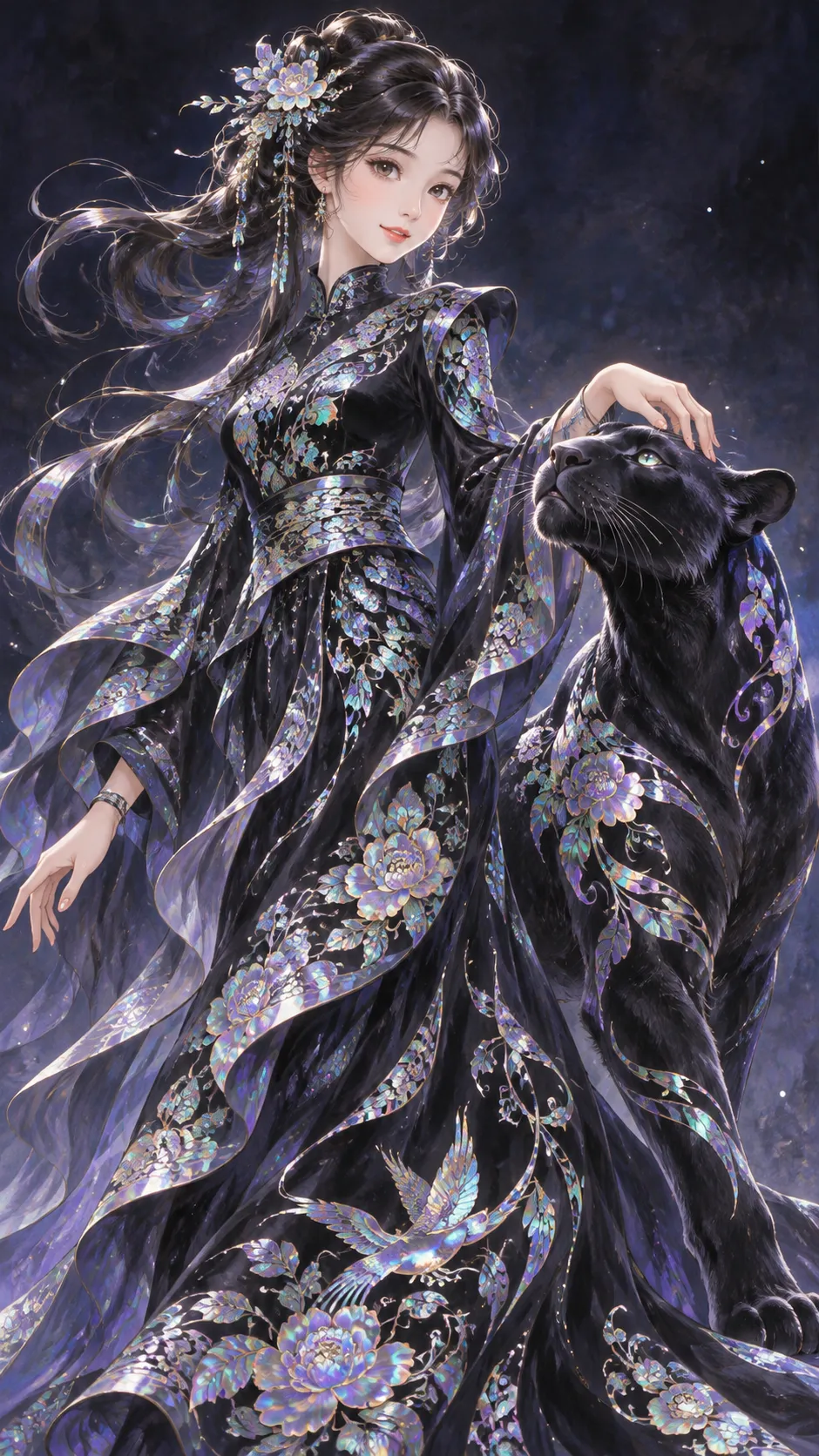
Create a hand-drawn 2D fashion illustration inspired by Takaoka lacquerware, featuring an adult Japanese woman in iridescent raden couture beside a mystical black panther.
Example outputs
Prompt template
- Format
- Text
- Outputs
- Illustration (image)
Create a complete 2D, hand-drawn artistic fashion illustration inspired by Takaoka lacquerware, a traditional craft passed down in Takaoka City, Toyama Prefecture. Draw the moment when the deep black brilliance of lacquer and the rainbow light of blue-shell inlay awaken as a mysterious, fantastical black panther. Combine the elegance of traditional Japanese bijinga, the mystery of fantasy painting, the decorative art of lacquerware, and the refined forms of contemporary haute couture. Show one beautiful woman and a fantasy black panther born from the decorative beauty of lacquer art in an elegant, mysterious artistic world. Make the woman’s clothing boldly incorporate the beauty of Takaoka’s blue-shell lacquer, and give the panther glossy black fur with iridescent highlights. Transform the craft into fantastical fashion and a mysterious living creature rather than merely reproducing its motifs as patterns.

### Main character

Depict one youthful-looking, beautiful adult Japanese woman. Give her an attractive, approachable face that combines the refined features of a Western doll with the delicate charm of a shōjo-manga heroine. She has clear, large eyes, a natural, gentle expression, and delicate, beautiful facial contours. Avoid excessively narrow eyes, heavy eyeliner, a cold expression, or a face that looks overly mature. Freely design her hairstyle, hair length, hair ornaments, expression, and gaze to suit the world of the artwork. Her delicate face is an important focal point; do not let hair ornaments or costume decorations obscure it.

### Costume design

Design original East-meets-West haute couture inspired by Takaoka lacquerware’s blue-shell lacquer, black lacquer, and delicate raden inlay. Use deep lacquer black as the base, artistically combined with blue-violet, ultramarine, emerald green, turquoise, pearl white, and muted silver.

The costume’s defining feature is the delicate appearance of countless thin shell fragments embedded in its black surface, shimmering with iridescent colors as the viewing angle changes. Incorporate intricate raden patterns inspired by blue-shell lacquer into structured elements such as the collar, shoulders, bodice, cuffs, waist, and skirt. Add finely detailed floral, bird, arabesque, and geometric motifs that appear to be assembled from individual, extremely thin shell pieces. Render the outlines and precise arrangement of the fragments, and their shifting blue, violet, and green iridescence, with delicate hand-drawn lines and color.

Integrate the raden patterns into the costume’s surface; do not make them look like gemstones or metal ornaments attached afterward. Do not make large gemstones, excessive metal decoration, or three-dimensional floral ornaments the main feature. Leave some smooth areas of black lacquer visible to create a beautiful contrast with the delicate inlay. Combine the formal sculptural beauty of lacquer art in the collar and bodice with soft fabric, graceful draping, and light movement in the sleeves and skirt. The silhouette may boldly and elegantly evoke the panther’s supple body or flowing tail.

Create fantastical haute couture that unites the substantial beauty of lacquer, the otherworldly radiance of iridescent shell, and the softness and movement of fabric. Do not reproduce traditional Japanese clothing unchanged; transform Takaoka lacquerware’s decorative beauty into contemporary artistic fashion. Freely invent the garment’s length, sleeve shape, silhouette, placement of raden patterns, and color combinations. Keep the chest, abdomen, back, and legs modestly covered.

### Fantasy black panther

Depict an imaginary fantasy black panther born from Takaoka lacquerware’s black brilliance and the rainbow light of blue-shell inlay. It is a mysterious sacred beast with a supple, beautiful body, dignified face, clear eyes, and natural feline anatomy.

Its coat is deep lacquer black, with delicate blue-violet and ultramarine color in the light-catching areas. Integrate iridescent raden decoration reminiscent of Takaoka’s blue-shell lacquer into parts of its body. Delicate patterns that appear to be made from thin shell fragments may appear on its shoulders, back, chest, limbs, or tail. Place the ornaments naturally along the fur and curves of the body without disrupting its beautiful anatomy or the flow of its muscles. Do not turn the entire panther into hard lacquerware or a metal sculpture; retain the soft fur and supple movement of a living animal. Render the raden shimmer as delicate iridescence shifting among blue, violet, green, and pearl white.

Give the panther’s eyes a mysterious glimmer and an expression of intelligence, dignity, and quiet trust toward the woman. A few delicate particles of light reminiscent of shell reflections may surround it. The panther is not merely a decorative animal: depict it as a fantastical sacred beast in which the artistic beauty of traditional craft has come to life. Freely choose a fitting pose, such as standing elegantly beside the woman, walking gracefully, or staying close as if watching over her. Give it a strong presence without letting it obscure the woman’s face or important costume details. It must have four legs and one tail. Avoid extra or missing legs, unnatural joint bends, and unnatural fusion between the body and tail.

### Composition and pose

Use a vertical 9:16 composition. Make the woman the large central subject, with her Takaoka blue-shell-inspired costume and the fantasy panther harmoniously arranged. Ensure that the woman’s delicate face, the costume’s fine raden patterns, and the panther’s black fur and iridescent ornamentation are each clearly visible.

Freely design the woman’s standing pose, body orientation, arm positions, hand gestures, gaze, and the movement of her hair and clothing. Do not lock her into one specific pose; use varied poses within the bounds of natural human anatomy. Aim for an elegant, dynamic composition in which the panther’s supple curves and the drape of the woman’s costume echo one another. The woman’s and panther’s gazes or body orientations may suggest quiet trust and a fantastical narrative. Do not cross her arms or place her hands in front of her face. Avoid extreme perspective and unnatural twisting of the wrists.

### Anatomically accurate hands and fingers

Prioritize natural skeletal structure and range of motion based on human anatomy. Draw a natural, continuous connection from shoulder to elbow, wrist, palm, and fingertips. Accurately show the direction of the palm, the angle of the wrist, the base of the thumb, and the thumb’s position relative to the other four fingers.

The thumb should extend independently from the side of the palm and move in a natural direction distinct from the index finger. Position the thumb, index finger, middle finger, ring finger, and little finger correctly. Ensure that the direction of the palm and the way the fingers overlap are consistent. Avoid making the thumb and little finger appear to have switched places. Use natural proportions for finger length and thickness, joint placement, and bending direction. Make the fingertips natural and graceful; do not tangle the fingers intricately or bend them back unnaturally. Do not let either hand’s fingers disappear unnaturally into the clothing or ornaments.

There are two arms and two hands, with five fingers on each hand. Avoid extra or missing fingers, fused fingers, joints bending backward, twisted wrists, and unnaturally long fingers. Balance pose variety with anatomical accuracy.

### Background

Do not depict a landscape, building, interior, window, forest, mountain, sea, horizon, or other scenery. Use a refined decorative background inspired by the beauty of Takaoka’s black lacquer and blue-shell lacquer. Base it on deep lacquer black, dark ultramarine, blue-violet, and charcoal gray, with delicate iridescent light placed selectively. Some areas may include subtle effects suggestive of reflections from thin shell fragments or the decorative beauty of raden.

Keep the background decoration quieter than the costume. Do not fill the entire background with rainbow light or ornament; preserve suitable negative space and contrast. Make the contours of the woman’s face and clothing, and the panther’s head and body, stand out clearly. In particular, prevent the panther’s black fur from disappearing into the dark background by carefully adding blue-violet or soft silver contrast around its silhouette. The background should evoke the mysterious decorative beauty of lacquer art without drawing more attention than the woman and panther. Do not use geometric curved patterns, excessively complex background ornament, or a frame-like decoration.

### Style and finish

The finished work must be a complete 2D, hand-drawn artistic fashion illustration, with delicate, beautiful linework, rich color, and careful shading. Blend the elegance of traditional Japanese bijinga, the mystery of fantasy painting, and the refined forms of contemporary fashion illustration. Use hand-drawn lines and color to evoke the iridescence of extremely thin shell fragments, intricate raden patterns, and the deep luster of black lacquer found in Takaoka’s blue-shell lacquer.

Elevate the appearance of lacquer and shell into painterly beauty rather than reproducing their textures photorealistically. Do not use a photographic style, 3D CGI, three-dimensional rendering, or live-action realism. Do not use an anime or shōjo-manga style; finish it as a refined artistic fashion illustration. Carefully depict the woman’s delicate features, natural anatomy, accurate hands and fingers, Takaoka-inspired raden patterns, and the panther’s dignified form. Use a color composition in which the woman’s black costume and the panther’s iridescent ornamentation enhance each other. Balance glamour and elegance with fantastical dynamism.

The highest priority is to express the distinctive decorative beauty of Takaoka blue-shell lacquer: extremely thin shell fragments precisely arranged on a black lacquer surface to create iridescent light. Do not make the costume or panther look as if decorated with attached gemstones; instead, transform that lacquerware technique into fantastical haute couture and the form of a mysterious black panther.

Do not draw text, logos, watermarks, or a frame.
What you'll create
A woman and a glossy black panther share a refined fantasy scene, linked by rainbow shell-like highlights. Thin decorative fragments and hand-drawn shading convey the black-lacquer fashion concept.
Usage instructions
No additional input is required; the prompt defines the subject, style, composition, and setting. Its central mechanism is to turn Takaoka lacquerware’s black lacquer and iridescent shell inlay into couture and a living panther. The woman’s pose, hairstyle, and gaze may vary, but keep the vertical 9:16 composition and make both the inlay details and the panther clearly visible.
Frequently asked questions
Should the inlay resemble attached gemstones?
No. The source explicitly distinguishes shell fragments on lacquer from attached gems.
Must the woman and panther both remain visible?
Yes. Their presence and inlay details should remain clear.



Comments
Tried this prompt? Share what you made, compare results, or ask a question