Lionfish Merman Underwater Portrait
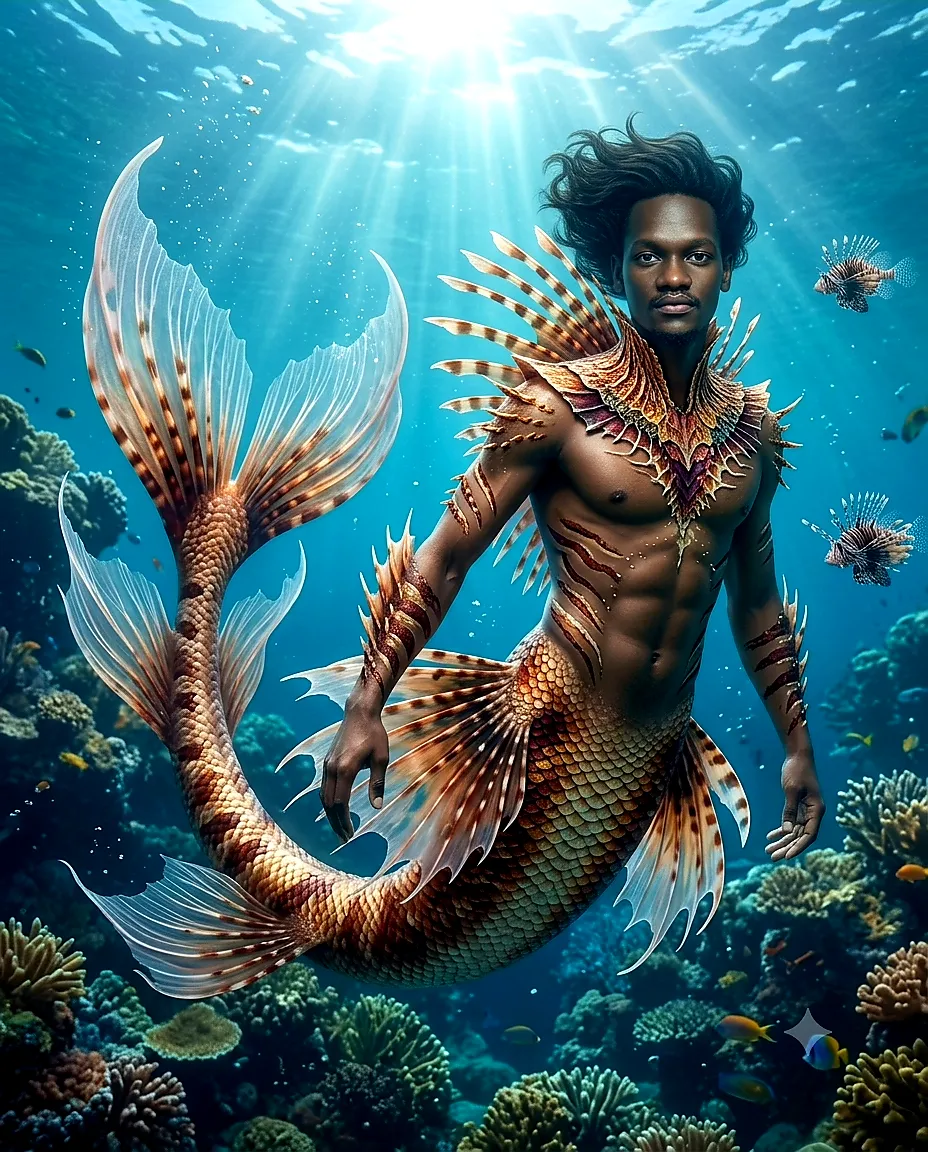
Create a hyper-realistic, cinematic underwater editorial photograph of a biologically plausible lionfish merman, preserving the identity of the person in the required reference images.
Example outputs
Prompt template
- Format
- Text Parameterized
- Inputs
- Reference_images (image) · Required aspect_ratio (text) · Optional · Default: 4:5
- Outputs
- Underwater_editorial_photograph (image)
Use the provided reference images as mandatory references. Preserve the person’s real facial features and identity with absolute fidelity: do not embellish or plasticize the face, or alter its shape, eyes, nose, mouth, beard, hair, jawline, or real proportions.

Create a hyper-realistic, cinematic, editorial underwater photograph of an elegant, magnetic, biologically plausible, visually rare lionfish merman. Use a vertical composition with an aspect ratio of ${aspect-ratio:4:5}, a wide camera and wide framing. Show the character in full, from head to tail tip, so the anatomy and environment can be read clearly.

Give the character a natural, slightly fuller, stockier body with real curves, a smooth chest, an abdomen without exaggerated muscular definition, proportional shoulders, firm arms, and a true human appearance that respects the reference person’s biotype. The proportions should be one-third human body and two-thirds tail. Make the tail much longer and dominant: sculptural, impeccable, hydrodynamic, elegant, and forming a noble curve through the water. Make the transition from human hips to tail organic, seamless, and anatomically convincing.

Around the neck, create a refined biological collar inspired by a lionfish. Form it from layers of fine scales, elegant organic plates, small ceremonial spines, and delicate fins integrated into the skin. It should resemble noble, venomous, aristocratic natural armor that wraps around the neck, clavicles, shoulders, and base of the neck. Make it look like a living extension of the body, with a majestic, dramatic, reef-like appearance—not glued-on fantasy armor.

Show lionfish characteristics across the entire body, not only the tail. Let refined scales and organic stripes emerge on the shoulders, arms, sides of the chest, ribs, hips, and upper tail, integrated into the skin as a convincing transition between man and marine creature. Add small, elegant, controlled thorny structures at strategic points such as the shoulders, sides of the collar, forearms, upper back, and hip transitions. Keep them noble, refined, and biologically plausible, never grotesque.

Use a sophisticated lionfish-inspired palette of burnt gold, copper, deep wine, reddish-brown, ivory, pearlescent white, metallic champagne, and soft black. Distribute the colors in organic, asymmetrical, natural stripes across the collar, shoulders, arms, torso, hips, and tail, creating a striking, refined, beautiful biological pattern. Preserve realistic skin texture, pores, micro-variations, natural hairs where visible, and the material qualities of a submerged body; avoid a plastic effect.

Make the tail extremely rich in texture, with luxurious materiality, refined scales, and a dominant visual presence that combines elegance, exoticism, and imposing stature. Give it a huge, glamorous, dramatic, refined final fin inspired by the broad fins of a lionfish, with multiple pointed, translucent, aristocratic veils in thin layers, like submerged organic fans. The tail should appear powerful, beautiful, and slightly dangerous, with a sharp, sophisticated silhouette. Add exuberant side fins on the arms, hips, back, and tail transitions, using thin, open, translucent membranes supported by delicate spines, recalling natural lionfish fans. Let the fins respond beautifully to the current and create a broad, noble, theatrical silhouette.

Make the ears a hybrid of marine-creature features and elven elegance: larger and elongated backward, with thin membranes, small elegant tips, and refined organic texture, like noble extensions of the lionfish fins. They may include discreet small metallic adornments in pale gold, aged copper, or dark champagne. Keep the hair dark, wet, dense, and slightly wild, reacting naturally to the water with loose strands, realistic submerged weight, and light flotation. Give the eyes extremely detailed irises, real optical depth, visible internal design, and a very subtle ethereal glow with soft-gold and aquatic blue-turquoise reflections; make them hypnotic, never neon. The expression should be serene, beautiful, noble, and slightly dangerous, like that of a creature that commands respect effortlessly.

Use a natural, lived-in, subtly sensual pose with magnetism and presence. Have the lionfish merman float or pose elegantly in a luxurious reef, with the body arranged diagonally or frontally, or in a noble curve, so the full silhouette and open fins are clearly visible. One hand may touch the biological collar, a coral formation, or the surrounding water; the other should follow the movement with lightness and sophistication. Keep the side fins and tail fans wide open and emphasized in the composition, as if the creature were naturally displaying its marine royalty.

Set the scene in an extremely clear, luminous, vivid, physically realistic greenish-blue sea, with convincing depth, high transparency, suspended microparticles, and subtle organic matter. Build three well-defined planes. In the foreground, place corals, anemones, rocks, fine algae, and organic elements slightly out of focus near the lens. In the middle ground, make the complete lionfish merman the main focus, majestically integrated into the environment. In the background, show a vivid, luxurious underwater biome with elaborate reefs, clear sand marked by currents, natural reliefs, discreet schools of fish, and small colorful fish. If appropriate, include one or two distant real lionfish as a visual echo of the creature’s lineage. Suggest ecological richness, beauty, and elegant danger.

Use absolutely realistic light, like premium underwater photography captured in ideal natural-light conditions. Show solar rays piercing the surface and creating sharp, organic caustics on the seafloor, rocks, skin, biological collar, translucent fins, and tail. Let the lighting enhance the warm palette, stripe contrasts, and refined transparency of the membranes. Aim for maximum graphic realism and naturalness, extreme texture, skin pores and real micro-variations, physical refraction, premium optical clarity without oversharpening, refined contrast, and true depth.

Avoid CGI, exaggerated glow, incoherent anatomy, malformed hands, an overly muscular body, a short tail, a plastic appearance, an artificial setting, text, and watermarks.
Replace the ${…} placeholders with your values
before using this prompt. See parameters
and defaults below
Parameters
Replace each placeholder with your own value, or use its default when one is provided
${aspect-ratio:4:5}
aspect-ratio
Default: 4:5
What you'll create
The subject becomes an elegant marine-fantasy hybrid with detailed membranes and natural body proportions. Wide underwater framing reveals the complete figure from head to tail tip.
Frequently asked questions
Should the tail be shortened to fit?
No. The full long tail and its tip must remain visible.
Is exaggerated luminous glow requested?
No. The prompt favors naturalness and physically plausible water refraction.



Comments
Tried this prompt? Share what you made, compare results, or ask a question