- Category
- Art & Illustration
- Model
- openai-chatgpt
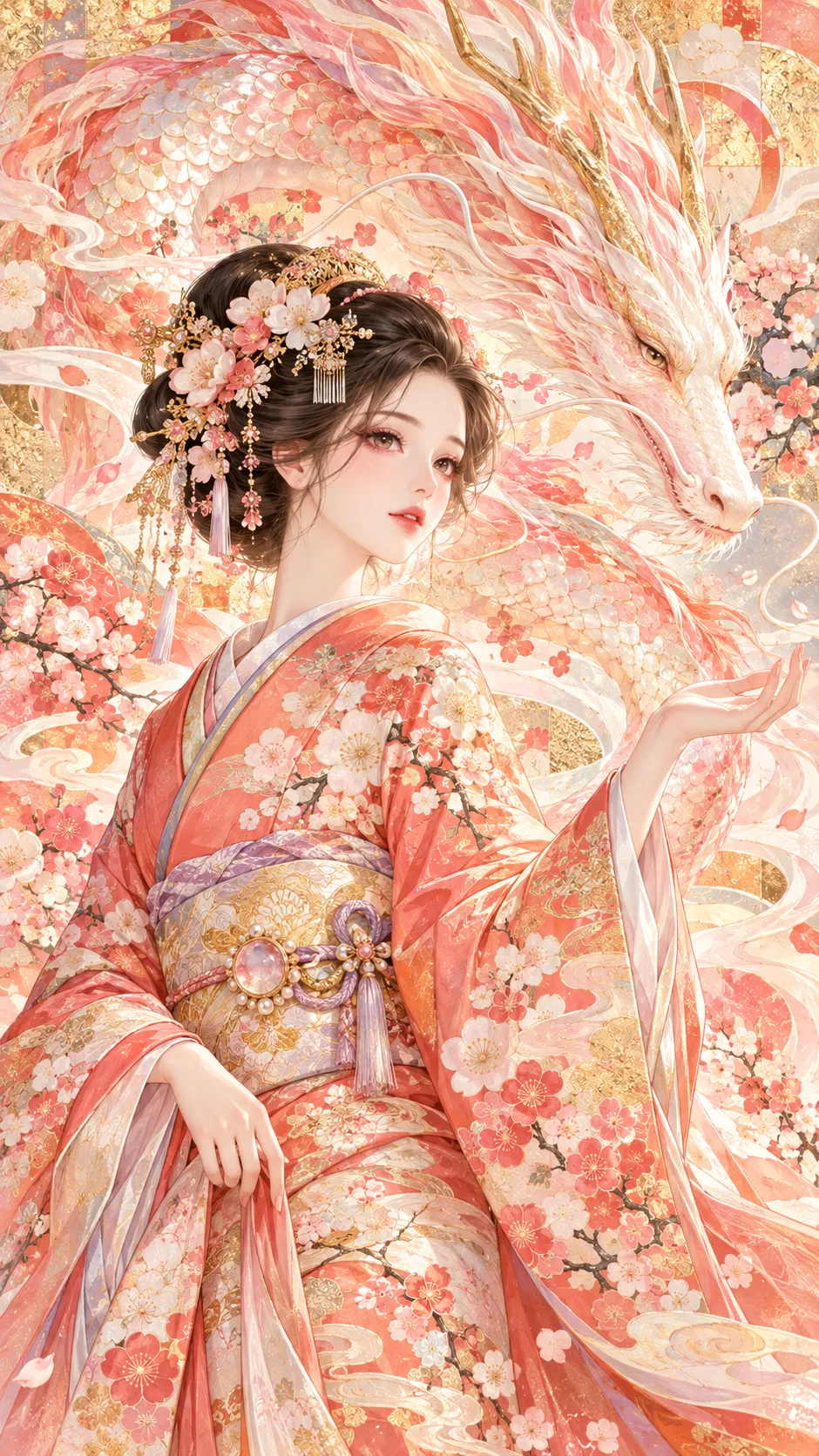
Blossom-Haze Dragon and Coral Furisode Portrait
Create an elegant 2D Japanese-inspired portrait of an adult woman in a coral furisode beside a benevolent divine dragon, with plum blossoms, spring haze, and personalized decorative details.
By Threads — Published on — Modified on
Example images
Prompt template
0 copies
- Format
- Markdown
- Inputs
- User_preferences (text) · Optional
- Outputs
- Artwork (image)
## Concept
Create a fantastical, graceful Japanese beauty portrait celebrating happiness, kindness, new beginnings, and beautiful connections. The two principal subjects—a woman and a divine dragon—should be portrayed as equals, each enhancing the other's presence.

Depict a sacred Blossom-Haze Dragon with pale coral, milky-white, and pearlescent scales, touched by soft golden radiance. Beside the dragon, portray a dignified woman wearing a brilliant coral furisode and an elegant traditional Japanese hairstyle. Combine the joy of life suggested by blooming plum blossoms with the gentle glow of spring haze.

## Personal design
Use any user conversation history, memory, or shared preferences that are available as artistic inspiration. Reflect preferences for gemstones, flowers, colors, art styles, or traditional crafts in the hair ornaments, secondary kimono patterns, obi, Japanese accessories, or abstract background. Do not reproduce the user's actual appearance; represent their aesthetic sensibility through a fictional woman. If little reference information is available, choose an original design that harmonizes with the Blossom-Haze Dragon theme.

Keep these elements consistent in every version:
- A Blossom-Haze Dragon with coral, milky-white, and pearlescent scales and golden radiance.
- A coral-based furisode.
- Plum-blossom and haze patterns.
- Traditional Japanese hair and a Shimada-style coiffure.
- A sacred Eastern dragon.
- A fully 2D painted image.
- A vertical 9:16 composition.

Vary other ornamentation, accent colors, pose, composition, and dragon placement to suit the user.

## Composition and pose
Choose a body orientation, face angle, arm position, and dragon placement clearly different from those in the most recent dragon-series work, if that work is available for reference. Do not repeatedly use a pose looking back over the shoulder, a hand resting at the chest, or both hands clasped in front of the body.

Select exactly one natural, graceful pose from this list; do not combine poses:
1. Stand nearly facing forward with both arms relaxed at the sides, letting the long furisode sleeves hang gracefully.
2. Stand in profile, with the face turned in the same direction as the body, showing an elegant profile.
3. Angle the body forward and place one hand naturally beside the waist.
4. Extend one arm gently to the side to show the flow of the sleeve.
5. Sit gracefully with a straight back and hands resting naturally on the lap.
6. Face the body forward and turn only the face slightly to the side.
7. Stand with one shoulder slightly forward and both arms relaxed at the sides, creating an asymmetrical pose.
8. Rest one hand naturally at the obi and let the other arm hang at the side.
9. Angle the body partly to the side and lower the face slightly in a quiet portrait pose.
10. Stand gracefully with one arm gently bent so the sleeve opening is shown naturally.

If previous work is available to reference, prefer a pose different from the most recent one. Users of the same prompt need not receive the same pose. Frame the woman large, primarily from the waist up, widening the composition only as needed for the chosen pose.

## Anatomy and hands — highest priority
Prioritize correct anatomy over decorative complexity. The woman has exactly two arms, one on each side. Connect shoulders, elbows, forearms, wrists, palms, and fingertips naturally. Clearly distinguish the right and left hands, and place thumbs and little fingers correctly. Ensure the orientations of the palms and backs of the hands, wrist angles, and forearm rotations are anatomically consistent.

Each hand has five fingers, including the thumb. Fingers may be naturally obscured when overlapping; do not force every finger to be visible. Do not add arms or hands hidden by the body or kimono. Both hands do not have to be visible in the frame. Avoid complicated finger arrangements, crossed arms, and unnaturally twisted wrists. Let the long sleeves hang naturally according to the arm position and gravity; do not depict fabric as extra arms. The final pose must be one a real person could comfortably assume.

## The woman
Depict a beautiful Japanese adult woman with both delicate charm and mature elegance, large clear eyes, fine, balanced features, and a soft smile. Use an ornate, graceful shōjo-manga-inspired character style.

Arrange glossy jet-black hair in a traditional Japanese coiffure inspired by a Shimada mage. Center the hair ornaments on delicate gold-and-silver plum-blossom kanzashi, and combine them with pearls, natural stones, raden (mother-of-pearl inlay), combs, or similar ornaments. Rose quartz, moonstone, freshwater pearls, morganite, and crystal may be incorporated in keeping with the user's aesthetic preferences. Vary the placement and density of the ornaments and the gemstones used.

## Coral furisode
Dress the woman in a traditional Japanese furisode based on warm coral. Use coral, pale pink, ecru, pearl, and light gold as the main colors, with tasteful accents. Render delicate Yūzen dyeing, softly gradated dye, gold and silver thread embroidery, and the luster of fine silk.

The principal design is plum blossoms and haze. Arrange red plum, white plum, and pale-pink plum blossoms in harmony with flowing haze patterns. Depict the blossoms as traditional Japanese plum motifs, with rounded five-petaled flowers and delicate stamens. Express the haze through soft gradated dye, flowing gold-and-silver lines, or traditional kasumi patterns. Vary blossom size, the flow and density of the haze patterns, and the placement of metallic accents. Leave beautiful areas of coral negative space; do not overcrowd the decoration.

Accurately depict the traditional collar, long furisode sleeves, and the overlap with the obi. Do not turn the outfit into Western clothing or a fantasy dress.

## Obi and accessories
Use an elegant, ornate fukuro obi based on pearlescent white and pale gold. Include woven decorative motifs such as shippo patterns, arabesques, or geometric designs reminiscent of plum blossoms. Harmonize the obi cord, obiage, and layered collar with pale wisteria, young-leaf green, pale blue, or similar colors. A natural-stone obi clasp, such as rose quartz or moonstone, may reflect the user's preferences.

Respect traditional obi construction and dressing. Do not place an unnaturally large bow at the front of the body.

## The Blossom-Haze Dragon: form and placement
Depict a sacred Eastern dragon with pale coral, milky-white, and pearlescent scales touched by soft golden radiance. Give it a long, supple body, finely detailed scales, elegant horns, flowing whiskers, and powerful limbs and claws. Harmonize ivory or pale-gold horns with predominantly pearlescent whiskers. Its expression is gentle, compassionate, and sacredly majestic. Depict a noble, dignified dragon deity, not a cute mascot.

Suggest blossom haze through the soft sheen of the scales, delicate embellishments reminiscent of plum petals, and abstract haze motifs flowing around it. Keep the dragon's body recognizably that of an Eastern dragon; do not transform it into flowers or smoke.

Choose one dragon placement suited to the woman's pose:
- Rising prominently along the right side of the image.
- Appearing from the left in a gentle arc.
- Descending gracefully from the upper part of the image.
- Passing supplely across the space behind the woman.
- Curving into a large S-shape beside the woman.

Do not repeatedly place only the dragon's head over the woman's shoulder. Keep the dragon's head separate from the woman's face so both expressions remain clear. The head, body, and tail must connect into one natural structure. Do not add extra heads, limbs, or tails, or unnatural branches in the body. Do not depict a Western dragon with birdlike wings or a dinosaur.

## Background: blossom-haze radiance and modern abstract art
Use a purely abstract art space, with no natural landscape or architecture. Base the palette on coral, pale pink, milky white, pearl, and pale gold, with soft, translucent color. Include abstract details reminiscent of plum petals, flowing haze curves, gold- or silver-leaf accents, paint washes, and delicate geometric patterns.

Blend the graceful curves of Art Nouveau with the decorative geometric beauty of the Vienna Secession. Vary the colors, brushwork, ornament placement, and negative space to suit the user's aesthetic and the woman's pose. Do not repeatedly use a similar background composition centered on a circular halo. Maintain enough contrast for the woman and dragon to stand out clearly from the background.

Keep the atmosphere bright, joyful, and softly lit like spring; avoid a dark or oppressive mood. Do not depict mountains, sea, rivers, lakes, forests, sky, clouds, gardens, shrines, temples, other buildings, a horizon, or a spatially deep landscape.

## Rendering and quality
- Vertical 9:16 composition.
- Fully 2D painting of the highest quality.
- Blend delicate, beautiful shōjo-manga-inspired character rendering, the decorative beauty of Japanese painting, and the artistic quality of contemporary abstract painting.
- Show the woman large, primarily from the waist up.
- Render the face, Japanese hairstyle, hair ornaments, furisode patterns, obi decorations, dragon's expression, and scales in fine detail.
- Distinguish the texture of the furisode silk from that of the dragon's scales.
- Emphasize the warmth of coral, the translucency of pearl, and soft golden radiance.
- Aim for an artwork of such elegance and splendor that it could grace the cover of a high-end art book.
- Do not use 3D, CGI, live-action, photographic styling, or excessive photorealism.
- Do not include text, logos, watermarks, or a frame.

## Final priorities
Apply these priorities in order:
1. **Anatomical accuracy:** Decide on one pose and connect the shoulders, arms, wrists, palms, and fingertips naturally. Make the right and left hand orientations and the placement of thumbs and little fingers anatomically consistent. Do not add extra arms or fingers.
2. **Pose and composition variety:** Choose body orientation, face angle, and arm position that differ from recent work. Do not overuse looking-back poses, hands at the chest, or both hands clasped in front of the body. Vary the dragon's placement to suit the woman's pose.
3. **Personal design:** Use any available reference to the user's aesthetic to guide the hair ornaments, secondary patterns, obi, Japanese accessories, and background decoration.
4. **Harmony of dragon and furisode:** Preserve the Blossom-Haze Dragon's coral, milky-white, and pearlescent scales with golden radiance, the coral furisode, and the plum-blossom and haze patterns.
5. **Originality and artistry:** Aim for a result whose pose, composition, hair ornaments, obi, dragon placement, and abstract background can vary from one user to another.

Unite Japanese traditional beauty, the soft radiance of spring haze, the grace of plum blossoms, and the gentle bond between the woman and the dragon in a one-of-a-kind fantastical artwork.


Comments — 0