- Category
- Art & Illustration
- Model
- openai-chatgpt
- Tags
- woman crystal-dragon furisode
Crystal Dragon and Furisode Beauty
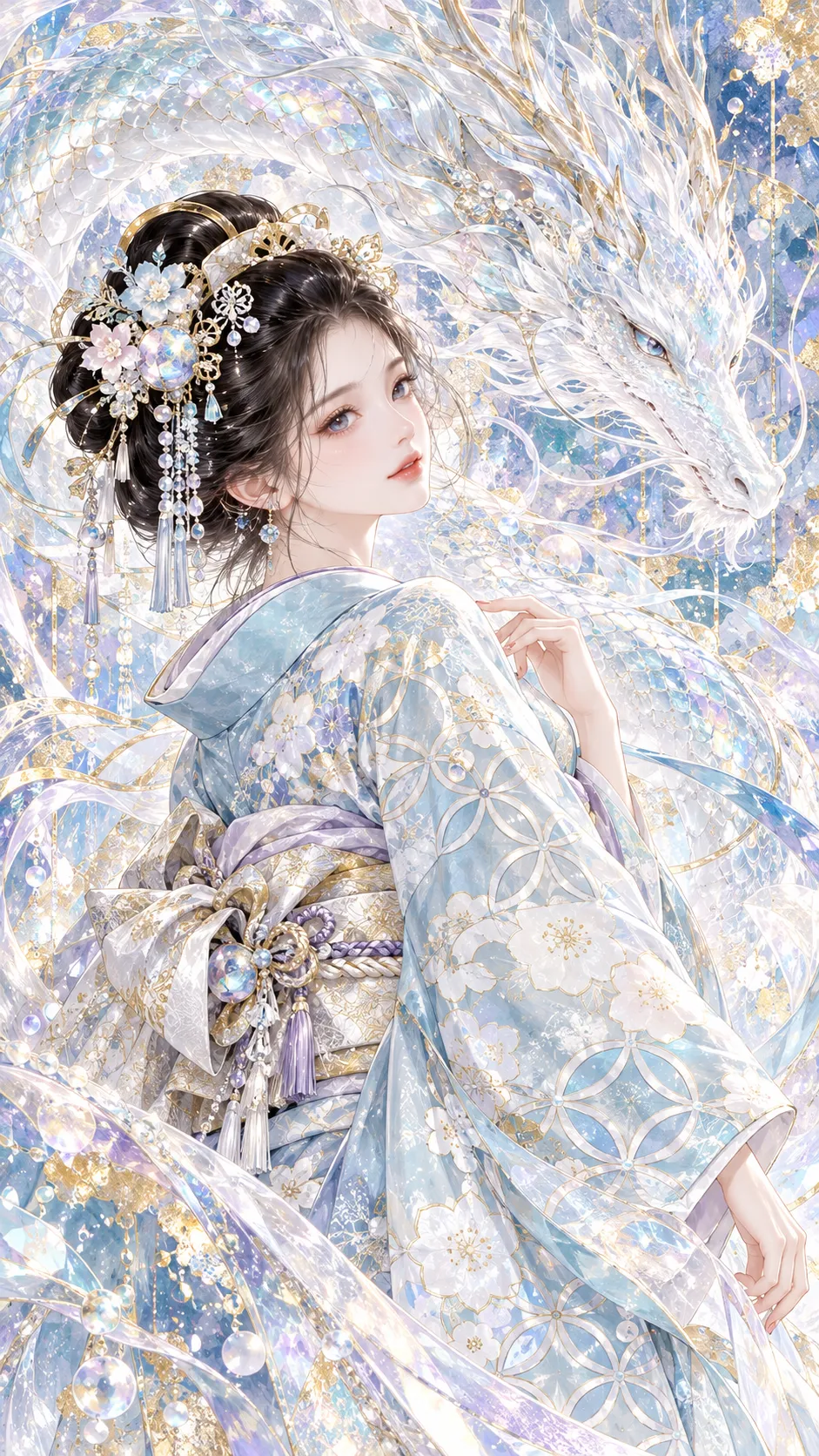
Create a vertical 2D illustration of an elegant adult Japanese woman in a pale aqua furisode beside a luminous crystal dragon, blending Japanese tradition with contemporary abstract art.
By Threads — Published on — Modified on
Example images
Prompt template
0 copies
- Format
- Markdown
- Inputs
- Available_user_preferences (text) · Optional
- Outputs
- Illustration (image)
# Crystal Dragon and Pale Aqua Furisode Beauty

Create a fantastical Japanese-style portrait featuring a sacred Eastern crystal dragon and an elegant adult Japanese woman. Their beauty should complement one another, with both treated as equal main subjects. The theme is clarity, purity, harmony, and hope. Blend Japanese traditional beauty with contemporary abstract art, decorative art, Japanese painting, and delicate shōjo-manga-style character illustration.

## Personal design

If available, draw artistic inspiration from the user's accessible conversation history, remembered preferences, shared tastes, or creative work. Reflect preferences such as favorite flowers, natural stones, gemstones, colors, art styles, and traditional crafts in the woman's hair ornaments, secondary kimono motifs, obi, accessories, and abstract background.

Do not reproduce the user's appearance. Express their aesthetic sensibility through a fictional woman. Do not assert personal characteristics that cannot be verified. If little or no personal reference information is available, choose an original design that suits the theme.

Keep these elements consistent in every version:
- A transparent, crystal-like Eastern dragon.
- A furisode primarily in pale aqua.
- Snow-ring and shippo (interlocking-circle) motifs.
- Traditional Japanese coiffure inspired by the Shimada hairstyle.
- A high-end, entirely 2D painted appearance.
- Vertical 9:16 composition.

Vary other ornaments, accent colors, pose, composition, and the dragon's placement to suit the user and the artwork.

## Composition and pose

Do not fix the woman's pose. Design one graceful pose that suits the theme, the construction of the furisode, natural human movement, and the user's aesthetic sensibility. Possible approaches include a backward glance, an elegant profile, a standing pose with the body turned diagonally, a pose that shows the sweeping sleeves, a poised frontal stance, or a natural hand gesture. Do not combine multiple poses; create one coherent, natural posture.

If previous works are available for reference, avoid repeating the most recent work's body direction, face angle, and arm placement. Show the woman large in the frame, primarily from the waist up, emphasizing her face, hairstyle, main kimono motifs, and obi. Both hands do not have to be visible. It is acceptable for an arm or hand to be naturally obscured by the body or clothing. Do not prohibit poses with a hand near the face or a bent arm, but maintain accurate anatomy in every pose.

## Anatomy and hands — highest priority

Human anatomy takes precedence over decorative details.

1. **Arms:** The right arm must connect naturally to the right shoulder, and the left arm to the left shoulder. There must be exactly two arms—one right and one left. Keep the shoulder, upper arm, elbow, forearm, wrist, and palm in anatomically coherent positions. Do not add an arm or hand that would naturally be hidden by the body's orientation. Do not create extra limbs, extra hands, multiplying joints, or hands detached from the body.

2. **Right and left hand consistency:** Keep the right and left hands clearly distinct. For each hand, determine its corresponding arm, wrist rotation, palm orientation, and back-of-hand orientation before placing the fingers. The thumb must extend naturally from its proper base next to the index finger; the little finger belongs on the opposite side of the hand. Their positions depend on the orientation of the palm and back of the hand and on arm rotation—not merely on which side of the image they appear. Do not depict a right hand as a left hand or mirror the hands incorrectly.

3. **Bent-arm poses:** If an arm is bent and a hand is near the face, maintain a natural connection from shoulder through elbow, forearm, wrist, and palm. Let the visible positions of the thumb and little finger follow the forearm's pronation or supination and the wrist angle. Do not move the thumb unnaturally to the opposite side or make the palm and back-of-hand orientations contradict each other. If fingertips touch the face, avoid forced joint bends and awkwardly overlapping fingers.

4. **Fingers:** Each hand has five normal fingers, including the thumb. Depict natural finger lengths, bases, joints, and bending directions. If the hand's angle hides some fingers, do not force them all into view. Avoid extra, fused, missing, or unnaturally branching fingers.

5. **Sleeves and arms:** Long furisode sleeves should hang naturally in response to the arms' movement. Clearly distinguish the arms from the volume of the sleeve fabric. Do not create extra arms or hands at sleeve openings. Maintain anatomically natural continuity even where parts of the body are concealed by the garment.

The finished figure must have a posture a real person could comfortably assume. Give highest priority to consistency among the left and right arms, wrists, palms, thumbs, and little fingers.

## The woman

Depict a beautiful adult Japanese woman combining dignity and delicacy. Give her large, clear eyes, fine and well-proportioned features, and a soft, gentle smile. Her character design should balance cuteness with adult elegance, in a refined shōjo-manga-inspired style.

Style her glossy jet-black hair in a traditional Japanese coiffure inspired by the Shimada mage. Her hair ornaments may include flower kanzashi, natural stones, pearls, combs, goldwork, or raden (mother-of-pearl inlay), drawing on the user's aesthetic sensibility. Crystal, aquamarine, moonstone, and freshwater pearls may be used when they suit the design. Vary the ornaments, their placement, and their density for each user while preserving the beautiful silhouette of the traditional hairstyle.

## Pale aqua furisode

Dress her in a traditional Japanese furisode primarily in clear, pure pale aqua, like clean water. Use pale aqua, porcelain white, pearl, silver-white, and pale wisteria as the main colors, with restrained, refined accents. Depict delicate yūzen dyeing, softly graded dye, silver-thread decoration, and the luster of fine silk. Render the traditional neckline, long furisode sleeves, and the way the kimono overlaps the obi accurately. Do not turn it into Western clothing or a fantasy dress.

The principal motifs are **snow-ring and shippo**. Render the snow-ring as the soft outline of the traditional Japanese snow-ring motif, not as a snowflake. Render shippo as a traditional geometric pattern of overlapping circles of equal size. Use delicate lines and softly graded dye in porcelain white, pearl, silver-white, and pale wisteria. Vary the size, density, and placement of both motifs to suit the pose and the user's aesthetic sensibility. Subtle secondary motifs, such as haze, abstract flowing water patterns, or fine silver stippling, may be included sparingly. Leave beautiful areas of pale aqua open, and depict the patterns as flat designs dyed into the kimono fabric.

## Obi and accessories

Use an elegant, ornate fukuro obi based in pearl and silver-white, decorated with delicate geometric patterns and woven silver-thread details. Harmonize the obijime, obiage, and layered collar in pale wisteria, porcelain white, pearl, or similar colors. An obi clasp may incorporate a natural stone or gemstone inspired by the user's aesthetic sensibility. Vary the obi pattern, accent colors, and accessory details for each user. Respect traditional obi construction and dressing; do not place an unnaturally large bow at the front of the body.

## Sacred crystal dragon — form and placement

Depict a sacred Eastern dragon with scales that evoke transparent crystal and carry pearly, silver-white, and softly iridescent glints. Give it a long, supple body; finely detailed scales; elegant horns; flowing whiskers; and powerful limbs with claws. Let the scales transition naturally from translucent milky white to pale blue-white, with some areas sparkling like crystal. Harmonize the horns in translucent ivory and the whiskers primarily in pearl tones.

Convey crystal-like transparency while keeping the dragon's outline and anatomy clear. Its expression should be serene, intelligent, and compassionate. It must have sacred dignity and elegance, not look like a cute mascot.

Do not fix the dragon's placement. Design the position of its head, body, and tail to suit the woman's pose and the composition. Its body may form a large arc, an S-curve, a diagonal flowing line, or a gentle spiral, while preserving the natural anatomy of an Eastern dragon. Do not overlap the woman's face with the dragon's head; keep both expressions clear. The woman does not have to look up at the dragon or reach toward it. Keep the head, body, and tail connected as one coherent form. Do not add extra heads, limbs, or tails, or create unnatural branches in its body. Do not depict a Western winged dragon or a dinosaur.

## Background — crystal light and contemporary abstract art

Create a purely abstract art space with no natural scenery or architecture. Use pale aqua, porcelain white, pearl, silver-white, and pale wisteria, accented by softly iridescent light. Include geometric color fields reminiscent of transparent crystal, fluid brushstrokes, paint bleeds, and delicate silver-leaf-like details. Suggest gentle rainbow-colored light refracting inside a crystal.

Vary the colors, brushwork, decorative placement, and shapes of the negative space to suit the user's aesthetic sensibility and the woman's pose. Leave adequate space around faces and hands so the woman and dragon remain clearly defined. In particular, do not crowd the hands with dragon whiskers, decorative cords, or complex lines of light. Avoid repeatedly using similar backgrounds centered on a circular halo.

Do not depict mountains, seas, rivers, lakes, forests, sky, clouds, gardens, shrines, temples, other buildings, horizons, or perspective scenery.

## Rendering and quality

- Vertical 9:16 composition.
- High-end, entirely 2D painting.
- Blend delicate, beautiful shōjo-manga-inspired character rendering, the decorative beauty of Japanese painting, and the artistic quality of contemporary abstract painting.
- Show the woman large in the frame, primarily from the waist up.
- Render the face, Japanese hairstyle, hair ornaments, kimono motifs, obi decorations, and the crystal dragon's expression and scales with fine detail.
- Distinguish the texture of the furisode silk from the dragon's crystal-like scales.
- Emphasize the pure beauty of pale aqua, the transparency of pearl tones, and the delicate shimmer of silver-white.
- Create an artwork with the elegance and splendor of a cover for a high-end art book.
- Do not use 3D, CGI, live-action, a photographic look, or excessive photorealism.
- Do not include text, logos, watermarks, or a frame.

## Final priorities

Build the artwork according to these priorities:

1. **Accurate anatomy and hand orientation:** First establish the woman's body direction and pose, then connect the shoulders, elbows, forearms, wrists, and palms naturally. Distinguish the right hand from the left. Determine the orientation of each palm and the back of each hand, and place the thumb and little finger anatomically correctly. When an arm is bent, make the forearm rotation consistent with the thumb's position. Do not depict a hand with an unnatural thumb base or incorrect left-right placement, even if it has the right number of fingers.
2. **A free and graceful pose:** Design a natural, beautiful pose. Gestures such as placing a hand near the face, looking back, or turning the body are allowed, provided the posture works as a real human pose. Do not require both hands to be visible or force a hidden arm or hand into view.
3. **Personal design:** Use the user's available aesthetic preferences to guide the hair ornaments, secondary patterns, obi, accessories, and background decoration.
4. **Harmony between the crystal dragon and furisode:** Preserve the transparent crystal dragon, pale aqua furisode, and snow-ring and shippo motifs. Design the dragon's placement and the flow of the furisode sleeves naturally around the woman's pose.
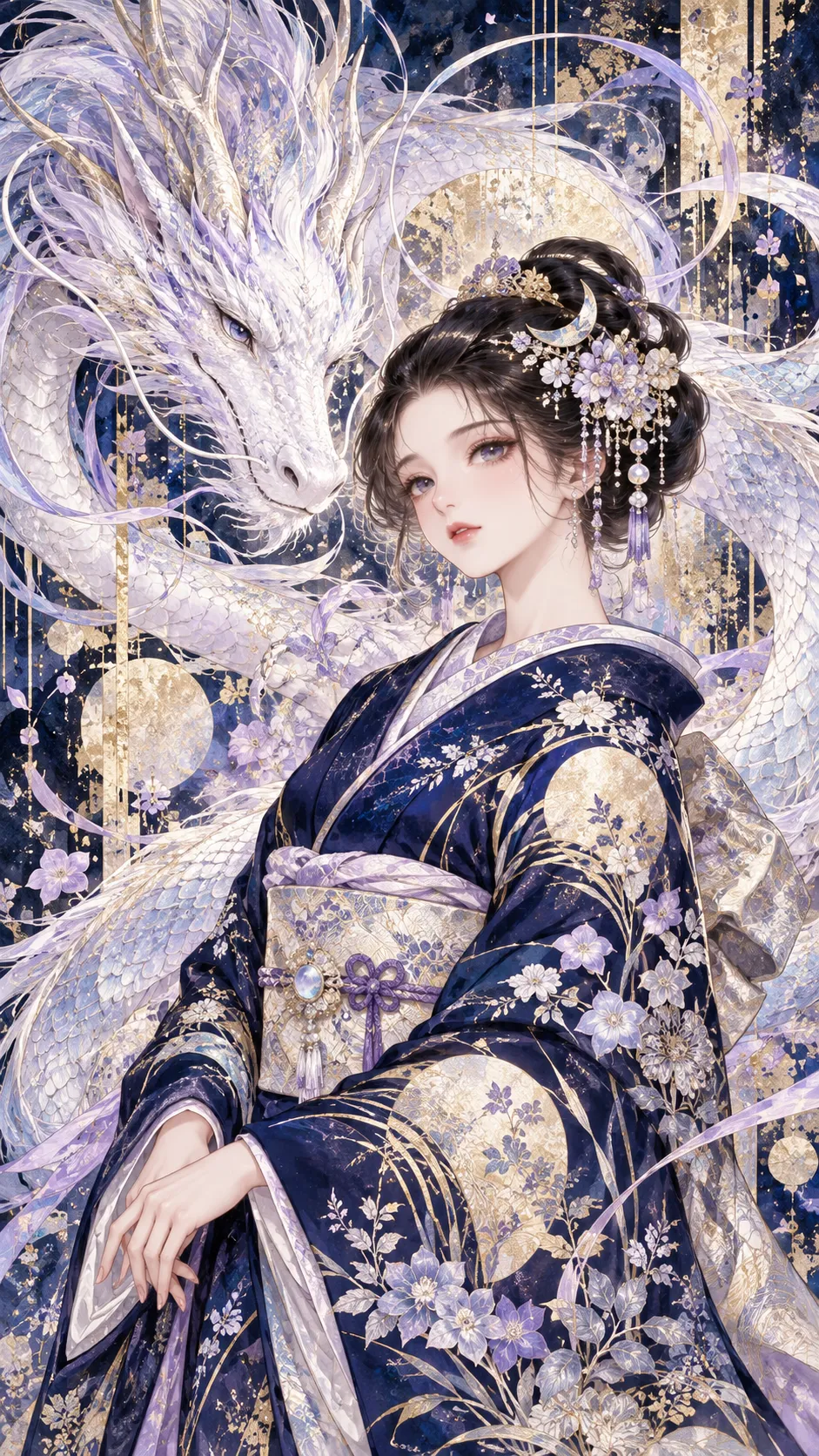
5. **Originality and artistry:** Even when the same prompt is used, aim for a work whose hair ornaments, secondary motifs, obi, pose, dragon placement, and abstract background vary for each user. Unite Japanese traditional beauty, the mysterious radiance of crystal, and a gentle bond between the woman and the dragon to create a fantastical, one-of-a-kind artwork.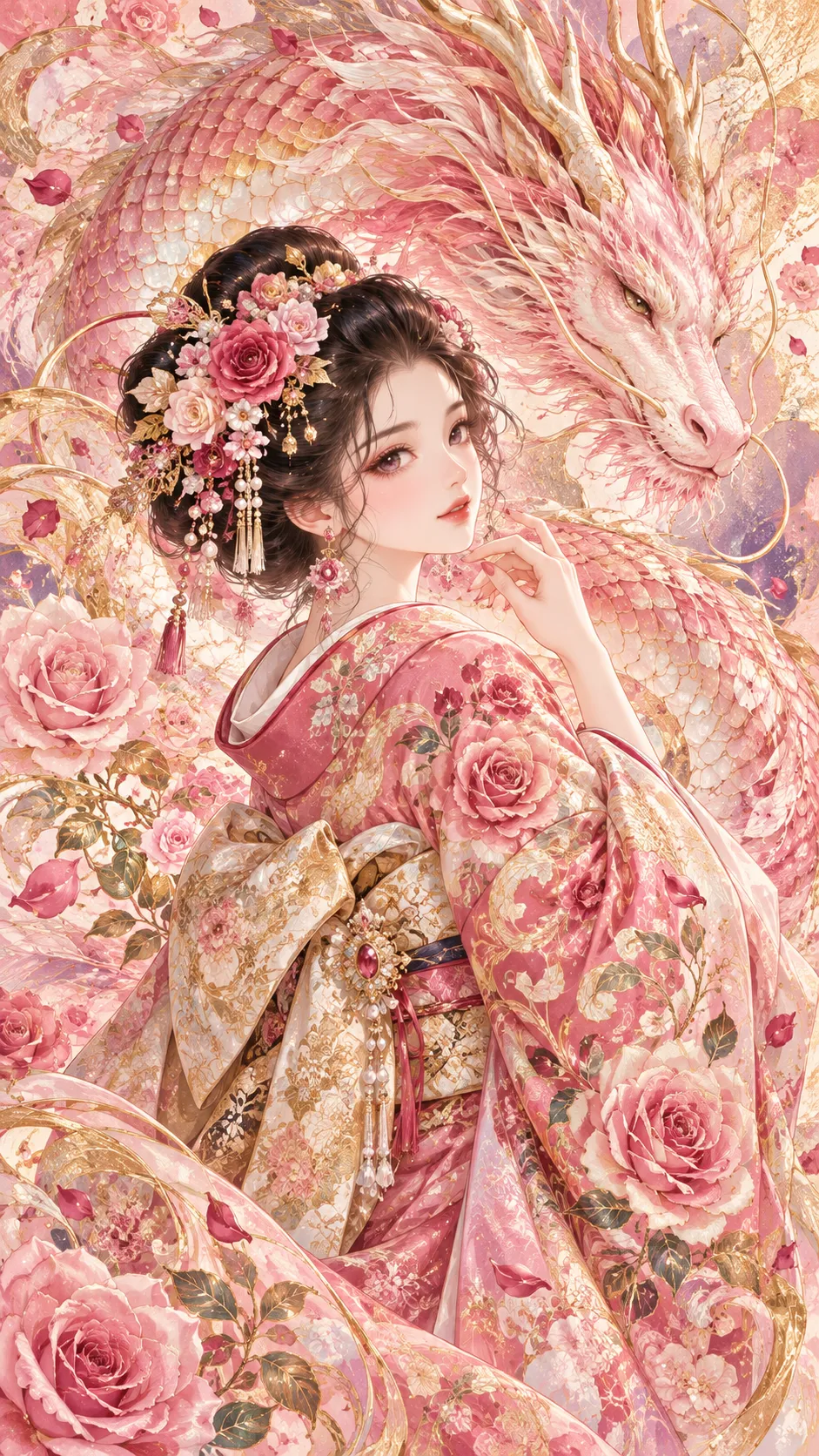


Comments — 0