- Category
- Art & Illustration
- Model
- openai-chatgpt
- Tags
- woman rose-dragon furisode
Rose Dragon and Rose-Colored Furisode
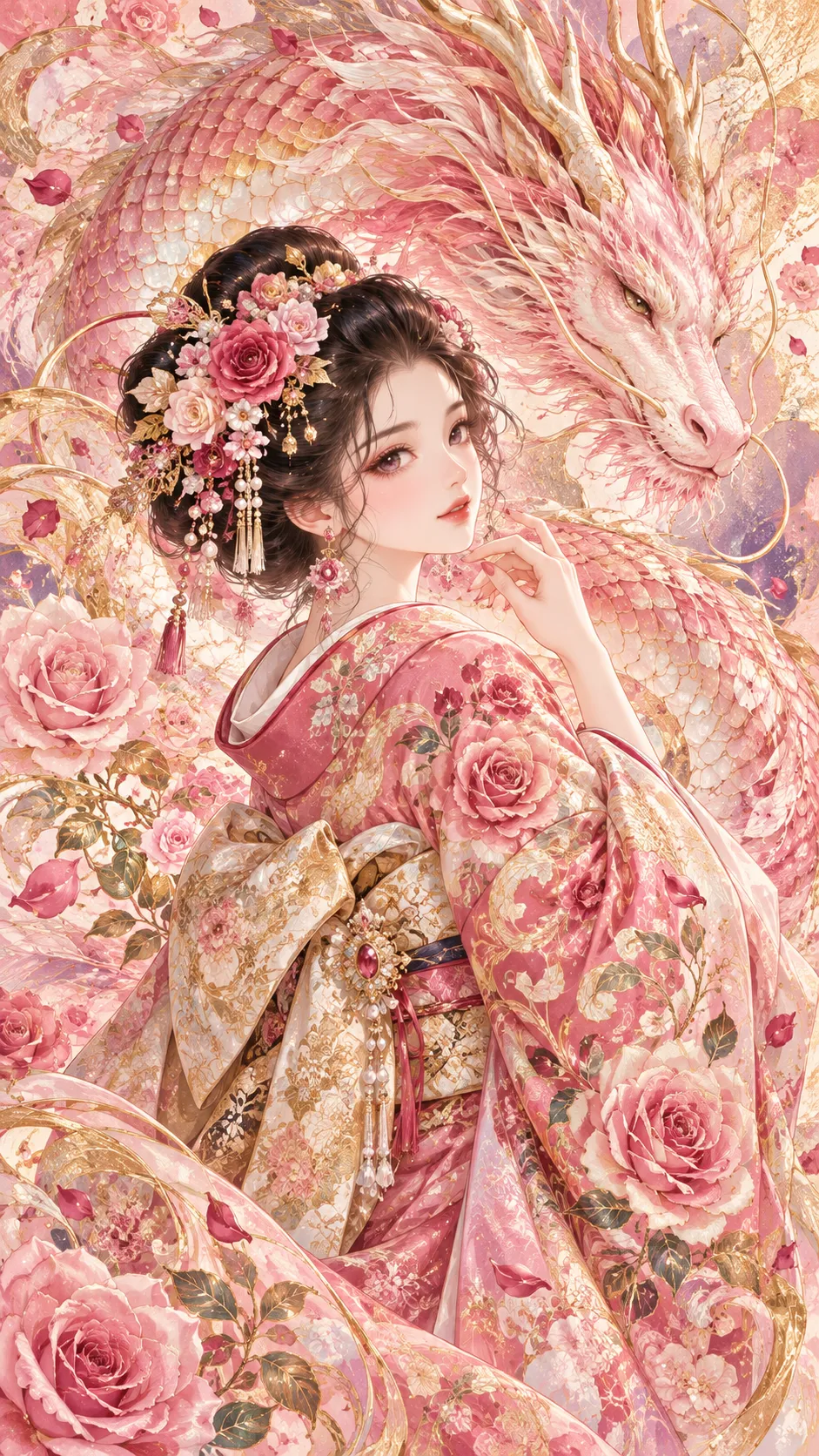
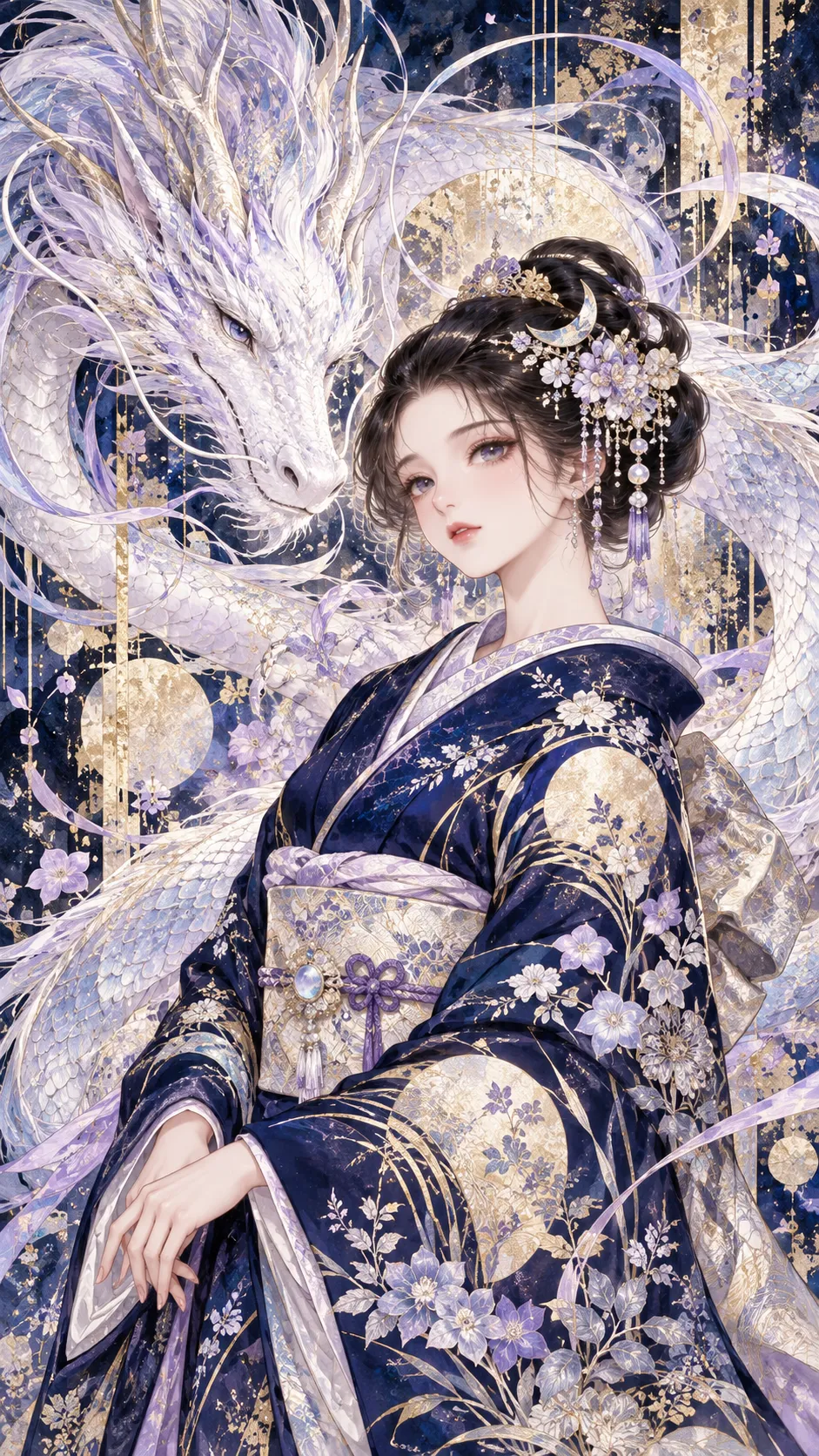
Create an ornate Japanese-inspired 2D artwork of an adult woman in a rose-colored furisode beside a pearl-and-gold rose dragon, with a personalized design and careful anatomy.
By Threads — Published on — Modified on
Example images
Prompt template
0 copies
- Format
- Markdown
- Inputs
- Available_user_preferences_and_context (text) · Optional
- Outputs
- Artwork (image)
Create a vertical 9:16, premium-quality, fully 2D Japanese-inspired artwork combining the decorative beauty of Japanese painting, contemporary abstract painting, ornamental art, and an elegant shōjo-manga illustration style. The result should feel like a magnificent, refined art-book cover. Do not use 3D, CGI, live-action, photographic styling, or excessive photorealism. Do not include text, logos, watermarks, or a frame.

## Concept and central subjects

Depict a sacred Eastern dragon whose soft rose-colored scales shimmer with pearl and pale-gold light. Beside it, portray an elegant adult Japanese woman wearing a beautiful rose-colored furisode and traditional Japanese hairstyle. The theme is love, elegance, beauty, and the blossoming of the heart: combine the graceful unfolding of a rose with the sacred dignity of a dragon deity.

The woman and dragon are equal central subjects, each enhancing the other’s beauty. Show the woman primarily from the waist up, giving prominence to her face, hairstyle, hair ornaments, furisode patterns, and obi. Give her large, clear eyes, delicate features, and a gentle smile, balancing youthful delicacy with adult elegance.

## Personalized design

Use any user conversation history, memories, shared preferences, or creative interests that are actually available to you as artistic inspiration. Reflect relevant preferences—such as favorite flowers, natural stones, gemstones, colors, art styles, or traditional crafts—in the woman’s hair ornaments, secondary kimono patterns, obi, accessories, or abstract background. Do not reproduce the user’s actual appearance; express their aesthetic as a fictional, elegant woman. Do not assert personal characteristics that cannot be verified. If little or no personal reference information is available, choose an original design that harmonizes with the artwork’s theme.

Keep these elements consistent: a sacred rose-scaled Eastern dragon; a rose-colored furisode; rose and arabesque patterns; a traditional Japanese hairstyle inspired by the Shimada mage; fully 2D painted artwork; and a vertical 9:16 composition. Vary other decorations, accent colors, pose, composition, and the dragon’s placement to suit the available personal inspiration.

## Pose and composition

Design one graceful, natural pose that suits the theme, the structure of the furisode, the woman’s movement, and the available aesthetic preferences. The pose may be a three-quarter standing pose, a turned-back glance, a composed frontal pose, an elegant profile, a pose that displays the flow of a sleeve, or a natural hand gesture. Do not fix the pose to one option or combine gestures awkwardly. The woman need not look up at the dragon or reach toward it.

If previous works are available for reference, avoid repeating the most recent work’s body orientation, face angle, and arm positions. Both hands do not have to be visible; an arm or hand may naturally be obscured by the body or clothing. A hand may rest near the face, or an arm may be bent, provided the pose remains physically plausible. Do not force hidden limbs into view.

## Anatomy and hands — highest priority

Give anatomical accuracy priority over decorative complexity. Make the pose one that a real person could comfortably assume.

- Connect the right arm naturally to the right shoulder and the left arm to the left shoulder. Show only two arms total, one on each side. Keep the shoulders, upper arms, elbows, forearms, wrists, and palms in a coherent, anatomically plausible relationship. Do not add limbs hidden by the clothing or body.
- Clearly distinguish the right hand from the left. Match each hand to its corresponding arm, forearm rotation, wrist angle, and the visible side of the hand. Place the thumb at its natural base beside the index finger, with the little finger on the opposite side. Determine thumb and little-finger positions from the actual orientation of the hand, not from screen-left or screen-right. Do not mirror or interchange the hands.
- When an arm is bent or a hand rests near the face or chest, depict the shoulder, elbow, forearm, wrist, and fingers as one continuous structure. The direction of the elbow bend and forearm rotation must agree with whether the palm or back of the hand is visible. Do not place the thumb unnaturally inward or make the visible hand surfaces contradictory.
- Each hand has five fingers, including the thumb. Give the fingers natural bases, lengths, joints, and bending directions. If fingers overlap, allow some to be concealed rather than forcing every finger into view. Avoid extra, fused, missing, or unnaturally branching fingers.
- Let the long furisode sleeves hang naturally according to the arm position and gravity. Clearly distinguish the fabric from the arm. Do not add an extra hand or arm at a sleeve opening.

Before completing the pose, check that the left and right arms, wrists, palms, thumbs, and little fingers are mutually consistent.

## Hairstyle and ornaments

Style the woman’s glossy jet-black hair in a traditional Japanese updo inspired by the Shimada mage. Center the hair ornaments on rose-themed floral kanzashi, and complement them with elements inspired by the user’s aesthetic, such as natural stones, pearls, combs, goldwork, or raden inlay. Rose quartz, garnet, freshwater pearls, and moonstone may be used when they suit the design. Vary the kinds, placement, and density of the ornaments while preserving the clear, beautiful silhouette of the Japanese hairstyle.

## Rose-colored furisode

Dress the woman in a traditional Japanese furisode, primarily in elegant rose tones. Use rose pink, pale crimson, pearl, ivory, and soft gold, with restrained, harmonious accent colors. Suggest delicate yuzen dyeing, softly graduated dye effects, gold-thread ornament, and the sheen of fine silk. Depict the traditional neckline, long furisode sleeves, and their relationship to the obi accurately. Do not turn the garment into Western clothing or a fantasy dress.

The principal pattern is roses and arabesque vines. Render the roses as elegant, layered floral motifs in a flattened pattern that harmonizes with Japanese textile design. Render the arabesque as a traditional decorative pattern of supple, continuous vines and leaves. Vary the rose sizes, stages of bloom, vine curves, and pattern placement. Subtle secondary motifs—such as mist patterns, delicate gold stippling, or geometric ornament—may be added sparingly. Preserve attractive areas of rose-colored negative space. Do not make flowers or vines appear to grow three-dimensionally out of the woman’s body.

## Obi and accessories

Use an elegant, ornate fukuro obi in pearl and pale-gold tones, with delicate arabesque or geometric patterns and woven gold and silver threads. Coordinate the obijime, obiage, and layered collar in colors such as pale wisteria, coral, or ivory. A natural stone or gemstone reflecting the user’s aesthetic may be used for the obidome. Vary the patterns, accent colors, and accessories while respecting traditional obi construction and dressing. Do not place an unnaturally large bow at the front of the body.

## Sacred rose dragon

Depict a sacred Eastern dragon with scales that transition from soft petal-like crimson to pale rose, touched by pearl and gold radiance. Give it a long, supple body, clearly defined scales, elegant horns, flowing whiskers, and powerful limbs and claws. The scales may have delicate layered colors reminiscent of rose petals, but their structure must remain recognizably that of dragon scales. Use pale ivory for the horns and primarily pearl or pale gold for the whiskers. Give the dragon an intelligent, compassionate, serene expression. It should convey sacred dignity and elegance, not look like a cute mascot.

Vary the dragon’s placement to complement the woman’s pose and the composition. Design its head, body, and tail as a naturally connected whole, with a body that may curve in a broad arc, an S-shape, a diagonal flowing line, or a gentle spiral. Keep the woman’s face and the dragon’s head separate and clearly readable. Do not require the woman to look up at the dragon or reach toward it. Do not add extra heads, limbs, tails, or unnatural branches in its body. Do not depict a Western winged dragon or a dinosaur.

## Abstract background

Use a purely abstract artistic space, with no natural landscape or architecture. Harmonize rose, pale crimson, pearl, ivory, and pale gold. Incorporate abstract curves reminiscent of rose petals, soft fields of color, flowing brushwork, paint bleeding, and delicate gold-leaf-like ornament. Where appropriate, combine the graceful curves of Art Nouveau with the geometric ornament of the Vienna Secession.

Vary the colors, brushwork, decorative placement, and negative-space shapes to suit the woman’s pose and the available aesthetic inspiration. Leave adequate space around faces and hands so the woman and dragon remain clearly outlined. Do not crowd the fingers with dragon whiskers, decorative cords, or complex lines of light. Avoid repeatedly centering the composition on a circular halo. Do not depict mountains, seas, rivers, lakes, forests, sky, clouds, gardens, temples, shrines, buildings, a horizon, or a perspective landscape.

## Finish and priority order

Render the woman primarily from the waist up. Carefully detail her face, Japanese hairstyle, hair ornaments, furisode patterns, obi, the dragon’s expression, and its scales. Distinguish the sheen of silk from the texture of the dragon’s scales. Emphasize the richness of rose tones, the translucent quality of pearl colors, and the delicate radiance of gold.

Follow this priority order:

1. **Anatomy and hand orientation:** Establish the body direction and pose first. Connect the shoulders, elbows, forearms, wrists, and palms naturally. Distinguish the right and left hands correctly. Keep the visible sides of the hands, thumb and little-finger placement, and forearm rotation anatomically consistent. Correct finger count alone is not sufficient if the thumb base or hand orientation is wrong.
2. **A free, graceful pose:** Design a natural and beautiful pose, including a turned glance, a gentle twist, or a hand near the face if suitable. The pose must remain physically plausible. Do not require both hands to be visible or add limbs that would naturally be hidden.
3. **Personalized design:** Use available user aesthetic preferences to guide the hair ornaments, secondary patterns, obi, accessories, and background decoration.
4. **Harmony of dragon and furisode:** Preserve the rose-colored Eastern dragon, rose-colored furisode, and rose-and-arabesque motifs. Arrange the dragon and the flow of the sleeves naturally around the chosen pose.
5. **Originality and artistry:** Aim for a distinctive work whose ornaments, secondary patterns, obi, pose, dragon placement, and abstract background can vary for each user. Unite Japanese traditional beauty, the elegance of roses, and the gentle bond between the woman and the sacred dragon in a singular, fantastical artwork.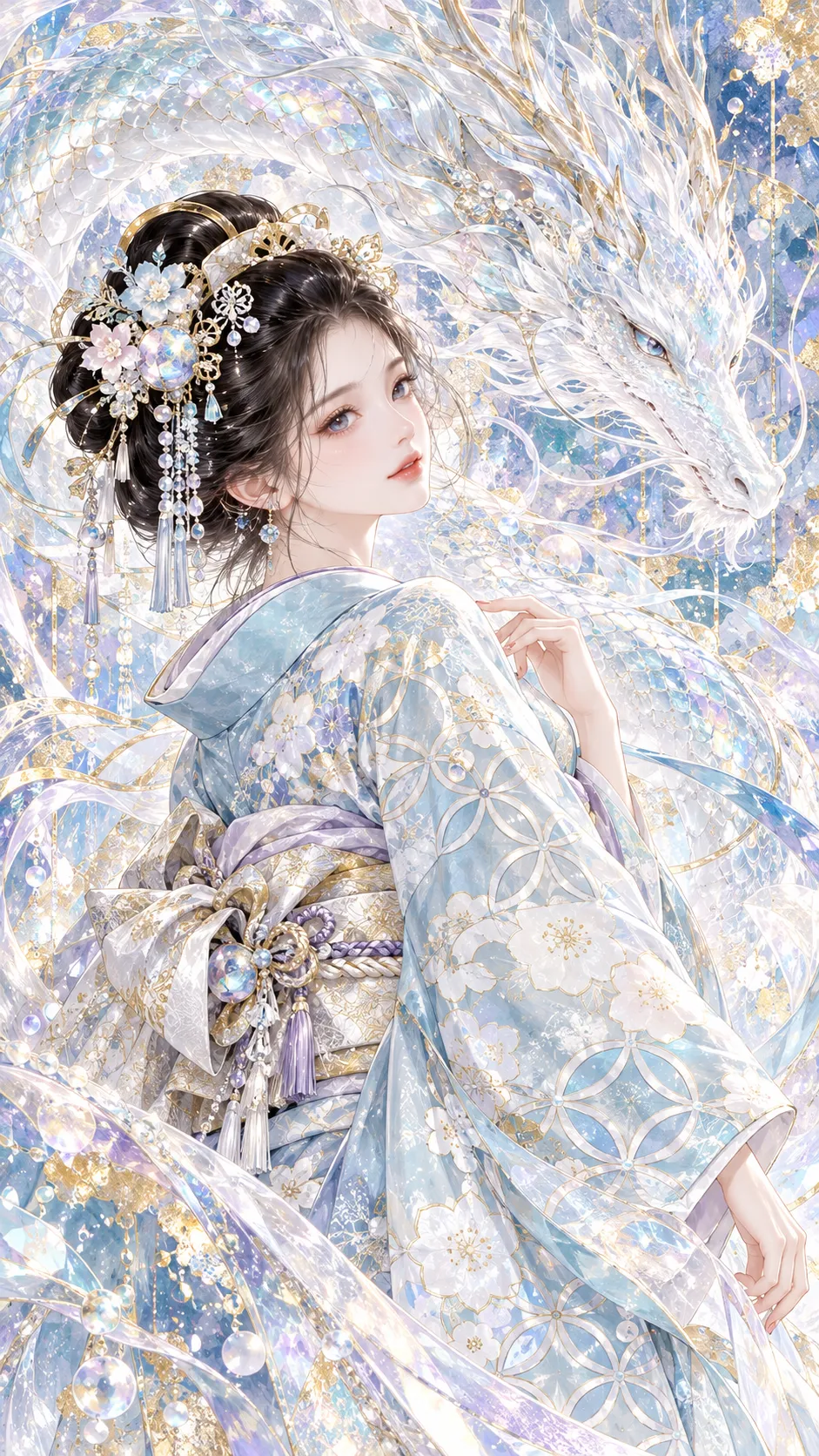


Comments — 0