- Category
- Art & Illustration
- Tags
- woman edo-period antique-map
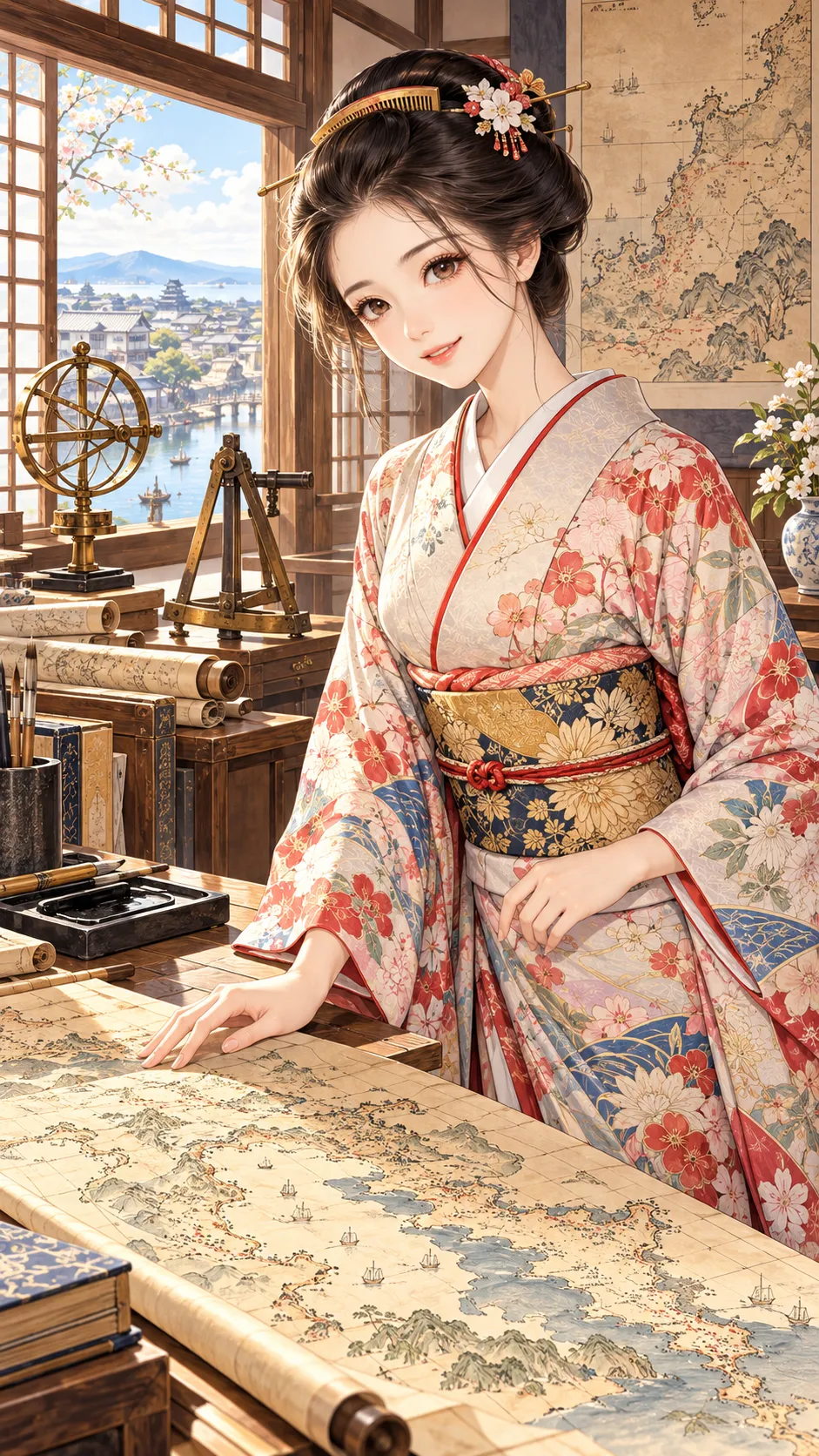
Edo-Period Woman with an Antique Map
Create a refined 2D historical illustration of an adult woman in a historically natural Edo-period kimono, standing beside a hand-drawn antique map in a quiet study.
By Threads — Published on — Modified on
Example images
Prompt template
- Format
- Markdown
- Outputs
- Historical2DIllustration (image)
Create a vertical 9:16, entirely 2D historical painting inspired by Japan’s surveying and mapmaking history around 1800, in the late Edo period. Imagine the world of Edo-period surveying and mapmaking transformed into an elegant Japanese beauty portrait.

SETTING AND ATMOSPHERE
In a calm room with wooden architecture, carefully arrange antique maps, washi paper, a brush, an inkstone, and a few surveying-related tools. An old hand-drawn map of Japan, showing coastlines, mountains, and roads, is spread across a wooden desk. Soft natural light enters through a lattice window, evoking the travel and scholarship of the Edo period. Keep the background orderly and supportive of the main figure; do not clutter it with excessive props.

MAIN SUBJECT
The central figure is a beautiful adult woman with a refined, charming face, large clear eyes, delicate eyelashes, and a natural, gentle smile. Combine the ornate appeal of shōjo manga with the grace of traditional Japanese beauty painting. Style her hair in an elegant updo inspired by women’s hairstyles of the late Edo period, with only a modest comb or kōgai hairpin suited to the era.

KIMONO CONSTRUCTION — HIGHEST PRIORITY
Dress her in historically natural Japanese clothing inspired by a late-Edo-period woman’s kosode. The outfit should consist primarily of one kosode and one obi.

The front panels should overlap naturally, with the wearer’s left panel crossing over the right in the correct right-front closure. The collar should follow a natural line from the neck to the chest, with no exposed chest. Each shoulder should connect naturally to one sleeve on its respective side. Clearly show how the sleeve openings, sleeve lengths, and body panels connect.

Wrap a single obi naturally around the waist and tie it in a manner appropriate to late-Edo-period dress. Do not add meaningless cords or multiple layers of fabric around the obi. Let the kimono hem fall naturally from the waist toward the feet; do not create excess fabric or a separate skirt-like structure. Do not add a haori, uchikake, shawl, cape, or decorative shoulder cloth. Keep the outfit’s construction clear and beautiful, centered on the kosode and obi.

KIMONO COLORS AND PATTERNS
Draw an elegant kosode inspired by Edo-period textile culture. Incorporate delicate flowers and plants, komon-style small patterns, flowing-water motifs, or geometric designs. Vary the kimono’s ground color, pattern, and obi color from one generation to another. Express ornament through beautiful colors and textile patterns rather than unnecessary accessories. Render the garment with the delicate, sophisticated beauty of a high-end Japanese beauty painting.

POSE AND COMPOSITION
Have the woman stand naturally beside the wooden desk with the antique map spread across it. Turn her body slightly at an angle while having her face look gently toward the viewer. Rest one hand naturally on the edge of the map and lightly place the other near the obi, creating a calm, graceful pose.

Draw the shoulders, arm lengths, elbow bends, and wrist angles in accordance with natural anatomy. Make the woman the prominent, large subject in the frame. Use a medium portrait cropped around the knees, with the kimono collar, obi, sleeves, and waist clearly visible. Include the antique map and surveying tools naturally within the frame.

ANTIQUE MAP AND HISTORICAL TREATMENT
Base the antique map on hand-drawn maps from the Edo period. Carefully depict the texture of washi paper, ink lines, mountains, and coastlines. Do not reproduce a modern, geographically precise map of Japan. Do not portray Inō Tadataka himself or a historical woman from an actual surveying expedition. The woman is a fictional character inspired by the history of Edo-period surveying and mapmaking.

ART STYLE AND FINISH
Combine the highest-quality Japanese beauty painting with an ornate shōjo-manga-style illustration, rendered as a completely 2D painting. Use delicate, beautiful outlines, translucent-looking skin, and an elegant expression. Carefully render the kimono’s textile patterns in a polished, high-quality illustration. Use warm, bright colors to create a refined, richly evocative historical romance. Give highest priority to the beauty of the woman and her clothing.

ANATOMY AND CONSTRUCTION — STRICT REQUIREMENTS
- Show exactly two arms, one on each side.
- Show one hand on each arm, with five fingers on each hand.
- Connect the shoulders, elbows, and wrists accurately.
- Show exactly one sleeve on each side of the kimono.
- Keep the collar in the correct right-front closure.
- Use one obi with a natural knot.
- Do not drape meaningless fabric from the shoulders.
- Do not add unnecessary cords around the obi or waist.
- Connect the kimono’s body panels and hem naturally.
- Do not add extra arms, hands, fingers, sleeves, or pieces of cloth.
- Do not use a photographic, live-action, 3D CGI, or three-dimensional rendered style.
- Finish as a beautiful, entirely 2D illustration.
- Include no text, logos, watermarks, or signatures.

FINAL IMAGE
Create a refined, premium-quality vertical 9:16, entirely 2D historical painting in which a woman in naturally beautiful late-Edo-period clothing and an antique map evoke a historical romance. Harmonize her charm, accurate kimono construction, delicate textile patterns, and the beauty of the old map.






Comments — 0