- Category
- Art & Illustration
- Model
- openai-chatgpt
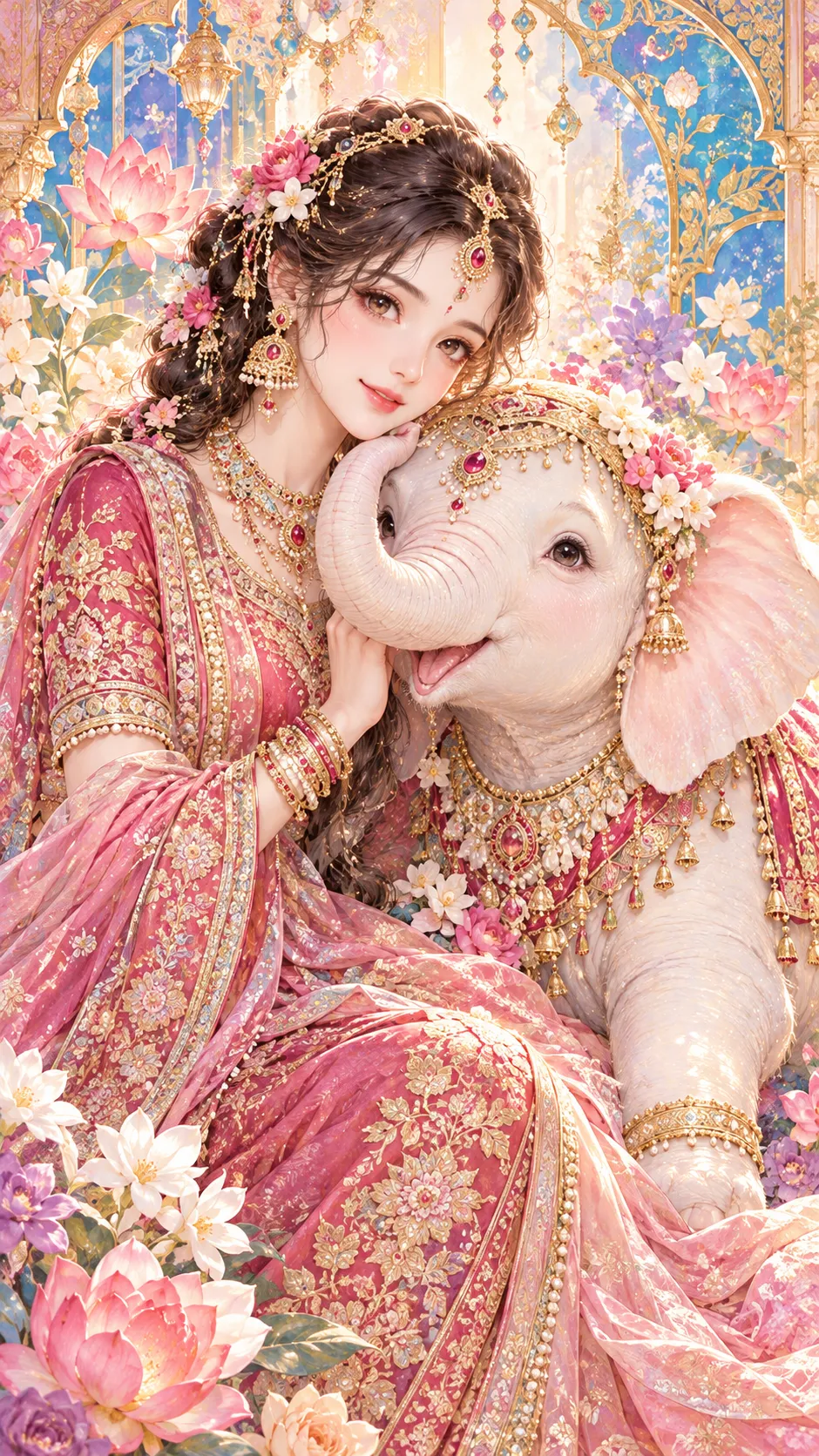
Indian Royal Beauty with a White Elephant Calf
Create an elegant 2D illustrated portrait of an adult woman in Indian court-inspired attire alongside a white elephant calf, with a warm bond, richly detailed adornments, and a bright decorative floral setting.
By Threads — Published on — Modified on
Example images
Prompt template
0 copies
- Format
- Text
- Inputs
- Aesthetic_preferences (text) · Optional
- Outputs
- Illustrated_portrait (image)
Create a high-quality, entirely 2D digital painting in a refined, beautiful shōjo-manga illustration style. The result should combine an elegant editorial portrait and fashion illustration with the traditional beauty of Indian court attire, modern abstract painting, and decorative art. Use graceful Art Nouveau-inspired curves, expressive linework, luminous layered color, and delicate light and shadow. Render silk, embroidery, gemstones, petals, and the calf’s soft skin with care. Do not make the image photorealistic, photographic, 3D, or figurine-like.

SUBJECTS AND MOOD
Depict two equal main subjects: one beautiful adult woman wearing a lavish outfit inspired by traditional Indian clothing and historical court culture, and one small, endearing white Asian elephant calf. Create a fantastical, heartwarming artistic portrait of a gentle bond grounded in kindness, trust, pure joy, and the beauty of life. Treat the calf as an independent living being, not as a pet or mere ornament. Keep the scene bright, graceful, affectionate, and refined; do not emphasize fear or sensuality.

Use the user's available conversation history or memory, if accessible, to inform aesthetic preferences such as colors, ornament, and artistic sensibility. Reflect those preferences in the clothing, palette, embroidery, jewels, hair ornament, flowers, and background. Do not assume personality traits or personal information that are not present. Do not apply one fixed palette or decorative style to everyone. If no relevant preferences are available, make an original artistic interpretation. Aim for results that can differ meaningfully from person to person. The animal must always remain one white elephant calf.

THE WOMAN
Depict a beautiful adult woman with both delicacy and mature elegance. Give her large, clear, natural-looking eyes suggestive of a beautiful shōjo-manga illustration; finely balanced features; luminous, translucent-looking skin; soft, refined lips; and a warm, approachable smile. When she looks at the calf, convey affection and tenderness. Avoid a cold gaze, extremely sharp-looking eyes, an overly seductive expression, or an immature, childlike appearance.

Choose a hairstyle freely, such as elegant braids, a graceful updo, soft waves, or traditional hair ornaments. Vary the hairstyle and ornaments between generations rather than fixing one design.

INDIAN COURT-INSPIRED CLOTHING
Choose one of these four outfit types and respect its characteristic construction and draping. Do not combine them indiscriminately:
1. An Anarkali-inspired court outfit: a fitted upper bodice and a long garment that flows gracefully outward from the waist, with refined embroidery, beautiful sleeves, and a softly draped dupatta.
2. A lehenga-choli-inspired festive outfit: a decorative blouse, a voluminous long skirt, and a lavish dupatta, with delicate embroidery and beautiful layers of fabric.
3. A sari-inspired traditional outfit: a long piece of cloth wrapped around the body, with natural pleats, a pallu flowing from the shoulder, and a decorative blouse.
4. A sharara-inspired court outfit: a beautiful kurta with flared sharara trousers, delicate embroidery, an elegant dupatta, and flowing fabric.

Incorporate details such as zardozi embroidery, gold-thread ornament, silk, and floral motifs. Keep the chest and abdomen modestly covered and the overall clothing dignified as court attire. Do not use a Western princess gown or wedding dress.

Keep the clothing colors open to interpretation. When possible, use the user's available aesthetic preferences and choose colors that harmonize with the calf's soft pale skin. Possible colors include rose pink, lavender, sapphire blue, turquoise, emerald green, coral pink, amethyst purple, and champagne gold; these are examples, not required colors. A monochrome scheme, tonal variations, complementary colors, or several gemstone hues are all acceptable. Harmonize the main fabric color, embroidery, dupatta, and gemstones. Do not make the entire outfit white to match the calf, and do not default invariably to gold or emerald green. Prioritize a bright, celebratory palette that flatters both subjects.

JEWELRY AND HAIR ORNAMENTS
Select ornaments that complement the outfit, such as a maang tikka, jhumka earrings, necklaces, bangles, or traditional hair ornaments. Choose gemstone colors freely, including ruby, emerald, sapphire, amethyst, rose quartz, or pearl. Vary the types, placement, colors, and density of the ornaments between generations. Keep the adornment lavish yet refined, so it enhances rather than obscures the woman's face.

THE WHITE ELEPHANT CALF
Show one small, adorable Asian elephant calf with naturally proportioned anatomy based on a real Asian elephant. Treat its white color as a fantastical expression inspired by the pale pigmentation found in real Asian elephants. Avoid a flat, pure-white surface; give the skin soft ivory-white and pale cream tones, with very subtle pinkish shading.

Give the calf a softly rounded forehead, gentle small eyes, naturally sized ears, a short and endearing trunk, plump cheeks, a small rounded body, four sturdy legs, and one short tail. Convey youthful innocence and a calm sense of life. Keep its proportions and roundness recognizably calf-like rather than simply shrinking an adult elephant. Avoid excessively large eyes and unnatural plush-toy styling.

Maintain exactly one trunk, one ear on each side, two front legs and two hind legs, and one tail. Connect the head, neck, body, limbs, trunk, and tail naturally. Shape the trunk consistently with an Asian elephant's features, including one natural finger-like projection at its tip. Do not give the calf extra, duplicated, missing, or fused body parts, or excessive tusks.

Optional, restrained adornments inspired by Indian court culture may include delicate jewels, a small forehead ornament, soft fabric decoration, or a floral garland. Keep them light and unobtrusive; do not obstruct the trunk, ears, eyes, or legs, and do not cover the calf's body in lavish fabric. Preserve its natural anatomy and endearing face above all.

POSE AND INTERACTION
Choose one pose that suits the artwork and make the composition natural and graceful. Possible poses include: the woman seated elegantly while the calf cheerfully lifts its small trunk; the woman gazing affectionately at the calf as it looks up at her; the woman with one hand at her waist while the calf stands calmly beside her; the calf standing slightly in front of the smiling woman; the woman arranging her dupatta with one hand while the calf curls its trunk; the woman turned at an angle as the calf peeks out beside her; both subjects looking in the same direction as they stand close together; the woman resting one hand naturally near her chest while the calf points its trunk upward; the woman gently resting one hand on the calf's head; or the woman turning back gracefully as the calf tilts its head beside her.

Vary their left-right placement, body orientation, facial angle, and distance. They do not have to touch: convey trust through gaze, expression, and proximity. Do not lift or embrace the calf. Avoid cheek-resting poses, complex overlaps between the woman's hands or arms and the calf's trunk or legs, and any overlap that makes the trunk look like an extra arm. Keep the two bodies sufficiently distinct for their anatomy to remain clear.

ANATOMY AND LIMB CLARITY — PRIORITY
Prioritize natural, accurate human anatomy over pose complexity. The woman has exactly two arms and two hands, one on each side. Each visible arm should form a clear, anatomically natural path from shoulder through upper arm, elbow, forearm, and wrist to palm and fingers. Before adding clothing or ornament, establish the locations and relationships of both shoulders, elbows, wrists, and hands, and make clear which side of the body each arm emerges from.

If the woman touches the calf, use only one hand; place the other arm naturally at her side, near her waist, or on her clothing. The touching hand must connect naturally from wrist to fingertips and must not merge with the calf's trunk or ears. Both hands need not be visible: a naturally cropped arm or one partly concealed by clothing is acceptable, provided visible body parts remain correctly positioned. Do not shape a sleeve or dupatta so that it can be mistaken for an arm. Give each visible hand five fingers, avoiding duplication, missing or fused fingers, and unnatural bends. If a hand pose becomes complex, prefer a relaxed, natural hand rather than widely splayed fingers.

Keep the calf's four legs and single trunk visually distinct. Do not confuse the woman's arms with the calf's legs, or let the calf's trunk overlap her arm in a way that creates an apparent extra limb. Check the arms, hands, fingers, and calf anatomy at the end and correct any unnatural details where possible.

BACKGROUND AND COMPOSITION
Use a vertical 9:16 portrait composition. Make the background a fantastical space combining modern abstract painting and decorative art, not a realistic forest, meadow, garden, palace, or other landscape. Include beautiful flowers, flowing curves, fine gold accents, translucent areas of color, soft light, and elegant plant motifs reminiscent of Indian miniature painting. Choose harmonious flowers such as lotus, jasmine, roses, or marigolds, and vary their types, placement, and palette between generations.

Keep the background colors flexible. Coordinate them with the outfit, the calf's pale skin, and the flowers. Pastels, vivid gemstone colors, and soft gold accents may be freely combined. Keep the setting bright and luminous rather than dark. Give the calf enough contrast against the background for its white outline to remain clear. Do not let decoration cover either subject's face or body contours, and keep background detail less prominent than the subjects.

Place both subjects large and near the center, with the woman framed primarily from the waist up. Make both the woman's face and the calf's head large enough to read clearly. Ensure the calf's eyes, ears, trunk, and soft skin are visible. The calf need not be shown full-body; although it should be physically smaller than the woman, make it visually substantial as the second lead, not a tiny background detail. Vary their left-right placement and use frontal, angled, profile, or over-the-shoulder views as appropriate. Show enough of the outfit's neckline, sleeves, embroidery, and dupatta to appreciate the design. Avoid excessive body overlap, keep the calf's trunk away from the woman's face, and preserve clear, unambiguous arm and hand placement.

FINAL REQUIREMENTS
The finished portrait should bring together the woman's delicate, graceful beauty; the calf's pure, endearing presence; their trusting, gentle expressions; ornate Indian court-inspired embroidery and jewelry; and a flexible palette and ornament design. Create a harmonious, imaginative world of soft white skin, a small trunk, and beautiful flowers that conveys kindness and happiness. Both the woman and the calf must read as main subjects. Use the refined shōjo-manga illustration style, entirely 2D painting, and vertical 9:16 composition.

Do not include extra arms, hands, fingers, legs, heads, trunks, or tails; unnatural joints, body twists, or limb connections; confused left and right arms; a fused trunk and arm; duplicated calf anatomy; more than one trunk or tail; anthropomorphism; plush-toy styling; an adult elephant simply reduced in size; excessive tusks; an unnatural embrace; a cheek-resting pose; excessive exposure; a childlike woman; an overly seductive expression; a cold or frightening gaze; clothing that ignores the construction of the chosen traditional outfit; an unnatural mixture of outfit types; a Western princess gown; fabric that appears to be made from real animal hide; a fixed clothing palette; a dark or eerie background; photorealism, photography, or 3D rendering; excessive decoration that obscures either subject; text; logos; watermarks; or a frame.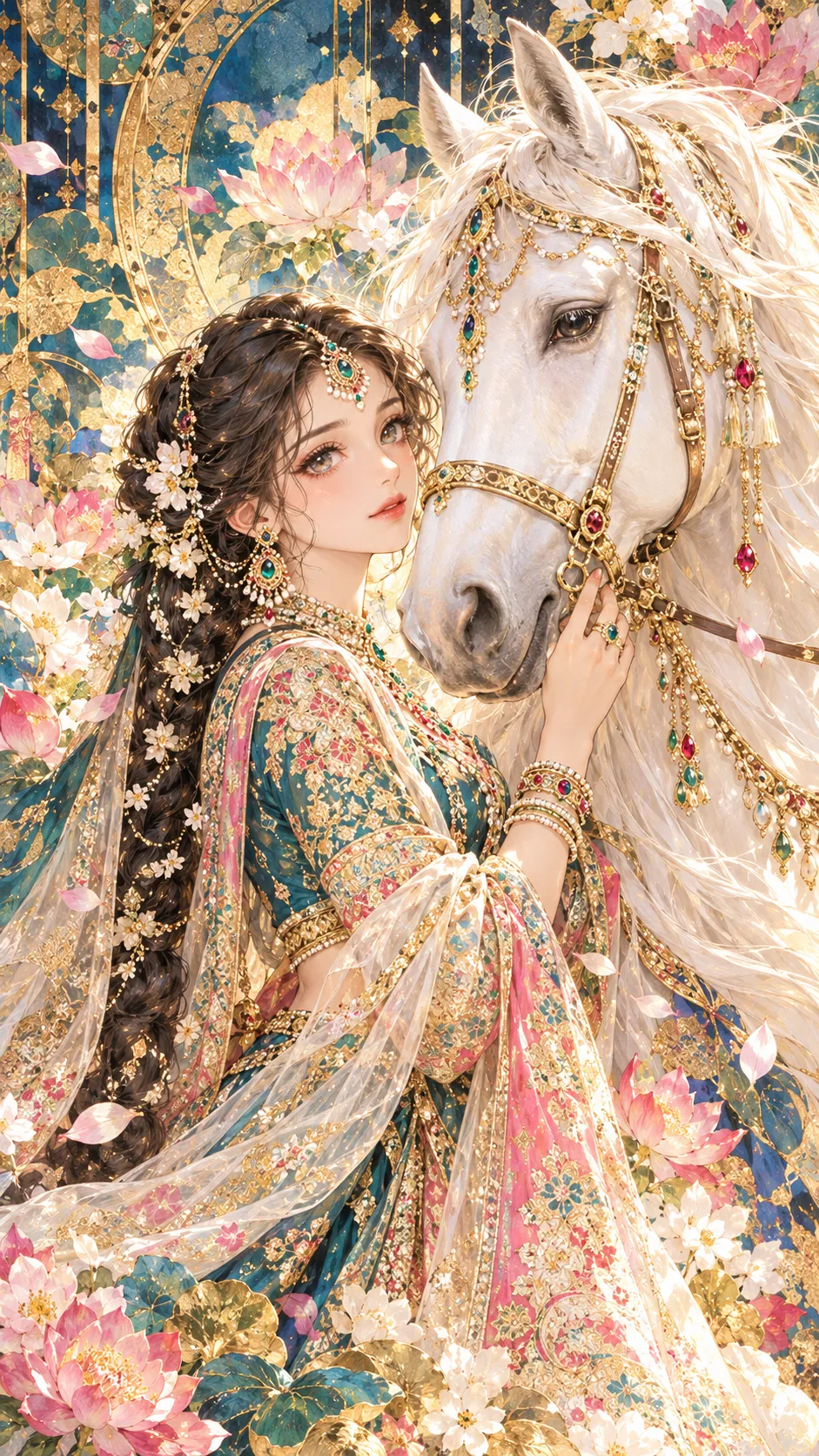


Comments — 0