- Category
- Art & Illustration
- Model
- openai-chatgpt
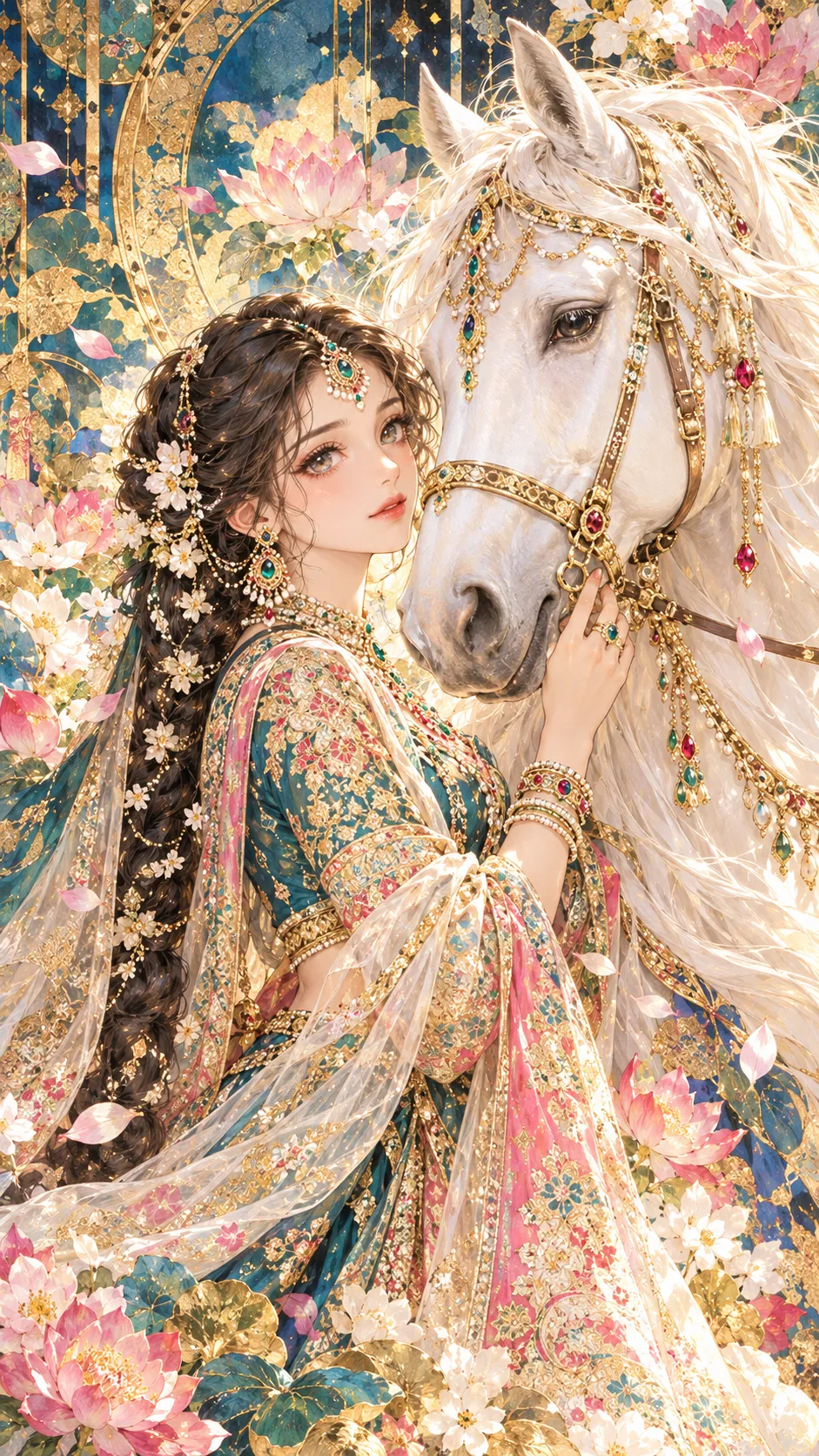
The White Horse and the Indian Court Beauty
Create a refined 2D illustrated portrait pairing an adult woman in Indian court-inspired dress with a white horse, surrounded by flowers and decorative abstract art.
By Threads — Published on — Modified on
Example images
Prompt template
0 copies
- Format
- Text
- Inputs
- Available_aesthetic_preferences (text) · Optional
- Outputs
- Illustrated_portrait (image)
Create a high-quality, fully 2D digital painting: an elegant, romantic artistic portrait of a beautiful adult woman inspired by Indian court culture and a single magnificent white horse. Portray them as equal main subjects, joined by a calm, trusting bond. Let their beauty complement one another. Create an ornate, warm-hearted work of art that reflects the viewer’s aesthetic sensibility.

Use any aesthetic preferences, favorite colors, decorative tastes, or artistic sensibilities available in the user’s conversation history or memory. Reflect them in the woman’s clothing, palette, embroidery, jewelry, hair ornaments, flowers, and background decoration. Do not infer personality traits or personal information that is not present in the available context. If no relevant preferences are available, make an original, beautiful artistic interpretation. Aim for a distinctive result for each person, even when they use the same prompt. The featured animal must always be one white horse; do not change its species, number, or coat color.

WOMAN
Depict a beautiful adult woman with both refined elegance and delicate charm. Give her large, clear eyes reminiscent of a polished shōjo manga illustration, delicate and balanced features, luminous skin, soft lips, and a gentle expression. She should appear sophisticated and graceful in a way that harmonizes with Indian court culture. She must clearly be an adult, not a child.

Choose a hairstyle to suit her outfit: for example, elaborate braids, an elegant updo, soft waves, or a style incorporating traditional hair ornaments.

CLOTHING
Dress her in an elegant, richly decorated outfit inspired by Indian traditional clothing and historical court culture. Select exactly one of the following four styles and respect its characteristic construction and way of wearing it; do not combine the styles indiscriminately:

1. Anarkali-inspired court attire: a fitted upper bodice and a long garment that flares from the waist, with refined embroidery, beautiful sleeves, and an elegant dupatta.
2. Lehenga choli-inspired festive attire: a decorative blouse, a voluminous long skirt, and an ornate dupatta, with delicate embroidery and graceful layers of fabric.
3. Sari-inspired traditional attire: a long cloth wrapped around the body, natural pleats, a pallu draped from the shoulder, and a decorative blouse.
4. Sharara-inspired court attire: a beautiful kurta with flared sharara pants, delicate embroidery, an elegant dupatta, and flowing fabric.

Use zardozi embroidery, gold-thread ornament, silk textiles, and botanical motifs where appropriate. Choose colors freely to reflect the user’s aesthetic; do not restrict the palette to match the horse’s coat. Use vivid jewel tones and graceful mid-tones as well as white, gold, or silver. Keep the chest and abdomen modestly covered. Respect the traditional garment’s construction and keep the result refined. Do not turn the outfit into a Western princess gown or wedding dress.

JEWELRY AND HAIR ORNAMENTS
Choose ornaments that harmonize with the clothing, such as a maang tikka, jhumka earrings, necklaces, bangles, and traditional hair ornaments. Incorporate colors such as ruby, emerald, sapphire, amethyst, or pearl. Vary the types, placement, and density of adornments from one generation to another. Prefer sophisticated courtly elegance over excessive layering.

THE WHITE HORSE
Depict one beautiful, well-proportioned adult horse with a luminous white coat, a rich flowing mane, a graceful neck, a refined face, large gentle eyes, naturally shaped ears, an elegant bridge of the nose, and a delicate muzzle. Respect real equine anatomy. Give the white coat soft, pearl-like shading; retain three-dimensional form with subtle silver-gray tones and warm reflected light rather than rendering it as flat, featureless white. Draw the mane as natural strands of hair, clearly distinct from the woman’s hair and clothing.

Keep the horse’s coat white. Do not give it wings, a horn, or other magical-creature features; it must not become a unicorn or Pegasus.

POSE AND BOND
Do not fix the pose. Choose one pose that suits the composition and render it naturally:
1. The woman stands gracefully beside the horse and smiles gently while the horse looks quietly ahead.
2. The woman and horse look calmly at one another.
3. The woman rests one hand gently on the horse’s neck.
4. The horse brings its face near the woman’s shoulder as she smiles warmly.
5. The woman turns back gracefully while the horse stands beside her.
6. The woman gently strokes the horse’s cheek with one hand.
7. The woman and horse stand close while looking in different directions.
8. The woman adjusts the dupatta at her chest with one hand while the horse stands quietly beside her.
9. The horse stands slightly in front of the woman, who looks at it with affection.
10. The woman rests one hand naturally at her waist and stands beside the horse with a dignified expression.

The woman does not have to touch the horse. If they do not touch, express trust through their gaze, expressions, and distance. Vary their left-right placement, body orientation, face angles, and spacing; do not overuse the same pose. Avoid complicated embraces, crossed arms, or wrapping both arms around the horse’s neck. Do not show the woman riding. The portrait should show them standing beside one another or naturally close together.

ANATOMY AND LIMBS — HIGHEST PRIORITY
Prioritize natural, accurate anatomy over pose complexity. The woman has two arms, one on each side, and two hands. Each arm must form a clear, anatomically natural path from shoulder through upper arm, elbow, forearm, wrist, palm, and fingertips. Before adding clothing or ornament, establish the positions of both shoulders, elbows, and wrists, and make clear which side of the body each arm extends from.

If the woman touches the horse, use only one hand; place the opposite arm naturally at her side, at her waist, or against her clothing. Any hand touching the horse must connect naturally from wrist to fingertips and remain distinct from the horse’s coat and mane. Both hands do not need to be visible. Arms may naturally continue beyond the frame or be partly concealed by clothing, provided the visible anatomy remains coherent. Do not make dupatta or sleeve fabric look like an arm; let fabric follow the body naturally.

Each hand has five fingers. Avoid duplicated, missing, fused, or unnaturally bent fingers. If a complex hand pose would be difficult, use a relaxed, natural hand rather than spreading the fingers awkwardly.

The horse has two front legs and two hind legs, four in total. Connect its head, neck, shoulders, torso, limbs, and tail naturally. Do not confuse the woman’s arms with the horse’s legs. In the finished image, check the arms, hands, fingers, and horse anatomy for visible irregularities and correct them where possible.

BACKGROUND
Do not depict a realistic landscape, meadow, forest, garden, stable, or palace. Create a fantastical art space combining contemporary abstract painting with decorative art: beautiful flowers, flowing curves, fine gold accents, translucent color fields, and soft light. Include graceful botanical motifs reminiscent of Indian miniature painting. Choose flowers that suit the work, such as lotus, jasmine, roses, or marigolds. Vary their selection, placement, and colors between generations. Freely combine pale colors, vivid jewel tones, and deep, fantastical hues.

Use appropriate contrast so the white horse’s outline does not disappear into the background. Do not place a pure-white background directly behind the horse’s face or neck; use color fields that bring out its coat. Do not let decorative elements obscure the woman’s or horse’s face or body outline.

COMPOSITION
Use a vertical 9:16 portrait composition. Center the composition on an editorial portrait framed approximately from the woman’s waist upward. Place both the woman and horse large in or near the center of the image, and make both the woman’s face and the horse’s head large enough to read clearly. Show the horse’s graceful neck, flowing mane, and gentle gaze. The horse’s entire body does not need to fit in the frame.

Vary which side each subject occupies, and vary their orientation: front-facing, angled, in profile, or looking back. Keep the outfit’s neckline, sleeves, embroidery, and dupatta visible enough to appreciate. Do not overlap their bodies excessively or press them together so closely that the positions of the woman’s arms or hands become ambiguous.

ART STYLE AND FINISH
Create a premium-quality, fully 2D digital painting: a delicate, beautiful shōjo manga-inspired illustration, a sophisticated editorial portrait, and an ornate fashion illustration. Blend the traditional beauty of Indian court clothing with contemporary abstract painting and decorative art. Use beautiful linework, transparent-looking layered color, and delicate light and shadow. Carefully distinguish silk, embroidery, gemstones, flower petals, the horse’s coat, and its mane. Give the woman’s eyes a fresh sparkle and the horse’s eyes a gentle sense of life. The result should feel like a highly refined, hand-painted illustration with strong artistic character.

Do not use a photographic or photorealistic style, or make the image look like a 3D render or figurine.

AVOID
- Extra arms, hands, fingers, legs, heads, or tails.
- Unnatural joints, twisted anatomy, unclear connections from shoulder to wrist, or confusion between the woman’s arms.
- Fusing the horse’s body with the woman’s hands or fingers; duplicated horse heads or legs; or anthropomorphizing the horse.
- Unicorns, Pegasi, wings, or horns.
- Unnatural embraces or excessive exposure.
- A childlike depiction of the woman.
- Clothing that ignores the construction of traditional garments, an unnatural mixture of several clothing styles, or a Western princess dress.
- Any suggestion that the clothing is made from real animal fur.
- Photographic, photorealistic, or 3D-CG styling.
- Excessive decoration that obscures either main subject.
- Text, logos, watermarks, or frames.

FINAL RESULT
Create a harmonious portrait in which the woman’s graceful beauty, the white horse’s pure and dignified presence, their gentle, trusting expressions, the clothing’s intricate Indian court-inspired embroidery and gemstone details, and the flowers’ fantastical colors all work together. Reflect the user’s aesthetic sensibility in the palette and ornaments. Keep the pose natural and the anatomy accurate. Make both the woman and horse equal main subjects in a beautiful portrait of their bond. Premium-quality, fully 2D painting; beautiful shōjo manga-inspired illustration; vertical 9:16; no text.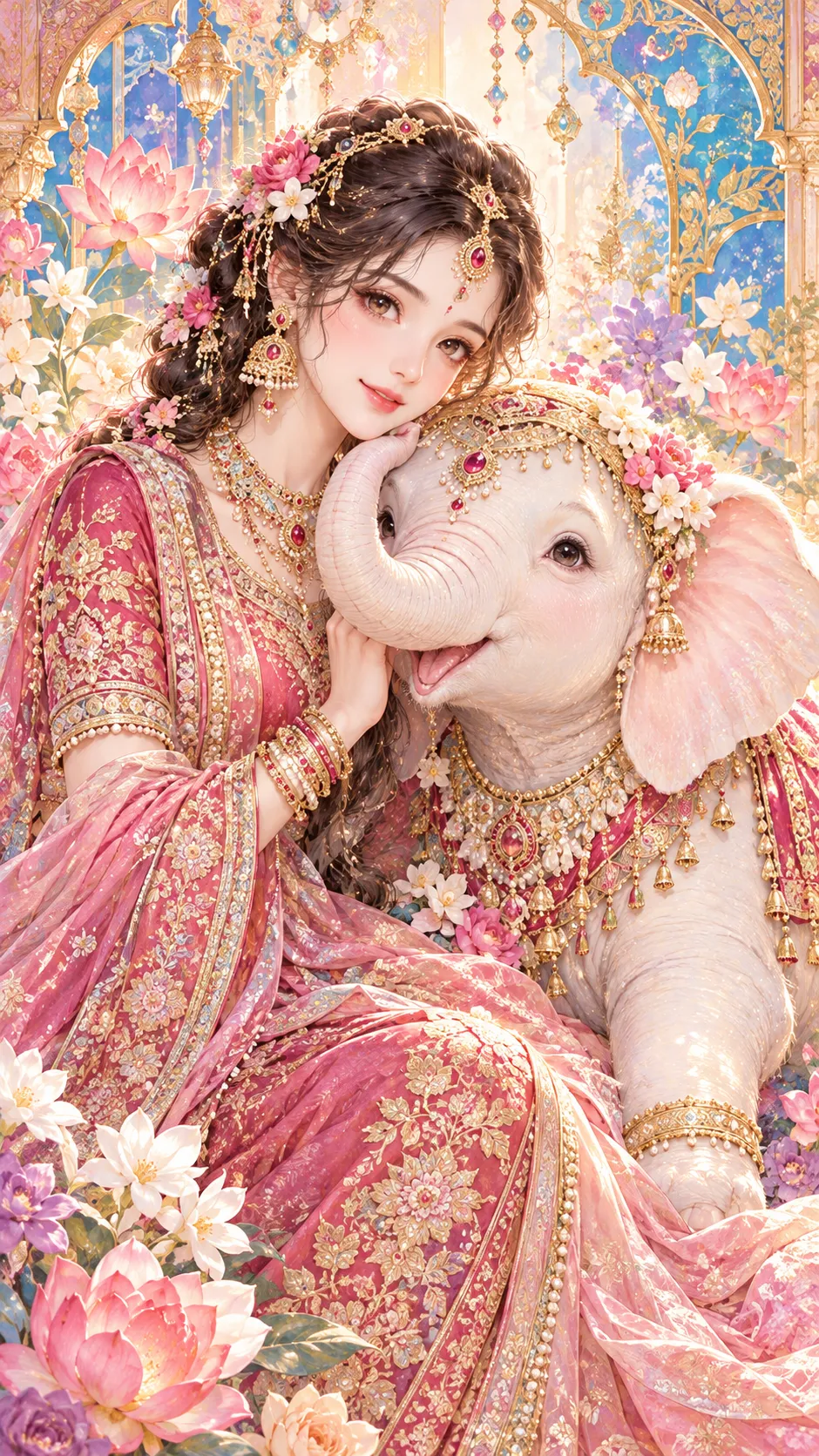


Comments — 0