Double-Exposure Beauty Portrait
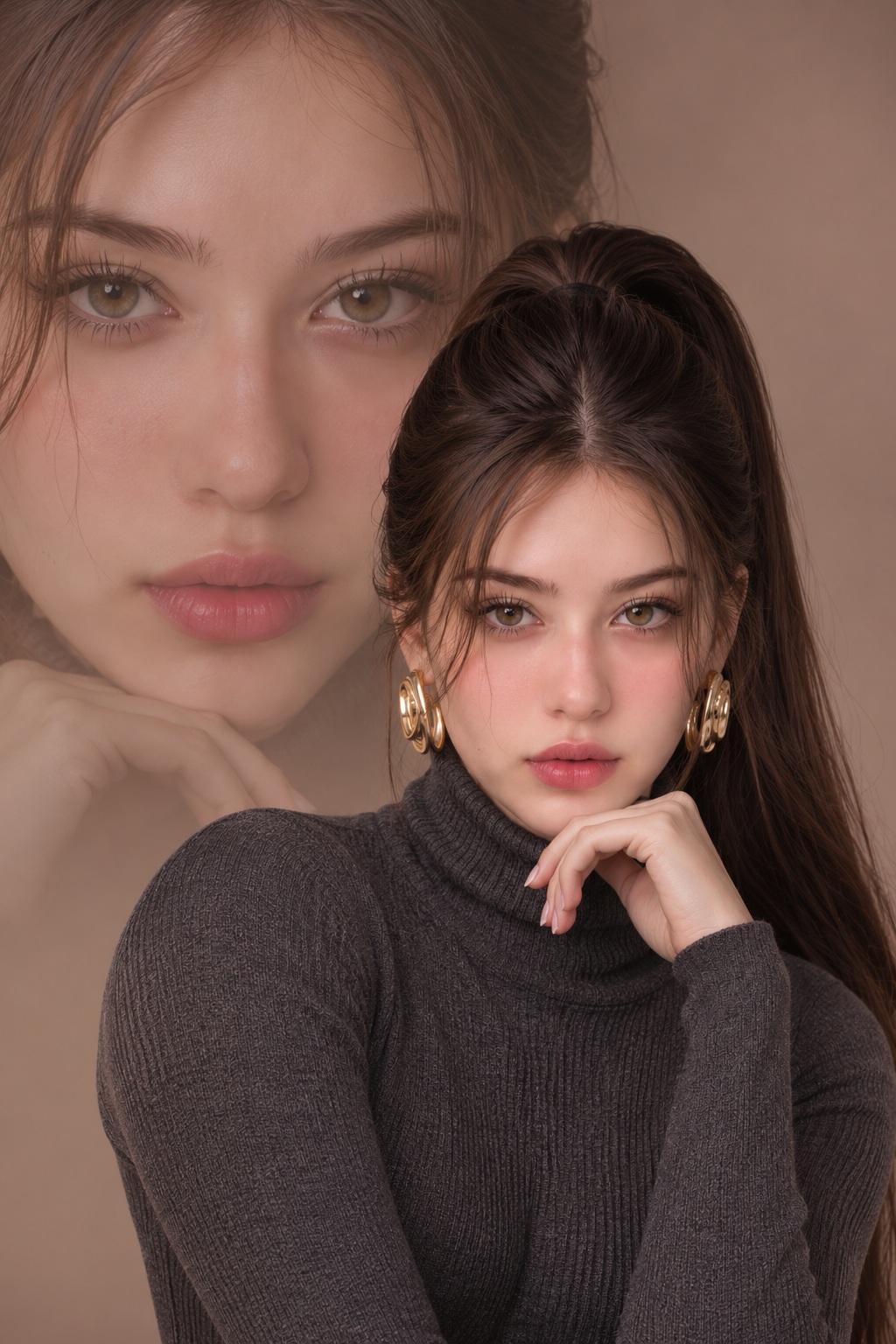
Create an elegant beauty portrait with a softly faded, enlarged second exposure of the same woman.
Example outputs
Prompt template
- Format
- Text
- Outputs
- DoubleExposurePortrait (image)
Create an elegant double-exposure beauty portrait on a soft dusty-mauve brown backdrop. In the foreground, a young woman with long dark-brown hair in a high sleek ponytail with loose face-framing strands, hazel-green eyes with a calm, direct gaze, natural rose-brown lips and flushed cheeks, rests her chin lightly on her hand. She wears a charcoal ribbed turtleneck sweater and large sculptural gold swirl earrings. Behind her, a huge, softly faded, semi-transparent close-up of the same face with her chin on her hand fills the upper left of the frame, blending smoothly into the background. Use soft diffused studio lighting, creamy muted tones, smooth skin with fine texture, and gentle blur on the background layer. 85mm lens, f/2.8, 8K, vertical 2:3.

Negative prompt: lowres, blurry foreground, deformed hands, extra fingers, bad anatomy, distorted face, asymmetrical eyes, plastic skin, mismatched faces between layers, hard double-exposure edges, flat lighting, oversaturated colors, watermark, text, logo, cropped, jpeg artifacts
What you'll create
A woman in a charcoal turtleneck rests her chin on her hand against a dusty mauve-brown backdrop. An enlarged translucent version of the same face fills the upper left, blending into soft studio light.
Generation settings
Advanced settings
- Negative prompt
- lowres, blurry foreground, deformed hands, extra fingers, bad anatomy, distorted face, asymmetrical eyes, plastic skin, mismatched faces between layers, hard double-exposure edges, flat lighting, oversaturated colors, watermark, text, logo, cropped, jpeg artifacts
Frequently asked questions
Should the two portrait layers depict different faces?
Both layers show the same woman with matching facial features.
How should the overlay edges appear?
The enlarged background portrait fades smoothly, without hard double-exposure boundaries.


Comments
Tried this prompt? Share what you made, compare results, or ask a question