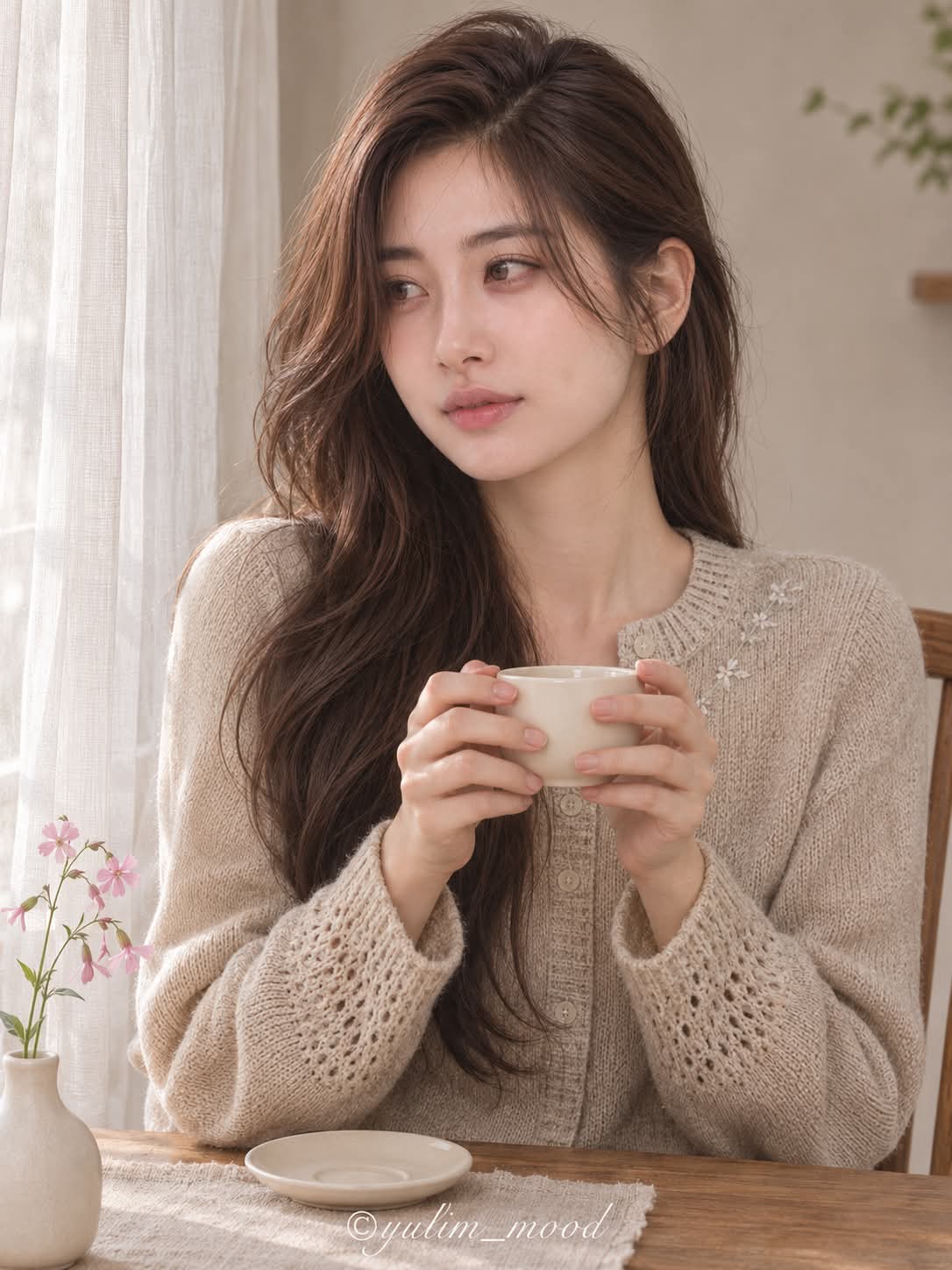
Holding a Teacup Beside a Sunlit Window
Create a close editorial portrait of an adult woman holding a ceramic teacup, with morning window light showing the openwork knit at her cuffs.
Example outputs
Prompt template
- Format
- Text Parameterized
- Inputs
- Adult_person_reference_image (image) · Required watermark (text) · Optional · Default: ⓒyulim_mood
- Outputs
- Portrait (image)
Create one independent, high-resolution vertical 3:4 full-frame digital photograph with a 70 mm lens at f/4.5. Use a cozy lifestyle editorial aesthetic, color-graded to evoke Kodak Portra 400: gentle warm-neutral midtones, muted oatmeal and ivory, restrained blush pink, fine organic grain, soft contrast, smooth highlight roll-off, and readable shadows.

Use the designated adult person reference as the sole source of facial identity. Preserve the same recognizable adult face, including the actual reference-visible shapes, sizes, positions, and proportions of its features, underlying skin tone, apparent age, natural asymmetry, and distinctive cues. The reference supplies identity, not the new scene’s lighting or exposure. Do not beautify, idealize, standardize, age-shift, reshape, blend identities, or substitute a generic fashion-model face. Respect reference-visible body proportions without inferring exact measurements from a face-only image.

Preserve the reference hair length, color, texture, natural waves or curls, parting, fringe, volume, tied or loose structure, and outer silhouette. Only gravity and slight movement from leaning forward may reposition naturally loose strands over the shoulders or cardigan. Do not invent a new hairstyle or artificial wind.

Scene: At a clear morning breakfast table around 9–10 a.m., she has lifted a small, warm ceramic teacup from its saucer and cups it gently between both hands. She turns her head slightly toward the sunlit window, absorbed in the warmth and quiet. Emphasize the contrast between the tightly knitted cardigan body and the openwork knit at the wrist, where actual light appears through the yarn openings. Her expression is serene and nearly neutral, not a broad smile.

Wardrobe: A warm oatmeal cardigan with a compact, clearly knitted body and soft, realistic weight. Its sleeves have matching dense knit over the upper arms and gradually change toward openwork over only the final 8–10 cm. Each loose cuff has small structural holes bounded by connected yarn loops; it falls a little away from the wrist, leaving space for the bright window backdrop to be seen through some holes. Do not turn it into lace, gauze, netting, or a glowing sleeve. Add two tiny delicate white embroidery accents, one near the neckline and one on the upper chest; neither is a logo. A soft ivory matte linen long skirt continues below the crop, with visible natural folds only where included.

Makeup: Very light translucent peach-coral styling, with a sheer satin base, realistic natural skin texture, restrained dew limited to the T-zone and upper cheeks, subtle peach-beige lids, a very thin brown lash-root line, individually separated natural lashes, softly diffused peach-coral blush, and moist but not glassy peach-coral lips. Makeup must not modify facial anatomy or apparent age.

Environment and props: A warm wood table beside a large east-facing window on the left of the room, covered by a thin ivory sheer curtain. The same small pale-blush Silene pendula-like sprig, with delicately notched five-petaled flowers and muted-green leaves, sits in a matte ivory ceramic vase on the window-side left of the table. The matching ivory saucer remains empty on the table below the frame while the cup is raised. The cup is a small rounded, handleless ivory ceramic vessel; no handle appears. Include a partial ivory linen table runner and no clutter.

Camera and composition: A tight medium close-up from the complete hairstyle to just below the bust, including the full teacup, both hands, both wrists, and the knit transitions. Move the camera slightly toward the window relative to the opening portrait and place it just above her seated eye level, looking gently downward. Frame her face in the upper portion and the cup and knit cuffs around the middle-to-lower portion. She holds the cup near her lower chest after lifting it from the table. Her elbows remain flexed close to her torso; both palms and curved fingers support the vessel’s sides, with thumbs near its upper edge and fingertips correctly wrapping the ceramic rather than penetrating it. Keep the face recognizable but allow the detailed cuff and hand contact to draw the eye. Do not crop through wrists or fingertips.

Lighting and fabric transmission: The only main light is the broad morning window on the set’s left, softened by the sheer curtain. Compose one loose cuff in front of a bright portion of the curtain, with a small air gap between cuff and wrist. Real background brightness is visible through individual knit holes, while the yarn remains opaque and textured. Adjacent skin and dense knit receive side light with their own material response; no section of cloth self-illuminates. Use physically consistent soft side light on the face, hands, vase, wood, and ceramic. A diffuse window-shaped reflection appears on the rounded cup and as subtle catchlights in the visible eyes. Natural shadows persist between fingers and cup, under curled sleeve folds, and below the saucer. No flash, front fill, invented rim light, or face-only exposure correction.

The essential result is genuine openwork transmission that is legible without exaggeration, and convincing two-handed cup support. Maintain the same recognizable facial identity from the reference. Preserve coherent perspective and depth, garment weight, natural hand anatomy, and readable fabric detail. Avoid artificial glowing knit, transparent torso fabric, fused fingers, a floating cup, duplicated ceramic vessels, harsh halos, clipped curtain whites, plastic skin, exaggerated blur, and inconsistent catchlights.

Add the exact watermark “${watermark:ⓒyulim_mood}” at the bottom center as a fixed, moderately translucent white graphic overlay, in refined connected calligraphic italic lettering with thin hairlines and thicker downstrokes. Use medium signature size, roughly one quarter of the image width, safely above the lower edge; every character and underscore must be readable. No outline, shadow, glow, frame, plaque, or box.
Replace the ${…} placeholders with your values
before using this prompt. See parameters
and defaults below
Parameters
Replace each placeholder with your own value, or use its default when one is provided
${watermark:ⓒyulim_mood}
watermark
Default: ⓒyulim_mood
What you'll create
A reference-guided adult woman holds a cup with both hands visible near a bright curtain. Warm-neutral digital photography, soft contrast and fine grain emphasize the quiet lifestyle setting.
Usage instructions
Supply the adult person reference image for facial identity and hairstyle. The cuff’s position against the bright curtain controls whether light through the knitted openings reads clearly; keep the cup and both hands fully in frame. The watermark text can be changed from its provided default.
Frequently asked questions
Should the cup be partly cropped?
No. The cup and both hands stay fully in frame.
Does the reference dictate the new exposure?
No. It supplies identity, while the new scene determines lighting.


Comments
Tried this prompt? Share what you made, compare results, or ask a question