The Rooms Still Remember You: The Warmth That Is Missing
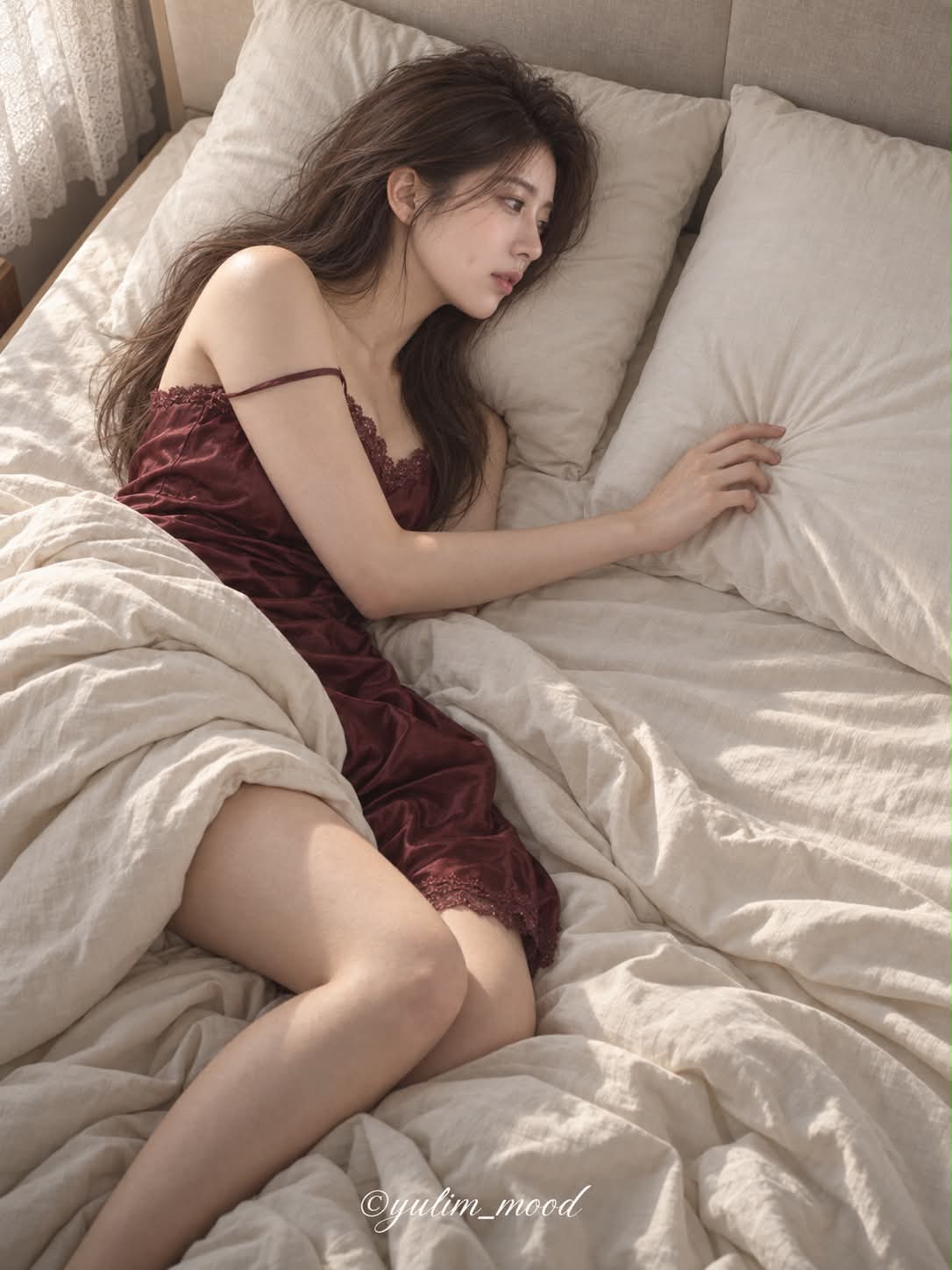
A cinematic late-autumn bedroom photograph of a woman reaching toward an unused pillow.
Example outputs
Prompt template
- Format
- Text Parameterized
- Inputs
- Adultwomanpersonreference (image) · Required Watermark (text) · Optional · Default: ⓒyulim_mood
- Outputs
- Photograph (image)
Editorial: Narrative Editorial — The Rooms Still Remember You: The Warmth That Is Missing.

Film/Capture:
Create ONE vertical 3:4 photoreal cinematic photograph, one continuous frame with one adult woman. Capture digitally and color-grade to evoke Kodak Vision3 250D: natural cinematic color separation, restrained saturation, low-to-moderate midtone contrast, fine organic grain, soft highlight rolloff and deep locally readable shadows. Warm ivory cotton and dark burgundy silk retain their tonal differences. No physical-film claim, global orange wash, artificial HDR, global bloom or aggressive sharpening.

Reference Identity:
PERSON-REFERENCE IMAGE MODE. Use the designated adult woman's person reference as the sole source of facial identity. Preserve her reference-visible facial features, their actual shapes, sizes, positions and proportions, underlying skin tone, apparent adult age, natural asymmetry and distinctive identity cues. Let the reference define her facial anatomy directly. Do not beautify, idealize, standardize, glamorize or replace her with a generic fashion-model face. Do not make her younger or older, erase age cues or add age-changing wrinkles. Preserve reference-visible body proportions; where the reference does not show the body, use plausible adult anatomy without invented measurements.

Hair:
REFERENCE-HAIR PRESERVE MODE. Preserve the reference-visible length, color, texture, curl, parting, fringe, tied or loose structure, volume and overall silhouette. Allow only the local physical responses described below; do not redesign the hairstyle.
Only the hair touching the pillow is gently compressed by contact; preserve all other reference-hair features.

Scene:
A quiet late-autumn Saturday morning in a warm bedroom, around nine. She has awakened alone and cannot bring herself to rise. Her hand reaches toward the unused pillow beside her, remembering someone who is absent. Intimate, languid melancholy with restrained sensuality. No second person, apparition, flashback figure or romantic smile.

Environment and Props:
A cream upholstered headboard, ivory cotton sheets and two pillows. Her pillow is compressed beneath her head and shoulder. The adjacent pillow remains unused, with a relatively smooth empty sleeping area occupying approximately one third of the image. Rumpled bedding gathers around her waist and hips. A closed window with a fine lace curtain is off frame to camera-left. Still indoor air; no wind-blown hair or curtain. Keep the scene uncluttered.

Camera and Composition:
Full-frame digital camera, 50mm lens, approximately f/4, sufficient working distance for natural perspective. A high-angle medium-full composition showing her head through mid-calf; feet are intentionally beyond the lower frame. Shoot diagonally downward at approximately 55 degrees from above the foot-side corner of the bed, not a flat overhead view. Her body forms a gentle lower-left to upper-right diagonal. Keep approximately 10–12% of the frame height as bedding clearance above the top of her hair. Preserve the empty pillow and unoccupied mattress area beside her. Focus includes her visible eye, major facial landmarks and the near edge of the empty pillow; distant bedding softens gradually. Do not let bedding obscure her face.

Pose and Expression:
She lies on her anatomical left side, head resting naturally on the compressed pillow. Her left arm rests loosely on the bed in front of that pillow. Her right arm reaches comfortably toward the empty pillow; the pads of her right index and middle fingers lightly indent its near edge, while the other fingers remain relaxed and anatomically separated. The wrist follows the forearm without an extreme bend. Her upper right leg is gently bent forward; one knee and part of the calf emerge from the duvet. The duvet remains supported across her waist and pelvis.
Her gaze rests on the empty pillow, away from the camera. Upper eyelids are heavy with interrupted sleep, brows and forehead relaxed, lips lightly closed without a smile, jaw released. There are no tears yet: absence appears as physical stillness and a hand reluctant to let go.

Wardrobe:
An opaque deep-burgundy silk slip dress with a fluid, lightweight satin weave and narrow matching lace edging at the neckline and hem. The left shoulder strap remains properly seated; the right strap has slipped slightly onto the outer shoulder. The bodice continues to cover the chest securely. Silk rests over the torso with small loose folds between ribcage and waist, compresses where her side meets the mattress and gathers beneath the duvet. Show collarbone, shoulder and the naturally uncovered leg without transparent fabric or accidental exposure.

Skin and Makeup:
Cinematic no-makeup styling: a very thin skin tint retaining natural tonal variation, softly groomed individual brow hairs, almost invisible beige-taupe eyelid shading, minimally separated lashes, a faint rose-beige cheek tint and translucent rose lip balm. Preserve realistic pore scale appropriate to this distance, fine natural vellus hair and matte-to-satin variation. No reshaping contour, enlarged features, erased under-eye color, uniform gloss or plastic smoothing.

Lighting:
The sole dominant source is a large window approximately 1.5m from her, off frame to camera-left and above her face. Low autumn daylight passes through lace and becomes broad, soft side-top light; avoid a crisp projected lace pattern. It reaches the upper-facing cheek, shoulder, right hand and empty pillow from the same direction. The opposite cheek and underside of the neck remain roughly 1–1.5 stops darker. Ivory bedding returns weak diffuse bounce beneath the chin and fingers; no separate frontal beauty light. Cotton shows soft diffuse brightness, silk shows elongated restrained highlights, and skin responds with subtle localized reflections. Preserve detail in bright bedding and skin. Eye reflections match the broad window where physically visible.

Essential Anchors:
Her body stays on her own side while her hand searches the empty side. Mattress and pillow compress under actual body weight. Finger pressure produces small pillow wrinkles and contact shadows; duvet folds follow pelvis and bent knee without floating. Maintain the same recognizable facial identity from the designated reference.

Watermark:
Add the exact text “${watermark:ⓒyulim_mood}” as a fixed graphic overlay at the bottom center. Use a medium signature size, approximately twice a small signature, precisely centered with a safe bottom margin. Refined white calligraphic italic lettering with thin hairlines, thicker downstrokes, connected lowercase letters and a pronounced rightward slant. Preserve the copyright symbol, every letter and the underscore. No outline, shadow, glow, box or border.

Avoid:
Alternate identity, facial redesign, age change, beauty-filter face, perfect symmetry, waxy skin, oversized pores, malformed limbs, extra or fused fingers, hand penetrating pillow, floating duvet, duplicated person, missing empty sleeping area, distorted high-angle anatomy, clipped whites, featureless lace or silk, artificial rim light, cutout blur and extra text.
Replace the ${…} placeholders with your values
before using this prompt. See parameters
and defaults below
Parameters
Replace each placeholder with your own value, or use its default when one is provided
${watermark:ⓒyulim_mood}
watermark
Default: ⓒyulim_mood
What you'll create
An adult woman lies on her side, reaching toward the unoccupied pillow beside her. A high diagonal view and soft autumn window light emphasize compressed bedding, restrained silk highlights and physical stillness.
Frequently asked questions
What conveys the sense of absence?
The empty sleeping area and her fingertips resting on the unused pillow are central visual anchors.
Are tears part of this moment?
No. The brief expresses longing through stillness rather than visible crying.








Comments
Tried this prompt? Share what you made, compare results, or ask a question