Through the Quiet Glass — Arranging Eucalyptus Leaves
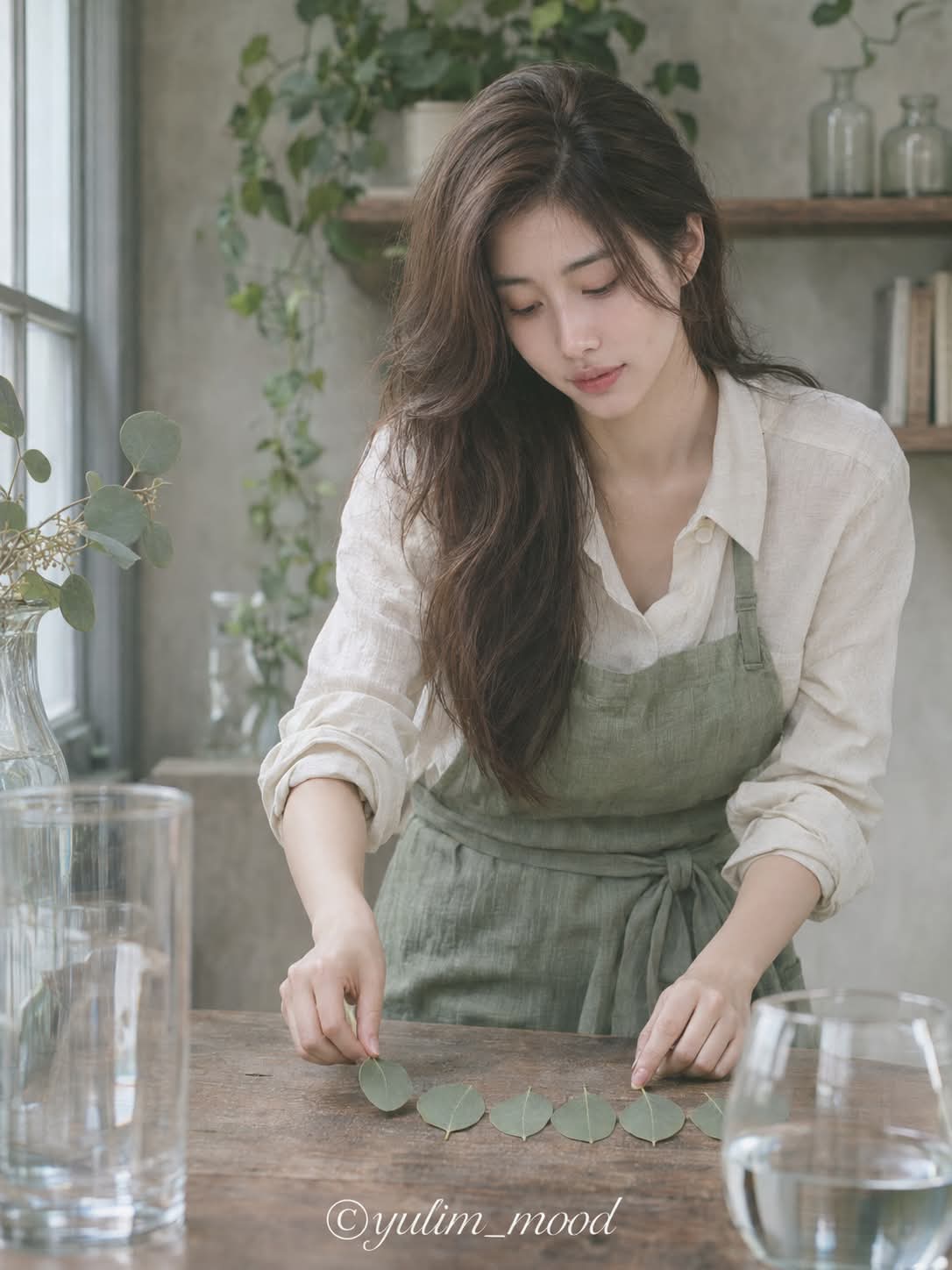
Create a fine-art editorial photograph of an adult woman arranging eucalyptus leaves in a quiet plant-study studio. A reference image guides her identity and hairstyle, while the scene, composition, and watermark are specified
Example outputs
Prompt template
- Format
- Text Parameterized
- Inputs
- Adultpersonreferenceimage (image) · Required Watermarktext (text) · Optional · Default: ⓒyulim_mood watermark (text) · Optional · Default: ⓒyulim_mood
- Outputs
- Photograph (image)
Fine Art Editorial.
Captured digitally and color-graded to evoke the heritage aesthetic of Fujifilm Pro 400H: cool pastel separation, muted sage and mint greens, low contrast, restrained fine organic grain, gentle highlights, and readable shadows. Vertical 3:4, one photograph.

PERSON-REFERENCE IMAGE MODE.
Use the designated adult person reference as the sole source of facial identity. Keep the same clearly recognizable adult person, preserving reference-visible facial identity, underlying skin tone, apparent age, natural asymmetry, and distinctive identity cues. Let the reference image define facial features directly. Do not beautify, idealize, glamorize, or replace her with a generic fashion-model face. Preserve the actual shapes, sizes, positions, and proportions of the reference features without reshaping or identity blending. Do not make her younger or older, erase age cues, or add age-changing wrinkles. Reference lighting and exposure are not scene constraints. If only the face is visible in the reference, do not infer exact body measurements; if a full-body reference is provided, preserve its visible natural proportions.

REFERENCE-HAIR PRESERVE MODE.
Preserve the reference-visible hair length, color, texture, curl, parting, fringe, tied or loose structure, volume, and overall silhouette. Allow existing loose strands to respond gently to gravity and head movement without inventing a new fringe or hairstyle. Hair must remain clear of the eyes and working fingers.

Scene:
A quiet adult woman carefully arranges six detached oval eucalyptus leaves on a substantial wooden workbench, finding order in a private, dreamlike late-morning pause. Five leaves already lie flat with their central veins approximately parallel. She is lowering the sixth leaf by its short petiole. The setting is a calm plant-study studio on an overcast day, without seasonal decorations. Still indoor air, no mist, smoke, or floating particles.

Space and glass:
A long matte, gently worn wooden workbench extends across the lower frame and recedes toward the upper left. A large diffused window stands beside the work area, outside the frame to camera-left. A subdued warm-gray plaster wall and a softly readable shelf sit behind her, without lines crossing her face.
Three transparent vessels stand firmly on the near edge of the bench: two tall cylindrical glasses grouped at lower left and one rounded drinking glass at lower right. The rounded glass is one-third filled with clear water. Keep the glasses close to the lens so their soft, overlapping curved edges create localized crescent reflections and displaced background fragments along the lower and side margins. These are ordinary tabletop vessels enlarged by near-camera perspective. Their bases make contact shadows on the wood; the water surface is level. Leave an uninterrupted clear central view of her face and the working fingertips. Refraction may displace a small outer apron region, never facial features or hand contact.

Camera and composition:
Full-frame digital camera, 50mm lens, f/5.6, approximately 1.8m from her face. Camera about 10cm above her eye level, tilted gently downward, observing the working side from a three-quarter angle. Frame the complete head down to just above the hips, including both forearms, both hands, the leaf arrangement, and the bench surface. Leave comfortable headroom. Place her face near the upper-right third and the leaves near the lower center. Use a shallow forward lean to keep her face and hands at reasonably similar camera distances. Focus through the clear gap on the face-and-working-hand region; retain readable facial landmarks and leaf contact without claiming perfect equal sharpness at every depth. The nearby glasses are much softer; the back wall softens progressively.

Action and expression:
Her weight is supported by both feet below the frame, knees relaxed, hips steady, shoulders lowered. Her torso leans slightly from the hips without collapsing onto the bench. Her anatomical right thumb and index finger gently hold the sixth leaf's petiole as its blade approaches the wood; the remaining fingers curl loosely and remain separate. Her anatomical left index fingertip lightly steadies the edge of an already placed leaf, with the other fingers relaxed near the tabletop. Wrists align naturally with the forearms. Her head inclines modestly, eyes directed down toward the leaf contact. Eyelids lower naturally with the gaze; brows remain relaxed, lips lightly closed, cheeks calm, jaw released. Quiet absorption, no camera gaze.

Wardrobe and makeup:
An opaque ivory cotton-linen shirt with a softened collar, plain buttons, visible fine weave, and sleeves rolled loosely to just below the elbows. Over it, an opaque muted sage-green linen bib apron with a neck loop and a tied waist, medium-light weight, matte slub weave, stitched edges, and natural gravity folds. No satin sheen or transparent fabric. Fabric seen through glass remains visibly opaque; only its image is locally refracted. Keep the clothing plain and unbranded.
Apply a sheer satin skin tint with restrained moisture sheen on the upper cheeks, subtle mauve-taupe shadow on the mobile eyelids, very thin brown lash-root definition, naturally separated lashes, and lightly groomed brows. Diffuse a faint peach tint over the cheeks; use a translucent rose-beige lip tint with a light balm finish. Makeup changes surface color and reflectance only. Preserve natural skin texture, camera-distance-appropriate pores, fine vellus hair, and tonal variation around the eyes, nose, and mouth.
The forward lean creates slight tension at the apron neck loop and soft compression folds near the waist; rolled cuffs fold irregularly around the forearms.

Lighting:
The only major source is a large rectangular overcast window, approximately 1.5m from her, about 45 degrees camera-left and forward of the subject, with its center above eye level. Its broad, soft light reaches the window-facing cheek, neck, hands, sleeves, and glass surfaces. The opposite cheek and apron folds retain gentle, readable shadow. The wood returns a very weak warm tint beneath the hands; the plaster wall provides weak diffuse ambient return. No added front fill or rim lamp.
Glass highlights are soft arcs and elongated window reflections, not a second light source. Eye reflections match the window's position when visible through the downward gaze. Maintain cool daylight influence across skin and objects without whitening the face separately. Preserve ivory weave, glass edge detail, and skin highlights. Dreamlike softness comes from near-lens glass and low-contrast color, not global fog or a glowing outline.

Maintain the same recognizable facial identity from the designated reference throughout the image. Keep the physical leaf arrangement, valid finger contact, stable vessel bases, coherent reflection direction, and progressive optical depth.

Add the exact watermark “${watermark:ⓒyulim_mood}” at the bottom center as a fixed graphic overlay, in clean white, refined calligraphic italic lettering with thin hairlines, thicker downstrokes, connected lowercase letters, and a rightward slant. Use a medium signature size, approximately twice a small signature treatment, with a safe bottom margin. Preserve every character and the underscore. No outline, shadow, glow, box, border, or background plaque.

Avoid: alternate identity, facial redesign, age changes, beauty-filter skin, waxy smoothing, malformed hands, extra or fused fingers, floating leaves, fingers penetrating leaves, foreground glass covering facial features or finger contact, giant vessels elsewhere in the room, transparent apron, satin linen, artificial front fill, uniform rim light, duplicated catchlights, clipped highlights, global bloom, heavy amber grading, crushed blacks, artificial HDR, CGI rendering, aggressive sharpening, and collages.
Replace the ${…} placeholders with your values
before using this prompt. See parameters
and defaults below
Parameters
Replace each placeholder with your own value, or use its default when one is provided
${watermark:ⓒyulim_mood}
watermark
Default: ⓒyulim_mood
What you'll create
The prompt creates a vertical fine-art editorial photograph of an adult woman carefully arranging eucalyptus leaves at a wooden workbench. It specifies a soft overcast-window lighting setup, cool muted colors, a three-quarter composition, and foreground glass reflections
Usage instructions
Frequently asked questions
What should the reference image control?
Use the designated adult person reference as the sole source of facial identity and preserve its visible hair characteristics. If it shows only the face, do not infer exact body measurements
Can I change the watermark text?
Yes. The watermark text is customizable; the original default is ⓒyulim_mood


Comments
Tried this prompt? Share what you made, compare results, or ask a question