Where the Lace Passed
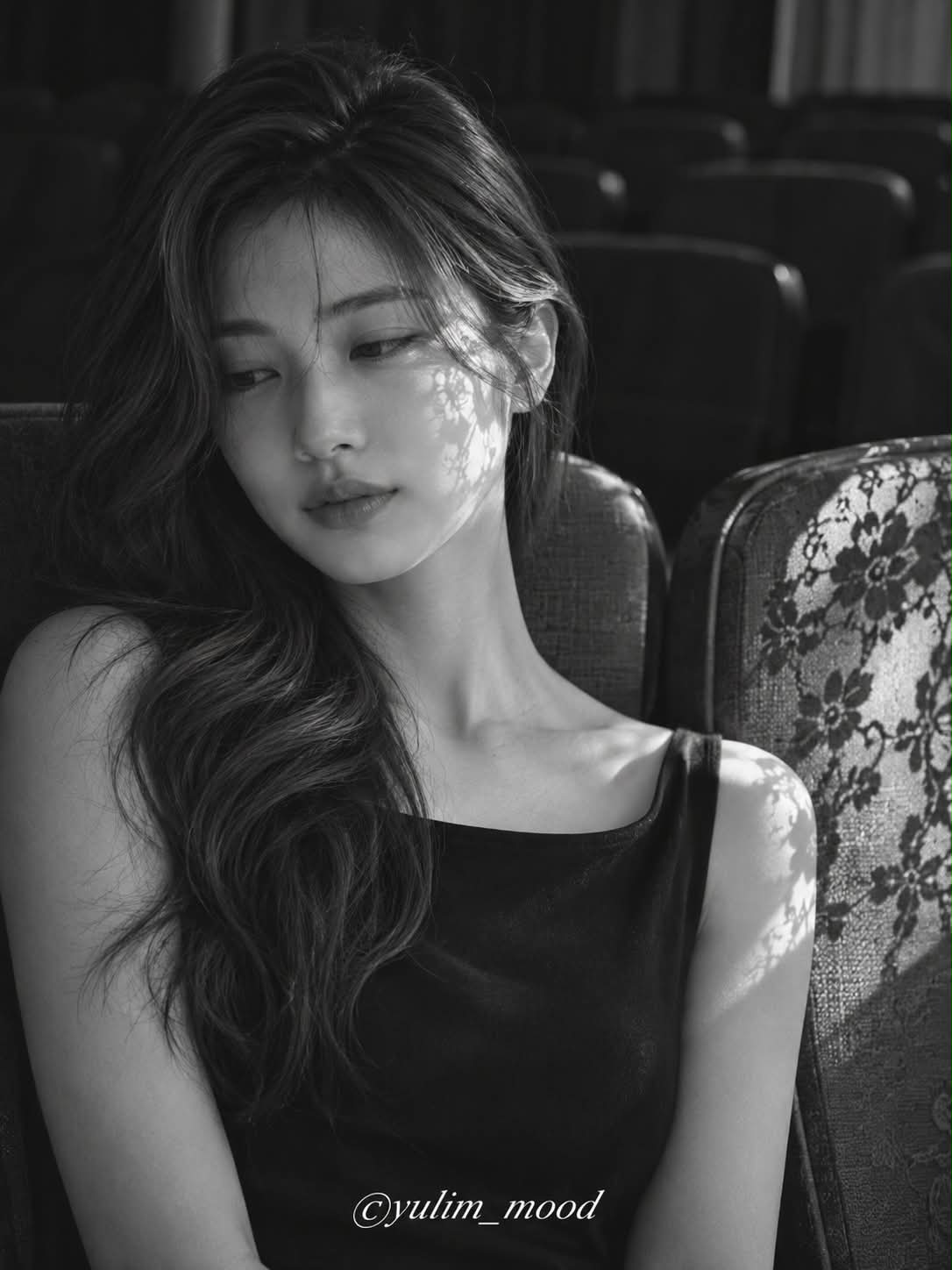
Create a black-and-white editorial portrait of an adult woman seated in an antique theater, with afternoon lace-filtered sunlight falling across her and an adjacent empty seat.
Example outputs
Prompt template
- Format
- Text Parameterized
- Inputs
- Adult_person_reference_image (image) · Required watermark (text) · Optional · Default: ⓒyulim_mood
- Outputs
- Editorial_portrait (image)
Primary Editorial: Conceptual Editorial

Film / Capture: Full-frame digital capture with Kodak T-Max 100–inspired black-and-white grading. Use very fine grain, detailed midtones, deep blacks, and controlled highlights that retain skin and fabric texture. Single vertical 3:4 photograph.

PERSON-REFERENCE IMAGE MODE
Use the designated adult person reference as the sole source of facial identity. Preserve the same recognizable adult woman, including her reference-visible facial geometry, feature shapes and proportions, underlying skin tone, apparent age, natural asymmetry, and distinctive marks. Let the reference define her features directly. Do not beautify, idealize, reshape, age-shift, or substitute her face. Derive the lighting, exposure, and catchlights from the theater scene.

SCENE
A woman sits quietly in an empty antique theater on a clear late afternoon. The house lights and stage lights are off. She sits at the end of a row near a high side window. One empty seat beside her remains clearly visible on camera-right. Its worn woven upholstery catches the same lace-filtered sunlight that touches her temple. Farther rows recede gradually into darkness, retaining just enough outline to establish the theater.

CAMERA AND COMPOSITION
Use a 70mm full-frame lens at f/5.6. Shoot at seated eye level from a slight diagonal across the row, showing the face in a gentle three-quarter view. Frame tightly from the crown to the upper chest, with a small margin above the hair. Place her face in the upper left and the empty upholstered seatback at mid-right. Keep the window and lace curtain outside the frame. Focus on the nearer eye and keep the farther eye and other facial landmarks readable. Position the camera so the empty seatback sits close enough to the facial focus plane for its lace motif to remain legible, while the farther seats soften progressively.

POSE, EXPRESSION, AND WARDROBE
Her weight rests on the seat cushion. Her upper back and one shoulder lean lightly into the upholstered backrest. One hand rests loosely on her lap, and both hands remain fully below the frame. Turn her head slightly toward the window while her eyes stay lowered toward the theater seating. Her eyelids are gently lowered, her brow and jaw are relaxed, and her lips rest lightly closed. The expression feels still and inward.

She wears a minimalist black sleeveless long dress in a matte woven fabric, with a clean neckline that reveals the collarbones. Keep subtle fabric texture and small folds at the armhole where her shoulder settles against the backrest. Use a thin semi-matte base with visible natural skin texture, soft shading around the eyes, and a muted matte lip that reads as a middle gray.

TARGET-HAIR PARTIAL OVERRIDE MODE
Preserve the reference hair length, color, texture, parting, fringe, volume, tied or loose structure, and overall silhouette. Tuck only the window-side section that falls over the lit temple behind the ear on that side. Keep the remaining hair as shown in the reference. Preserve the same recognizable face and apparent age.

LIGHT AND LACE SHADOW
Low-angle direct afternoon sunlight enters through the high side window off camera-left. The window frame limits the beam, and an embroidered lace curtain filters it. Seat her close enough to the curtain for the medium-scale embroidered motif to remain legible on her skin and on the adjacent seatback.

Let a narrow band of patterned light cross the exposed temple and outer cheek. Keep the densest embroidery shadows clear of the eyes and lips. Let the same motif reappear on the empty seatback to camera-right, aligned along the same diagonal in the frame. The pattern breaks across the open gap between the two surfaces. On the cheek it bends subtly with the facial contour. On the upholstery it stretches across the broader plane and softens slightly with distance from the curtain.

The same window beam grazes the exposed shoulder, and its edge falls across the nearby row. Keep lit skin and upholstery below clipping. The far side of the face and the deeper rows receive only weak reflected light from the room. Retain a trace of detail along the shadowed jaw and black fabric. Any visible catchlight is small and consistent with the window on camera-left.

WATERMARK
Place the exact text “${watermark:ⓒyulim_mood}” at the bottom center in white, elegant italic calligraphy, at a clearly legible medium size with a safe bottom margin and a readable underscore. Use plain lettering with no outline, shadow, glow, or box.

AVOID
Face reshaping, beauty-filter skin, waxy smoothing, coarse grain, artificial HDR, oversharpening, clipped highlights, added frontal fill or rim lighting, a lace texture pasted onto the skin, a pattern suspended across empty air, dense lace shadows obscuring the eyes, a seatback blurred beyond recognition, and stray fingers at the frame edges.
Replace the ${…} placeholders with your values
before using this prompt. See parameters
and defaults below
Parameters
Replace each placeholder with your own value, or use its default when one is provided
${watermark:ⓒyulim_mood}
watermark
Default: ⓒyulim_mood
What you'll create
An inward-looking woman sits in a theater as patterned afternoon light touches her temple and cheek. The same lace motif reappears on a nearby empty seatback in finely grained black and white.
Usage instructions
Provide the adult person-reference image so the prompt can preserve that person’s facial identity and hair while placing her in the theater scene. The lace-filtered light and composition are specified in detail; adjust the watermark text if you want a different credit while retaining its placement and style.
Frequently asked questions
Should lace patterns float across the gap between surfaces?
No. The pattern breaks between the face and seatback.
Are the hands visible?
No. Both hands remain below the tight portrait frame.


Comments
Tried this prompt? Share what you made, compare results, or ask a question