Transform a Reference Photo into a Warcraft Orc
Create a cinematic, photorealistic battle scene featuring the recognizable person from a reference photo transformed into a battle-ready Warcraft orc.
Example outputs
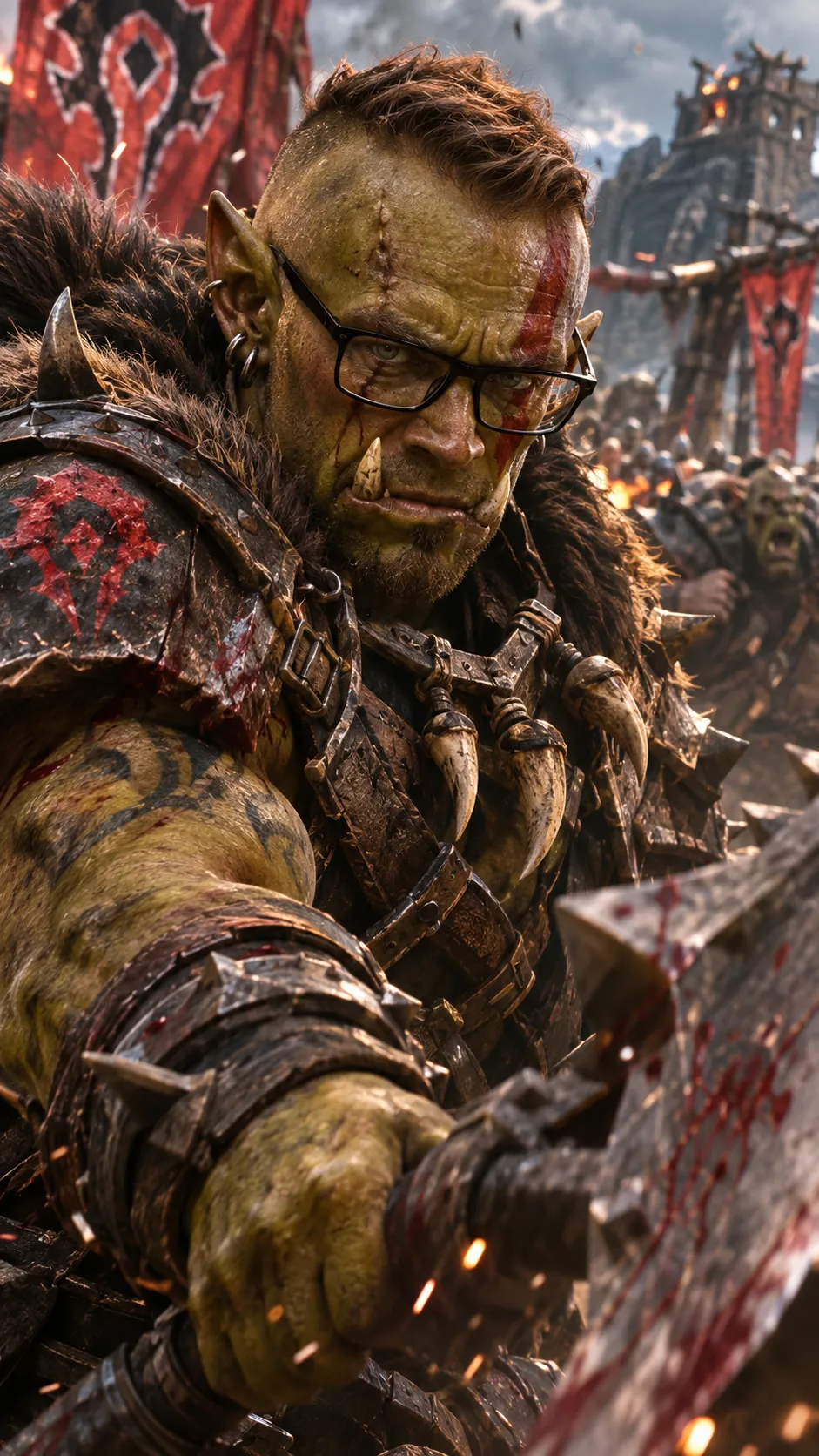
AI-generated video of a recognizable person transformed into a powerful green Warcraft orc charging through a smoky battlefield with a massive battle axe in the foreground.
Download video result 2Prompt template
- Format
- Markdown
- Inputs
- Reference_photo (image) · Required
- Outputs
- Cinematic_still (image)
Create an ultra-photorealistic live-action cinematic still set in the dark fantasy world of Warcraft.

Use the uploaded reference photo as the **primary and only reference for the identity and facial appearance of the person**. The person in the reference is the human identity that must be transformed into the orc character.

## IDENTITY PRESERVATION

Preserve the person's recognizable identity as much as possible while transforming the face into a believable live-action orc.

Keep the underlying facial structure recognizable:
- head shape
- forehead proportions
- brow structure
- eye spacing
- cheekbone structure
- nose proportions
- mouth and lip structure
- jaw proportions
- natural facial asymmetry
- approximate age
- distinctive facial characteristics
- hairstyle adapted naturally to the orc design
- glasses, if present in the reference, may be retained and physically integrated into the character

Do NOT replace the person with a generic fantasy character.

The result must clearly feel like **the same person transformed into an orc**, not a random orc.

Do not beautify, rejuvenate, age incorrectly, or redesign the person's identity.

## ORC TRANSFORMATION

Transform the person into a powerful adult Warcraft-style orc while retaining recognizable elements of the original face.

The transformation should be anatomical and physically believable:
- large muscular orc physique
- greenish olive skin
- pronounced brow ridge
- slightly elongated lower face
- broad jaw
- larger ears with pointed tips
- prominent lower tusks emerging naturally from the mouth
- subtle facial scars
- rough weathered skin
- natural pores, wrinkles and skin imperfections
- short coarse facial hair where appropriate
- believable orc anatomy

The face must not look like a human wearing green makeup.

The human facial identity should remain recognizable underneath the orc anatomy.

## CAMERA / FRAMING

Strict vertical 9:16.

Extreme cinematic close-up / medium close-up.

The camera is positioned very close to the character, slightly below eye level, creating a powerful intimidating perspective.

The character's face dominates the frame while the upper torso, shoulder and weapon remain visible.

Use a strong three-dimensional composition with:
- foreground element very close to the lens
- sharp protagonist in the middle ground
- deep atmospheric background

Use a cinematic 35–50mm lens.

Natural perspective and realistic lens characteristics.

Shallow depth of field, with the character's eyes and facial details in extremely sharp focus.

## POSE / DYNAMIC ACTION

The character is captured **during an active moment rather than posing for a portrait**.

His body is moving forward aggressively as if charging into battle.

The torso is slightly rotated.

One shoulder is closer to the camera.

His head is turned approximately 20–30 degrees relative to the camera.

His gaze is directed intensely toward something just beyond the camera.

His facial expression communicates controlled aggression, concentration and battle readiness.

The character is caught in the middle of a powerful movement.

His weapon is moving through the foreground, creating strong motion energy and partial occlusion.

The frame should feel like a single frozen moment from a live-action battle film.

## WEAPON

The orc wields a massive brutal two-handed battle axe.

The axe is extremely close to the camera in the foreground, partially entering or crossing the lower-right portion of the frame.

Its blade is large, heavy, scratched and physically worn.

Visible dents, chipped metal, dirt and traces of battle damage.

The weapon should create dramatic perspective and motion blur.

Small sparks and fragments fly through the air around it.

## ARMOR / CLOTHING

The orc wears practical, battle-worn Warcraft-inspired armor.

Dark leather, rough fur, aged metal plates, straps and primitive heavy equipment.

Large fur collar around the shoulders.

Spiked shoulder armor.

Leather belts and harnesses.

Bone and tusk ornaments attached to the armor.

A distinctive red warpaint or faction marking on the shoulder armor.

Everything must look physically constructed from real materials.

Armor must be dirty, scratched, weathered and damaged from combat.

Avoid clean fantasy cosplay.

Avoid excessive armor covering the entire body.

## BACKGROUND

A massive Warcraft battlefield extends behind the character.

Huge red war banners move violently in the wind.

Distant orc warriors charge through smoke and dust.

Battlefield fires burn between ruined structures.

Large fortified stone and wooden structures rise in the background.

Smoke, sparks, dust and flying debris fill the atmosphere.

The environment is chaotic but remains visually secondary to the protagonist.

Use strong depth separation between:
1. foreground weapon and debris,
2. protagonist,
3. distant battlefield.

## LIGHTING

High-budget live-action fantasy cinematography.

Strong directional sunlight mixed with warm firelight.

Warm golden highlights on the edges of the orc's face, armor and fur.

Cooler ambient light in the shadows.

Strong contrast between illuminated skin and dark armor.

Realistic light interaction with rough green skin, metal, leather and fur.

Visible atmospheric haze and volumetric light.

Natural cinematic exposure.

No artificial studio lighting.

## SKIN / MATERIAL REALISM

Ultra-realistic physical skin.

Visible pores.

Wrinkles.

Tiny scars.

Subtle sweat.

Dirt embedded into the skin.

Natural variation in green skin tones.

Individual hair and beard fibers.

Individual fur fibers.

Scratched metal.

Weathered leather.

Realistic bone and tusk texture.

Every material must behave according to real-world physics.

## VISUAL STYLE

Ultra-photorealistic live-action cinematography.

A frame from a massive Hollywood dark-fantasy action movie.

Photographed with a real cinema camera.

Extremely detailed but physically believable.

Natural film grain.

High dynamic range.

Sophisticated cinematic color grading.

Realistic motion blur.

Realistic atmospheric depth.

The image must look like a **real actor physically transformed with practical prosthetics, makeup, costume and physical set construction**, enhanced only by subtle invisible VFX.

NOT a video-game screenshot.

NOT concept art.

NOT digital painting.

NOT a 3D render.

NOT CGI character art.

NOT a fantasy illustration.

## COMPOSITION

The character must remain the dominant visual subject.

Place his eyes approximately in the upper-middle region of the frame.

Use the weapon as a powerful foreground compositional element.

The weapon should partially obscure the lower portion of the frame without covering the face.

Use diagonal movement lines from the weapon, shoulders and battlefield architecture to create visual energy.

The background should remain recognizable as a huge Warcraft battlefield but strongly defocused.

The image should communicate **motion, danger and imminent violence**, rather than a static character portrait.

## CRITICAL IDENTITY RULE

The uploaded reference determines **WHO the character is**.

The Warcraft/orc design determines **WHAT he has become**.

Do not substitute the reference person's identity with a generic orc face.

The final character must look like the specific person from the uploaded reference transformed into a realistic Warcraft orc.

## NEGATIVE PROMPT

generic orc face, random fantasy character, different person, altered identity, unrecognizable face, younger face, older face, beautified face, generic model, human with green face paint, cartoon orc, exaggerated fantasy proportions, video-game character, game screenshot, concept art, illustration, digital painting, CGI render, plastic skin, smooth skin, artificial face, doll-like face, excessive armor, clean costume, cosplay appearance, fantasy superhero pose, static portrait, passport-style framing, symmetrical studio portrait, distorted anatomy, malformed hands, extra fingers, duplicated limbs, floating objects, warped weapon, deformed tusks, distorted glasses, low detail skin, fake lighting, oversaturated colors, excessive glow, excessive magical effects, flat composition, shallow environment, blurry face
What you'll create
A recognizable human identity is translated into a believable live-action orc within a dark fantasy scene. Facial proportions, natural asymmetry and adapted hairstyle carry through the transformation, while realistic skin, armor and battlefield materials avoid an illustrated game-render finish.
Usage instructions
Frequently asked questions
Should glasses disappear during the transformation?
If glasses are present in the reference, the source includes them among the identity details to adapt.
Is a generic orc face acceptable?
No; the underlying head shape, eye spacing and individual facial structure should remain recognizable.




Comments
Tried this prompt? Share what you made, compare results, or ask a question