Photorealistic Macro Iris on a Black Background
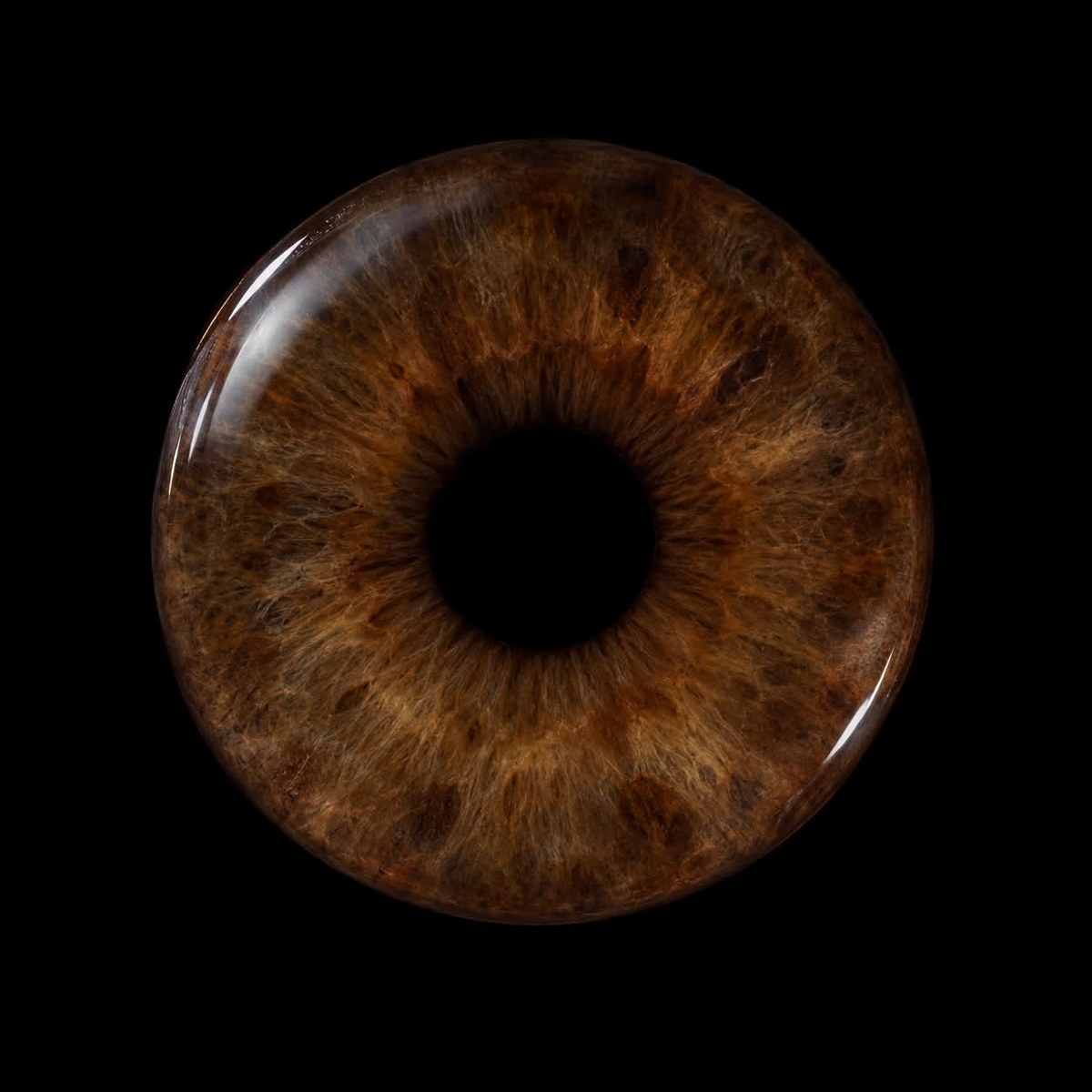
Create a highly detailed macro image of the user’s real iris and pupil, preserving the reference iris’s unique color and pattern beneath a glossy, transparent glass-like surface.
Example outputs
Prompt template
- Format
- Text
- Inputs
- Eye_reference_photo (image) · Required
- Outputs
- Iris_macro_image (image)
Use the attached photograph of my eye as the exact reference for the iris.

Create a hyperrealistic macro image of only the iris and pupil, positioned precisely at the center against a completely black background.

CRITICALLY IMPORTANT: Preserve the individual iris from the source photo as accurately as possible. Do not invent a new iris or create an averaged eye pattern. Preserve its true color, shades, transitions, spots, rings, veins, radial fibers, and every unique feature. The shape and arrangement of the pattern should match the photograph as closely as possible.

Give the iris a dimensional appearance, as if it were beneath a perfectly transparent, convex layer of glossy glass or jeweler’s epoxy resin. Create a sense of depth and layering: the finest iris fibers should appear within the transparent volume and glow slightly.

The surface should be very smooth and glass-like, with beautiful, delicate studio-light reflections along the edges. Do not let the reflections obscure the iris pattern.

Use maximum detail: show the tiniest natural fibers, veins, and irregularities of a real iris. Photorealism, macro photography, ultra-detailed, extreme sharpness, realistic iris texture, glossy glass effect, translucent depth, subtle internal glow, luxury fine-art photography, cinematic studio lighting, deep blacks, high dynamic range, 8K quality.

The iris should look like an expensive collectible artwork or jewelry object while remaining anatomically realistic.

Keep the composition minimalist: one round iris with its pupil centered, surrounded by plenty of clean, deep black space.

Do not add the sclera, eyelids, eyelashes, skin, eyebrows, text, a frame, or decorative elements. Do not change the original eye color. Do not intensify blue, green, or golden tones if they are not present in the photograph. Do not create a symmetrical fantasy pattern in place of the real iris pattern.
What you'll create
Only the iris and pupil appear precisely centered against black. Dimensional detail emphasizes the source eye’s rings, spots and radial fibers without adding skin or surrounding anatomy.
Frequently asked questions
Are eyelids or sclera included?
No. Only the iris and pupil appear.
Can the iris colors be intensified?
No. Original shades and unique patterns must be preserved without invented color.






Comments
Tried this prompt? Share what you made, compare results, or ask a question