Original Photo + Japanese Cinematic Manga Split
Turn one photo into a vertical composition that pairs the unchanged original with a Japanese cinematic manga rendering of the same scene. The prompt specifies the layout, lighting, color palette, illustration style, and a small English title
Example outputs
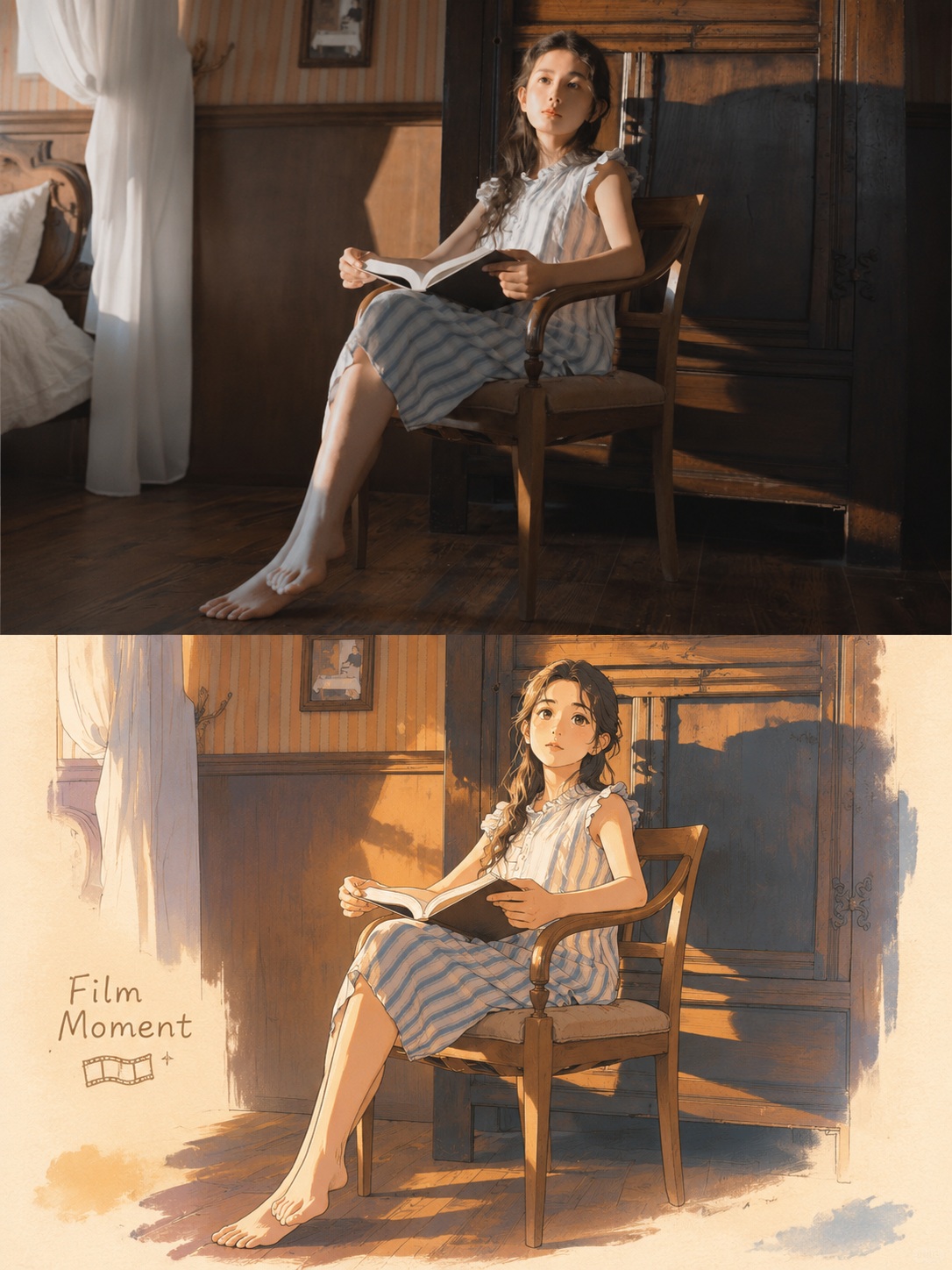
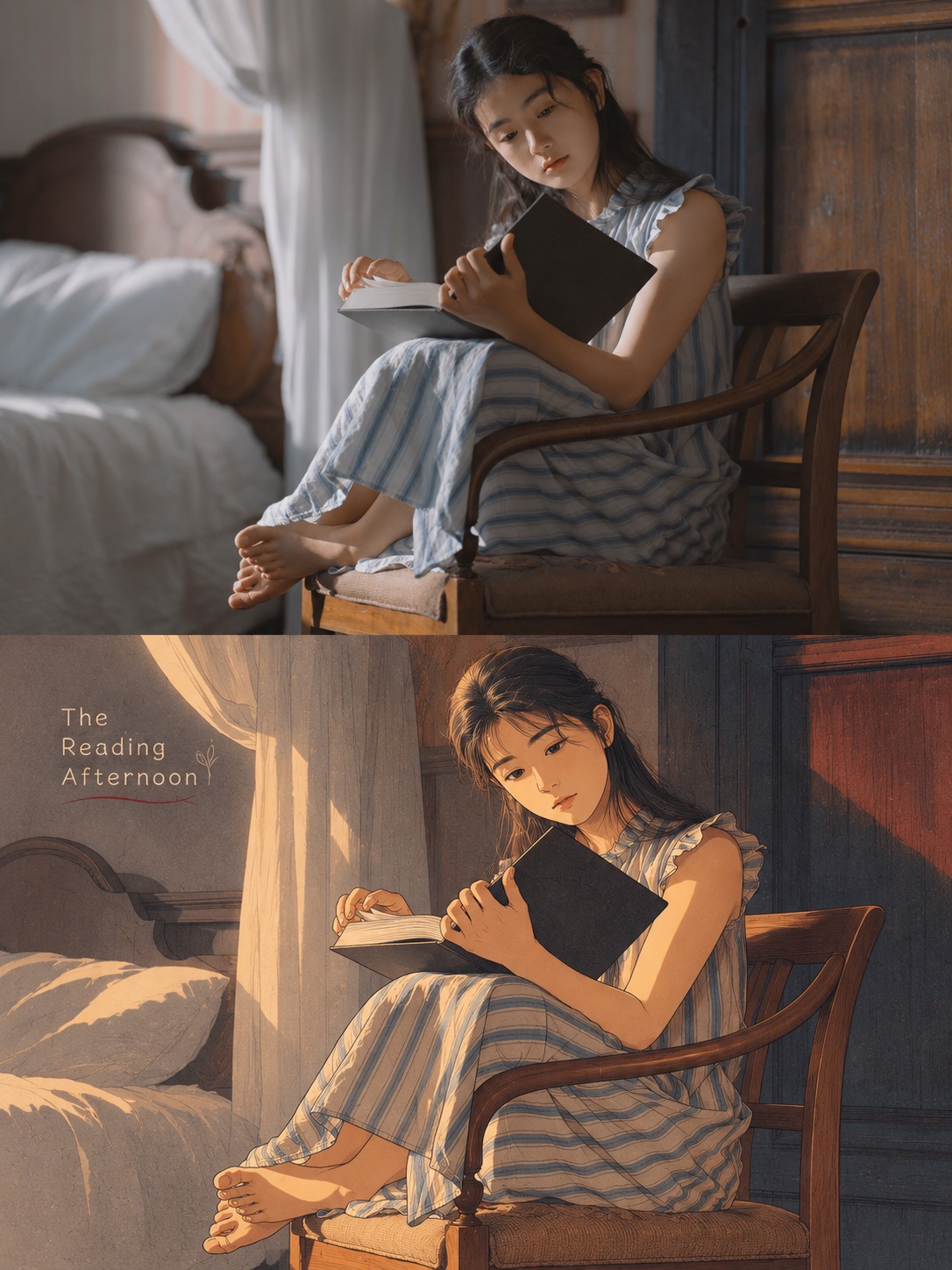
Prompt template
- Format
- Text
- Inputs
- Source_photo (image) · Required
- Outputs
- Split_photo_and_manga_image (image)
Using only this single uploaded photo, create one 3:4 vertical work combining the original photo with a Japanese cinematic-lighting narrative manga illustration. Create one image only: do not make a collage or combine multiple photos.

【Fixed layout】
Divide the canvas into two equal-height sections, each occupying exactly 50% of the total canvas height. Keep both sections the same width and seamlessly joined, with no border, gap, dividing line, overlap, or content crossing the midpoint.

【Upper half: original photo】
Use the original photo directly. Preserve the people’s identities, facial features, face shapes, hairstyles, expressions, body proportions, poses, clothing, objects, setting, perspective, spatial relationships, natural lighting, and original colors. Do not redraw, retouch faces, recolor, desaturate, mirror, stretch, distort, add, or remove subjects. Only proportional scaling and cropping of nonessential outer areas are allowed.

【Lower half: manga illustration】
Reillustrate the same photo as a two-dimensional manga in a Japanese cinematic-lighting narrative style. Accurately reproduce the people, actions, objects, spatial positions, and perspective in the original photo. Keep facial features natural and preserve each person’s face shape, hairstyle, and body proportions; do not change poses.

Combine fine pen linework with cinematic production-art illustration. Follow the photo’s actual light source and clearly show lit and shadowed surfaces, cast shadows, and reflected environmental light. Use directional divisions of light and shadow to emphasize the spatial relationship between the people and their surroundings.

Combine hard-edged shadows with soft transitions. Accentuate rim lighting locally, but do not invent a strong light source. Keep faces clear and render the structures of the eyes, nose, mouth, and hands accurately. Do not obscure people with large areas of shadow.

【Color and texture】
Use amber gold, midnight blue, warm gray, and dark red as the main colors, adjusting their proportions to suit the actual environment in the photo. Create rich but restrained color layers and avoid excessive orange-and-teal grading. Use clean two-dimensional flat coloring, subtle shading, and a small amount of artistic paper texture; keep the image clear and luminous.

【Composition and negative space】
Let the manga’s effective visual content occupy about two-thirds of the lower section, with balanced artistic negative space around it. Use light and shadow to create a natural visual path, and do not add unrelated background elements. Add a small English title in a refined, rounded, cute font with the character of an independent-film art publication.

【Quality requirements】
The result must be a two-dimensional cinematic narrative manga, not a photo filter, 3D render, or ordinary anime screenshot. Keep the light-source direction accurate, the light-and-shadow relationships clear, and people’s proportions natural. Avoid blurred facial features, body distortion, noise, and an AI-smudged appearance.

Keep all manga artwork, the title, and decorations entirely within the lower 50% of the canvas.
What you'll create
This prompt places the original photo in the top half of a 3:4 vertical canvas and reimagines the same scene as a two-dimensional Japanese cinematic manga in the bottom half. The illustration uses directional light and a restrained palette, with a small English title and balanced open space
Usage instructions
Frequently asked questions
How should the lower illustration relate to the photo?
It should depict the same people, actions, objects, spatial positions, and perspective, while preserving the people’s features, proportions, and poses
Can the colors change to suit the source scene?
Yes. Use amber gold, midnight blue, warm gray, and dark red as the main palette, adjusting their proportions to the actual environment in the photo
What text should appear in the illustration?
Add a small English title; the prompt does not specify its wording




Comments
Tried this prompt? Share what you made, compare results, or ask a question