Photo-to-Paper-Collage Comic Split
Create a 3:4 split composition that preserves the original photo above and reimagines the same scene as a layered paper-cut comic below.
Example outputs
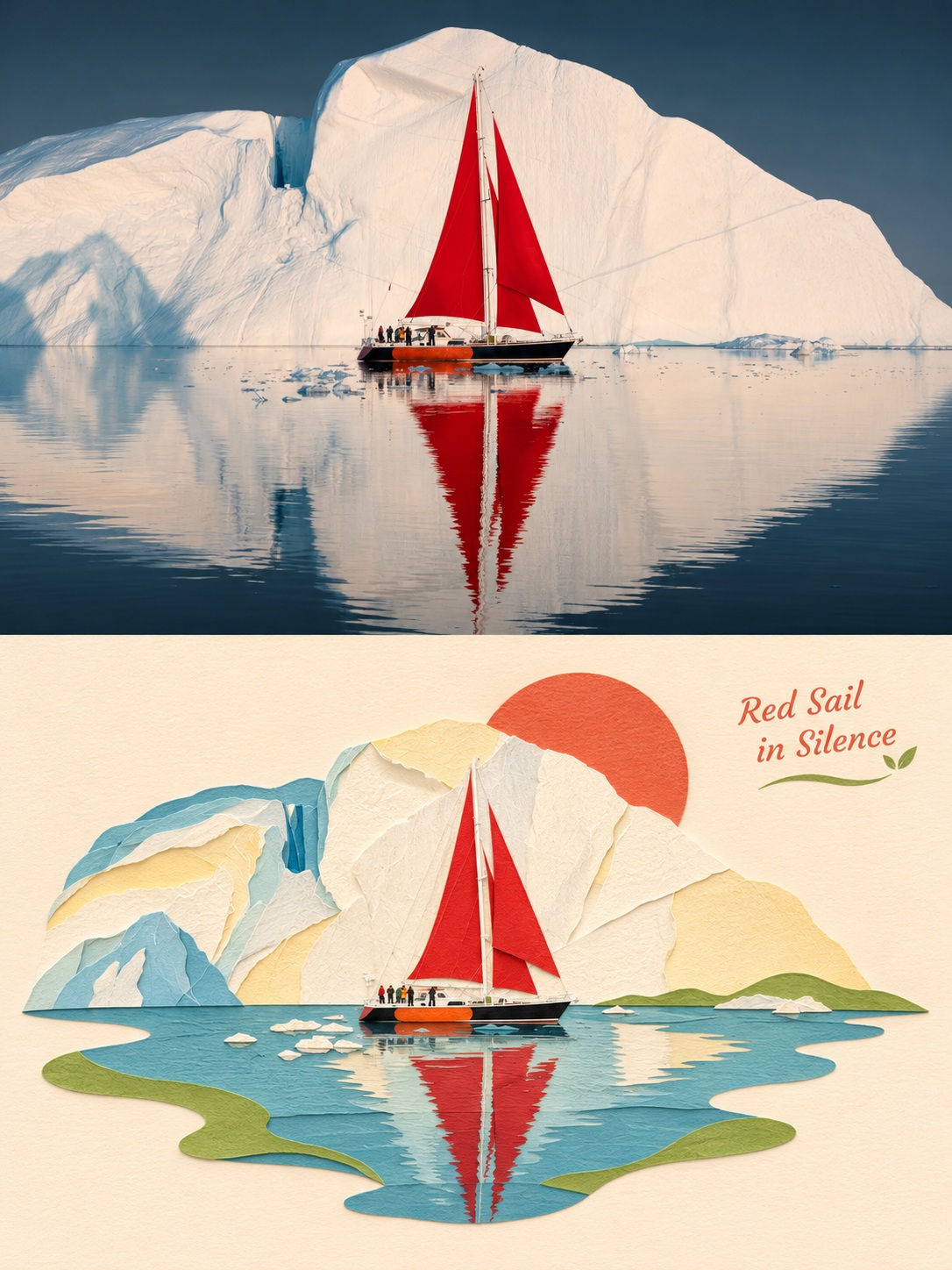
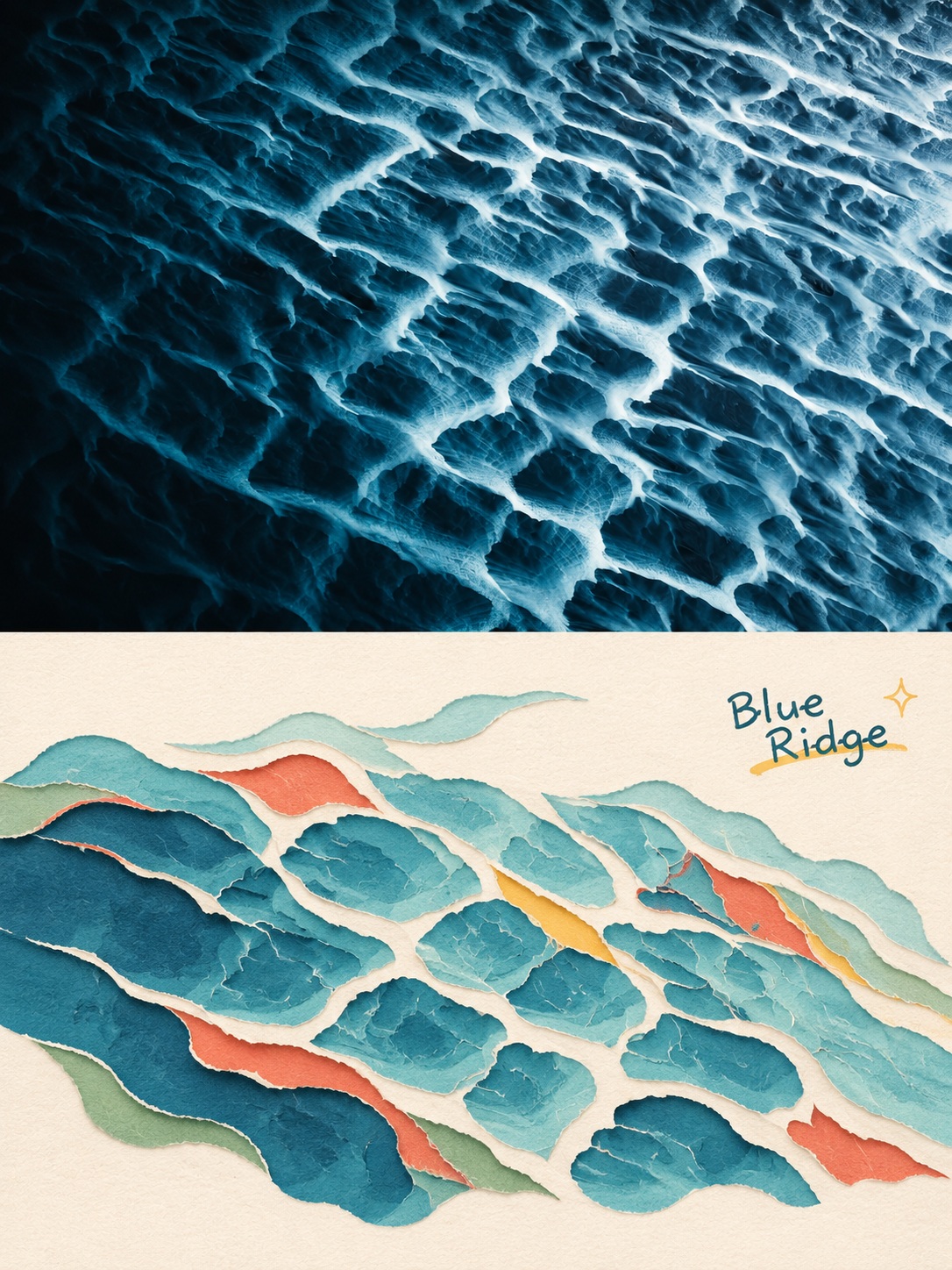
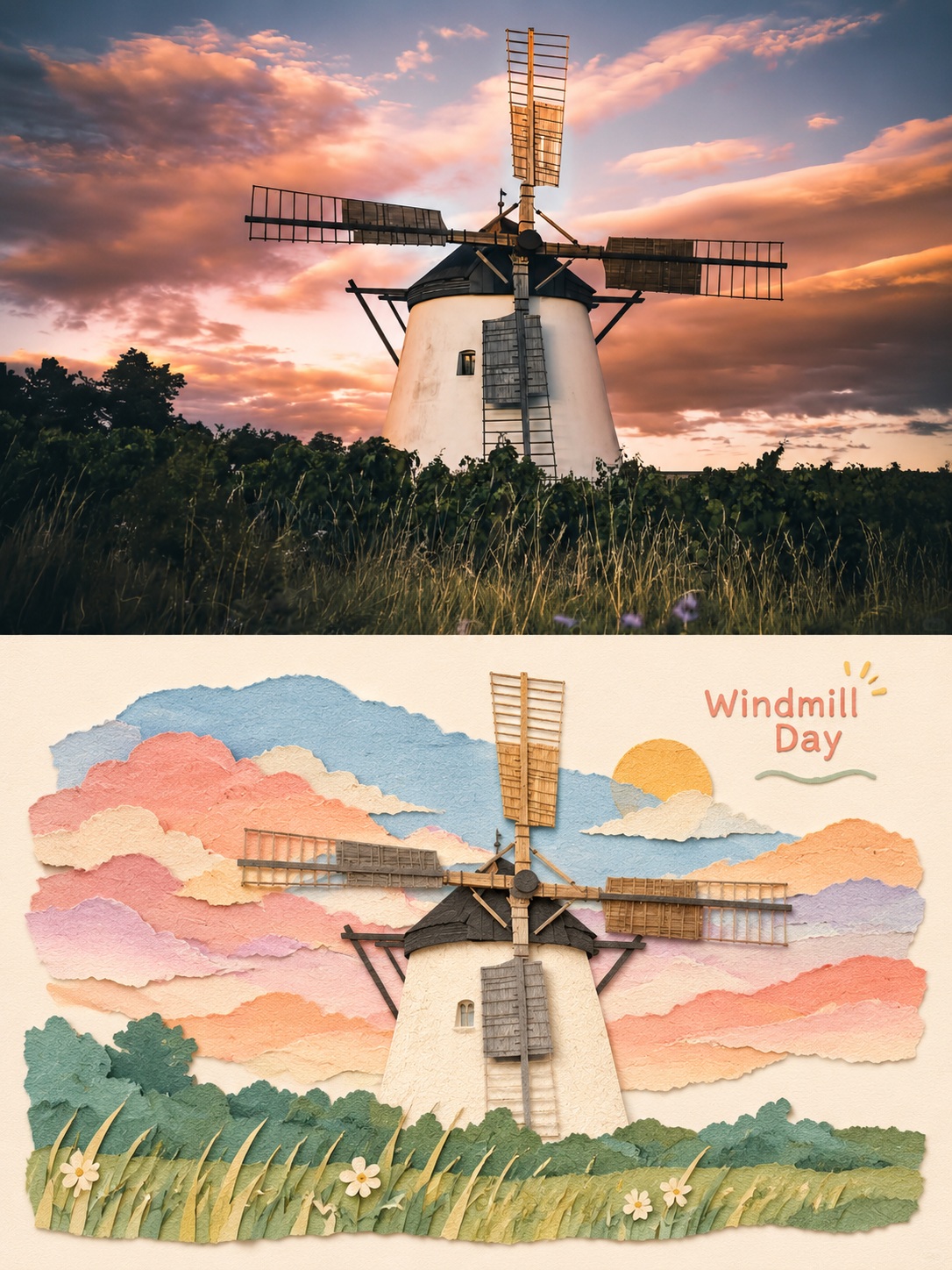
Prompt template
- Format
- Text Parameterized
- Inputs
- Original_photo (image) · Required Palette (text) · Optional · Default: coral red, cream yellow, lake blue, and leafy green
- Outputs
- Split_photo_and_paper_collage_comic (image)
Using only the single uploaded photograph, create one 3:4 portrait-format image combining the original photo with a modern paper-collage comic reinterpretation. Output one image only; do not create a collage of multiple images or mix photographs.

Layout: Divide the canvas into two equal-height halves, each exactly 50% of the canvas height, with matching widths and a seamless join. Use no border, gap, divider line, overlap, or elements crossing the midpoint.

Upper half — original photograph: Use the original photo directly. Fully preserve the subject’s identity, facial features, face shape, hairstyle, pose, clothing, objects, spatial relationships, perspective, natural lighting and shadows, and original colors. Do not redraw, retouch the face, recolor, desaturate, mirror, stretch, distort, add, or remove subjects. Only proportional scaling and cropping of nonessential outer areas are allowed.

Lower half — comic: Reinterpret the same scene as a two-dimensional modern paper-collage comic. Accurately preserve the person’s proportions, facial features, action, relationships between objects, and the scene’s recognizability. Use refined hand-cut outlines, colorful paper shapes of varied forms, layered collage, selective cutouts, and staggered layers. Keep the person whole and natural; do not fragment the face or body. The environment may be simplified into rhythmic abstract paper shapes and clean blocks of color.

Use a harmonious, lively palette of ${palette:coral red, cream yellow, lake blue, and leafy green}. Give paper edges clear definition, with delicate paper fibers and subtle natural shadows. Aim for the look of a high-end art publication and a modern design poster.

Composition and negative space: The comic subject and the environment’s meaningful visual content should occupy about two-thirds of the lower half, with ample negative space on all four sides. Use an asymmetrical but balanced composition; avoid piling up fragments. Add a small title in a cute English typeface, integrated into the lower half without creating an extra section.

Quality requirements: Keep the result a flat, two-dimensional paper-art composition, not a 3D toy effect or a children’s craft drawing. Do not use a gouache filter. Keep facial features natural, anatomy accurate, the paper surface clean, noise low, and the image free of smeared AI artifacts. All comic, title, and decorative elements must remain entirely within the lower 50% of the canvas.
Replace the ${…} placeholders with your values
before using this prompt. See parameters
and defaults below
Parameters
Replace each placeholder with your own value, or use its default when one is provided
${palette:coral red, cream yellow, lake blue, and leafy green}
palette
Default: coral red, cream yellow, lake blue, and leafy green
What you'll create
The lower half reinterprets the same scene as flat layered paper-cut comic art. Exact equal halves and a seamless join keep the original photo distinct from the lower graphic transformation.
Usage instructions
Use exactly one uploaded photograph; the upper half preserves it while the lower half reinterprets the same scene as a layered paper-cut comic. Adjust the palette to change the comic’s colors, while keeping the strict 50/50 split and all comic elements within the lower half.
Frequently asked questions
Can decorations cross the midpoint?
No. Comic and decorative elements must stay entirely below it.
May several photographs be mixed?
No. Exactly one source photograph is used.


Comments
Tried this prompt? Share what you made, compare results, or ask a question