Man Dissolving into Luminous Particles
Create a dark, photorealistic conceptual portrait of a man surrounded by a physically convincing halo of luminous particles, using an identity reference to preserve his appearance.
Example outputs
Prompt template
- Format
- Text
- Inputs
- Identity_reference (image) · Required
- Outputs
- Conceptual_portrait (image)
Create an ultra-photorealistic, high-end conceptual portrait of the young adult man in the uploaded identity reference. The uploaded identity reference must be the only source of the subject’s real facial identity. Preserve his exact recognizable identity and natural anatomy: face shape, forehead, hairline, eyebrows, eye structure, nose bridge and tip, nostrils, lips, cheekbones, jawline, chin, ears, neck proportions, skin tone, natural skin texture, pores, subtle imperfections, facial asymmetry, age, and all distinctive facial characteristics.

COMPOSITION AND CAMERA ANGLE
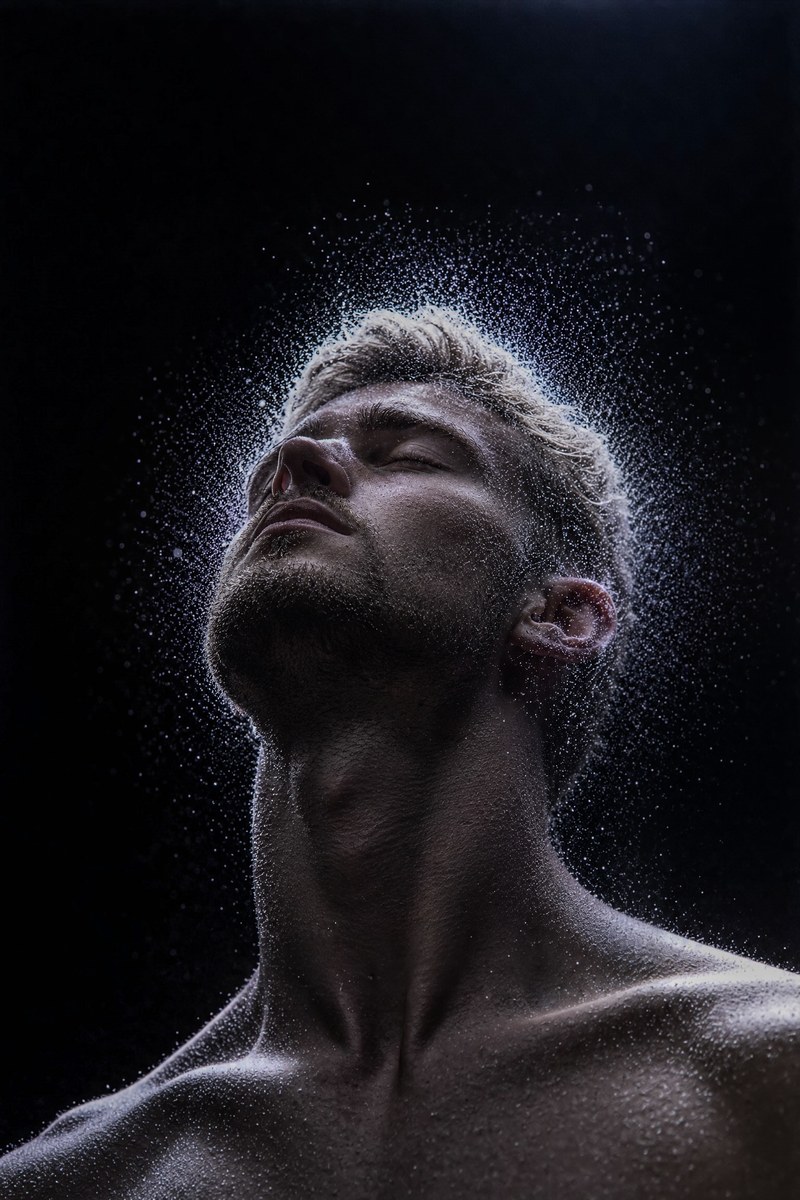
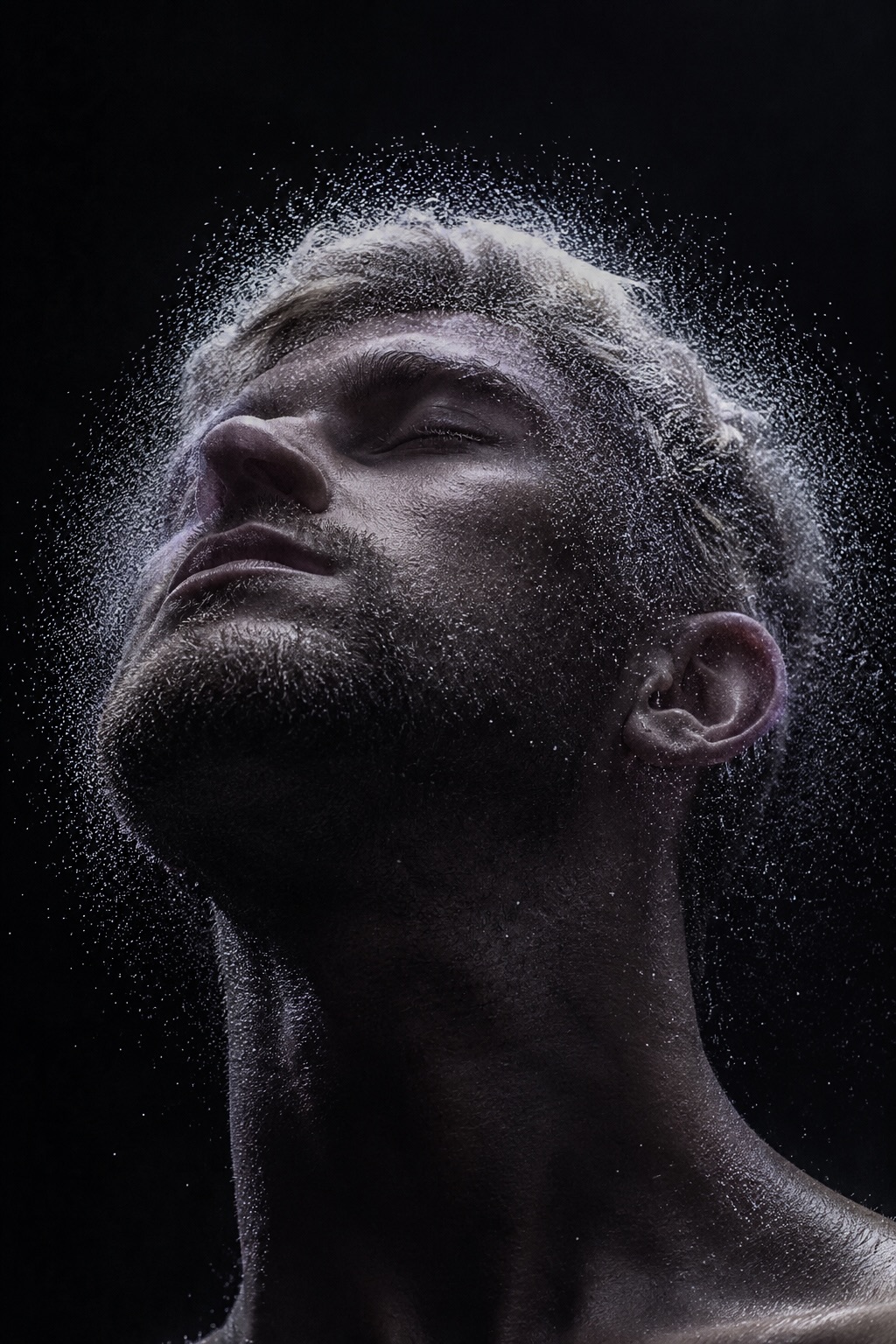
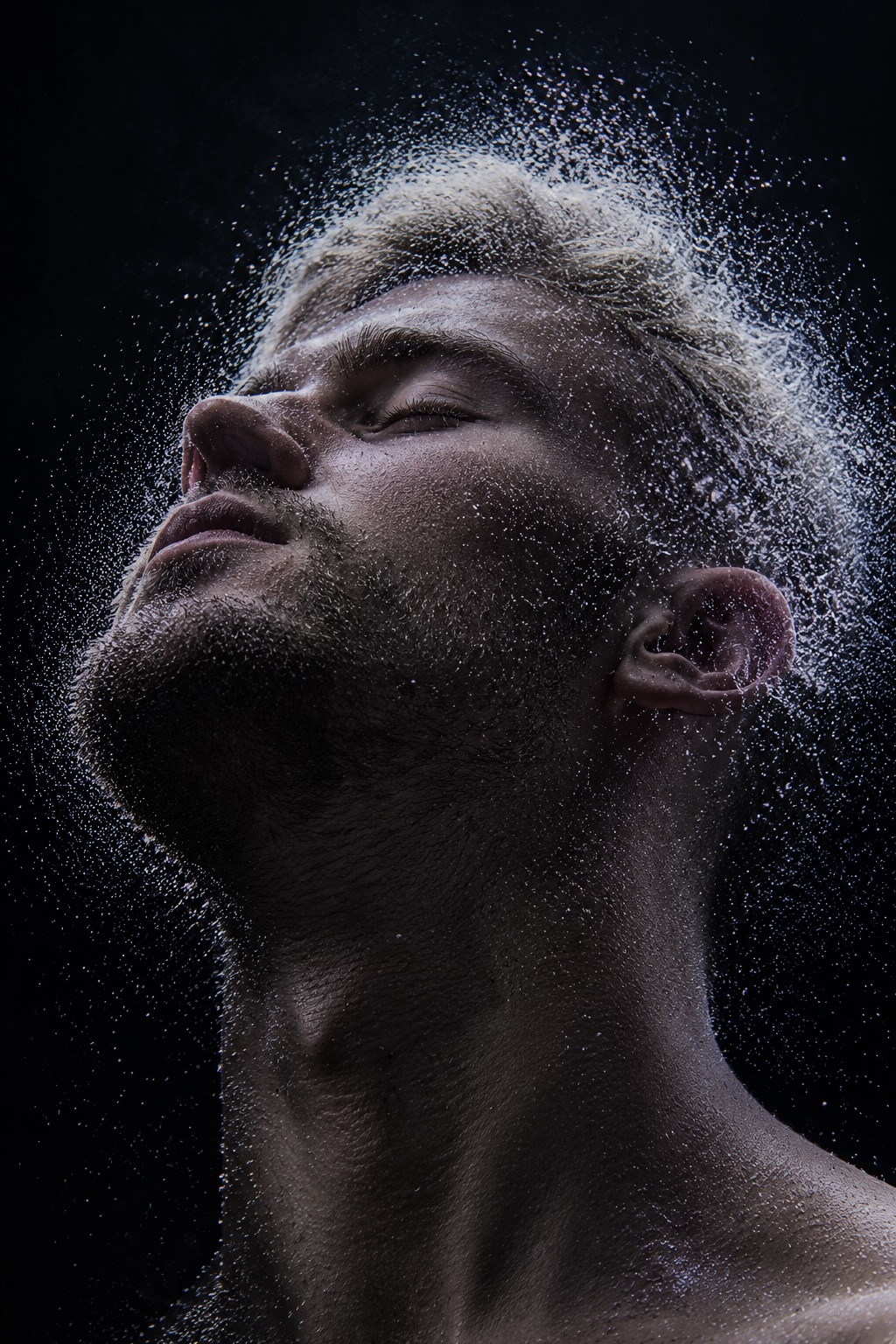
Create an extreme close-up portrait photographed from a very low angle directly underneath the subject, looking upward toward his face. Tilt his head strongly backward, exposing the jawline, underside of the chin, throat, and neck. The face should occupy most of the upper portion of the frame. Position the camera approximately at neck or chest level and aim it upward toward the face. Turn the subject’s face slightly toward the left side of the frame, creating a subtle sculptural three-quarter orientation while maintaining the dramatic upward perspective. The composition should feel monumental, mysterious, and almost weightless. Use a vertical portrait composition, approximately 2:3 or 4:5, with the face and particle halo dominating the frame.

EXPRESSION
Keep the subject’s eyes gently closed, facial muscles relaxed, and expression neutral, peaceful, and introspective. Let his lips rest naturally and remain slightly parted. No smile. The pose should feel calm and meditative rather than aggressive.

PARTICLE EFFECT
The defining visual element is a massive field of extremely fine luminous micro-particles surrounding and partially covering the head. Thousands upon thousands of tiny, individually visible particles should form a delicate three-dimensional cloud around the entire upper portion of the head. The particles should resemble microscopic luminous dust and follow the natural contours of the skull, forehead, nose, cheeks, jaw, and chin, creating the illusion that the human head is dissolving into light.

Make the densest concentration of particles a bright halo around the upper forehead and crown. Let particles gradually become sparser toward the outer edges, naturally disappearing into the black background. Some particles should subtly overlap the facial surface, while others float several centimeters away from the skin to create genuine depth. The particle field must feel physically present and photographed in real space, not like a flat digital overlay. Use subtle variations in particle density, brightness, and depth. Let a few particles fall slightly out of focus because of the shallow depth of field.

LIGHTING
Set the portrait in an extremely dark, minimalist studio with an almost completely black background and no visible objects. Use a powerful, soft white or silver light source to illuminate the particles from above and slightly behind the head. The brightest region should be the particle halo above the forehead and crown. Add very subtle cool violet or purple undertones within the shadows and reflected particles.

Keep the face mostly submerged in deep shadow. Let only selected facial planes catch soft highlights: the bridge and tip of the nose, upper cheekbone, lips, forehead, edge of the jaw, ear, shoulder, and portions of the neck. Create dramatic contrast between the almost-black skin shadows and the brilliant white particle halo. Use extremely soft, controlled cinematic lighting with deep blacks and delicate specular highlights. No flat frontal illumination and no visible studio equipment.

SKIN AND REALISM
Preserve authentic human skin. Retain visible pores and subtle natural skin texture wherever illuminated. Do not smooth the skin or make it look plastic or CGI-like. Illuminated areas should reveal realistic micro-texture, tiny imperfections, and natural tonal transitions. The image must look like an actual photograph captured in a professional dark studio rather than a 3D render.

CAMERA AND OPTICS
Use the photographic character of a professional full-frame cinema camera with a 100mm–135mm macro or telephoto portrait lens. Use a very shallow depth of field, with the sharpest focus concentrated around the illuminated facial planes and nearest particles. Include natural optical falloff, realistic lens rendering, subtle atmospheric diffusion around the brightest particles, very delicate bloom around highlights, natural photographic grain, and high dynamic range with preserved shadow detail.

COLOR PALETTE
Use deep black, charcoal, graphite, cool white, silver, extremely subtle violet, and faint lavender highlights as the dominant colors. No saturated colors, neon cyberpunk aesthetic, or colorful background. The overall image should feel monochromatic, elegant, mysterious, and futuristic.

ATMOSPHERE AND QUALITY
The image should feel minimalist, ethereal, meditative, mysterious, and scientific yet artistic. The visual concept should resemble a moment when a real human body is transitioning into pure energy or microscopic particles. Despite the surreal concept, every physical element must retain photographic realism. Aim for high-end luxury editorial and fine-art conceptual photography, cinematic realism, extremely detailed micro-particles, realistic skin texture, light scattering, depth, and perspective, natural optical imperfections, subtle 35mm or large-format photographic character, and fine organic film grain.

STRICT NEGATIVE CONSTRAINTS
Do not change the person’s identity, redesign the face, reshape facial features, create a generic male model, or perform a face swap. Do not alter ethnicity, age, or facial proportions. Do not beautify or over-symmetrize the face, make the skin plastic or excessively smooth, or add makeup, jewelry, or clothing visible around the face. Do not introduce a background environment. Do not make the particles look like snow, smoke, glitter, or digital pixels; do not make them uniform in size or use obvious CGI particle effects. Do not create a cartoon, fantasy illustration, or 3D-render aesthetic. No CGI appearance, illustration, 3D-rendered look, or artificial beauty retouching. The final image must look like a real, professionally photographed conceptual portrait, with the surrealism coming entirely from the physically believable luminous particle field.
What you'll create
A man tilts his head strongly backward above an upward-facing close camera. The sculptural three-quarter pose emphasizes jaw, chin and throat within the luminous-particle concept.
Frequently asked questions
Where is the camera positioned?
Around neck or chest level, aimed upward beneath the face.





Comments
Tried this prompt? Share what you made, compare results, or ask a question