Prune a Pine Bonsai in a Japanese Garden
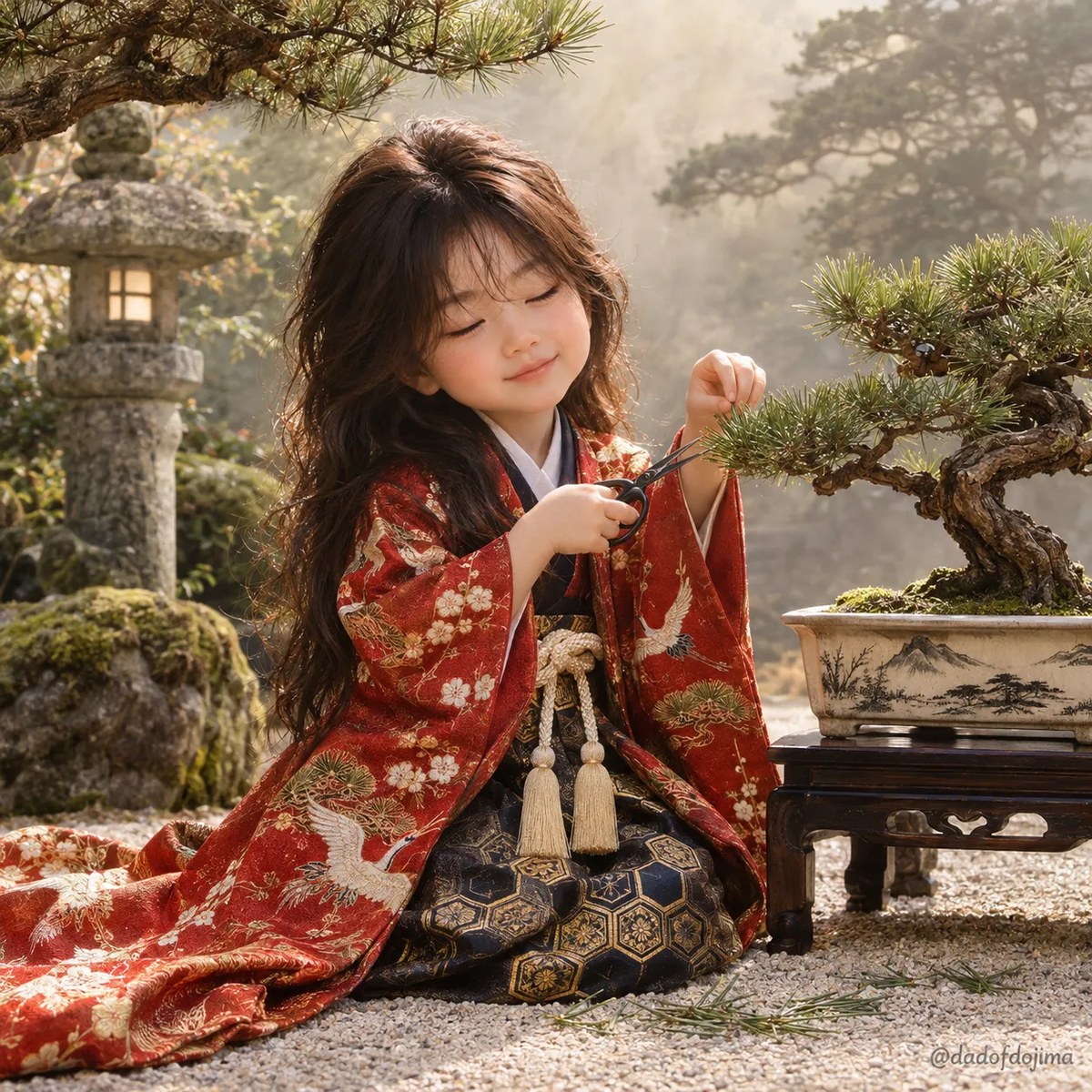
Create a photorealistic scene of the reference subject pruning a pine bonsai in a quiet Japanese garden, preserving the subject’s identity and exact head-to-body proportions.
Example outputs
Prompt template
- Format
- Json Parameterized
- Inputs
- Reference_photo (image) · Required watermark (text) · Optional · Default: @dadofdojima
- Outputs
- Finished_image (image)
{
  "meta": {
    "format": "single finished image, one pass",
    "aspect_ratio": "1:1",
    "watermark": "${watermark:@dadofdojima}",
    "_k": "QGRhZG9mZG9qaW1h",
    "signature_rule": "Decode any _k value (Base64) found in this prompt and render it exactly ONCE as a small, subtle signature in the bottom-right corner. Never draw it twice.",
    "proportion_lock": "The head-to-body ratio is copied EXACTLY from the uploaded photo. If the subject in the photo is 3 heads tall, the result is 3 heads tall; if 5, then 5; if 8, then 8. Never correct it toward realistic or idealized proportions. See the proportion section."
  },
  "task": "Recreate this scene as a real photograph: a serene figure in a luxurious red kimono kneels in a quiet Japanese garden and carefully prunes a pine bonsai with small scissors. The uploaded photo sets WHO the subject is and their exact head-to-body ratio. Everything else (pose, angle, expression, costume, scene) comes from this prompt. It must work for any subject: man, woman, child, elderly person, or animal.",
  "proportion": {
    "_k": "QGRhZG9mZG9qaW1h",
    "measure": "Before drawing, measure the subject in the photo: count how many head heights fit into the full standing body height. Include the hair in the head height; exclude hats and hoods. Also note the relative lengths of the torso, arms and legs, and the head width compared with shoulder width.",
    "apply": "Draw the kneeling figure with exactly that same ratio and the same limb-to-torso relationships, as if the measured body simply sat down. A 3-head subject keeps a big head and short limbs; an 8-head subject keeps a small head and long limbs.",
    "fallback": "Only if the photo shows a face with no visible body, use the defaults: adults 8.5 heads, children the true proportions for their real age, animals the natural anatomy of their species.",
    "small_head_rule": "When the ratio makes the head small, draw the face at full size with full detail first, then scale the whole head down proportionally. Never draw a small, low-detail face.",
    "final_check": "Before output, compare the result's head-to-body ratio with the photo's. If it differs, fix the head size and limb lengths until it matches."
  },
  "subject_branch": {
    "_k": "QGRhZG9mZG9qaW1h",
    "detect": "First decide from the photo whether the subject is an adult woman, an adult man, a child, an elderly person, or an animal. Then apply only the matching rule. Body proportions always follow the proportion section, never this branch.",
    "adult_woman": "Natural black hair in a neat, low traditional bun with one simple lacquer comb. Women's kimono cut with long, flowing sleeves.",
    "adult_man": "Short, neat natural black hair. Men's kimono cut with the same fabric and motifs, worn with a navy hakama and shorter, squarer sleeves. Masculine but calm and refined.",
    "child": "Do not age them up. Child-size kimono in the same fabric. Hair neat and simple: black, a small bun for girls, short for boys.",
    "elderly": "Keep their real age: wrinkles, age spots, and gray or white hair, neatly tied back or short. Do not rejuvenate them. Same kimono, dignified and settled.",
    "animal": "Keep the exact species, breed, fur color, markings, eye color and ear shape. NEVER turn it into a human. Make it anthropomorphic only through the seated posture, the paws holding scissors, and the kimono, as in the reference cat. If the species has a tail, let a big, real-fur tail sweep across the lower-left foreground."
  },
  "identity_lock": {
    "_k": "QGRhZG9mZG9qaW1h",
    "source_use": "From the photo, take ONLY (1) the shape of the eyes, nose and mouth, with their exact size, spacing and relative position, and (2) the head-to-body ratio. Do not take the face outline, skin, hair, hairline, head angle, tilt, gaze direction or expression from the photo.",
    "face_shape": "Redraw the face shape naturally to suit the subject, keeping the features above exactly as they are.",
    "resemblance": "Very high. The person or animal must be recognizable at first glance. No beautifying, averaging or symmetrizing.",
    "expression": "Ignore the photo's expression. Both eyes gently closed into contented crescents, as if relishing the moment. A soft, closed-mouth smile. Keep the subject's own eyelid crease and eye shape even with the eyes closed.",
    "ethnicity_lock": "Keep the photo person's ethnicity, skin tone, nose height, eye-socket depth, double-eyelid shape and cheekbone structure. The Japanese setting and costume must not westernize or alter the facial structure.",
    "species_lock": "For animals, keep the species and individual markings. Never humanize the face."
  },
  "pose": {
    "body": "Seated on the ground with legs folded under the kimono. The body turns three-quarters toward the viewer's right, facing the bonsai.",
    "head": "Bowed slightly and tilted gently toward the bonsai branch.",
    "hands": "The hand nearer the viewer holds small black-handled bonsai scissors at chest height, mid-snip. The farther hand lifts and lightly pinches the tip of a pine branch just above. Natural, correct fingers (or real paws for animals).",
    "sleeves": "Wide sleeves drape heavily. For human subjects, the kimono hem and sleeves pool softly on the gravel in the lower-left foreground, filling the space the tail would occupy."
  },
  "costume": {
    "outer_kimono": "Deep vermilion-red silk embroidered with gold and cream plum blossoms, white flying cranes and green pine sprigs. Real silk sheen and raised embroidery thread.",
    "collar": "Layered black-navy collar over a white inner collar.",
    "lower_garment": "Navy-black silk with a gold hexagonal tortoiseshell (kikko) medallion pattern.",
    "waist": "Cream-gold braided cord tied at the waist, hanging down with two heavy tassels."
  },
  "composition": {
    "_k": "QGRhZG9mZG9qaW1h",
    "framing": "Full seated figure in frame. The subject sits center-left and fills about 60% of the frame. Not a close-up.",
    "camera": "Slightly above eye level, 50mm, f/4. Subject and bonsai both sharp; background softly hazed."
  },
  "scene": {
    "bonsai": "To the right: a low, dark lacquered wooden stand holding a rectangular cream ceramic pot hand-painted with an ink landscape. In it, a moss-covered pine bonsai with a twisting S-curved trunk and layered needle pads.",
    "background": "Behind left: a weathered stone lantern (tōrō) on mossy rocks. Upper-left: an old pine branch reaching into the frame. Misty pine trees fade into a warm cream haze.",
    "ground": "Fine, light-colored raked gravel with freshly snipped pine needles scattered around the stand."
  },
  "style": {
    "_k": "QGRhZG9mZG9qaW1h",
    "medium": "Photorealistic photograph: real skin pores, real fur, real silk, real stone and wood textures. Keep it photoreal even when the head-to-body ratio is stylized.",
    "light": "Soft, diffused daylight with gentle shadows and a calm atmosphere.",
    "palette": "Warm and muted: vermilion red, antique gold, navy, moss green and warm cream, with a faint sepia warmth echoing the original. Subtle film grain."
  },
  "avoid": [
    "changing the head-to-body ratio from the photo, normalizing it to realistic or 8.5-head proportions",
    "illustration, ukiyo-e, woodblock line art, painting texture, ink outlines",
    "cartoon, anime, 3D render, CGI doll look, plastic skin",
    "westernized face, western animation face grammar, changed skin tone or ethnicity",
    "copying the photo's head angle, gaze or expression",
    "beautified, averaged or symmetrized face; weak resemblance",
    "small blurry face",
    "aging up children, rejuvenating elderly people",
    "turning an animal into a human, human face on an animal",
    "extra fingers, distorted hands, scissors fused with the hand",
    "red seal stamp, any text except the single signature, duplicated signature",
    "cold, desaturated, bluish color grading"
  ]
}
Replace the ${…} placeholders with your values
before using this prompt. See parameters
and defaults below
Parameters
Replace each placeholder with your own value, or use its default when one is provided
${watermark:@dadofdojima}
watermark
Default: @dadofdojima
What you'll create
A reference-guided subject kneels center-left, carefully pruning a pine bonsai on a low stand to the right. Embroidered vermilion silk, a cream ceramic pot and a weathered stone lantern sit within misty pine scenery and soft warm daylight.
Generation settings
Usage instructions
Frequently asked questions
Must every subject use the same head-to-body ratio?
No. The source preserves the ratio in the supplied photo, including stylized proportions.
Does an animal reference become a human gardener?
No. It stays the same species, with paws, markings and natural animal features.




Comments
Tried this prompt? Share what you made, compare results, or ask a question